

Anyone on X can drop your account into a list without following you, so those additions pile up quietly in the background. One panel answers the whole question: which public lists hold your handle, and what each of those lists looks like from the outside.
Circleboom reads every public X List that contains your account through X's official API and renders each placement as its own card, carrying how many accounts sit on that list and how many people subscribe to it. Click a card and you land on that list inside X, where the members and the creator are visible.
→ check which Twitter lists you're on
The part most guides skip: the public half is the only half anyone can show you.
What being added to a Twitter list actually means
Being listed is a categorization event, not a follow.
Someone looked at your account, decided it belonged in a bucket they had already named, and filed it there without asking you first.
That bucket might read "fintech builders." It might read "AI people worth watching." It might read something you would rather not have attached to your handle at all.
So the question behind which Twitter lists am I on is not really an inventory question. It is a question about how the rest of the platform has decided to describe you, in language you did not write.
The mechanics make this easy to miss. X lets any account add any public account to a list, no follow required and no approval step, which is why list membership accumulates for years without ever announcing itself.
Most people find out by accident, usually while looking for something else.
Lists are public objects by default, and that default is the whole reason this matters. Reading whether Twitter lists are public is the natural first stop once you realize strangers have been filing you somewhere.
Circleboom collects those external placements into one view of your X account, so a check that would otherwise mean clicking through profile after profile fits on a single screen.
Why does being on a Twitter list matter at all?
Because list membership is the only description of your account written by someone other than you.
Your bio is a claim you make. A list name is a verdict somebody else reached.
Curators build lists to read, to monitor, or to pitch:
- Journalists keep source lists.
- Recruiters keep talent lists.
- Investors keep watchlists.
- Analysts keep competitor lists.
When your handle keeps landing in the same category across several of them, that category has become part of your public description.
The reverse case is the one worth checking for. If the lists holding you sit outside your intended niche, your content has been reaching an audience you never aimed at. Reading what lists are for on Twitter explains why that drift happens so quietly.
There is an ugly case too.
Spam operations and bulk-list scripts sweep public accounts into junk lists at scale, and those lists carry names that stay visible on your profile's list tab to anyone who looks.
Pair the reading with your own audience data.
Twitter interest targeting shows the topics your actual followers care about, and the distance between that picture and the list names is exactly where positioning work begins.
The signal is the follower count, not the number of lists
Most write-ups on this topic stop at "here is where the tab lives," then move on. The more useful read is the pair of numbers printed on every card.
Each list card in Circleboom carries a member count and a follower count.
Member count says how many accounts sit on the list beside you. Follower count says how many X users subscribe to that list's timeline.
Those two numbers point in completely different directions.
A nine-hundred-member list that nobody follows is a scrape, not a signal.
A fourteen-member list followed by four thousand people is a shortlist somebody is genuinely reading every morning, and sitting on it puts your posts in front of that audience without any effort from you.
Rank the lists you are on by follower count, not by how crowded each one is. That single reordering changes which placements deserve your attention and which deserve none.
Once a list looks like real distribution, the accounts beside you on it become the interesting part. Compare Twitter and X accounts measures how much of your audience already overlaps with the peers a curator grouped you alongside. That turns a guess about positioning into a number you can act on.
Who builds the lists you end up on
List creators are, almost by definition, organizers. Building and maintaining a list is deliberate work, so the people doing it tend to be active in the space rather than passing through.
That makes the creator column more valuable than the list itself in many cases.
A curator who filed you under their industry list has already made a judgment about your relevance, which is a warmer starting point than a cold reply ever gives you.
The card does not name the creator, though. You get there by opening the list on X and looking at who owns it, which is one click and worth taking for any list with real followers behind it.
There is a second reason to look. Curators tend to build several lists on related themes, so one creator who filed you under a topic list has probably built the adjacent ones too. Their profile is a shortcut to a whole slice of the space you work in.
And curators change. A list that mattered two years ago may have been abandoned since, while a small new one is quietly growing its subscriber base.
Follower counts move even when membership does not, which is the argument for checking the panel on a schedule rather than once.
How to check which Twitter lists you are on with Circleboom
The check runs inside Circleboom's X List Manager, in the Lists You're On view. Connect your account, open the panel, and every public list holding your handle loads as a clickable card that carries you through to X.
On video: how each list card renders its member count beside its follower count.
The run below takes about three minutes on a normal account and falls into three phases.
Connect your X account to Circleboom
- Log in to Circleboom Twitter and authorize your X account with official OAuth.

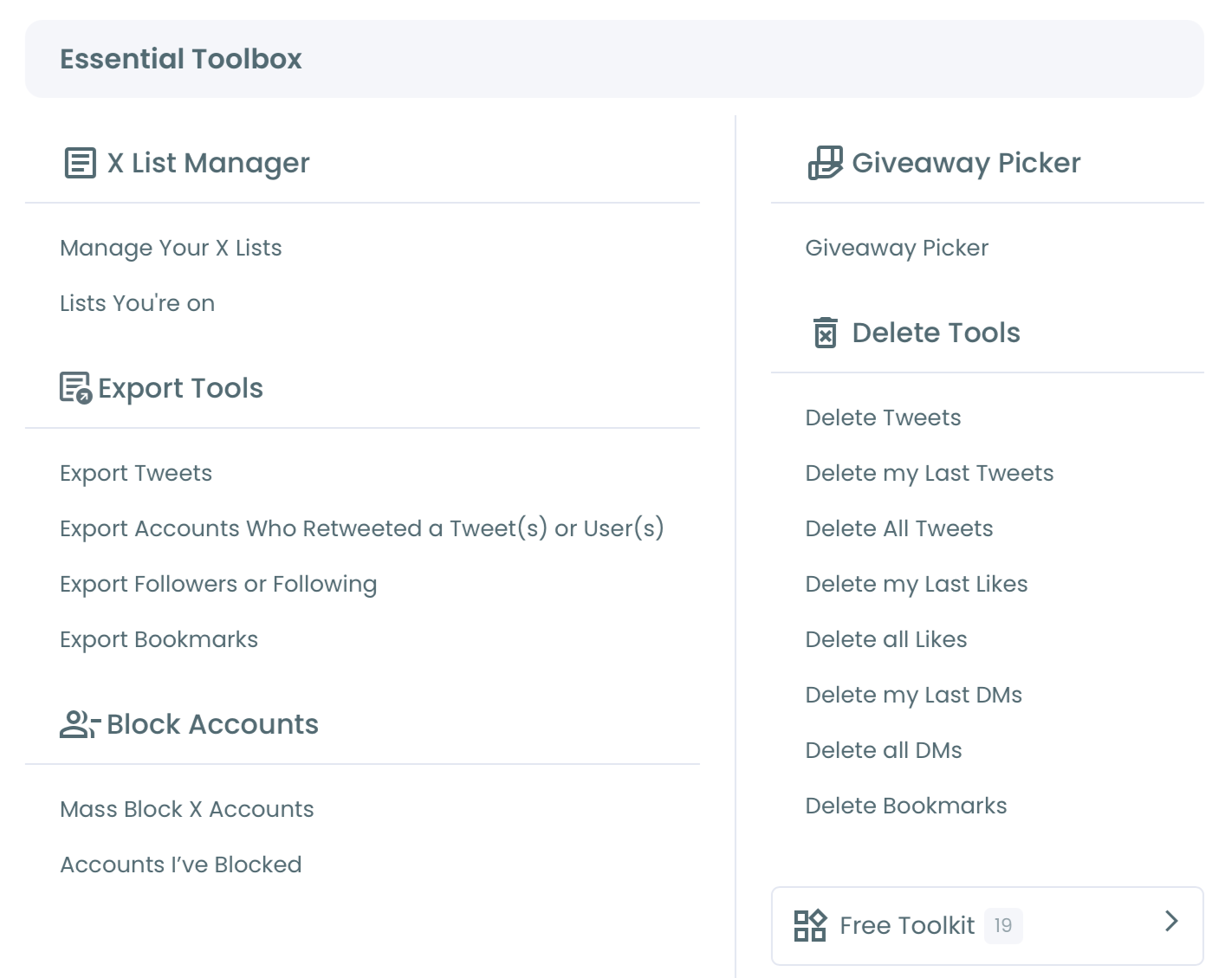
- Open our Essential Toolbox menu from the dashboard, where the list tools sit together.
Read the names before you read the numbers
- Select X List Manager and switch to the Lists You're On view, which loads the card grid.
- Scan the list names first and write down every category that appears more than once.
Open the lists that carry real distribution
- Compare the follower counts printed on the cards and shortlist the handful with a real subscriber base behind them.
- Click any shortlisted card to open that list inside X, where the full membership and the list timeline are visible.
- Check the creator's profile from the list page, since the creator's identity is the one piece the card itself does not carry.
Each step exists because the one before it is a precondition: no authorized connection means no list data at all, the names frame what the counts are measuring, and the creator only exists on the X side of the click. Reorder those and you end up staring at numbers with no idea what they describe.
In one line: connect, open the panel, read names, rank by follower count, open the outliers.
What this check cannot show you, and why that limit is honest
Private lists stay invisible. If somebody added your account to a list they marked private, the X API does not return it, so no tool built on official access can hand it to you.
Any article promising a complete picture is wrong about the platform rather than clever about the tooling.
Two smaller gaps sit alongside it. The card does not name who added you, so identifying a creator means opening the list on X.
And there is no history: what loads is a snapshot of current membership, not a log of every list you have ever been on.
That honesty is a direct function of how the data is fetched. Circleboom is published on X's Enterprise developer directory, so the read happens under a permissioned developer agreement using your own authorization.
A reputation check never turns into handing your credentials to an unofficial scraper.
The same Twitter List Manager handles the lists you own as well, with bulk building, member filtering, and CSV export layered on top of the read-only view.
X's own Lists documentation confirms the platform-side rules, including the part people find hardest to accept: only a list owner can remove a member.
If you only want the raw tally rather than the full read, how many Twitter lists am I on covers the narrower version of this question.
What to do with what you find
Sort every list into one of three buckets:
- Lists that match your positioning, where the creator already sees you as relevant.
- Lists outside your niche, where your content has reached an audience you did not target.
- Junk or hostile lists, where the only lever is blocking the creator.
Bucket one is an outreach list you did not have to build. Bucket two is a content signal. Bucket three needs the least thought and the fastest action.
Interests are the quickest cross-check on the second bucket. Reading how to check interests on Twitter walks through the topic profile of the audience you actually attracted, which usually explains the mismatch on its own.
For the first bucket, the peer set is the real prize. Working through how to analyze your competitor's Twitter account helps you understand why a curator grouped you with the specific accounts sitting beside you.
I run this check quarterly rather than monthly. List membership moves slowly, and a quarterly pass catches a category drifting before it hardens into how everyone describes you.
Some lists are worth tracking over time. Export a list of followers on Twitter hands you the membership as a file.
Compare that file against the next pass and you can see who joined, who left, and whether the category around you is tightening or spreading.
The whole check in four lines
Finding out which Twitter lists you are on takes one panel and about three minutes, and it hands back the only description of your account written entirely by other people.
Read the names for category, rank by follower count for reach, and open the small handful of lists that carry genuine distribution.
The limit is worth repeating, because almost nobody states it: the public half is all any tool can show, since private lists never leave X.
Everything else on that screen is usable the moment you look at it, from the peer accounts beside you to the curators worth a reply.
→ see the X lists that include your account
Reader questions about Twitter list visibility
Can I see private Twitter lists I have been added to?
No. The X API does not return lists their creators marked private, so those placements stay invisible in Circleboom and in every other tool built on official access. Only the list owner sees them.
Does X tell me when someone adds me to a list?
No. Any account can add you to a list without following you and without any notice reaching you, which is why most accounts discover their placements only when they go looking. Opening the panel is faster and more complete than waiting for something to alert you.
Can I remove myself from a Twitter list I dislike?
No. Only the list owner can remove members, which is a platform rule rather than a tool limitation. Blocking the creator takes your account off their lists, and reporting the list to X is the other available route.
How often should I check which lists include my account?
Quarterly suits most accounts. I also check before anything that puts my profile in front of new people, like a launch or a podcast appearance, because those lists are visible to whoever decides to look me up.
Does being on a lot of Twitter lists help my reach?
Only when the lists have followers. A list nobody subscribes to distributes nothing at all, which is why the follower count printed on each card tells you far more than the total number of lists ever will.






)
