
I used to think the account filling my notifications was my biggest supporter.
It was not. That account had liked a few hundred of my posts and had never once put its own name on any of them.
The follower who had actually carried my work to a new audience barely showed up in my notifications at all, because a repost does not ping you the way a reply thread does.
When I finally pulled a ranked list, it disagreed with my instincts almost completely.
Who interacts with my tweets most, and how do you actually see it on X?
The followers who repost you are the ones spending something on you. Circleboom ranks those followers on X by counting how many of your posts each one reposted across your last 3,200 tweets, and puts that number in its own Times Retweeted column.
→ find the followers who repost you most
That column is the whole reason I stopped trusting my notification tab. Here is the run that produces it.
How I find who interacts with my tweets most, step by step
The run I use now, start to finish.
Connect the account so the count comes from X itself
- Open Circleboom Twitter and authorize the X profile whose interactions you want measured.

- Pick Follower / Following Management and Analytics from the sidebar. It holds every audience segment built for the profile you just authorized.
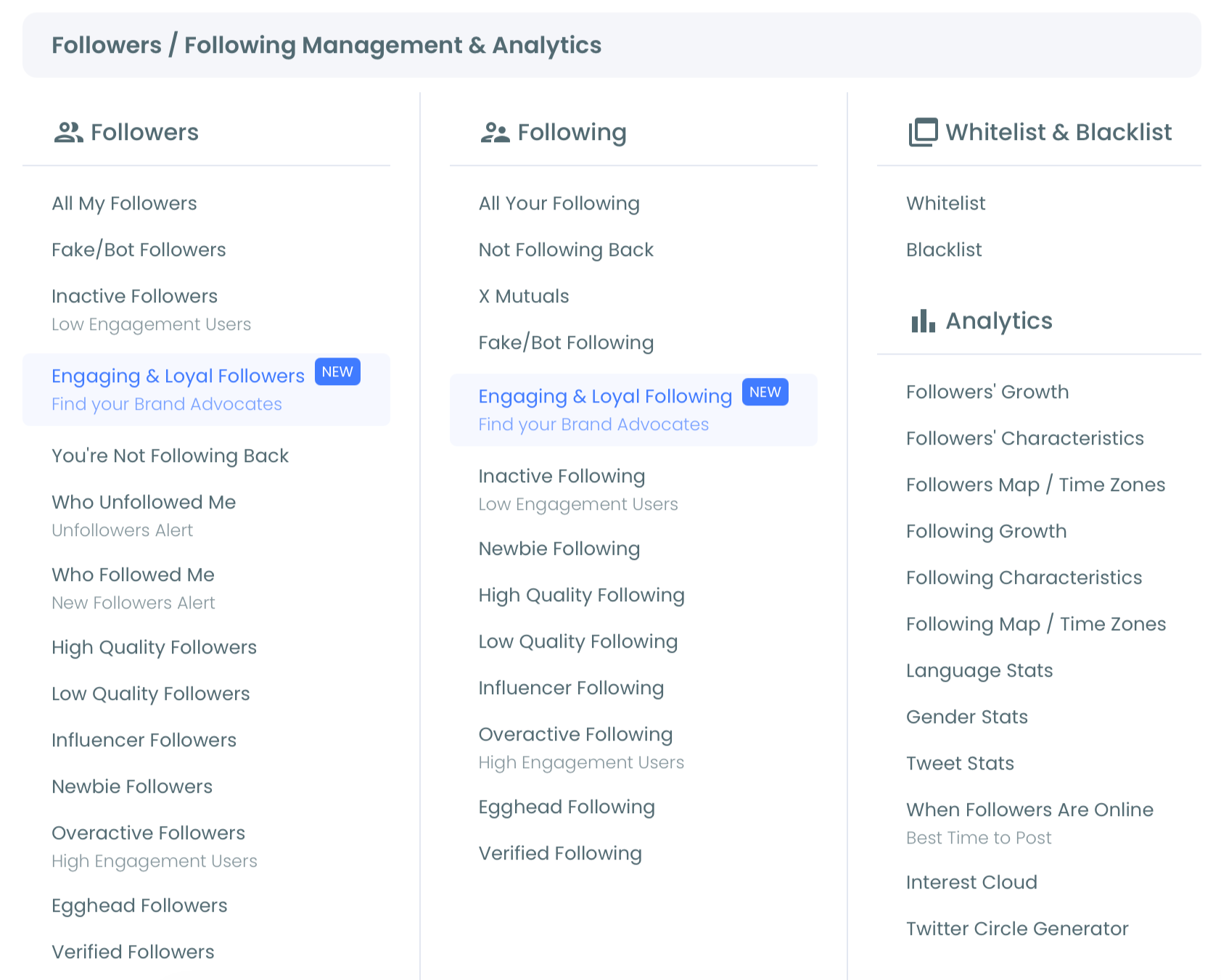
- Select Engaging & Loyal Followers and let the preparation screen run. Circleboom fetches up to your last 3,200 posts, then requests the repost list for each one, so the wait is 1 to 3 hours and you get a notification when the list is ready.
Read the ranking before you act on any of it
- Sort by Times Retweeted, descending. That column exists only in this feature, and it is the one number on the page measuring what a follower did for you rather than how busy they are in general.
- Filter Fake/Spam and Inactive out under Follower Quality. Circleboom already drops fake, suspended and locked accounts during processing, and this second pass clears the low-quality rows that survived it.
- Whitelist the rows at the top. A whitelisted account is excluded from bulk actions everywhere else in the product, so a later cleanup pass cannot quietly remove the people who have been carrying your posts.
That order is what keeps the read honest. Authorizing the profile routes the data through official API access, sorting puts the costliest behavior on top, and the quality filter strips the accounts whose reposts were never really a decision.
Quick recap: connect, open the segment, wait out the pipeline, sort by Times Retweeted, filter the noise, whitelist the top.
Why my notifications were the wrong place to look
Notifications are a feed of attention, not a record of support. They rank by recency and by whatever pings loudest.
One account replying to you six times in an afternoon will bury a follower who reposted you once a week for eight months.
I had been reading the wrong instrument for years and calling it audience knowledge.
The fix is to stop measuring who reaches you and start measuring who reached other people on your behalf. You can start there: rank the followers who interact with your posts most.
There is a softer version of the same mistake in the visual maps people build of their audience. A Twitter interaction circle for your most engaged connections is genuinely fun to look at. It still answers a question about mutual attention rather than about who moved your work.
Watch it run: the engagement problems that look like a content problem and turn out to be an audience-composition problem.
https://www.youtube.com/watch?v=PfmuTBzLNOA
What a like, a repost and a reply each cost the person sending it
Interactions are not one currency. They are three, and the exchange rate between them is the part almost nobody prices correctly.
A like costs nothing. It is one tap, it stays semi-private in practice, and nobody in the sender's audience ever learns they did it.
It also does not necessarily mean the post was read, which is part of why the question of whether a like counts as an impression on Twitter keeps coming back.
A reply costs time and a public opinion. The sender has to compose something and attach their name to a view, in a thread strangers can walk into.
Why a repost is the expensive one
A repost costs the most. X's own guidance on how to repost describes it as sharing something publicly with your followers, and that is the whole point.
The sender is spending their own audience's attention on your words, and taking on some of the credit or blame that follows.
There is a fourth rung above all of them, and it is the one worth watching for by hand.
A quote post carries the same cost as a repost plus the cost of a reply, because the sender publishes your work and their own commentary on it in a single move. Nobody quote-posts something they are indifferent to.
The ladder is not a scoring system. It is a reminder that the same word, interaction, is being used for four behaviors that mean four different things about the person doing them.
Rank interactions by what they cost the sender, not by how many of them there were.
Why four reposts beat four hundred likes
That ladder is why a follower with four reposts often matters more than a follower with four hundred likes. The first one made four separate decisions to stake something in public. The second one made four hundred decisions that cost nothing at all.
What the ranking actually predicts about your reach
The Times Retweeted column is a forecasting tool disguised as a leaderboard.
Every row on it is an account that has already proven it will hand your post to a second audience, which is the only mechanism by which a post travels past the people who already follow you.
Run the arithmetic on your own numbers and the point stops being theoretical.
Say 10,000 followers, and the finished list shows 200 accounts with more than one repost against your name. If the median account there has 800 followers, that group alone can put your next post in front of a second-degree audience larger than your entire following.
Those 200 accounts are not your audience. They are your distribution.
The distribution is also unevenly shaped, which is where sorting matters.
In most accounts the top of the list is a short, steep head of a dozen or so heavy reposters, followed by a very long tail of followers with exactly one.
The head is a relationship you can maintain by hand. The tail is a pattern you read for what your content actually earns.
Why Circleboom counts reposts and not everything else
Circleboom builds the Engaging & Loyal Followers list from repost data specifically, then cross-references it against your current follower list so only real followers appear.
It works backward from your content instead of forward from your follower list. That is why it is the one segment in the product that can tell you what someone did for you rather than what they are like.
The narrowness is deliberate. Reply volume is a soft signal partly because replies can be produced at scale, which is exactly what tools that auto reply to your tweets are built to do.
A repost count resists that inflation, because each one costs the sender something in front of their own audience.
Circleboom is an official X Enterprise Developer company, so those per-post repost lists come from X's own API rather than from a scraper reconstructing your timeline from outside.
That matters more here than in most other parts of the product. A partial repost list produces a confidently wrong ranking rather than an obviously incomplete one.
Open the list of who interacts with my tweets most once and the difference between the two questions stops being abstract.
Where the count stops being enough on its own
A Times Retweeted number answers one question cleanly and refuses to answer several others. It does not know whether the repost was approving or mocking, and X does not expose that distinction to anyone.
So the count is a shortlist, not a verdict.
Circleboom's own guidance on the segment says the same thing in plainer words: check that the engagement is positive, relevant and authentic before treating an account as high value.
On a list of a few hundred rows, that is ten minutes of opening profiles, and it is the ten minutes that separates a real read from a leaderboard.
If you want the same view for one specific post instead of your whole history, Export Retweeters does that job.
For the other half of the picture, Circleboom's engagement analytics shows which of your posts drew the reactions in the first place.
Does the loudest account interact with my tweets most on X?
Usually not, and the gap between loud and valuable is the most useful thing this ranking taught me. Loudness is a property of the account.
Support is a property of the relationship, and only one of the two shows up in a Times Retweeted column.
An account that replies to everything is running a habit. Including you in it costs them almost nothing, and the habit would keep running if you stopped posting tomorrow.
An account that reposts you four times over a year is making a repeated, specific choice about your work, in front of people who follow them for their taste.
This also explains a frustration a lot of accounts hit: high interaction counts alongside flat reach. If your interactions are concentrated in the cheapest currency, the numbers look healthy while nothing travels.
That is the real subject under followers who never retweet or like your Twitter posts. The diagnosis usually starts with which interaction type is missing rather than with how many are missing.
The practical version of that read takes about a minute.
Look at your last ten posts and ask which of the four behaviors each one drew.
If nine of them collected likes and none collected a repost, your content is landing as agreeable rather than as useful, and no amount of posting more of it will change the shape.
Engagement is real without being useful
One more thing the feature is honest about: engagement is not alignment. A follower can repost you constantly and still be a poor fit for a collaboration, because their audience sits somewhere else entirely.
The count tells you the relationship is real. It does not tell you what the relationship is good for.
Your first run
Ranking who interacts with my tweets most changed one habit and one belief. The habit was checking notifications for a sense of who mattered. The belief was that interaction volume and interaction value move together.
They do not, and the Times Retweeted column is the cheapest way I know to see the gap. Sort it once, read the top twenty rows against your own assumptions, and whitelist the people who were carrying you while you were watching the wrong tab.
→ Kick off your engaging and loyal followers list
Common questions readers send us
Why does the list take one to three hours to build?
Because it is built per post, not per follower. Circleboom pulls up to 3,200 of your tweets and then makes a separate request for the repost list of each one, which is far more API work than filtering a follower list that is already loaded.
You get a notification when it finishes, and the result is stored so you never repeat the wait just to look at it again.
Does someone need to follow me to appear in the ranking?
Yes. The final step of the pipeline cross-references the cleaned repost list against your current follower list, so an account that reposts you without following you does not land in this segment. Those accounts still exist and still matter, which is why per-post retweeter exports are a separate job in Circleboom.
Can a follower drop off the list without doing anything wrong?
Yes, and this catches people out. Your most recent 3,200 posts define the boundary, so a follower who reposted you loyally before it opened can look quiet now purely because your own posting volume pushed their contributions out of range. Their behavior did not change. Your measurement window moved.