
Finding my first tweet on Twitter is a two-number problem, and most people only ever check one of the numbers.
The first number is the join date sitting under the calendar icon on the profile. The second is the total post count, and that one decides whether any tool can reach the first tweet at all.
I learned them in the wrong order. I scrolled, I narrowed search windows week by week, and only afterwards did I work out why an account that opened in 2012 kept bottoming out somewhere around 2019.
How do I find my first tweet on Twitter?
Read your total post count before you choose a method. Circleboom pulls as many as 3,200 of an X account's newest posts into a CSV, so sorting the CreatedAt column oldest-first drops your earliest reachable tweet into the top row.
→ find my first tweet on Twitter
How I find my first tweet on Twitter, step by step
The order I settled on, cheapest check first.
Open Circleboom and reach the export
- Log in to Circleboom Twitter and approve the X account you will be reading from on X's own OAuth screen.

- Go into the Essential Toolbox menu, which is what holds the Export Tools.
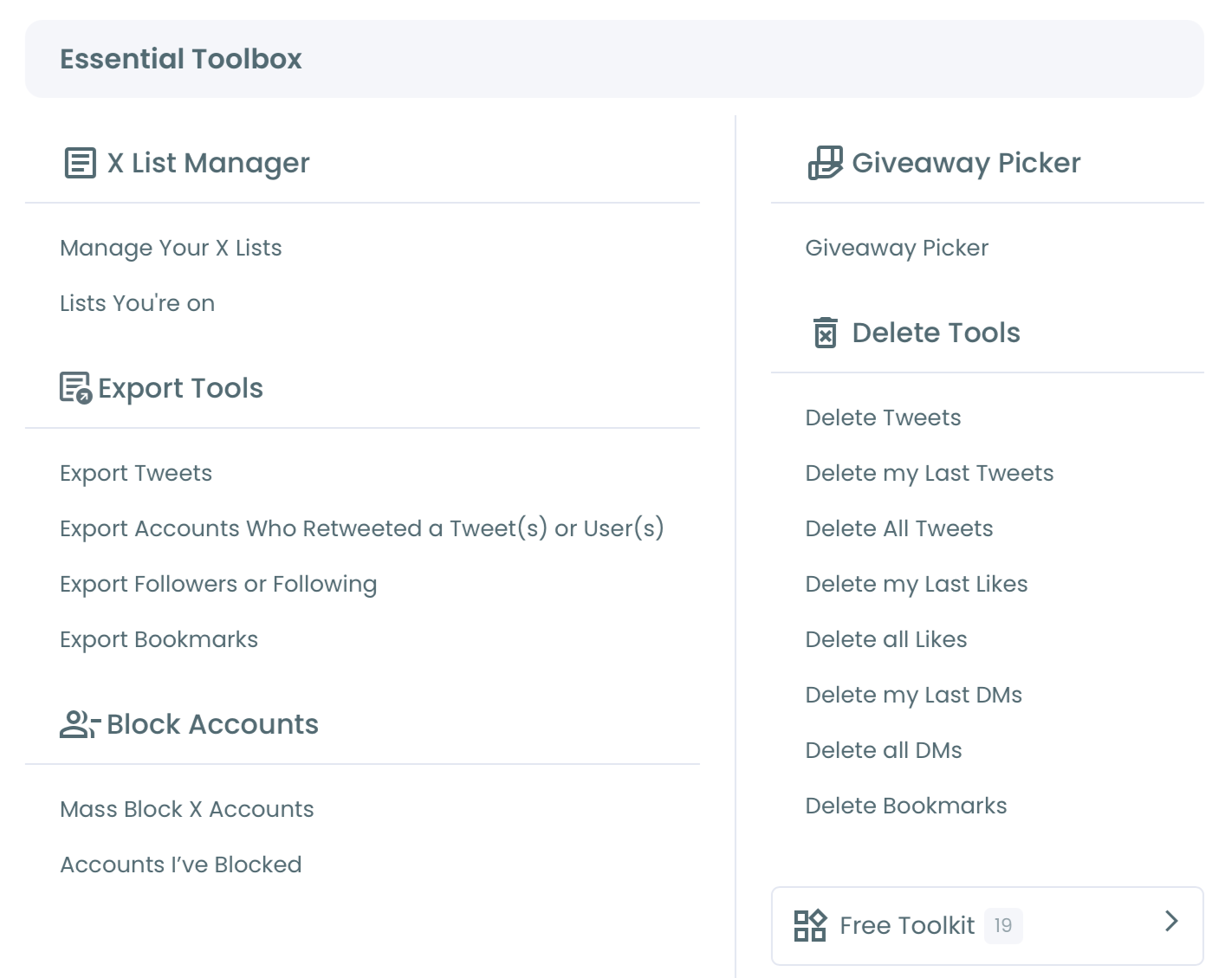
- Choose Export Tweets and type in the X username whose history you want, your own or anyone else's public account.
Read the count, then complete the export
- Read the total post count Circleboom reports once it fetches the account. Under 3,200 means the file will contain the first tweet. Above 3,200 means the file starts partway through the story.
- Confirm the export and enter the email address the file should go to.
- Complete the purchase on the secure Stripe checkout page. The CSV then arrives by email, and a second copy waits inside your Circleboom account, so a buried inbox never costs you the export.
Sort the file down to its oldest row
- Open the CSV and sort the CreatedAt column ascending. The top row after that sort is the oldest post X returned for the account.
Each step in that sequence narrows the question before the next one costs anything, which is why the order is worth keeping. The post count says whether the first tweet is reachable, the fetch confirms it against the live account, and the sort does in one click what scrolling does in an hour.
Quick recap: read the post count, run the export, sort CreatedAt ascending, read the top row.
Why the oldest rows are worth opening: what happens when posts from years back go back into rotation.
https://www.youtube.com/watch?v=XiItTNcpchM
Why the 3,200-post ceiling decides your method
X's API hands back at most the newest 3,200 posts on any account, and that ceiling is the whole reason people fail at this. It is a platform constraint, not a product one, and no plan upgrade on any tool moves it.
So the methods people list as interchangeable are not interchangeable at all.
The arithmetic decides who is affected.
Three posts a day for three years puts an account at roughly 3,300 lifetime posts, already past the ceiling. One post a week over the same three years lands near 160, nowhere close.
Sign-up date is therefore useless as a predictor. Two profiles created the same afternoon can need completely different methods, and the count is the only thing on a profile that says which case you are in.
What the count actually rules in and out
Under 3,200 lifetime posts, every route works, and the fastest one wins.
Above 3,200, the profile scroll, the search operators, and every API-based export are all reaching for the same window, and none of them contain the post you want.
Your own X data archive becomes the only way in.
That is why I now pull my full Twitter posting history as the first move rather than the third. The count comes back before I have spent anything on the wrong approach.
Early likes sit behind their own retrieval window, so they are a separate hunt with separate limits. For that one, find the oldest tweet I liked on Twitter covers the method.
The date filter trap that wastes an afternoon
Filters narrow what X already returned. They do not reach further back.
This is the single most expensive misunderstanding in the whole task.
Circleboom lets you apply a date range, an engagement threshold, a post type, a language, or a keyword before the export runs, and all of those filters are processed against the retrieved set.
On a profile sitting at 40,000 lifetime posts, setting the date range to its opening year returns nothing. The first year is not inside the newest 3,200 posts that were retrieved.
The same rule governs the in-app dashboards. Sorting and filtering in Twitter Advanced Search or in the analytics tables narrows the visible results without fetching more of them.
Reading an empty filter correctly
An empty result is information, not a failure. It tells you the first tweet sits outside the window, and it tells you to stop hunting for a tool that reaches further back.
At that point the archive is the route. X publishes its own instructions for downloading your X archive and posts. You request the file from account settings and X prepares it for you, which is why this path only works on an account you control.
Misreading an empty result is one of several ways a search goes wrong before the data does, and Twitter search mistakes to avoid covers the rest of them.
Test the window before you commit to it
There is a cheaper probe than an export, and I run it first on accounts I am unsure about.
Circleboom's post analytics table loads the same accessible history the export draws from, with a date-range filter sitting on top of it.
Set that range to the account's first two years. If rows come back, the early history is inside the window and the export will contain the first tweet.
If nothing comes back, you have your answer without downloading anything.
The probe is not proof on its own, because impression data can be missing for older posts and an empty table can look like a broken filter.
Read it alongside the post count rather than instead of it. Two signals agreeing is enough to act on; one signal alone is a guess.
What the export gives you that the profile scroll does not
The export turns your history into a sortable dataset instead of an infinite scroll.
Circleboom retrieves each post through the official X API and writes fifteen columns for every row: PostId, CreatedAt, Lang, TweetType, HasMedia and the full Text, alongside the bookmark, impression, like, reply, retweet and quote counts.
CreatedAt is the column that ends the search. One ascending sort and the oldest reachable post is at the top, dated, with its text and its type beside it.
That matters more than it sounds. Circleboom is an official X Enterprise Developer company, so those rows arrived down an authorized channel, not from a scraper that might quietly drop posts or invent them.
Provenance is not a side detail on a question like this one. It is the difference between a date you can show somebody and a date you merely believe.
You can also find my first tweet on Twitter in the export for an account that is not yours, which no archive request can ever do for you.
That asymmetry is worth holding on to, because it is the one place in this task where an outside tool reaches something the platform's own download never will.
Read should you delete your old tweets before you act on anything you find. The export doubles as the backup you will wish you had made.
Is the oldest row really your first tweet?
Not always, and the CSV tells you why.
Every row carries a TweetType value, and there are only three of them: tweet, retweet, reply.
If your oldest row is a retweet, your first original post is further down the sort. If it is a reply, you were answering someone before you ever posted for yourself.
Then compare CreatedAt against the join date on the profile. A gap of days is normal. A gap of years usually means the earliest posts were deleted, or the account was quiet for a long stretch before it started publishing.
If you are checking someone else's timeline, you can search Twitter accounts by join date to establish that starting point before you read the gap.
A profile scroll hides every one of those distinctions. A retweet and an original post look nearly identical there, and nothing carries a date in a form you can sort.
What I do with the first tweet once I have it
The first tweet is rarely worth keeping for its own sake. Mine was not.
What it gives you is a fixed point. You now know the real start of your published history, and you have a dated record of everything between then and now sitting in a spreadsheet.
That fixed point does more work than the post itself. It is the honest baseline for any before-and-after claim you make about the account. It dates the era your voice actually formed in, and it marks how much of your history is old enough that nobody should be judging you on it.
The questions a sorted file answers
The spreadsheet answers questions the timeline cannot:
- Which year did you post most.
- When did replies overtake original posts.
- How long was the gap between opening the account and treating it seriously.
Those are one sort each, and none of them are visible from a profile page.
Some people rewrite the good ones instead of deleting them, and Circleboom can rewrite old tweets with AI when an early post has a decent idea inside bad phrasing. Others treat the file as an archive and leave the timeline alone.
If the anniversary is the point rather than the audit, best first tweet ideas is a lighter read on what a good opening post looks like now.
Why older guides point you at a tool that is gone
X once ran a #FirstTweet microsite, covered by TechCrunch at launch. You typed in any handle and got that account's first post back.
It is gone. Any page still pointing you at a one-click official button is describing a Twitter that no longer exists, which is worth checking before you follow a set of steps that assumes it.
The objection I hear most
"Why pay for an export when X's own advanced search costs nothing?"
Because X's search is bounded by the same window as the export, and because it gives you a screen instead of a file.
Narrowing from:username since: until: week by week can absolutely land on an early post, and on a small account it will.
On a large one you are spending an afternoon confirming what a post count could have told you in five seconds, and you finish with a screenshot rather than a dated, sortable record of your history.
The honest version is this: check the count, and if you are under the ceiling, decide whether the fifteen columns are worth more to you than the scroll. For most accounts doing an audit, a rebrand, or a cleanup, they are.
→ Run a tweet export on my X account
First-tweet questions that keep coming up
Can I find someone else's first tweet?
Yes, if their account is public. The export runs against any public X account and returns the same 3,200-post window with the same CreatedAt column, which is the one route that does not depend on owning the account. Protected accounts cannot be exported at all.
What if my first tweet was deleted?
It will not appear in any export or search, because deleted posts are not returned through official data channels. Your own X data archive is the only place a record might still exist, and even that reflects what the platform still holds.
Does the export show my first tweet's real like and retweet counts?
It shows the counts as they stood at the moment the export ran, not live values. The file is a point-in-time snapshot, so engagement numbers that change later on X will not update inside a CSV you already downloaded.