
X never tells you who saw a post. It tells you how many, and it names only the people who did something about it.
Can you see who sees my tweets on X?
No. X reports views as an anonymous count, exposes no viewer identity anywhere in the product, and no third-party service can recover it. Circleboom reads the same account through official Enterprise APIs, charting impressions for every tweet on X and naming the accounts that liked, reposted, or replied, which is the only identity layer that exists.
→ who sees my tweets
The three layers hiding inside "who sees my tweets"
Three separate questions get collapsed into one here, and most answers respond to only the middle one. Pulling them apart turns a disappointing answer into a usable one.
The three layers are eligibility, volume, and identity. Each has a different answer on X, and exactly one is a dead end.
Who is eligible to see your posts on X
Eligibility is the widest layer and the only one you fully control.
A public post can be read by anyone with a browser, logged in or not. A protected post reaches approved followers only, as X sets out in its public and protected posts settings documentation.
Your followers are the smallest slice of that pool. Reposts, quotes, search results, and topic timelines carry a post to accounts that have never opened your profile.
That gap is why who sees my tweets if I have no followers on Twitter has a real answer rather than a flat "nobody."
Eligibility and audience are not the same thing. Confusing them is what makes new accounts assume their posts are invisible, when the honest description is that the posts are visible to everyone and discovered by almost nobody.
Those are different problems with different fixes.
How many people actually saw your posts on X
Impressions answer the volume question, and they are the number X does publish. A view is counted each time the post renders on a screen, including a scroll-past that lasted half a second, as described in X's view counts documentation.
That distinction matters more than most dashboards admit. An impression is a rendering event, not a reading event, so a five-figure view count can sit on a post that nobody finished.
There is a second limit built into the metric. The platform reports a view total and never a unique-people total, and it never breaks that figure into individuals at any level of the product.
Two hundred views is a volume of renders, not a confirmed audience of two hundred humans.
Circleboom pulls that per-post number for every tweet on X into one sortable table. That is the point where X impression analytics stops being a post-by-post errand and turns into a comparison.
Which accounts X names for you
Engagement is the identity layer, because every engagement carries a username. A like, a repost, a reply, and a quote all attach a real account to your post, and X shows you that account by name.
The gap between an anonymous impression and a named engager is the gap between reach and relationship. One is a statistic. The other is a person you can reply to, add to a list, or work with.
The identity layer has one internal boundary worth knowing. Bookmarks are counted but never named, so a post with a high bookmark number tells you people saved it without telling you which people.
Likes, replies, quotes, and reposts all resolve to accounts. Bookmarks stop at the count.
That named set is small on purpose, and it is worth organizing. Circleboom's Engaging Followers and Following view ranks the accounts you follow by how consistently they engage with your posts on X. Every row carries an activity band, so a quiet supporter never reads the same as a busy one.
How to check who sees my tweets on X
To check who sees your tweets on X, read the impression count for reach and the engager list for identity, then treat the second as the actionable half. The flow below connects the account, opens the analytics layer, and ends with a named list you can export.
Five steps, two phases.
Connect your X account to the analytics layer
- Log in to Circleboom Twitter and approve the X connection so your post history becomes readable through the official API.

The connection screen lives at Circleboom Twitter.
- Open the X Post Planner menu, the section that carries every posting and reporting tool for the account.
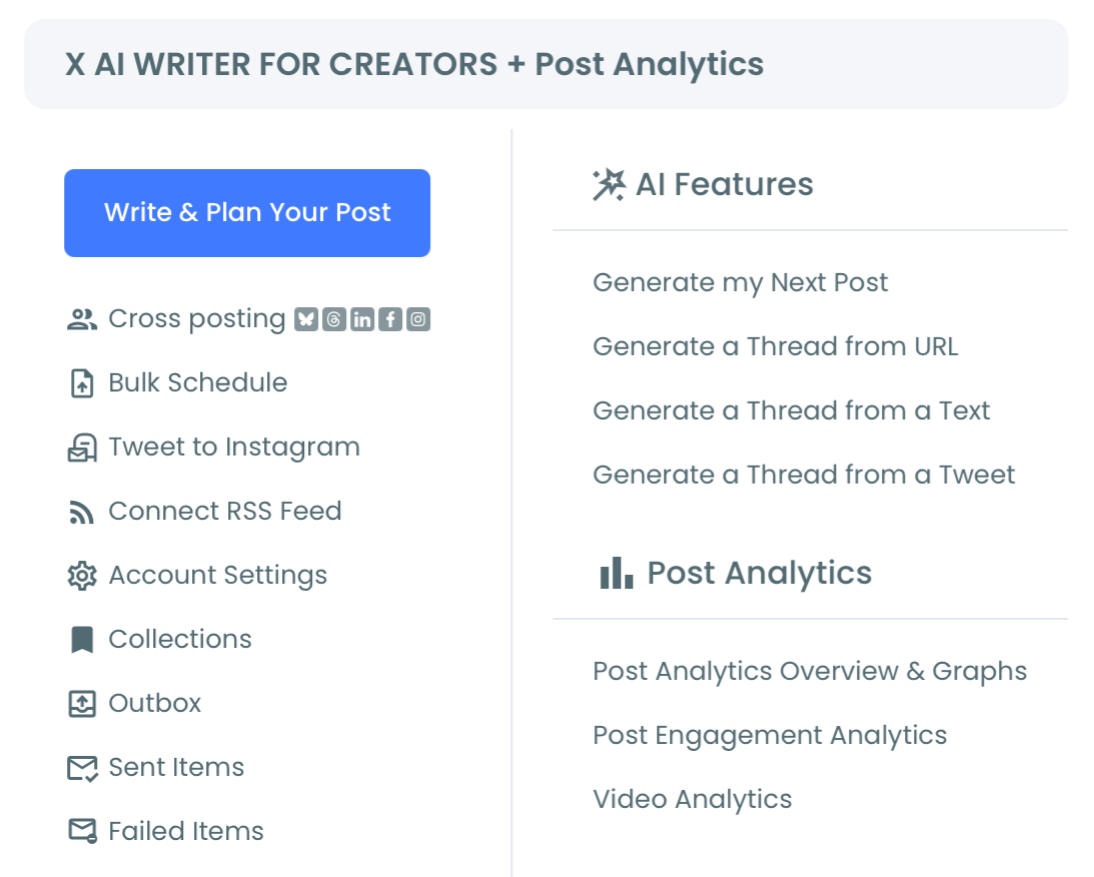
- Select Post Analytics and give the table a moment to populate every row it can reach.
Read the reach, then name the people behind it
- Rank the table by impressions to see which posts left your follower base, then switch the sort to engagement rate to see which of them earned a reply, a like, or a repost.
- Open the engager list on those top rows and list the accounts that reposted or replied, since those usernames are the only viewers X will ever confirm for you.
That order works because reach tells you where to look and engagement tells you who to look at. Reversing it means auditing a hundred accounts on posts that never travelled in the first place.
It is also the honest version of can you see who views your Twitter: the table stops at counts, and the list stops at people who acted.
At a glance: connect the account, open analytics, rank by impressions, sort again by rate, capture the named engagers.
Why X will never show you a viewer list
Viewer identity is not stored as a product feature anywhere on X, which is why nothing can retrieve it. Impressions are aggregated into counts, and the counts are what the API returns.
There is no hidden endpoint holding a roster of names. A service promising one is either guessing from public engagement or inventing the list outright.
That is the real answer behind the persistent search for who viewed your Twitter profile, and it has not changed across any version of the platform.
The closest X gets is profile visits, and that stays aggregate too. You see a count of clicks through to your profile over a rolling window: no names, no timestamps, no way to expand a number into a list.
Anonymity is the design, not a missing feature. Every platform that reports view counts reports them without identity, because attaching names to passive viewing would change how people browse.
What the impression number on X can and cannot tell you
Where X stops returning the data
Impression data has boundaries, and knowing them stops you from misreading a chart. The most recent 3,200 posts are as deep as X's index goes for standard access, so a long-running account has history sitting outside the analytics window entirely.
Impressions can also come back empty for posts published before the account was connected to any analytics tool, or old enough that X no longer serves their metrics at all.
When impressions are missing, engagement rate cannot be calculated for that post, and the row simply shows nothing rather than a zero.
None of that is a data gap on the tooling side. Those boundaries are the shape of what X returns, and every product reading the platform honestly runs into the same wall.
The other metrics X reports next to impressions
Impressions are one metric among eleven that X returns for each post, and several of the others answer questions the view count cannot:
- Bookmarks, which count saves without naming the saver.
- Profile clicks, which measure how many readers wanted to know who wrote this.
- URL clicks, which measure whether the link was the point.
- Video views and video starts, which separate autoplay from intent.
- Engagements, the combined total that the engagement rate divides by.
Reading two of those side by side beats staring at one. A post with heavy impressions and almost no profile clicks travelled without making anyone curious about the account behind it, and that is a different problem from a post nobody saw.
How much of your reach has a name on it
The metric worth adopting, once you stop hunting for names, is the share of your reach that resolves to an account. That ratio is trackable, it moves when your content changes, and it points at the people worth replying to this week.
The arithmetic is simple enough to run on your own rows. If a post collected 12,000 renders and 40 accounts put their name on it, that is one identifiable person for every three hundred views.
Comparing that figure across your last ten posts says more than any single row can.
Reach with nobody named tells you the post was delivered and ignored. Reach with names attached tells you it landed.
A flat impression count is a report on where the post travelled, not a review of your sentences, and those two readings get confused constantly.
You can also push the question sideways instead of deeper. Twitter follower demographics shows which regions and languages your audience clusters in, which is closer to "who" than any view count will ever get.
Anyone still hunting for a viewer roster is optimizing against a number that does not exist. The version worth asking is who sees my tweets on X in volume, and which of them stepped forward.
What Circleboom reads from X instead of a viewer list
Circleboom works from the numbers X itself publishes and puts both layers on one screen. Impressions become a trend you can compare period to period. Engagers become a sortable, exportable list of real accounts.
As an official X Enterprise Developer company, Circleboom collects that data through sanctioned channels rather than scraping, so pulling your own analytics stays inside X's own rules.
The per-post detail sits in Engagement Analytics, where each tweet carries its impressions, engagements, and engagement rate side by side.
Sorting the full history by impressions shows which posts travelled furthest. Sorting by engagement rate shows which ones held attention.
The analytics view is read-only, which is worth saying plainly. Nothing you do inside it publishes, edits, or deletes a post, so there is no cost to sorting the same table five different ways while you work out what you are looking at.
Video walkthrough: how the named repost list is pulled for a single tweet, which is the identity layer this article keeps pointing at.
https://www.youtube.com/watch?v=aoBQHepQ67s
Is it safe to check who sees your tweets with a third-party tool?
Yes, when the tool reads through X's official API and never asks for your password. Circleboom uses standard authorization, so access can be revoked from your X settings at any moment and nothing moves outside sanctioned channels.
The unsafe category is narrower and easy to spot. Any site marketed as a Twitter profile viewer is selling a capability the platform does not expose. The usual price is your credentials or a permission you did not intend to grant.
A simple test filters almost all of them. If a service claims to show data X itself does not display to the account owner, the data is either fabricated or obtained in a way that will eventually cost you the account.
The same test works on the softer version of the pitch. Tools that promise "estimated" or "probable" viewers are modelling a guess from public engagement you can already see for free, then charging for the wrapper around it.
There is a second cost people underestimate. Granting write permissions to a service that only needs to read is how accounts end up posting things their owners never wrote, and a viewer-list product has no legitimate reason to need write access at all.
What you can actually know about your X audience
X gives you an anonymous count and a named set of engagers, and that is the complete inventory. Nothing recovers viewer identity, and the tools that claim to are selling a fiction with a login form attached.
Reading impressions properly and working the engager list is what the honest version of this question turns into. Circleboom puts both halves in one view, pulled through official access, with the reach trend and the named accounts on the same screen.
→ how far your posts travel on X
Common questions about tweet visibility
Can I export the engager list as a file?
Yes. The engager segments export as CSV, which is how most people move the list into a spreadsheet, a CRM, or an outreach plan. Exports draw on a token balance shown on the export button, so you can see what a pull costs before you start it.
Why is my view count so much higher than my follower count?
Because reposts, quotes, search, and recommendation timelines carry posts well past your follower base. A high ratio of views to followers usually means one specific post travelled through an amplifier account rather than signalling anything about your account overall.
Does any paid tier on X reveal who viewed a post?
No. Premium tiers add depth to the analytics you already receive, not a new identity layer, and no plan at any price returns viewer names. For a tier to expose that data, the data would have to exist somewhere first, and it does not.