
You cannot outpace a competitor you are not watching, and on X the most honest competitive signal is not their content calendar. It is their follow graph. Who they start following tells you which market they are eyeing. Who starts following them tells you which customers are evaluating them. Who quietly unfollows tells you what is no longer working.
Need the quick version?
Start here: Circleboom lets you monitor competitor X account followers on Twitter/X using official Enterprise APIs, with continuous tracking of new followers, new followings, and unfollows, plus alerts on every change. The full walkthrough is below, including the exact signals that predict a rival's next move.

Why Monitor Competitor X Account Followers Daily, Not Quarterly
Traditional competitive research runs on a quarterly cadence: pull numbers, write a deck, present it, move on. By the time the deck is live, the competitor has already shipped three things you did not know were coming.
The follow graph updates every day. When you watch it every day, you stop playing catch-up.
Most of what matters in B2B, the creator economy, and consumer brands is visible in X's public follow data long before it hits a press page or a funding news feed. A rival B2B SaaS quietly starts following a cluster of accounts in a new vertical? They are pricing a new ICP. A consumer brand starts following a half-dozen micro-influencers in a specific region? A regional campaign is being built. A competitor starts losing followers in clusters tied to a recent policy shift? Their messaging is backfiring, and you have a window.
The only thing missing is a tool that watches for you, and surfaces the diffs in a structured format you can actually act on.
The Three Signals Worth Monitoring Every Week
Raw follower count is the least useful number in competitive analysis. It is a lagging indicator that feels important because it is the one X shows you most prominently.
These three signals, tracked over time, are where real insight lives.
Who a competitor starts following. This is pure research signal. Agencies, consultants, platform partners, and talent they start following today usually show up in their product or marketing six to twelve weeks later. It is the closest thing to seeing their internal roadmap.
Who starts following a competitor. Journalists, analysts, and enterprise buyers do not follow dozens of accounts a week. When the follow button clicks from that kind of profile, something is happening. A funding round, a big customer, a new analyst report, a rumor worth digging into.
Who unfollows a competitor. The quietest, most actionable signal of all. Churn in the follower base is often the earliest public signal of a customer rollout gone wrong, a leadership departure, or a brand stumble.
None of this shows up in X's native analytics for anyone else's account, which is where tracking someone's X followers becomes a real competitive moat.
How to Monitor Competitor X Account Followers in Four Clicks
Circleboom runs every operation through the same Enterprise APIs that X provides to its most trusted partners, because it is listed on X's Enterprise customer directory as an Enterprise developer. That means your research workflow stays inside official, compliant channels from the first click, and your own account never takes on risk.
Here is the exact setup I use for every competitor I watch:
- Log in to Circleboom Twitter and connect your X account from the main dashboard.
- Open Track Someone's X Account's Following and Followers under the Monitoring menu, then paste the competitor's handle into the tracker.
- Enable all three tracking types (new followers, new followings, unfollows) and turn on alerts so every change pings your inbox instead of requiring a manual refresh.
- Review the structured change table, export the rows that matter, and push the insights into your next competitive readout.
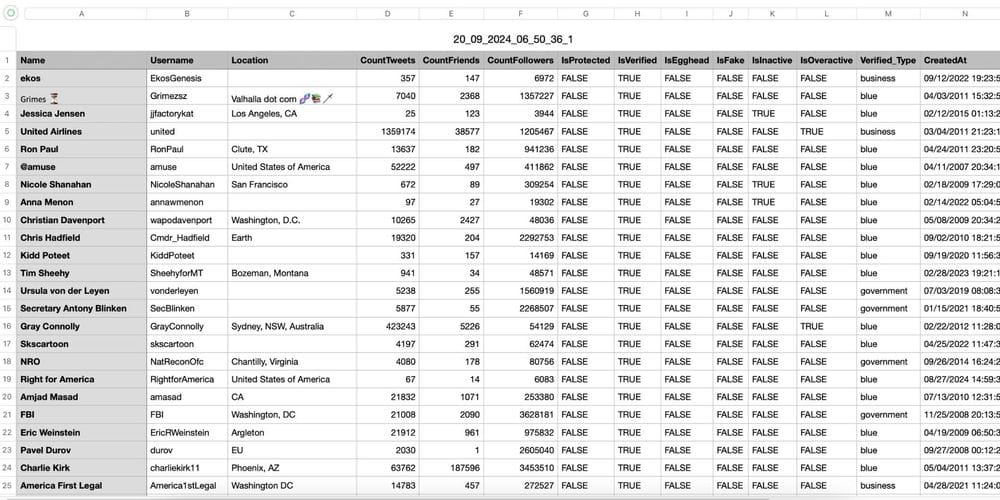
Compared to keeping a Google Sheet of rival accounts and refreshing browser tabs each morning, this flow collapses a week of manual research into a recurring background process. Every row already carries username, bio, follower count, account age, and activity signals, so qualifying a new datapoint takes seconds, not minutes.
Once you have a couple of rivals under watch, you can monitor competitor X account followers as a daily habit rather than a quarterly project.
 Altug Altug
The Tracker vs The Benchmark Report: When to Use Which
Tracking one competitor is a start. Comparing two is where real positioning shows up.
The Tracker answers "what is this account doing lately?" The Benchmark Report answers "how do these two accounts relate to each other, and where do their audiences overlap?" You want both.
Use the Tracker when you need motion data: new follows, unfollows, alerts on change over time. It is your always-on competitive feed.
Use the Account Comparison and Benchmark Report when you need structural data: shared followers, shared followings, the overlap between your audience and theirs. That is where you find out which customers follow both of you (the ones most likely to switch), which creators sit inside both audiences (your partnership shortlist), and which niches they are already winning that you have not even entered yet.
Most competitive analysts I know start a new account with a Benchmark Report to map the landscape, then switch to the Tracker to watch the daily pulse. The two tools feed each other.
Going Deeper With Circleboom's Analytics Stack
Tracking and benchmarking give you the motion and the map. The rest of Circleboom's analytics lets you turn that into a competitive narrative.
Competitor analysis rolls up profile, content, and audience signals into a single comparative view, which is useful when you need a one-page readout for a leadership meeting.
Follower stats surface the demographic and activity shape of a rival's audience, so you can see not just how many followers they have but who those followers actually are.
Follower growth stats give you the trajectory. A rival adding 2,000 followers a month in a specific geography is a very different story from one adding 2,000 in a scattershot pattern, and that difference should shape how you respond.
For any deeper cut, exporting follower or following data as CSV feeds directly into your own analytics stack. I drop exports into BI tools and cross-reference them with our own customer list to spot overlap, churn risk, and potential accounts to reach out to before anyone else does.
Is It Worth the Effort to Monitor Competitor X Account Followers?
Yes, especially compared to the alternative. The alternative is reading about a competitor's moves in TechCrunch after they have already shipped, or noticing a churn wave in your own numbers without any clue what triggered it.
Teams that run a persistent competitive tracking setup routinely say they respond to rival moves roughly a month faster than teams that rely on quarterly research. A month is often the difference between reacting to a launch and preempting it.
Because every piece of this data lives on a public X profile, none of it requires you to bend a rule. Circleboom simply turns invisible public activity into structured, time-stamped, exportable insight, which is something X's own interface never bothers to offer.
What You Actually Walk Away With
The first week of monitoring feels like noise. By week four, patterns start emerging. By month three, you can usually predict the next three moves of the competitors you track, because the follow graph has given you the same setup enough times to recognize it.
Content teams stop being surprised by rival campaigns. Sales teams learn which buyers are already sniffing around a competitor, which makes outbound sharper. Product teams see which adjacent markets a rival is researching long before a feature ships into one of them.
Because Circleboom is listed among the companies on X's official Enterprise developers list, every bit of this competitive work runs through official APIs, not scraping, and every tracked datapoint is already public on the platform. Your legal team never has to flinch, and your own account never picks up risk.
If you are ready to treat competitive intel as a daily feed instead of a quarterly deliverable, you can monitor competitor X account followers on your top three rivals this afternoon.
Frequently Asked Questions
How many competitors can I monitor at once?
You can monitor competitor X account followers across as many public accounts as your plan allows, and in practice most teams start with three to five rivals before expanding to the wider competitive set.
What is the difference between the Tracker and the Benchmark Report?
The Tracker watches one account's follow activity over time, while the Benchmark Report compares two or more accounts to surface shared followers and shared followings for structural positioning work.
Is it ethical to monitor competitor X account followers this closely?
Yes. All tracked data is already public on X, and Circleboom accesses it through official Enterprise APIs, which means you are analyzing information the platform already exposes, not breaking any rule.
How quickly does new data appear after a change on X?
Circleboom uses continuous periodic snapshots, so new followers and unfollows typically surface within a short window after the change rather than instantly in real time.
Can I export the tracked and benchmarked data?
Yes. Every tracked dataset and every Benchmark Report can be exported as CSV, which is why most analysts combine these tools with their existing BI or CRM workflows.
You can take your first competitive reading right now by picking your top rival and setting up a recurring watch on them, and monitor competitor X account followers as part of a true competitive intelligence routine.
)