

Most bot cleanups stall halfway through.
The list gets built, a few thousand accounts get selected, the batch starts, and then the browser closes on a laptop lid or a restart.
The queue stops where it stands, the accounts it already processed are gone, and the rest are still following you.
The number that decides whether that happens is not your follower count. It is how long you can leave one browser window open and untouched.
What a paced purge gives you.A reviewed shortlist of suspicious followers instead of a raw follower dump.Batch sizes matched to the time you can genuinely stay at the machine.A removal run that pauses itself at X's rate limits instead of pushing through them.
Circleboom reads your full follower list on X through official API access, scores every account against bot signals, and stages the removals you approve into a queue. Start where you can purge bot followers on Twitter.
What actually limits a bot follower purge on Twitter
Detection is the easy half. The failure I see most often sits at the execution step, because the batch gets sized against the follower count instead of against the clock.
Removing a follower on X is not one request that fires from a web page and finishes.
Your reviewed segment goes into a queue, and the Circleboom Remove Twitter/X Followers Extension works that queue from inside your own Chrome session, account by account, through sanctioned API access.
Two consequences follow, and both change how you plan the run:
- The browser has to stay open and authenticated until the queue drains.
- The run paces itself, so a large batch occupies real minutes rather than a moment.
Close the tab at sixty percent and the accounts already processed are gone from your follower base while the rest are still following you.
You can restart, but you are restarting against a list that has already changed underneath you.
That is the practical reason a cleanup gets abandoned. It is also why the advice to get rid of Twitter bots in a single sweep falls apart past a few thousand followers.
Why the pause message is a feature, not a stall
When the queue reaches X's rate limit, processing does not fail. Circleboom stops and shows a plain line: "The removing process will continue in N minute(s). Please keep your browser open."
Pause durations vary between 1 and 20 minutes, and the run resumes on its own once the quota renews.
Circleboom is one of the companies on X's official Enterprise developers list. Working inside sanctioned rate limits rather than around them is the condition attached to that access, and the pause message is where you see the condition being met.
A cleanup that waits eleven minutes without complaint is a cleanup that leaves your account where it started.
That trade is worth understanding before you press the button. It also explains most of the confusion behind why you can't remove followers on Twitter at the speed the flagged list implies.
X polices inauthentic behaviour from its own side too. The platform's automation rules set out what counts as prohibited automated activity, and enforcement sweeps do remove accounts.
Those sweeps run on X's schedule, though, not yours, and low-effort spam sits below the line for a long time.
You can remove bot followers from your X account on your own timetable instead of waiting for one.
How to purge bot followers on Twitter step by step
Three phases: protect first, build a batch you can finish, then run the queue and leave it alone.
Watch the run: how a scored follower list collapses into a removable segment and what the interface looks like while the queue drains.
https://www.youtube.com/watch?v=8Iot3TJ7mKc
Lock down your known accounts first
- Log in to Circleboom Twitter and connect the X account you want cleaned.

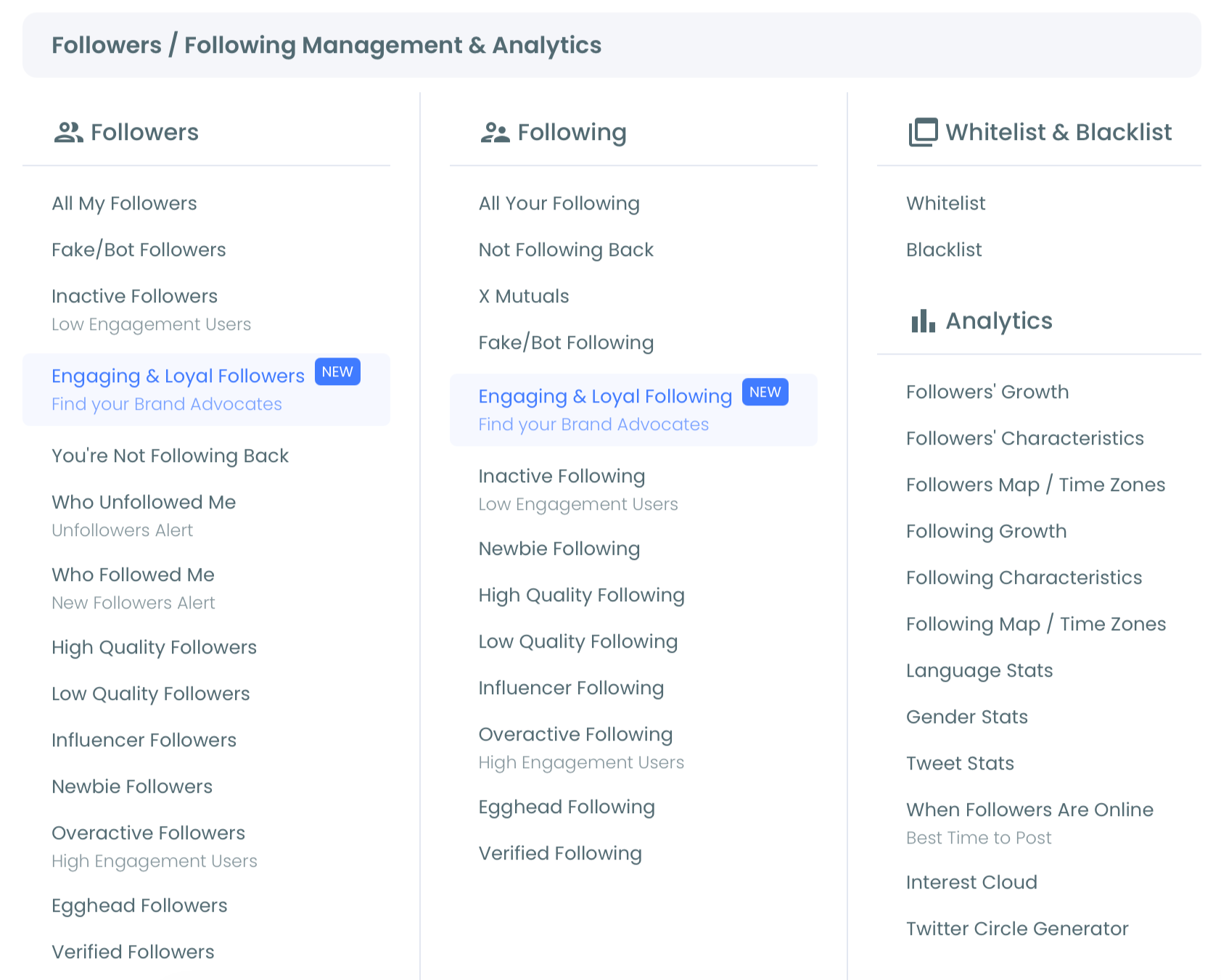
- Open the Follower and Following management menu, then select Fake/Bot Followers from the Followers group.
- Whitelist your known accounts before applying a single filter. Customers, partners, colleagues, community members. Whitelist status persists across every Circleboom feature and excludes those accounts from every bulk operation you run afterwards.
Build a batch you can finish in one sitting
- Sort by Follow Ratio ascending to bring the most structurally suspicious accounts to the top. Values below 0.1 point to mass-follow behaviour, and below 0.05 the pattern is hard to explain any other way.
- Narrow the segment with Filter Options rather than selecting everything the scan flagged. Combining Fake/Spam with a low Tweet Count, a recent Join Date and an Inactive engagement tier produces a much higher-confidence group than any single signal.
- Read the Active Filters bar before you select anything. It shows the exact combination currently applied, which is the only reliable check that the segment on screen matches the segment in your head.
- Export the selection to CSV while it still exists. Removal is permanent through Circleboom, and the export is your only record of who was in the batch. Circleboom's Export Twitter Accounts output carries the quality flags alongside each profile, so the file doubles as evidence if a removal is ever questioned.
Run the queue and leave the browser alone
- Select the reviewed rows and choose Remove Follower. The accounts move into the extension queue rather than disappearing on the spot.
- Keep Chrome open and the Circleboom session authenticated until the queue reports itself finished. Pause messages during the run are normal and resolve without any input from you.
That ordering is what keeps the process honest.
Whitelisting first means protection exists before any selection does. Sorting before filtering means the filter lands on the accounts most likely to be wrong, not on whatever the default order put in front of you. Exporting before staging means the batch survives its own irreversibility.
Skip any one of the three and the run either removes someone it should not have or leaves you with no way to prove what happened.
How many bot followers should you remove in one batch?
Size the batch by the session you can actually give it, not by the number the scan returned.
The arithmetic is simple once you accept that pause time dominates. Processing itself is quick. The waiting between quota renewals is what fills the clock.
An account with 12,000 followers and a 20 percent suspicious share is looking at roughly 2,400 candidate removals.
On paper that is one batch. In practice it is several pause cycles strung together, and it belongs in a window where nobody needs the machine.
Three batch shapes cover almost every case:
- A short sitting. Take the top slice by Follow Ratio ascending, a few hundred accounts, the ones no reasonable person would defend.
- A working session. Run a filtered segment while you work on something else in another window, checking back when a pause message appears.
- A long unattended window. Reserve the full flagged segment for a period when the browser can stay open and the machine will not sleep.
Sizing by session length is what turns an abandoned cleanup into a finished one.
The same logic scales down to lighter audits. Trimming weak accounts rather than obvious bots means widening the filter, not changing the method.
The route to identify and remove low quality followers on Twitter uses the same queue at the same pace.
A short run is a run you can still read
There is a second reason to keep batches small, and it has nothing to do with the clock.
Four hundred rows is a segment you can scroll and sanity-check before committing. Four thousand is a number you approve on faith.
Every false positive caught at that stage is a relationship kept, and the catch rate collapses once the list stops fitting on a screen anyone would actually read.
Smaller batches also give you feedback between runs. Clean a slice, wait a week, and rerun the scan.
The second list tells you something the first one could not: whether you are clearing a backlog or refilling a bucket.
Should you remove them, block them, or leave them alone?
Removal is the default. Blocking is the escalation. Leaving them is a decision, not an absence of one.
Remove Follower takes the account out of your follower base without notifying anyone.
The account keeps access to your public posts and can follow you again tomorrow, which is exactly why it is the safe choice when your list is a shortlist rather than a verdict.
Blocking is heavier and public-facing. The account loses access to your content and cannot re-follow, so it fits coordinated spam and repeat offenders rather than a quiet account with four tweets.
Leaving them alone has a cost that compounds quietly.
Bots accumulate at a low steady rate during normal operation and in bursts after anything that gets reach, and after about thirty days a wave stops looking like a wave because the recency signal that made it obvious has expired.
When the same accounts keep coming back
If the same profile shapes reappear after every cleanup, the answer sits upstream of removal. Working out how to stop bots from following you on X usually does more for a repeatedly targeted account than a larger batch does.
For a single account you are unsure about, the Fake Twitter Account Checker answers the question in seconds without touching your follower base at all. It is a useful sanity check on the borderline rows before you commit a segment, and it costs nothing but a username.
Detection here is probabilistic by design. The scan reports likelihood, not certainty, so a support account that never posts and an international follower with an empty bio can both land in the flagged group.
Review is where the accuracy comes from, and you can clear bot followers out in bulk only after that review has happened.
What to do next
The whole process fits in one sitting once the batch matches the window you have.
- Whitelist every account you would be upset to lose, before any filter exists.
- Sort by Follow Ratio ascending and read the first page properly rather than trusting the count.
- Combine Fake/Spam with low Tweet Count, recent Join Date and Inactive engagement for a high-confidence segment.
- Export the selection to CSV, then stage it for removal.
- Keep the browser open, ignore the pause messages, and check back when the queue reports done.
The habit matters more than any single run. A quarterly pass takes twenty minutes and stops the slow accumulation that drains the meaning out of a follower count.
That is the argument behind why you should regularly clean your Twitter followers instead of waiting for a crisis to force the issue.
I would rather run four small purges a year than one panicked one the week before a sponsor call.
→ Start your bot follower purge
Questions people ask before a bot purge
Do I have to install a Chrome extension to remove followers?
Yes, for bulk removal. The Circleboom Remove Twitter/X Followers Extension processes the staged queue from inside your Chrome session, which is why the browser has to stay open while it works.
Mass Block uses a separate extension of its own, so you install one per operation rather than one for everything.
What happens to the replies a removed follower already left on my posts?
They stay exactly where they are. Removal changes the follow relationship and nothing else, so any replies, likes, quotes or reposts that account made before the batch remain attached to your posts.
Pauses during the run last between 1 and 20 minutes and need no action from you either way.
If a removed account follows me again, will it come back flagged?
Probably, because the scan scores your current follower base fresh every time it runs. An account that still carries the same follow ratio, tweet count and activity tier will land in the flagged group again on the next pass.
That repeat appearance is the signal to escalate from removal to a block rather than to run a larger batch.
What happens if I close the browser mid-run?
Re-run the scan before you restart. The queue stops where it is, the accounts it already processed are removed permanently, and the remainder are still following you, so the flagged list you were working from is out of date.
Rebuilding it from the current follower base means the rows you already cleared will not reappear, and you size the next batch against what is actually left.






)