
The honest answer is that X does not hand you a "recently followed" list. There is no follow-date column, no timestamp, and no sort control on the native following page, so the accounts you added last week sit in the same unsortable pile as the ones you added three years ago. To see recently followed accounts on X, you reconstruct the view: pull your entire following list into a structured table you can sort, filter, and search.
Where does X show the accounts you recently followed?
It does not, at least not directly. Native X keeps no follow-date and no sort control on your following list, so the reliable way to see recently followed accounts on X is to load the full list into an audit view you control. Circleboom pulls every account you follow on Twitter/X into one sortable, filterable table through official X API access, so you can review the newest layers and log new follows going forward.
→ see recently followed accounts on X
Why X Hides Your Recently Followed Accounts
X stores who you follow. It does not store when you followed them. That single gap is the reason "recently followed accounts on X" is harder than it sounds.
Two things follow from it. First, your following list order is not a follow-date timeline. It is not strictly chronological, not alphabetical, and not sorted by follower count, and you cannot change it. Second, because there is no stored follow-date, no tool can retrieve a true "date I followed this account" for the follows you made in the past. X never recorded it.
That leaves a real question with a workable answer. If you cannot retrieve the history, you rebuild the view from the data X does expose: the full list of accounts, each account's age, activity, and ratio. Circleboom turns your following list on X into a sortable dataset through official API access, which is where the reconstruction starts.
X's own following FAQ confirms the native list gives you the accounts but none of the sorting you would need to isolate recent activity.
If you want the mechanics of how the list is ordered, this walk-through of how to get a full following list on X covers the retrieval side in depth.
Two Meanings of "Recently Followed"
The phrase splits into two questions, and each has a different method.
- Accounts you recently followed. You want to review the newest additions to your own following list.
- Accounts a target recently followed. You want to watch what a competitor, a lead, or an account of interest just started following.
Native X answers neither cleanly. For your own list, it shows every account with no way to isolate the recent ones. For someone else's list, it shows their follows with the same unsortable ordering, and it sends no alert when that list changes.
Circleboom answers both. The first is an audit job handled by All My Following, the complete view of your own follows. The second is a tracking job: snapshot a target's following on a schedule and diff each snapshot so every new follow lands as a dated entry. That method is broken down in this guide to tracking recent follows on X.
If your goal is simply to read the full list of accounts you follow without the native truncation, this Twitter following list viewer explainer covers the read-only side.
The Reconstruction Method, in Plain Terms
Here is the load-bearing idea. You cannot pull a follow-date that was never stored, so you rebuild "recent" from signals that do exist plus a forward-looking log.
For your own following list, the structured audit brings up the layers you actually care about. Sort by account Joined date to spot the newest accounts on X you have followed. Filter by engagement to find follows that have gone quiet. Search by bio keyword to isolate a batch you added during one campaign. None of these is a literal follow-date, but together they let you reconstruct which slice of your list is worth reviewing.
For anything you follow from today onward, tracking closes the gap X leaves open. Once a snapshot baseline exists, every new follow is a dated event, so "recently followed" stops being a guess.
Circleboom retrieves all of this through official X API access, which matters for two reasons: the data is complete rather than truncated, and your account stays inside X's rules the whole time.
Video walkthrough: how a target's brand-new follows appear as dated entries once tracking is turned on.
How to See Recently Followed Accounts on X in Circleboom
The workflow below runs the audit side end to end. It answers the most common version of the query: review the newest layers of your own following list.
1. Log in to Circleboom Twitter and connect your X account with official OAuth.
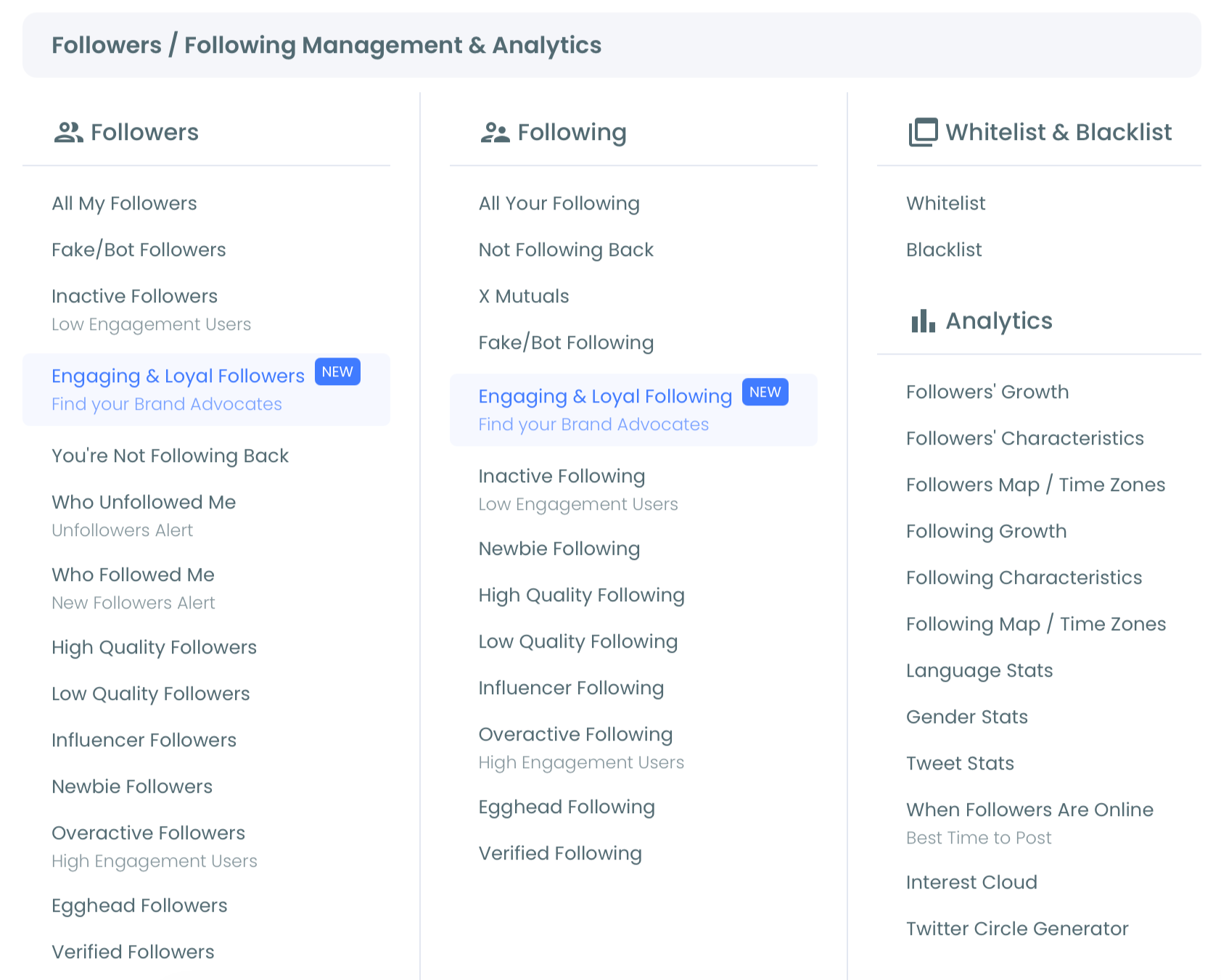
2. Open the Follower & Following menu and select All My Following to load every account you currently follow into one table.
3. Sort and filter to reveal the recent layer. Click the Joined column to bring newest accounts to the top, or open Filter Options and set a Join Date range, an engagement level, or a bio keyword to isolate the batch you want.
4. Act on what you find. Whitelist the follows you want to protect, add strong sources to a Twitter List, or select stale accounts and unfollow them in gradual, rate-limited batches.
That order works because the login earns official API access first, the full-list load gives you the complete picture before you judge anything, and filtering narrows scope before any action touches your account. Skip the review step and you risk unfollowing an account that only looked inactive.
What the Audit View Actually Shows
When you view your recently followed accounts on X this way, every row carries enriched data that the native list never shows. You see the account name and handle, total tweets, join date, following and follower counts, follow ratio, and an activity classification of high, medium, or low engagement.
That enrichment is what makes the reconstruction possible. A plain list of avatars tells you nothing. A sortable table with account age and engagement lets you separate the follows still worth keeping from the ones added for a reason that no longer applies.
When the audit turns up accounts that have stopped posting entirely, the case for clearing them is covered in this look at unfollowing inactive Twitter accounts.
Two supporting views help here. If you want to see the accounts you follow who never followed you back, the not following back segment isolates them in one pass.
A running record of who dropped you over time comes from the who unfollowed me on Twitter tracker, which keeps that log automatically. Both build on the same structured following data.
Safety and Rate Limits
Any cleanup that follows the audit runs through the official pipe, and X applies limits to it. Circleboom is an official X Enterprise Developer, so every read and every unfollow moves through sanctioned access rather than scraping.
Unfollow actions cap at 50 per 15-minute window and up to 800 per day. Circleboom recommends staying well under that, around 100 to 150 accounts at a time, to avoid tripping X's automated detection. When the daily ceiling is reached, the queue pauses and resumes the next day. If you are cleaning a large following list, this breakdown of how to mass unfollow Twitter accounts walks through pacing the batches safely.
The Bottom Line
You cannot retrieve a follow-date X never stored, but you can reconstruct the view completely. Pull your full following list into a sortable table, sort by join date and engagement to reveal the recent and the stale, and turn on tracking so every new follow from today is logged as a dated event. That is the difference between guessing at your following list and actually reading it.
Circleboom does the whole job through official API access, so the data stays complete and your account stays compliant. Open your list, sort it, and see the recent layers for yourself.
→ pull your recently followed accounts on X into a sortable view
Common Questions About Your Following List
Can I see the exact date I followed someone on X?
No, because X does not store a follow-date, so no tool can retrieve one for past follows. You can reconstruct the recent layer by sorting your full following list and, going forward, by logging every new follow as a dated event through follow tracking.
Does my X following list show newest follows at the top?
Not reliably. The native order is not strictly chronological and cannot be sorted, which is why loading the list into a structured table is the only dependable way to bring up recent additions.
Can I check the accounts another person recently followed?
Yes. Snapshot that account's following on a schedule and diff each snapshot, so every new account they follow appears as a dated entry rather than getting lost in an unsortable list.
Is it safe to review and clean my following list this way?
Yes. Circleboom reads and edits your following list through official X API access with built-in rate limits, so the review stays inside X's rules and your account stays protected.
)