
You know your competitors' handles, their best posts and roughly how often they publish. What you cannot see from the outside is who follows them, and whether that audience leans male or female compared with yours. This guide shows where to get that answer and how to read it without over-reading it.
Is your competitors' audience more male or female on X?
Circleboom measures the male and female share of each competitor's followers on X and sets it next to your own, using follower records from official X Enterprise APIs. One report covers up to 5 accounts.
→ Twitter follower gender
Why a competitor's follower gender is hidden on Twitter
A competitor's follower gender is hidden on Twitter because profiles carry no gender label and the platform's own analytics cover your account, not someone else's. There is nothing on a rival's profile page to read, so Twitter follower gender for another brand stays a blank unless something calculates it.
That leaves most teams with two weak substitutes.
The first is a survey figure for the whole platform. Pew Research Center's 2025 report on Americans' social media use notes that men are more likely than women to report using X. That is a fact about the platform's user base. It says nothing about whether a given brand's followers follow the same pattern.
The second is inference from content. A team looks at a rival's posts, decides who they seem written for, and treats that impression as audience data. I have sat in planning meetings where a whole creative direction rested on that kind of guess.
The cost shows up later. A partnership gets briefed for the wrong audience. A campaign voice gets copied from a brand whose followers are a different crowd. A client asks how you know, and there is no source to point to.
What fixes it is a measured comparison: the same calculation, for their account and yours, on one date. Circleboom runs that male or female audience check on X for any public account you name.
What Circleboom's X competitor report measures
Circleboom's X Competitor Analysis & Benchmark Report measures Twitter follower gender for up to 5 accounts and draws them on one chart. The panel is called Gender breakdown, and it shows a Male share and a Female share for each account.
The comparison set is flexible. You can enter your own account plus up to 4 competitors, or leave yours out and compare up to 5 other accounts.
The figures are calculated, and the report says so. Circleboom works the breakdown out from profile data in the follower records it retrieves from X. The company is listed on X's Enterprise customer directory, which means those records arrive through X's own API and your account is never exposed to a scraping tool.
Gender is one panel among several. The same report also covers how each account posts and how its posts perform, so the follower gender panel for X accounts always has context around it.
What the bar is allowed to claim
Each bar claims one thing: the calculated share of male and female accounts in that follower list, taken as a whole. It makes no claim about any single follower, and Circleboom's own limits for the feature say the breakdown describes the audience as a group, not any individual account.
That boundary is the reason the figure is safe to use in planning. You are comparing the make-up of two audiences. You are not labeling people.
Before you run it: a Circleboom tutorial on getting gender demographics for both your friends and your followers on Twitter, the same two sides the report's toggle switches between.
How to check whether a competitor's audience is more male or female on X
The process, step by step, from an empty comparison to a read panel.
Choose comparable accounts before you spend a token
- Open Circleboom Twitter Management in your browser. The dashboard that loads holds every menu used below.

- Go to the Monitoring menu and select the X Competitor Benchmark Report, the first item in the list.
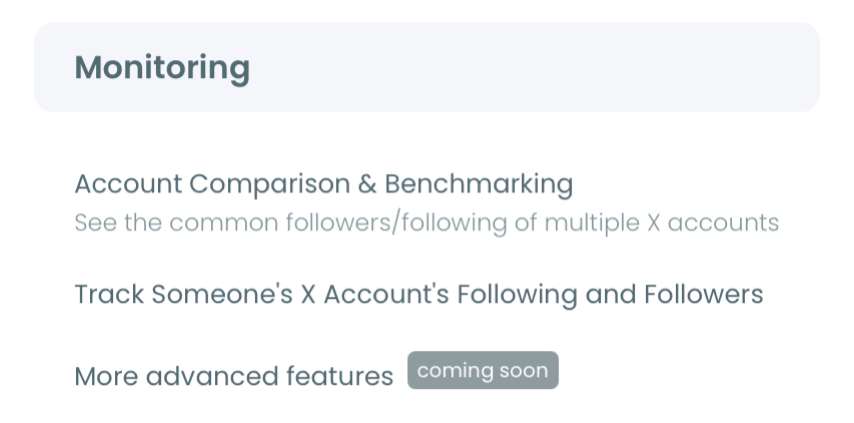
- Enter the accounts under Account Handles. Put your own handle first, then use the + button to add each competitor, up to 5 accounts in total. Pick direct peers: the same market, language and rough scale. A global entertainment brand and a regional support account share a sector and little else.
Run every account on the same date
- Select Start Competitor Analysis, then pick how often the report runs. Just this once produces a single report. Keep it up to date every month adds an automatic report each month for the period you choose.
- Check the token cost shown on that screen before confirming. Competitor Tokens are counted as competitors multiplied by reports, and your own account is free. If the balance is short, the button changes to a buy-and-start option.
- Open the finished report with View report on its card under Your saved analysis. The card also shows the run date, which belongs in any slide or message where you quote the result.
Read the gender panel in the right view
- Find the Gender breakdown panel in the audience demographics block and read it with Followers selected. Each account has one stacked bar. Note which way each bar leans and how far apart the accounts are. Read every share as a figure for the group, and never read it alone.
- Switch the toggle to Following to see the split for the accounts each brand follows. This view describes a brand's chosen network, so keep it out of any sentence about audience.
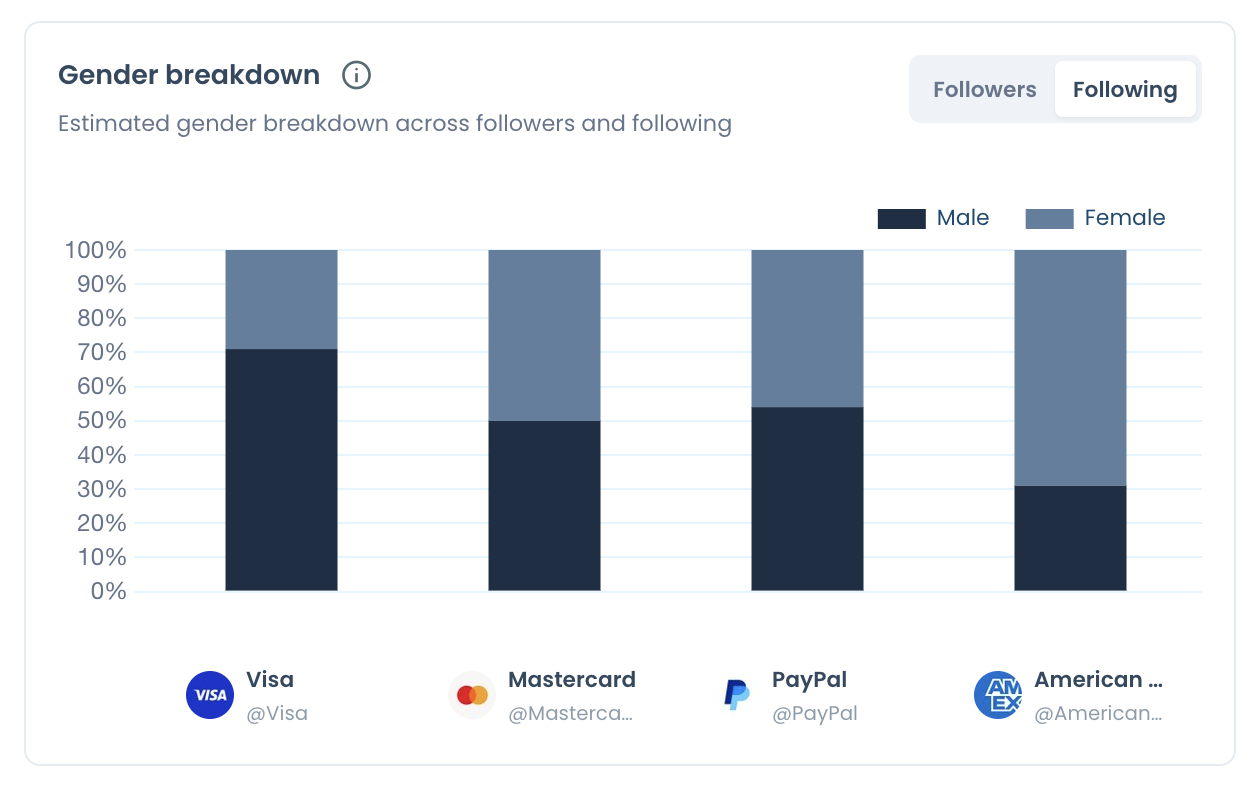
The sequence does two jobs: peers are chosen before the run, so the bars are worth comparing, and Followers is read before Following, so the audience figure is never confused with the brand's own follow list.
A short summary of the path:
- Pick peers and enter up to 5 handles.
- Start the analysis and confirm the token cost.
- Read Gender breakdown on Followers, then on Following.
Check each handle against the report's entry rules before you add it. The account has to be public. It also has to sit at or under 3,000,000 followers, and that ceiling applies to your own account as much as to a rival's.
If a category leader is too large or simply not a fair peer, treat it as a reference to study and keep it out of the set. Twitter follower gender is most useful between accounts that compete for the same people.
Never read gender alone: a three-part reading order for an X audience
A gender share becomes useful only as the first of three readings. Circleboom's guidance for this metric says to use it alongside interests and geography, without assuming tone or preferences from gender alone. Turned into a working order, that guidance looks like this:
- The gender panel. Which way does each account lean, and how wide is the gap?
- The wider demographic picture. Where are these followers, what languages do their profiles use, and what do their bios say?
- The shared audience. Are the two follower lists different people, or largely the same ones?
Look at gender first and conclude from it last.
The order matters because each later reading can overturn the first. A wide gender gap between two accounts looks like a headline. If the second reading shows those audiences also sit in different countries and describe themselves with different bio keywords, gender was never the main difference. If the third reading shows heavy overlap, the two "audiences" are partly one audience counted twice.
Is there a full demographic picture beyond gender?
Yes. In the competitor report, the audience demographics block puts country, time zone and language panels next to gender, plus an activity heatmap and a bio keyword cloud, for every account in the set.
For your own account, Circleboom goes deeper. Followers' Characteristics and Following Characteristics break the same composition data into more granular, drillable detail than the comparison's summary. The landing page for Twitter follower demographics describes that view.
The Following side has its own reading. The accounts you follow are your "friends" in older Twitter vocabulary, and the post on Twitter friends demographics is about that list.
One limit carries across every panel in the block. These are calculated descriptions of a group. A language bucket, a country share and a gender share all describe the crowd, and none of them is a record about one follower.
Are your followers and a competitor's followers the same people on Twitter?
A gender panel cannot tell you, because two audiences can show the same split and share almost no accounts. Overlap is a separate measurement.
It matters for how you act on the gender reading. Suppose a rival's audience leans the same way as yours. If the two lists are mostly different people, their followers are a new group worth reaching. If the lists are mostly the same people, a similar split is exactly what you would expect, and there is little new audience to win.
For this question the report has a Common Audience panel. Choose two accounts from the set and it returns the number of followers and the number of followings they share, each with a link to the list, then repeat it for the next pair. For accounts you have not added to a report, Compare Twitter (X) accounts is the tool built for followers that two accounts have in common.
If you want the method laid out first, read how to find common followers between Twitter accounts without coding.
Run the overlap check on the one or two rivals whose gender reading surprised you. It is the fastest way to learn whether the surprise is about a new audience or about your own followers seen from another angle.
What to change on X once you know the split
Once you know the split, change your own calibration and leave the rival's playbook where it is. The growth tip attached to this metric is specific: when a competitor's gender mix differs from yours, copying their campaign tone may not fit, so tone, visuals and the call to action get tuned to your own audience.
In practice I see three sensible reactions:
- The splits differ. Stop using that rival as a voice reference. Keep studying their formats and timing, which the other report sections cover.
- The splits match. Their creative choices are more relevant to you, and the bio keyword cloud is the next panel to compare.
- Every account in the set looks alike. Gender does not separate this category. Move to the measures that do.
The same reading works before a partnership. Put the creators on your shortlist into the slots a rival would take, and one run sets each of their audiences beside yours. If a creator's followers lean differently from the audience the brief is written for, that is worth knowing before the contract.
What you should not do is draw conclusions about what men or women want from a bar chart. The panel reports composition. Preferences have to come from how your own followers respond to your own posts.
Ads, timing and the date on the finding
Paid campaigns follow the same logic. A rival's audience make-up is a prompt to review who your ads are aimed at, and X's ad settings are where that decision gets applied. For the campaign side, see these advertising best practices on Twitter.
A last practical point: date the finding. Twitter follower gender is a snapshot of an audience on the run date. If the comparison feeds a quarterly plan, the monthly schedule keeps a fresh run arriving without anyone having to remember it.
If the split matches, and if it does not
Your next action depends on what the two bars showed.
If your audience and the competitor's lean the same way, treat their content choices as relevant evidence and go straight to the second reading: demographics and bio keywords.
If they lean opposite ways, drop that account as a tone reference today, and write the next campaign from your own audience's record.
If you have not run the comparison yet, the mistake I see most often is waiting for a bigger research project to justify it. One report on your account and two rivals answers the question this page started with, and Twitter follower gender stops being a guess in the brief.
→ Run a Twitter follower gender comparison
Common questions after a male and female audience comparison
How do I put the comparison in front of a client or my manager?
Use Create Branded Presentation inside the report. It builds an export that carries your logo, and the report's guidance is to pair each chart with the decision it supports and to keep the account set and dates visible. Circleboom's sample benchmark report shows the layout before you run your own.
How do I see the gender split of my own followers in more detail?
Use Gender Stats, Circleboom's own-account view of the same metric. Your account appears in the comparison as one column, and the standalone tool is where you study it by itself. The post on how to analyze gender demographics of your Twitter followers covers that side.
Does the Followers / Following toggle change the engagement numbers too?
No. The toggle changes the audience panels only: audience quality and the demographics block. Posting behavior, content formats, engagement, reach, leaderboards and video describe an account's own posts, so they read the same in both views.
Can I stop a monthly comparison after it has started?
Yes. A scheduled set runs for the number of months you selected, and End Scheduling on its card stops the automatic runs at any time. Reports already produced stay available under Past Analyses.