
How do you run a repost cleanup on X when the app only lets you undo reshares one at a time? You use a tool that pulls your reposts in bulk and deletes them in a single filtered pass. That is the short answer, and the steps below make it concrete.
Your repost cleanup, start to finish.Clear recent reposts in minutes with no archive upload.Reach older reposts through your X data file.Filter by post type, date, or keyword so the right reshares survive.
Circleboom's Delete Tools remove every repost on X through the official X API. Start with a repost cleanup.
Reposts are the shares you stacked on your timeline over months or years, and they carry your name the same way your own posts do. When they no longer match who you are, clearing them by hand is the wrong tool for the job.
Why the Native Undo Button Isn't Enough
X gives you one way to remove a repost: open the post, tap the highlighted repost icon, and undo it. That removes the reshare from your profile, but it handles exactly one post per action. There is no date filter, no bulk select, and no way to target reposts as a group.
For an account with a few hundred reshares, that limit turns a cleanup into an evening of repetitive tapping. X's own repost FAQs confirm that undo works post by post, and that reposts count toward your daily posting limit like any other post.
Circleboom closes that gap. It removes all your reposts on X in one batch as an official X Enterprise Developer, so the operation runs through sanctioned access rather than a risky workaround.
I reach for it whenever a manual pass would take longer than the cleanup is worth, which is almost always. When that is the case, you can delete all your reposts in a single batch instead of tapping through them.
How to Delete All Reposts on X (Step by Step)
Here is the flow, in order. The first phase connects your account and loads your reshares; the second filters to reposts and runs the delete.
Connect your account and load your reposts
- Log in to Circleboom Twitter and connect your X account with official OAuth.

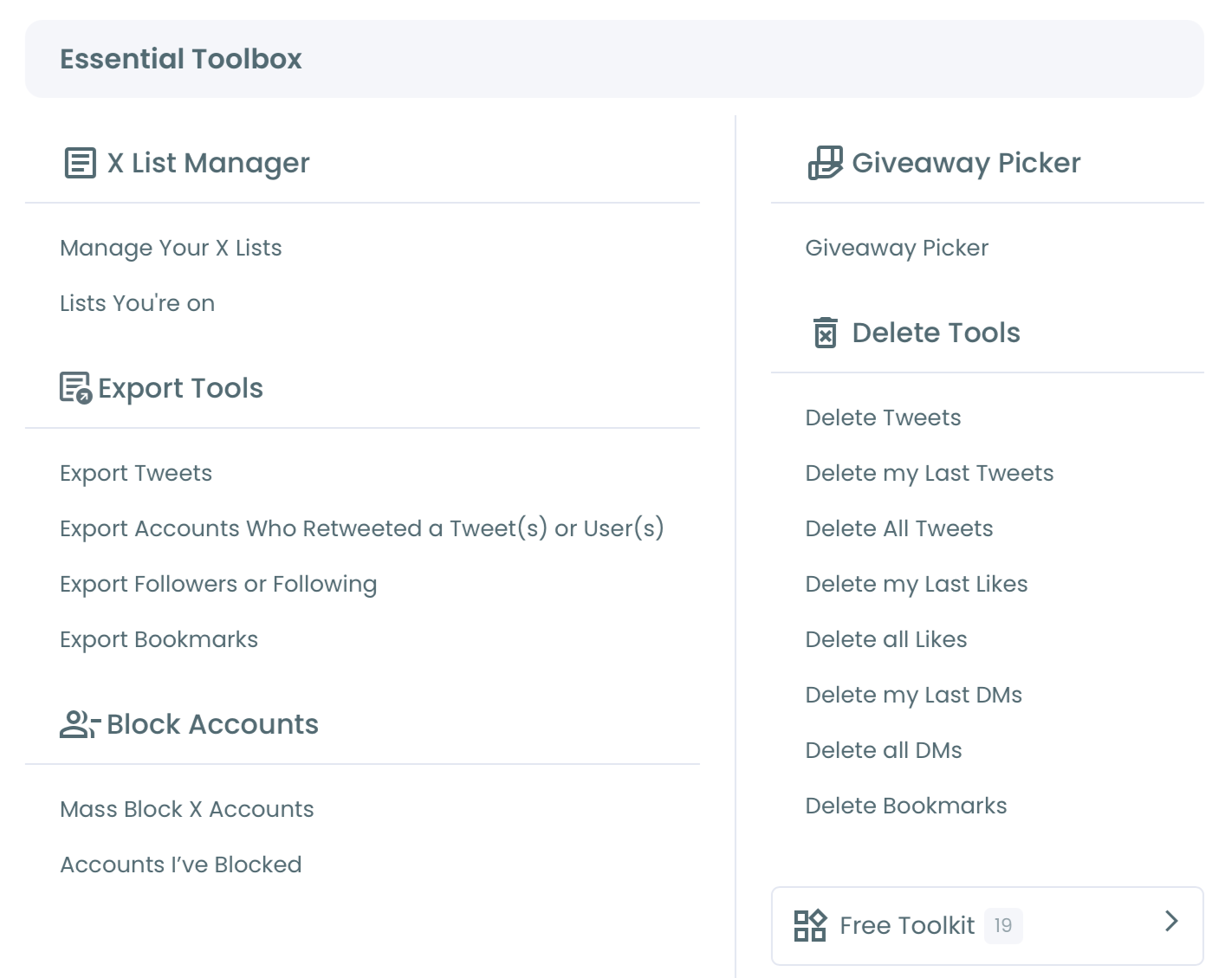
- Open the Essential Toolbox menu where the Delete Tools live.
- Choose your window. Load your last 3,200 posts straight from the API for recent reposts, or upload your X data archive to reach reshares older than that limit.
Filter to reposts and run the cleanup
- Set the post-type filter to reposts only. Deselect original tweets and replies so the batch targets reshares and leaves your own content in place.
- Add a date, keyword, or engagement rule when you want to keep specific reposts instead of clearing all of them.
- Review the queued count, then delete. Circleboom displays the exact number of reposts to be removed before the irreversible step runs.
That order matters because the login secures official-API access, loading the right window matches the tool to how far your reposts go back, and the post-type filter protects your original posts before deletion. Reverse the filter and delete steps, and you risk removing content you meant to keep.
Quick recap:
- Log in and connect your X account.
- Open Essential Toolbox and pick your window.
- Filter to reposts, add optional rules, and confirm the batch.
iPhone walkthrough: clearing an entire repost history from the X app in a few taps.
Recent Reposts vs Full History: Which Route You Need
The route you pick depends on how far back your reshares go, and this is the decision most guides skip.
The recent route reads your last 3,200 posts directly through the API, with no archive step. It is the fast path and handles the majority of accounts completely. The archive route processes the tweet.js file from your X data download, which reaches every repost regardless of age. It is the tool for long-active accounts whose reshares predate the API window.
If your cleanup centers on one stretch of time or a single source, deleting retweets from specific dates or an account narrows the same filter to an exact target.
Either way, a repost is treated as a post type you filter to. That is the same mechanic behind a full delete all tweets on X run, except here you keep the ReTweets filter on and your original posts survive.
Circleboom runs both routes from one place, so you can clear every repost on X whichever window your history needs.
Cleanups often travel in pairs. If you manage your follows during the same tidy, the combined mass delete tweets workflow shows how removing posts and pruning accounts fit into one session.
What Changes After a Repost Cleanup
Once the batch finishes, the reshares are gone from your profile and from the timelines that displayed them. Your follower count, your original posts, and your replies stay exactly as they were, since the filter only touched the repost type.
The visible change is on your profile itself. A visitor scrolling your posts now sees your own writing and the reshares you chose to keep, not years of accumulated boosts. For an account carrying a few hundred stale reposts, that is the difference between a timeline that reads as current and one that reads as a mixed archive of old enthusiasms.
Cached copies on some devices may show a repost briefly after removal, which is normal and clears on its own. Nothing else about your account is affected.
Keep a Record Before You Delete
Repost cleanup is permanent, so a backup is worth the extra minute. Before running a large batch:
- Export any reshares that hold reference value, since Circleboom cannot undo a completed delete.
- Note the accounts or topics you want to keep, so your filters spare them.
- Confirm the queued count matches what you expect before you click.
Want to know who amplified a post before you clear your own side? The Twitter retweet list extractor pulls that list first, so you keep a record of the engagement a reshare earned.
The same toolkit handles your recent posts too. You can manage and delete your recent posts in the same session, which helps when the cleanup covers more than reposts alone.
To capture the reach side, export accounts who reposted a tweet before you delete, so the list of who shared your content survives even after your own reshares are gone. A cleanup you can reconstruct is a cleanup you can run without hesitation.
Common Repost Cleanup Mistakes to Avoid
A few missteps turn a clean job into a frustrating one, and they are easy to sidestep once you know them.
- Deleting before filtering. The tool loads with everything selected, so set the repost filter first or you clear original posts you meant to keep.
- Skipping the export. There is no undo, so any reshare with reference value should be saved before the batch runs, not after.
- Using the wrong window. Running only the API route when your reposts stretch back years leaves the oldest ones untouched.
- Ignoring the queued count. That number is your last checkpoint, so read it against what you expect before you confirm.
I have made the first two myself, early on, and the fix each time was the same: slow down at the filter and the count. Those two screens are where a repost cleanup either stays precise or turns into a regret. Treat them as the real work, and the delete itself becomes the easy part.
What to Do Next
Your route depends on your situation, so match the cleanup to it.
- If your reposts are all recent, run the API route now, no archive needed.
- If your reshares go back years, download your X archive first, then filter to reposts.
- If you want to keep a handful, set a date or keyword filter before you confirm.
- If you are unsure how many reposts you even have, load them first and read the count before deleting.
Whichever branch fits, the result is the same: a profile that reflects what you choose to amplify today.
→ Remove all your reposts on X
Common Questions About Deleting Reposts on X
Can I delete every repost on X in one go?
Yes. Circleboom loads your reposts in bulk and removes them in a single batch, covering your last 3,200 posts through the API or your full history through your X archive.
Does a repost cleanup remove the original posts I reshared?
No. Deleting a repost only takes the reshare off your own profile and timeline. The original author's post stays live on their account.
Can I still repost my own tweet after clearing my reposts?
Yes. Clearing your repost history does not change what you can share going forward. If you are curious about the limits, whether you can repost your own tweet more than once is covered separately.
How long does a bulk repost cleanup take?
The recent-API route usually finishes in a few minutes. Very large archive-based batches take longer, since the X API paces the deletions, so keep the browser open until it completes.
Is deleting reposts in bulk reversible?
No. Removal through the X API is permanent and there is no undo. Export anything you might want later before you run the batch.