
You are staring at a timeline full of posts that went nowhere and wondering if clearing them is worth the risk. The honest answer is that deleting the right low engagement tweets helps your account, while deleting the wrong ones costs you posts you cannot get back.
This guide gives you the decision rule and the exact steps.
A low-engagement cleanup does three things at once.It raises your average engagement so future posts start from a healthier baseline.It clears outdated, off-topic, and broken posts that no longer fit your account.It keeps evergreen and reference tweets safe behind a Protect List.
Circleboom filters and removes low engagement tweets on X through official X APIs, keeping your best posts safe.
→ delete low engagement tweets

I have cleaned up enough accounts to know the mistake people make first. They sort by like count, select everything under a number, and delete in one click.
That works until it deletes the quiet thread that still sends them profile visits every week. A cleanup is only smart when the filter is smart.
Decide Which Low Engagement Tweets Actually Deserve Deletion
Not every underperformer belongs in the trash. Before you touch a single filter, run each candidate through one question: does this post still do a job that likes never measured?
Three types earn their place even with weak engagement:
- Reference posts and how-to threads that people bookmark and return to.
- Replies that answered a real customer or community question.
- Posts that pull search traffic or profile clicks without racking up likes.
Everything else is fair game. Off-topic hot takes, dead-link announcements, duplicate posts, and filler from an old account direction are the true dead weight, and they are what you actually want gone.
If you are still deciding whether the cleaner move is a prune or a full reset, the difference between deleting your tweets or your Twitter account is worth reading before you commit.
Low engagement flags a candidate. Value decides the verdict.
Judge by Post Type, Not Just the Number
Engagement patterns differ by what a post was trying to do, so the same like count means different things for different formats. A one-liner joke that flopped is dead weight. A detailed tutorial with the same likes may still be pulling saves and clicks.
Weigh each candidate against its own job:
- Opinion and reaction posts: judge on likes and replies, since conversation was the point.
- Reference and how-to posts: judge on bookmarks and profile clicks, not applause.
- Link posts: judge on link clicks, because a post can drive traffic while looking quiet.
Read that way, a "low engagement" tutorial often turns out to be a keeper, while a "high engagement" pile-on you no longer stand behind turns out to be the real thing to cut.
Why the Cleanup Works at All
X weighs how people react to your posts, not just how many you publish. Its ranking model is trained on interactions like likes, reposts, and replies, a mechanic documented in X's own recommendation-algorithm write-up.
When a stack of zero-reaction posts sits in your recent history, it sets a low bar that every new tweet has to beat. Clear that dead weight and the same future post is judged against a stronger baseline.
This is why regular pruning, done through a verified X Enterprise partner, tends to lift the average rather than shrink your presence. Once you know which posts qualify, you can clear low engagement tweets in a single filtered pass instead of scrolling for hours.
It is also why fixing weak content beats deleting alone when you want to improve engagement on mobile fast and safely.
Back Up Before You Delete Anything
Deletion on X is permanent, so the first real step is not deleting at all. It is saving a copy.
Download your X archive from your account settings before you start. The archive is your safety net, and it is also the file the cleanup uses to reach posts older than the recent API window.
With a backup in hand, a wrong call is recoverable as a record even if the live post is gone. Skipping this step is the one mistake with no undo button.
There is a second reason the archive matters. X's live API only reaches your most recent 3,200 posts, so an account with years of history cannot be cleaned through the API alone.
The archive file carries your entire record regardless of age or volume. If your low engagement tweets are mostly old, the archive is the only path that actually reaches them, which makes the backup both your safety net and your access key.
How to Delete Low Engagement Tweets on X Step by Step
The process splits into two clear stages: prepare your history so the tool can see everything, then filter and confirm so you only remove what you chose. Circleboom handles the deletion through official API access at every step.
Set up your account and load your archive
- Log in to Circleboom Twitter and authorize your X account through official OAuth.
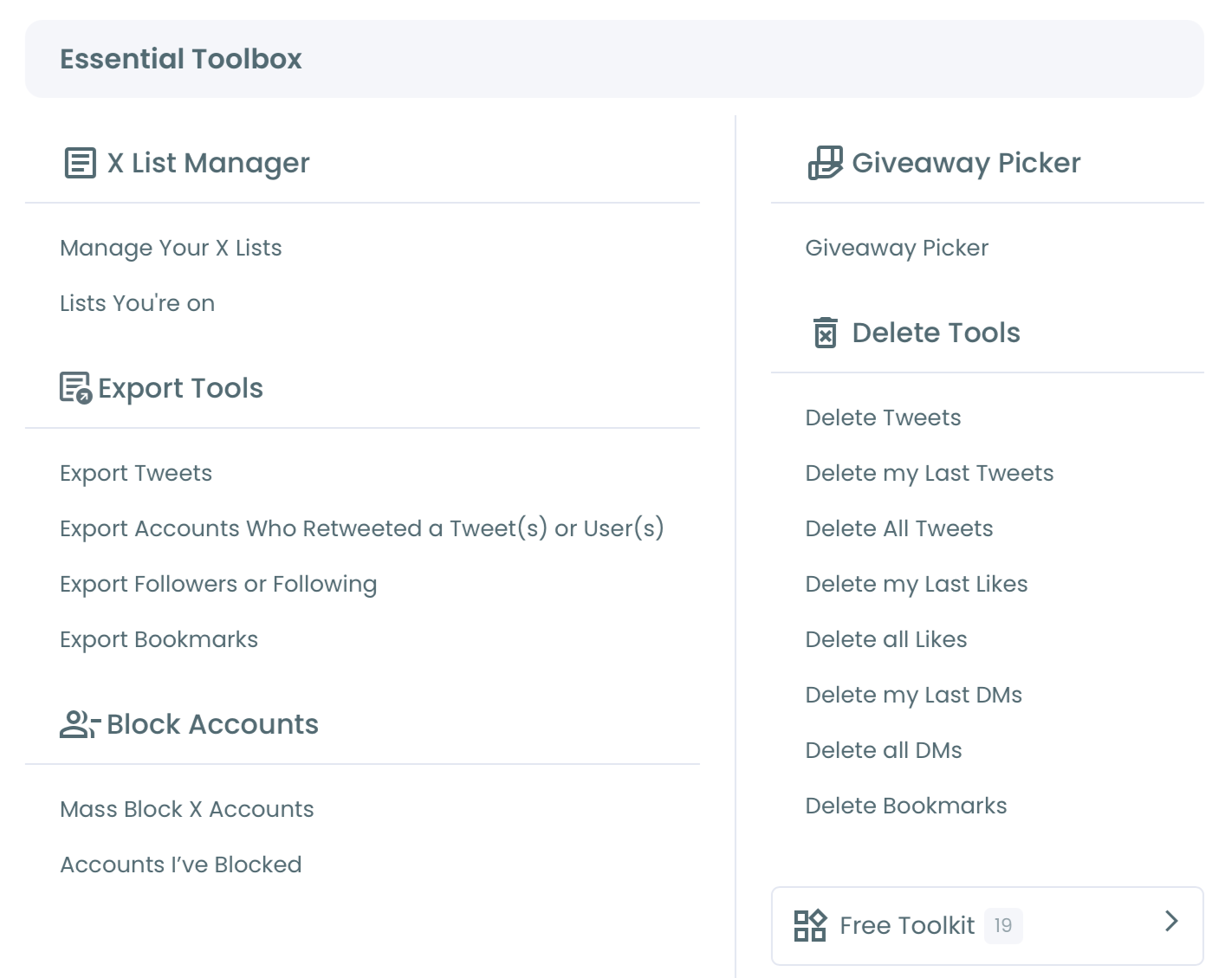
- Open the Delete Tools under the Essential Toolbox menu to reach the tweet-deletion workspace.
- Upload the tweet.js file from your X archive so the tool can process posts older than the recent 3,200-tweet API window.
Filter for weak posts and confirm the delete
- Apply the like-count and repost-count filters to isolate posts below the threshold you set, and add any keeper you spot to the Protect List.
- Check the Approve & Delete count, then run the deletion to permanently clear the filtered posts.
That sequence protects you because nothing irreversible happens until the final count is on screen. The login unlocks compliant access, the archive gives the tool your full history, the filters target only weak posts, and the Protect List catches exceptions, so you remove underperforming tweets with confidence rather than guesswork.
Quick recap:
- Log in and authorize with official OAuth.
- Open Delete Tools in Essential Toolbox.
- Upload your tweet.js archive.
- Filter by like and repost count, protecting keepers.
- Review the count and confirm.
Short demo: mass deleting weak tweets in one run without deleting your account.
Common Missteps That Cost You Good Posts
The biggest error is trusting a single number. A tweet can look dead because its impression data never loaded, not because nobody engaged.
When you cannot tell, it is worth checking why your tweet analytics might not be showing before you flag the post as a failure. The second error is treating age as guilt.
Old does not mean bad. Plenty of accounts get the most value from resurfacing strong older posts, and if you would rather target by time than by performance, learning to delete old tweets by year keeps the cleanup precise.
When you do want a performance-based sweep across methods, the roundup of the best methods to delete tweets shows where engagement filtering fits among the options. If your goal is broader than engagement alone, the same Twitter post analytics dashboard shows which posts are worth reworking instead of removing.
For themed clutter the engagement filter would miss, the delete tweets by keyword option catches posts on topics you have moved on from.
What to Do Next
Run the cleanup with a checklist so nothing slips.
- Export or download your archive first, since deletion is permanent.
- Sort candidates into delete, keep, and undecided.
- Move every keeper and every undecided post to the Protect List.
- Set the like and repost filters to your account's real "low" threshold.
- Review the Approve & Delete count before you confirm.
Do that and the answer to "should I delete low engagement tweets on X Twitter" becomes a controlled action rather than a gamble. You lift your average and keep the posts that quietly earn their spot.
→ Start clearing weak tweets now
What People Ask Before Deleting Tweets
Do I need my X archive to delete low engagement tweets?
For your full history, yes. The archive lets the tool reach posts beyond the recent 3,200-tweet API window, so older weak tweets are included rather than left behind.
Can I keep some low engagement tweets while deleting the rest?
Yes. Add any post you want to protect to the Protect List, and the deletion skips those tweets even when they fall under your engagement threshold.
Will a cleanup hurt my reach in the short term?
No. Removing zero-reaction posts raises your average engagement, which is a healthier signal for the algorithm than a large but flat posting history.
Is bulk deleting tweets safe for my account?
Yes. Circleboom is a verified X Enterprise developer, so every bulk deletion runs through official API access with no scraping and no risk of policy violations.
What threshold counts as low engagement?
It depends on your typical numbers. Check your own analytics first, then set the like and repost filters just below your normal range so you catch genuine underperformers, not average posts.
%3F)