How do you pick a Twitter giveaway winner that no one in your replies can call rigged? The pick itself is the easy part. Fairness is won or lost in the pool the pick draws from.
A fair tweet draw comes down to three moves.Pull the complete list of everyone who actually entered, not the partial preview X shows.Filter out fake, spam, and ineligible accounts before a single name is chosen.Let software draw the winner at random, with the parameters saved so anyone can recheck them.
Circleboom collects every eligible participant from your giveaway tweet on X and draws winners at random through official X API access. → Start with a fair tweet draw.
Why the winner you scroll to by hand is never provably fair
Most giveaway disputes do not start with the winner. They start with the list. When you scroll a tweet's likes or reposts to find a name, you are working from a preview, not a record. X shows a partial, unordered slice of who engaged, and that slice shifts each time the page refreshes.
So even an honest, eyes-closed pick has a hole in it. You cannot prove the pool was complete, you cannot prove ineligible accounts were removed, and you cannot show the exact method you used. Your audience is left to take your word for it, which is the one thing a giveaway is supposed to remove.
A real tweet draw fixes the record first. It retrieves the full engagement dataset for your tweet, applies your entry rules to every account, and only then selects. The difference is not speed. It is that the result can be checked by someone who does not trust you yet.
That gap between "I picked randomly" and "here is proof I picked randomly" is where credibility lives. X's own guidelines for running promotions push in the same direction, ruling out things like multiple-account entries and duplicate-post spam that a hand count quietly lets through.
What actually makes a tweet draw fair
Fairness in a draw is not a vibe. It breaks into three checkable properties, and a manual pick fails at least two of them.
Completeness. Every eligible entrant had a real chance to win. If your source list was a scrolled preview, some entrants never made it into the hat, so the odds were wrong before you started. Pulling the full participant set is the only way completeness holds.
Eligibility. The winner met the rules you announced. If you asked people to repost and follow, the winner should have done both. Checking combined conditions by hand across hundreds of entries is where mistakes and favoritism both hide.
Reproducibility. Someone else, given the same list and the same rules, would reach the same eligible pool. A documented process (participant count, filters applied, number of winners and substitutes) turns a private decision into a public, repeatable one.
Circleboom builds all three into one workflow on X. Because it operates as an official X Enterprise Developer, it reads the full participant list through sanctioned API access rather than scraping or screenshots. The pool you draw from is the real one.
Before you run anything, it helps to see how to view a full list of reposts from a tweet. That is exactly the completeness gap the native interface leaves open.
The step most guides skip: cleaning the pool before the draw
Here is the move that separates a defensible giveaway from an awkward one. You filter the pool before the draw, not after.
Any giveaway of reasonable size pulls in bot and spam accounts that liked or reposted with no intent to engage. Draw from an unfiltered set and there is a real chance the random winner is one of them. Handing a prize to a spam account, then quietly re-rolling, is worse for trust than no giveaway at all.
If that bot layer is thick on your own account, how to remove bot, fake, and inactive followers clears it before it can skew a draw.
Screening ahead of the pick removes that risk cleanly. It also means the odds belong to your genuine audience, which is the group the campaign was for. If you are unsure how thick the bot layer runs, check how to tell if someone's followers are fake or real. It gives you a feel for the ratio before you launch.
A draw is only as fair as the pool is clean.
How to run a tweet draw on X, step by step
The flow below moves from connecting your account to a saved winner card, in order.
Connect your account and open the picker
- Log in to Circleboom Twitter and connect your X account with official OAuth.
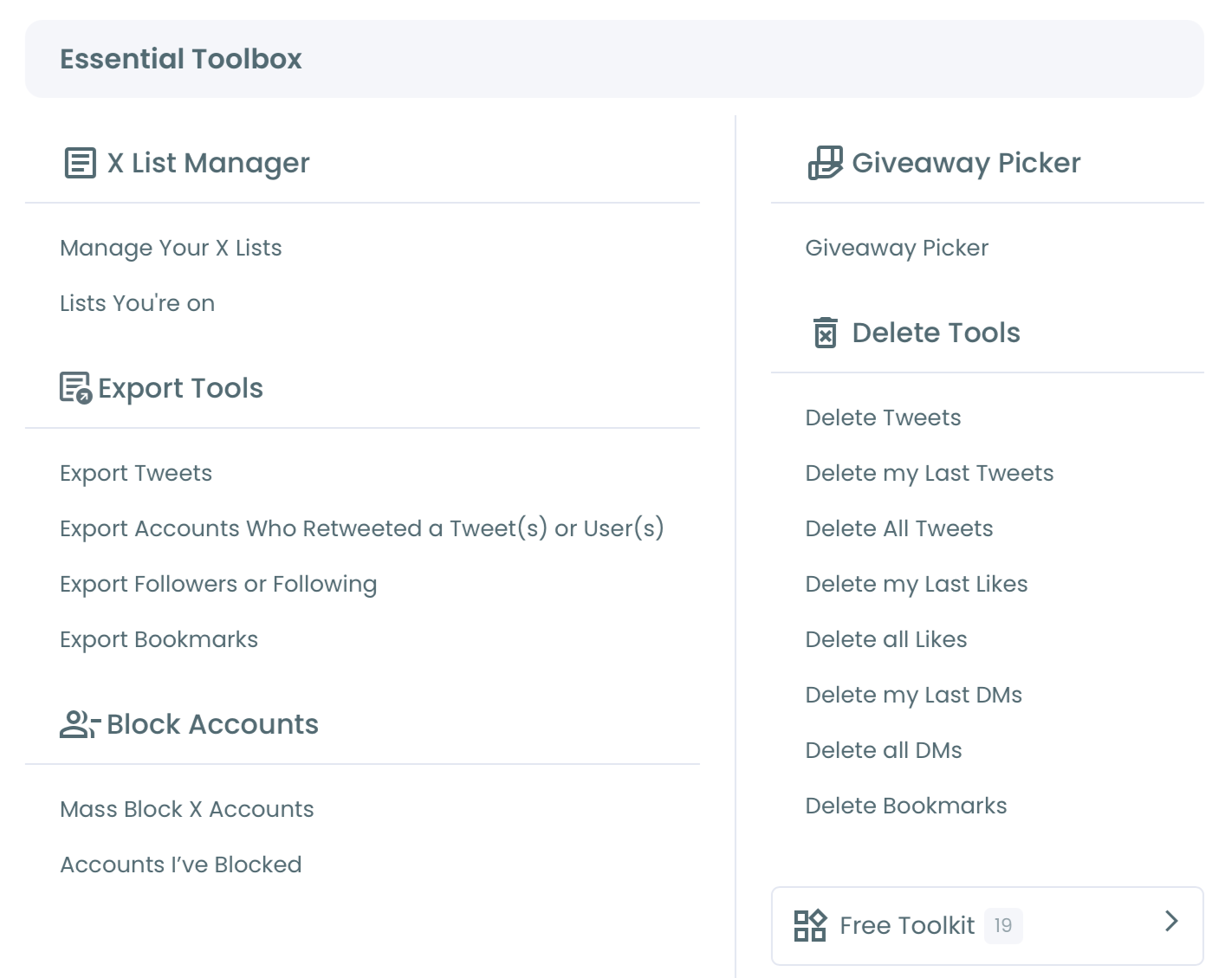
- Open the Giveaway Picker inside the Essential Toolbox menu.
Define who counts as an entrant
- Paste your giveaway tweet URL and confirm the preview shows the right post and its repost, reply, and like counts.
- Set your participation conditions (reposted, replied, liked, or tag-a-friend) and pick a match type, where "All conditions" demands every rule and "Any conditions" accepts one.
Clean the pool, then draw
- Apply account and profile filters to hide fake, spam, egghead, inactive, or out-of-scope accounts, so only valid entrants reach the hat.
- Draw the winners by setting the number of winners and substitutes, then confirming the random selection.
That order matters because each step protects the next: the login earns sanctioned data access, the conditions define eligibility, and the filter cleans the pool before any name is drawn, so the result holds up when you post it. To pick your giveaway winner this way is to end the argument before it starts.
See it live: how the eligible-participant pool is built and the random winner card is generated in one pass.
The output is proof, not just a name
The end of the workflow is not a name in your notes. It is a branded winner card showing the selected accounts, alongside the participation conditions and filters that produced them. You download it, or share it straight to X.
That card is the reason to run a structured draw at all. It converts a private decision into public evidence: here is who won, here is how many qualified, here is exactly what I screened out. Participants who see it are more likely to enter the next round, which is where the real return on giveaways shows up.
Sharing the card back to X does a second job. It turns the result into engagement content, since entrants reply to confirm their own participation and to congratulate the winner. A transparent draw is one of the few moments where proving your process and generating replies are the same action, so the credibility work pays for itself in reach.
If you want a second layer of documentation, you can also export the retweeters as a CSV before drawing. That gives you a timestamped record of the eligible pool, frozen at the moment of selection, which is the single most useful thing to have if a result is ever questioned weeks later.
A quick pass with the Twitter Bot Checker after the campaign tells you something else. It shows whether the follow-to-enter rule brought real accounts or just entry-hunters who unfollow the day after the prize goes out. That answer decides whether the giveaway grew your audience or only your follower number.
Substitutes and the saved record are the safety net
Two features of a structured draw do quiet work that a manual pick cannot copy, and both matter most when something goes wrong.
The first is substitutes. When you draw, you set a number of winners and a number of backups in the same pass, so the substitutes come from the same verified pool at the same moment. If a primary winner never claims the prize or turns out to be ineligible, you move to a backup that was already part of the recorded selection, rather than staging a fresh, suspicious-looking second draw.
The second is the saved parameter set. The eligible count, the exact conditions, and the filters applied are stored with the result. That record is what lets you answer a challenge with a screenshot instead of an argument, and it is why a documented draw settles disputes that a private one only inflames.
The proof you keep is worth more than the pick you make.
A quick fairness check before you announce
Before you post the winner, a short review catches the mistakes that cause disputes. Each item maps to one of the fairness properties above, so the list is not busywork.
- Confirm the participant count looks right for the tweet's engagement, not suspiciously small.
- Check that the eligibility conditions on the card match what you announced.
- Verify the quality filters removed fake and inactive accounts before the draw ran.
- Make sure substitutes were drawn in the same pass, from the same pool.
None of this takes more than a minute, and it is the difference between posting a result and posting a proof. A winner card that survives that check will survive your replies, because every question a skeptic could raise has already been answered on the image itself.
Manual scroll versus a structured draw
The contrast is not about effort, since a small giveaway can be scrolled in a few minutes. It is about what each method can prove afterward.
A manual scroll gives you a name and nothing else. You cannot show the full pool, you cannot show the eligibility check, and you cannot reproduce the result, so every part of the fairness rests on your word. A structured draw gives you a name plus the pool, the rules, the filters, and a random selection anyone can re-examine.
Giveaways are one of the few tactics that lift both reach and follower count at once, but only when the audience believes the result. If your numbers already look thin, it is worth knowing what a good engagement rate on X actually is before you spend a prize chasing them.
And if this is your first campaign, how to run a successful Twitter contest covers the promotion side that sits around the draw. That means framing the entry rules and timing the announcement so the winner post lands while the audience is still watching.
The bottom line
A fair tweet draw is not one lucky click. It is a complete pool, a clean eligible set, a random pick, and a saved record that a stranger could audit. The manual scroll fails on the first and last of those, which is why disputes keep landing in the replies.
Run the draw through a documented process and the winner announcement becomes proof instead of a claim. Your next campaign gets easier to promote because the last one was visibly fair.
→ Open your next tweet draw
Common questions about tweet draws
How does a tweet draw actually choose the winner?
It selects at random from the pool of accounts that met your announced conditions, after fake and ineligible accounts have been filtered out. No account is weighted or hand-picked, and the number of winners and substitutes is set before the draw runs.
Can I require people to both follow and repost to enter?
Yes. You set combined conditions and choose "All conditions" so an entrant must meet every rule to qualify. The tool checks each account against those rules automatically, which is the part that is unreliable when done by hand.
What happens if the random winner turns out to be a bot?
That is exactly what the filter step prevents. You screen out fake, spam, inactive, and egghead accounts before the draw, so the eligible pool only contains real participants. Cleaning the pool first is safer than re-rolling a bad result in public.
Is a tweet draw safe to run on my X account?
Yes. Participant data is read through official, sanctioned API access, so nothing is scraped and your account stays within platform rules. You can run a compliant tweet draw as often as your campaigns need.