
On a brand-new or freshly restarted account, your first tweet should say something useful about a topic your audience already cares about, not announce that you have arrived. Day one gives you zero followers and zero social proof, so a plain "Hello X, new here" tweets into a room with nobody in it.
The reliable move is to react to a conversation your niche is already having, and lead with a reason for a stranger to care.
That single choice is what to tweet on Twitter first, and it decides whether your account opens with a reply or with silence.
What should your very first tweet be when nobody follows you yet?
Lead with one useful idea, opinion, or question tied to your niche, not an introduction. Circleboom surfaces high-engagement posts in your topic areas on X through official, sanctioned API access, so you can react to proven angles instead of guessing on your one opening post.
→ what to tweet on Twitter first
Most day-one guides hand you a menu of tweet types and leave the hard part unsolved. On a fresh account you have no analytics, no follower feedback, and no history to tell you which angle will land. You are guessing at topic, format, and timing all at once, on the post that sets the account's first impression.
That is where a day-one post quietly fails. Not because the idea was bad, but because nothing told you whether it would resonate before you hit publish.
Why the "Introduce Yourself" First Tweet Falls Flat on Day One
An introduction tweet points at you, and on day one you are the one thing a stranger has no reason to care about yet. Nobody follows an account because it announced its own arrival.
People follow because a post taught them something, made them laugh, or said out loud what they were already thinking.
There is also a mechanical reason this matters more on the first post than on any later one. X's timeline leans on early engagement signals to decide how far to push new content. A first tweet that earns a few replies and reposts tells the system the account is worth showing, and that early lift carries into your next several posts. A first tweet that flatlines gives the algorithm nothing.
If you are restarting a dormant account instead of creating a new one, the same logic holds, plus a question about the account itself. Some people wonder whether a stale account is even salvageable. This look at whether you can reset your Twitter algorithm or need a new account walks through when a fresh start actually helps.
Real Day-One Tweet Ideas That Earn a First Reply
A strong first tweet on a zero-follower account does one job: it gives a stranger a reason to engage before they know who you are. Here are shapes that do that, each with an example you can adapt to your niche.
- The value drop. Teach one specific thing in a single line. *"New accounts obsess over follower count. The number that actually predicts growth is replies-per-post. Chase that first."*
- The hot take. State an opinion your niche argues about. *"Posting 10 times a day on a new X account hurts you. One sharp post that earns replies beats ten that get ignored."*
- The build-in-public open. Share what you are making and invite people along. *"Day 1 of documenting how I grow this account from zero. I'll post what works, what flops, and the exact numbers."*
- The question tweet. Ask something your audience has a real opinion about. *"What's the first account that made you rethink how you use X? Building a list from the replies."*
- The proof-of-value line. Frame what you'll deliver around the reader. *"This account is going to be tactics for growing on X without buying followers or gaming the feed. Starting now."*
The build-in-public angle is the one most day-one lists skip, and it is quietly the strongest for a new account. It turns a single first tweet into an ongoing story a reader can subscribe to, which is exactly what converts a one-time impression into a follow.
Notice none of these open with "hi, I'm new here." They open with something the reader can use, react to, or argue with.
How to Find Your First Tweet Idea with Circleboom
To decide what to tweet on Twitter first without guessing, look at what is already performing in your topic area, then react to a proven angle in your own voice. Circleboom's Inspiration feed pulls trending posts in your niche on X, each tagged with real engagement metrics, and gives you AI tools to rewrite, reply to, or quote any of them from the same screen. The flow below runs that loop end to end in four short moves.
See it live: how a trending post in your niche becomes a rewritten first tweet in a couple of clicks.
Connect your new X account to Circleboom
Log in to Circleboom Twitter and connect your X account with official OAuth. A day-old account connects the same way an established one does, so nothing about being new blocks you here.
Open the X Post Planner and set your topics
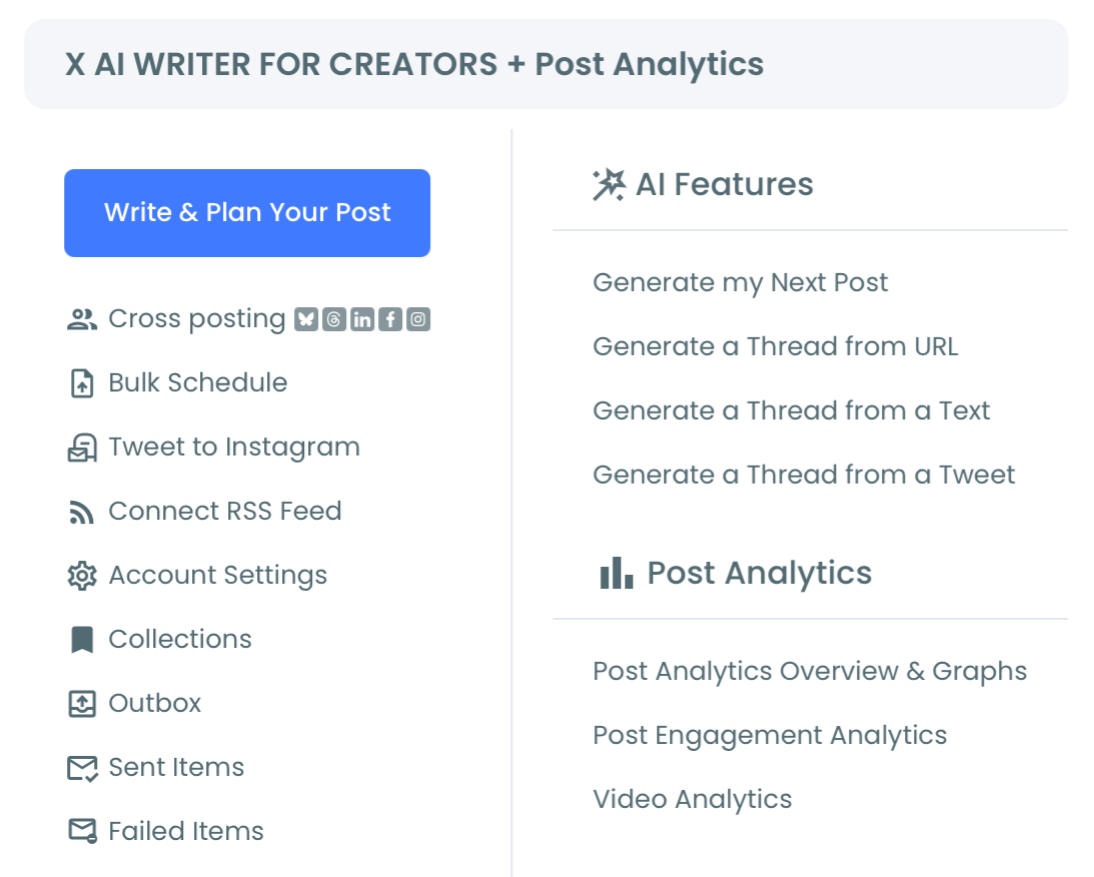
Go to the X Post Planner menu and confirm your content interest topics so the Inspiration feed reflects your niche instead of platform-wide noise.
Sort the Inspiration feed by engagement
Read each card's metrics, views, replies, reposts, likes, and bookmarks, then shortlist the posts genuinely landing with people right now. On a new account with no data of your own, this borrowed evidence is your best selection signal.
React in your own voice and schedule
Hover a card and choose Rewrite for an original post on the same topic, AI Reply to join a live thread, or AI Quote to add commentary. Refine the draft with "Describe and improve tweet," fold in your own specific angle, then schedule it as your first tweet.
That order works because it front-loads evidence before creativity: you pick what to say based on what your audience already responds to, then shape it into your voice, then publish. Skip the evidence step and you are back to guessing on the post that matters most. Circleboom pulls every one of those trending posts as an official X Enterprise Developer, so day-one research runs through approved, policy-compliant access instead of scraping.
At a glance: connect, set topics, sort by engagement, rewrite, schedule. The feed handles the "what's working" research so your effort goes into the angle.
Unlike opening a blank composer and hoping something sticks, your first tweet on X arrives pre-validated by real engagement. That is a far better bet on the one post that sets your account's tone.
If you would rather generate a post from scratch than react to one, the X Post Planner also carries the AI writing tools that turn a rough idea into a scheduled post.
What You Gain by Getting the First Tweet Right
A first tweet grounded in what works does more than fill an empty timeline. It hands every new visitor a clean signal of what the account is about, so the people who land on your profile in the opening week understand why to follow.
It also gives the timeline an early engagement signal to build on, which counts most before you have followers priming your reach.
The compounding benefit is momentum. When your opening post reacts to a live conversation, it can pull replies from accounts already in that thread, and each reply is a door to a new audience. A new account that reacts to trending posts consistently builds faster than one posting cold takes into an empty feed, because a reaction meets an audience that is already paying attention.
Getting the first one right also makes the second one easier. Once you see which angle earned engagement, you have a template for your next post, and the blank-page problem stops coming back. If you want your early posts to keep pulling real people rather than bots, it helps to know that creating a new X account does not automatically eliminate bots. Audience quality is worth watching from day one.
There is one setup detail worth handling before your first tweet, too. A clear, on-topic handle helps a stranger place you in three seconds, and a Twitter username generator surfaces available names that fit your niche.
If you want more angles to pick from, this Twitter username generator for available handles walks through the trade-offs. An X profile summary generator can draft a bio that reads like you.
The Bottom Line
You do not need followers, a finished brand, or a clever hook to post a first tweet worth reading. You need to lead with value instead of an introduction, and let what already works in your niche pick the angle for you.
That is the permission most new accounts are waiting for. The scariest post becomes the easiest one the moment you stop trying to be original and start reacting to a conversation your audience is already having. When you're ready, start your day-one post with evidence instead of a guess.
→ Plan what to tweet on Twitter first with Circleboom
Common Questions About Your First Tweet
What should my very first tweet say if I have zero followers?
Lead with one useful idea, a clear opinion, or a question your niche cares about, never an introduction. On a follower-free account, a value-first post gives a stranger a reason to engage, and that early engagement is what the timeline uses to decide whether to show your next tweet.
Is a restarted account's comeback tweet different from a brand-new first tweet?
Not in strategy. Treat the comeback post as a first tweet: lead with value, react to a live conversation, and don't rely on old followers to carry it. If the account has been dormant a long time, decide first whether a reset or a fresh start makes more sense, then post your comeback like day one.
How do I know which day-one idea will actually land?
Check what is already performing in your topic area before you post. Circleboom's Inspiration feed shows trending posts in your niche on X ranked by real engagement, so you can pick an angle that has already earned views and replies instead of guessing blind.
Can I reuse a trending tweet as my own first tweet?
Use it as a starting point, not a copy. Rewrite it in your voice and add your own perspective or example so the post is genuinely yours. A near-duplicate reads as low-effort, while a fresh take on a proven angle is exactly what a strong first tweet does.