

You find out who ditched you on Twitter by comparing your current follower list against a stored snapshot of an earlier one, because X publishes no unfollow event and sends no notification when somebody leaves.
Circleboom keeps those snapshots and hands the departures back as a named, dated list you can sort.
Circleboom tracks your Twitter follower list over time and returns every account that unfollowed you as a sortable row, carrying the join date, the follower count, the follow ratio and an activity tier. Those four columns are what separate a platform sweep from a real audience decision.
→ who ditched me on Twitter
Pulling the list takes about two minutes. Weighting it is the part almost nobody does.
X tells you who arrived and stays silent about who left
X is asymmetric about follower events by design, and the asymmetry runs in one direction only.
A new follower gets an in-app notification, a badge on the notifications tab and, if you leave the setting on, an email.
A departure gets nothing at all.
X's following and followers FAQ documents the arrival side in detail and offers no equivalent for the other direction, because there is no equivalent to document.
So the only trace a departure leaves on your account is the count moving down by one.
That number carries no name, no date and no profile behind it.
A week where forty low-quality accounts drop off looks identical to a week where four of your most-read followers walk away, and the second week is the one that matters.
The gap is old enough that Circleboom has covered how to see who unfollowed you on Twitter more than once, and the platform still has not closed it.
You can find out who ditched you on Twitter in the time it takes to read this section.
The list on its own is not the answer either. It is the raw material for one.
Reading the account totals alongside it helps here too, since Twitter follower stats put a single week's movement next to the months around it.
How to find out who ditched me on Twitter (step by step)
To find out who ditched you on Twitter, open Circleboom's unfollower view, set the time period selector to the window you care about, then sort the resulting rows by follower count before taking any action.
The steps below run that loop end to end, and the second phase is where the useful judgment happens.
See it in sequence: the menu path from login to a dated unfollower list, with the time period selector doing the work.
https://www.youtube.com/watch?v=FgrlzCm62FY
The whole flow is six steps and splits cleanly into pulling the data and reading it.
Open the unfollower list and set your window
- Log in to Circleboom Twitter and connect your X account through official OAuth.

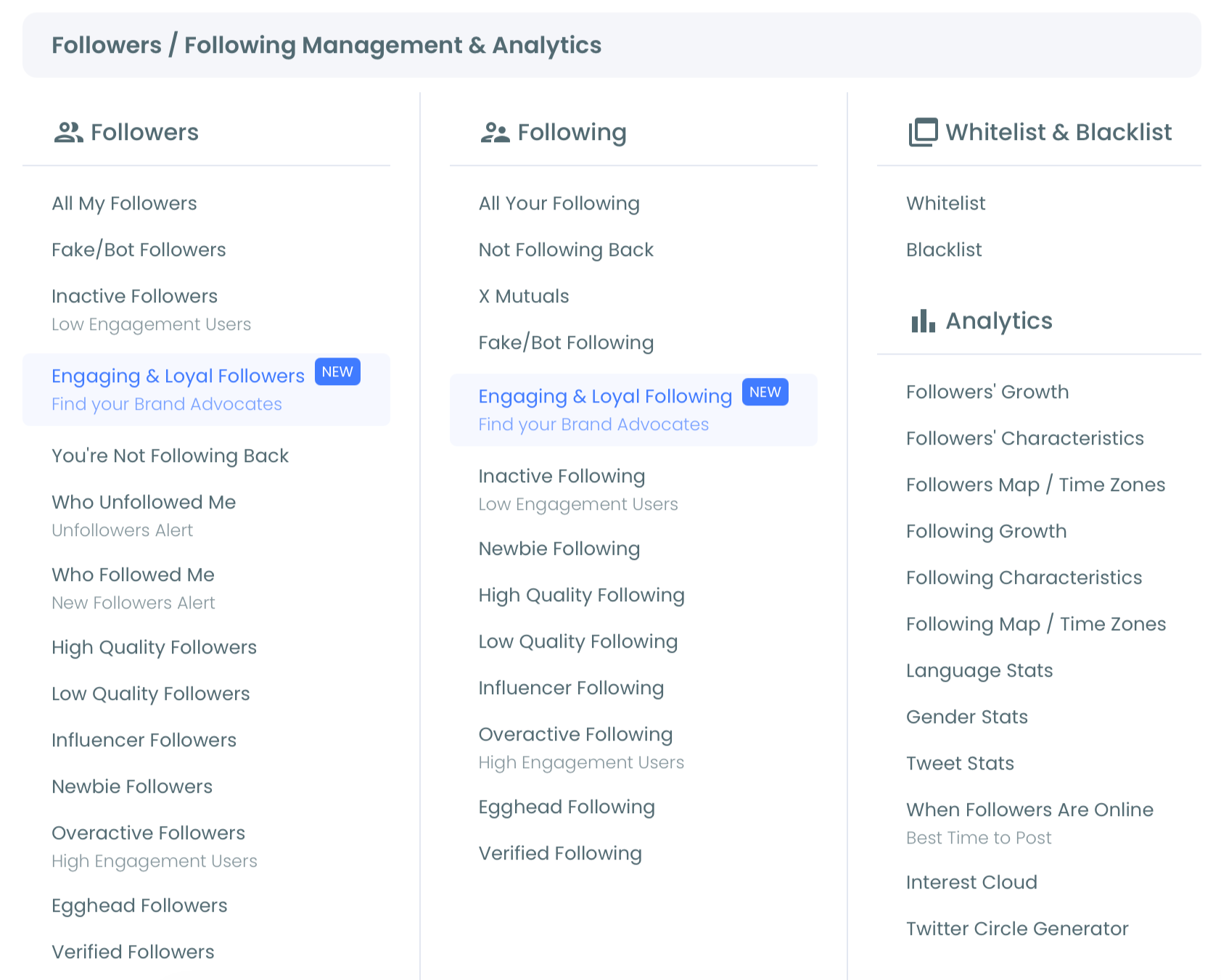
- Open the Follower and Following management menu, then choose Who Unfollowed Me from the audience insights group.
- Set the time period selector sitting above the table. It opens on the last single day, and the range runs through two days, three days, five days, a week, two weeks, four weeks, three months, six months and a full year.
Weigh the rows before you act on any of them
- Sort by the Followers column so the largest accounts that left sit at the top of the table rather than wherever the default order put them.
- Set a Follower Count minimum in Filter Options to cut the long tail of tiny accounts and keep only departures above the size you actually care about.
- Export the filtered segment as CSV before you unfollow anyone, because the export is the only copy that lives outside the dashboard once you start changing your following list.
That order holds up because each step narrows the question the next one has to answer.
The window decides which departures are even in scope, and the sort tells you which of them carried reach.
The Follower Count minimum then does the heaviest narrowing of the four, cutting away the long tail that was never going to change a decision. The export means you can still reconstruct the segment after you have acted on it.
Run those steps out of order and you end up making decisions about accounts you never looked at.
At a glance: set the window before you read the rows, and export before you act on them.
Circleboom is a verified Enterprise developer on X's directory. The weighting method below is only as good as the follower counts it reads, and that access is why the Followers column on a departing row is a real number rather than a partial one.
You can open your Twitter unfollower list on any window in that range without changing anything about your account.
Not every unfollow costs the same
Headcount is the wrong unit for follower loss, and it is the only unit X gives you.
An unfollow does not just remove one reader. It removes that account's own audience from the pool of people who could have seen your posts through a repost, a quote or a reply.
The row's Followers column is a rough measure of the second-degree reach that walked out with it.
Work it through on a round number.
If you have 12,000 followers and you lose 40 in a week, headcount says you lost about a third of one percent of your audience, which is nothing.
Now split that same 40 two ways.
Forty accounts with about 200 followers each represent roughly 8,000 people of onward exposure. One account with 40,000 followers leaving on its own represents five times that, and it shows up in the count as two digits either way.
Same number in the count, two completely different weeks, and only the sorted list can tell them apart.
This is why the Followers column is worth more of your attention than the raw total. Circleboom's guidance on how to rank your Twitter followers by influence applies to departures just as cleanly as it does to arrivals.
The same logic runs in reverse when you are looking at who stayed, which is what sorting Twitter followers by popularity is for. I run both views in the same sitting, because the question is never really "how many left" but "did the composition of my audience change."
A big follower count is a reach estimate, not a verdict
One caveat on the weighting: a large follower count is not automatically a large amount of real reach.
An account with 40,000 followers and a follow ratio near 1.0 is a different animal from one with 40,000 followers and 39,000 followings.
Read the ratio column next to the follower column rather than instead of it.
When a single departure looks big enough to change your plans, check Twitter follower quality before you decide it was.
Which filters narrow an unfollower list fastest
The filter panel on the unfollower view is the same one that runs across every follower and following screen, which means the weighting method above becomes a saved habit rather than a manual scan.
Four controls do most of the work on a churn list:
- Follower Count minimum, which removes the long tail and leaves only departures big enough to matter.
- Follow Ratio range, which separates genuine accounts from ratio-farmers holding an inflated total.
- Join Date range, which isolates accounts created inside a narrow window.
- Engagement, which tells you whether the account was ever active in your replies to begin with.
An Active Filters bar sits at the top of the listing whenever any of these are on, showing each applied filter as a removable tag.
That bar is worth a glance before every bulk action, because the single most common mistake on this screen is acting on a filtered segment while believing you are acting on the full list.
Two more controls help on wide accounts.
The inline search bar above the table looks up a specific name or handle without opening the panel at all.
The Find in Bio and Name field inside the panel goes further and searches bios too, which is how you check whether a whole cluster of departures shared a topic or an industry.
Is it worth unfollowing them back?
Usually not, and the reason is that a one-sided follow costs you almost nothing.
The account still posts things you either want to read or do not. Whether they read you back has no bearing on that, and treating symmetry as hygiene turns your following list into a scoreboard instead of a feed.
Where reciprocation does matter is when you are deliberately managing ratio on a growing account, or when your following list has drifted past the point where the timeline is useful.
In that case the question is really about pruning, and the accounts worth keeping are the ones described in power followers, not the ones who happen to follow back.
If you do decide to unfollow in bulk, Circleboom paces the operation at 50 unfollows every 15 minutes up to roughly 800 per day, and picks up again the following day when the daily ceiling is reached.
The pacing is the point. It keeps a large cleanup inside X's own limits instead of tripping them, and it means a big list resolves over a couple of days rather than in one burst that draws attention to your account.
There is one more reason to slow down here. Because the finest resolution on this screen is a single day and there is no per-row timestamp, an unfollow that happened this morning and one that happened last night look identical in a one-day window.
Waiting a cycle costs you nothing and buys you a cleaner read.
What the list actually changes
Finding out who ditched you on Twitter converts a number with no explanation into a set of rows you can sort, filter and export.
The window controls what is in scope, the follower count tells you what the departure cost, and the ratio column keeps you from overreacting to a big number attached to a hollow account.
The habit worth building is small: read the list weighted, not counted.
Forty departures is not a fact about your content until you know how much reach those forty accounts actually carried, and that is a two-click question once the data is in front of you.
Sort, filter, then judge. Everything else on the screen is there to support that order.
→ See who ditched me on Twitter
Common questions about Twitter unfollowers
Does the CSV export cover the whole list or only what is filtered?
Only what is filtered. The export writes the segment currently on screen, so a Follower Count minimum or a narrow window carries straight through into the file.
Clear the Active Filters bar first if you want the complete set of departures rather than the weighted slice you were reading.
What happens if an account leaves and comes back inside the same week?
It depends on where the daily sync falls. Circleboom refreshes follower data from the X API once a day, so a departure and a return that both land between two syncs never reach the table at all.
One that survives a sync boundary appears as a departure and then simply stops appearing, which is another reason a one-day window over-reports and a weekly one reads truer.
Why does an account show up as an unfollower when it still follows me?
Occasional discrepancies in the X API can list an account as a departure when it has not actually left, and these usually correct themselves on the next day's fetch.
Circleboom refreshes follower data from the API once a day, which is also why an unfollow from an hour ago will not appear until the next sync. Related platform-side movement is covered in does Twitter randomly remove followers.
Exporting before acting on a same-day list is the safeguard against that, since the file preserves the segment even when a row turns out to be a ghost.
Can I get the list without opening the dashboard every day?
Yes. The Unfollowers Alert sends scheduled email summaries of new departures, so the dashboard becomes something you open when a summary looks unusual rather than a daily habit.
You can also export Twitter accounts as CSV if you would rather keep the record in a spreadsheet.






%3F)