A follower count that climbs while your replies stay flat is not a mystery. It is a bot wave, and it repeats because most cleanup habits touch only one half of the problem. You can empty the list every month and still watch it refill, because clearing the list and closing the door are two different actions on X.
Bots follow you because your account is an input to their loop, not because of something you posted. Circleboom, an official X Enterprise Developer company, scores each of your followers on activity, follow ratio, account age, profile completeness, and engagement, then groups the suspicious ones into a single reviewable list on X.
→ why do bots keep following me on Twitter
The step almost everyone skips is the one that stops the next wave rather than the current one.
The follower list is rarely the only place you notice it. The same account clusters show up as likes on posts you wrote months ago. Plenty of people search for why their posts are being liked by adult spam bot accounts long before they ever open their follower list.
Likes, follows, and DMs are three outputs of one automated loop.
That loop is worth naming plainly, because it explains the recurrence better than anything you could change about your posting. So pull the bot signals on your own follower list before you decide the problem is your content.
How to find and stop the bots following you on Twitter
Watch it run: the pass that separates a fresh bot wave from the followers who were already there.
https://www.youtube.com/watch?v=AG84Xvajhj4
Eight steps, and the order is the point.
Open the flagged list before the wave ages into your baseline
- Log in to Circleboom using the X account whose follower list keeps refilling.

- Click through to Follower / Following Management and Analytics. Circleboom groups every audience-quality view under it.
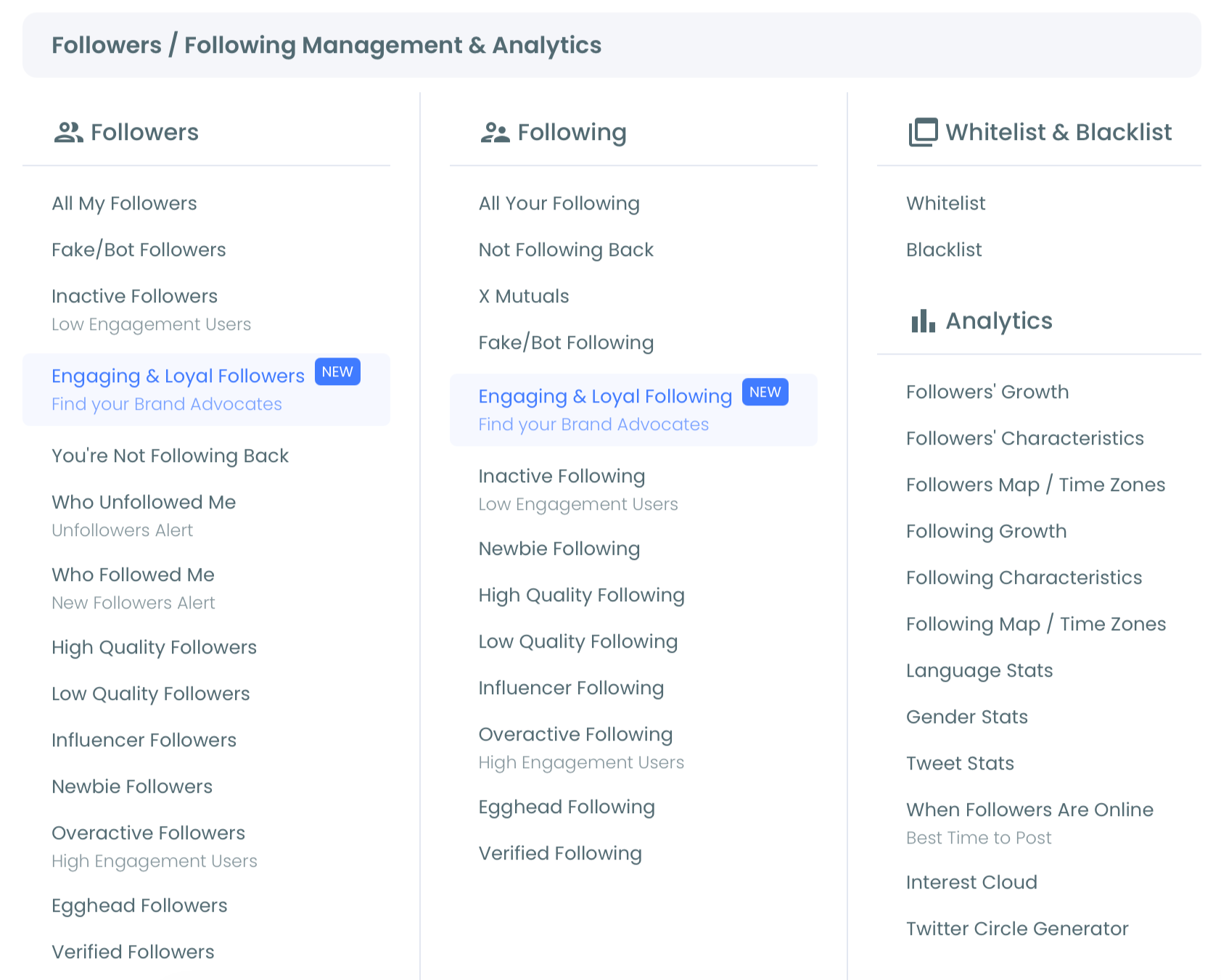
- Open Fake/Bot Followers under Followers. Circleboom retrieves your full follower list through the official X API and isolates the accounts that cross its suspicion threshold on several signals at once.
Rank the suspicion instead of trusting the label
- Sort by Follow Ratio ascending. The accounts with the most lopsided structure move to the top, and a ratio under 0.1 is one of the strongest indicators of mass-follow behavior in the whole table.
- Open Filter Options and stack the signals that agree with each other:
- Follower Quality set to Fake/Spam, plus Eggheads for accounts with no profile photo.
- Tweet Count with a low maximum, which catches accounts that follow but never post.
- Join Date narrowed to the weeks around your spike.
- Follow Ratio with a hard maximum instead of a mental estimate.
- Engagement set to the inactive tier, where most automated accounts land.
- Whitelist anyone you recognize. A whitelist label excludes that account from every bulk action across the platform and stays applied until you remove it, so this is the cheapest minute you will spend in the whole process.
Pick the action that matches the behavior
- Export the filtered segment before you act on it. The CSV carries ProfileId, Username, Bio, CreatedAt, the follower and following counts, and the IsFake, IsEgghead, IsInactive and IsOveractive flags. You keep a record of exactly who was in the segment. Exports draw on a token allowance, with the balance left to you printed beside the button.
- Send cleanup cases to Remove Follower and repeat offenders to Add to Mass Block List. Both bulk operations are processed by a Circleboom Chrome extension and pause automatically for one to twenty minutes when X's rate limit is reached, so leave the browser open while the queue drains.
Each step in that sequence shrinks what the following one can damage. Sorting ranks the segment, filtering trims it, whitelisting shields the accounts you would regret, and the export leaves you a way to check your own work if a filter caught someone it should not have.
Quick recap:
- Log in and open Fake/Bot Followers.
- Sort by Follow Ratio, then filter by quality, join date and tweet count.
- Whitelist known contacts.
- Export, then remove or queue for blocking.
Why do bots target some X accounts more than others?
Bot networks pick targets by behavior, not by taste. Read the loop from the outside and it runs in a fixed order, which is the part that explains the recurrence.
It begins with a new spam account that has no followers and therefore looks exactly like what it is. Its first job is to stop looking that way.
So it scrapes handles off whatever topic is moving, follows them in bulk, waits, keeps whoever reciprocated, and drops everyone who did not. Then it runs the same pass on the next topic.
Your handle enters that loop at the scraping step, and it enters again every time something you wrote travels further than usual. Nothing in the sequence inspects what you write. It reads your reach and it reads how often people here follow back, and both of those are properties of distribution rather than of content.
The same logic drives the market for buying fake followers on Twitter. That market is worth understanding even if you would never touch it, because the accounts sold in those packages come from the same supply as the ones that arrive at your profile uninvited.
A 2024 study of follow-back accounts on X found that they cluster into distinct communities. They tend to be newer profiles with elevated follower and following counts.
The detail that matters more is the one the authors admit: a classifier built specifically to catch these accounts struggled to reach high recall. Even purpose-built academic detection misses some of them. The method is in #TeamFollowBack: Detection and Analysis of Follow Back Accounts on Social Media.
X itself treats the behavior as a rules problem rather than a taste problem. Its authenticity policy prohibits mass-registering accounts that are not genuine and transparent about their source, identity and popularity, along with unauthorized automation. That is the category these accounts fall into, whatever they claim in their bio.
None of this is a judgment on your content. It is a judgment on your reachability, which is why the wave arrives again after you clean it.
That reframing is what genuinely explains why do bots keep following me on Twitter. Nothing about you changed. Your visibility did, and visibility is the input these networks buy.
What Circleboom counts as a bot signal, and what it does not
Circleboom's classification is composite, and no single signal is enough on its own. An account with a low tweet count alone is not flagged. An account with a low tweet count, a follow ratio under 0.05, no profile photo, a creation date from last month and an inactive engagement classification is, because the signals agree with each other.
The inputs are all public account data pulled through the official X API:
- Activity relative to age, so a three-year-old account with five posts scores worse than a one-month-old account with five.
- Follower-to-following imbalance, where a ratio below 0.05 is a common suspicion threshold.
- Tweet distribution, which catches both silence and burst posting.
- Account age, which is weak alone and strong in combination.
- Profile completeness, covering missing photos, missing bios and auto-generated-looking usernames.
Engagement classification sits on top of those as a sixth input, and most automated accounts land in the inactive tier. If you want the shorter version of how the scoring reads in practice, the Twitter Bot Checker walkthrough covers it.
The list is a candidate list, not a verdict. Circleboom shows likelihood, not certainty, and X publishes no bot flag that any third party could read.
A legitimate account can land in the list. A brand support handle with no posts of its own. A parody account. An international user who never uploaded a photo. A real person who stopped posting in 2019.
That gap is why the review step exists before the action step. It is also why the platform keeps a separate Twitter follower quality view alongside the bot list instead of collapsing every judgment into one score.
The practical rule that falls out of this is to judge clusters, not individuals. One suspicious account is noise, and it is also where false positives live. Twenty accounts created in the same fortnight, all with no photo, all following four thousand people and followed by nine, are a pattern you can act on with confidence.
Run the scan, then read the columns, then decide. You can open the flagged follower list for your X account and sort it without committing to a single removal.
Why removing a bot follower does not stop it from coming back
This is the piece that explains the recurrence, and it comes from X's own documentation rather than from any tool.
X's following help page states plainly that removing a follower will not prevent that account from following you again. It loses the relationship and can rebuild it whenever its script next runs.
Blocking behaves differently. X describes block as a feature that restricts specific accounts from following you, messaging you, and engaging with you. Blocking an account you currently follow makes both sides unfollow.
Two pages, removing a follower and blocking on X, describe two different outcomes that most cleanup advice treats as interchangeable.
So the ledger has two sides. Remove Follower drains the stock. Only a block touches the inflow.
Circleboom mirrors that split rather than hiding it. Remove Twitter/X Followers is the right action for accounts that are simply low quality and will not come back with intent. The Mass Block queue is the right action for the cluster that arrived together, posts the same scam link, and reappeared the last time you cleaned.
The queue is built for exactly that. Accounts added through Add to Mass Block List accumulate across sessions, so you can review your followers in segments over a week and execute the whole set once, after you have looked at it. You can mass block Twitter accounts from that reviewed queue rather than blocking one profile at a time.
Both actions run gradually on purpose. When the rate limit is reached, processing pauses and resumes on its own, which is what keeps a large operation from reading as aggressive behavior on your account.
One consequence people underestimate: the DM spam usually outlives the follower cleanup, because a removed account can still message you.
If your inbox is the part actually bothering you, another pass through the follower list will not help. Start with snoozing Twitter DM notifications and clearing out spam messages.
Worth remembering about stock and inflow
Bots keep following you because the arithmetic of removal never converges. Every wave you clear is stock, and the inflow that produced it stays open until the accounts that keep returning are blocked instead of removed.
The signals that identify them are public. The classification is a probability. The choice between the two actions belongs to you, not to the scan.
Clear the stock. Close the door on the repeat offenders. The next audit is then a five-minute check instead of a monthly chore.
→ start the bot signal scan on your X followers
Common questions about bot followers on X
Will removing bot followers get my account restricted?
No. Removing a follower is a standard X feature, and Circleboom works through bulk removals gradually via official X API access. Processing halts for a minute, or as long as twenty, whenever the quota empties. That pacing keeps a big cleanup from resembling automated aggression on your side.
Do I need a Chrome extension for this?
For bulk Remove Follower and Mass Block, yes. Both operations are processed by a Circleboom Chrome extension, and the browser has to stay open while the queue drains. The scanning, filtering, sorting, whitelisting and export steps all work without it.
Can I undo a removal if the filter caught a real follower?
Not through Circleboom, which is the reason the export step sits before the action step. The removed account can follow you again on its own, but you cannot restore the relationship from your side. Export the segment first, and whitelist anyone you recognize before you select.