

Native X shows only the month and year an account joined, and on some profiles not even that. An X (Twitter) account creation date lookup closes the gap by returning the full calendar date, right down to the day of the week.
How do you find the exact date an X (Twitter) account was created?
Run an X (Twitter) account creation date lookup with a tool that reads X's own data. Circleboom's Twitter Join Date Checker returns any public account's exact creation date, including the weekday it was registered, using official, authorized access to X's data.
→ look up any X account's creation date

What an Account Creation Date Lookup Actually Shows
An account creation date lookup returns the precise day a profile was registered on X, not the rough month-and-year stamp the platform prints under a bio. On a public profile, X displays something like "Joined June 2009." The exact date, and the weekday, stays hidden.
Circleboom surfaces that hidden detail. Enter a handle and the tool returns a single confirmation line: the exact creation date plus the day of the week. Searching a well-known account like `@elonmusk` returns "This Twitter/X account has been created at 2 June 2009, Tuesday." You can run the lookup on any public handle the same way.
That extra precision looks small on paper. In practice, the day-level date is the difference between a vague impression of account age and a hard, citable data point you can drop into a report.
There is a self-service route for your own profile. You can download your X data archive to dig up details on an account you own. That route only works for your own profile, though, and the archive takes time to arrive. A lookup answers the same question for any public account in seconds.
Why the Exact Date Beats the Year
Here is the part most creation-date guides skip: the exact date is a forensic signal, not trivia. Month-and-year hides the patterns that matter when you are judging whether an account is genuine.
Coordinated account networks rarely register one at a time. They spin up in bursts, often on the same day or across a tight window. A month-and-year display flattens that burst into a single label. A day-level lookup lets you see that six "different" accounts pushing the same narrative were all created on the same Tuesday afternoon.
When bot activity is the worry, it helps to know the difference between bots and automated accounts before you judge intent.
Account age is one of the fastest credibility checks available when you evaluate a Twitter/X profile. An account claiming years of authority that turns out to be three weeks old tells you something the follower count never will. The Twitter Join Date Checker turns that gut feeling into evidence.
Run an account creation date lookup and you get a clean number for:
- Vetting an unfamiliar account before you reply, follow, or collaborate.
- Spotting clusters of freshly created accounts around a trending topic.
- Documenting account age in research, moderation notes, or partnership due diligence.
The date is most useful next to other signals. A recently made account with an inflated following starts to explain itself once you check whether the audience is real. The same instinct that drives how to spot fake Twitter followers applies here, and a fake account check confirms it in one pass.
Who Uses an Account Creation Date Lookup, and When
The tool is simple, but the reasons people reach for it are specific. Account age answers a different question for each type of user, and it is one of the fastest ways to identify fake accounts hiding behind a polished profile.
A journalist vetting a source who suddenly appears with insider claims wants to know whether that account existed last year or last week. A brand assessing a potential collaborator treats a five-year-old account differently from one made the month the pitch arrived. A community moderator tracking a wave of near-identical replies uses creation dates to separate long-standing members from sock puppets spun up to brigade a thread.
Consider a composite case. A profile with 40,000 followers starts pushing a product to your audience. The follower count reads as authority. Run an account creation date lookup, and the profile turns out to have been created six weeks ago. Age alone does not prove fraud, but a six-week-old account with 40,000 followers is a pattern worth a second look before you engage.
Researchers lean on the exact date for a different reason: reproducibility. "Joined 2021" is not a citable fact. "Created 14 September 2021, Tuesday" is. When your notes have to hold up to scrutiny, the weekday-level date is the version that survives review.
Turning a Creation Date Into an Age Signal
The raw date is only step one. The value comes from what you do with it. A creation date becomes an age signal the moment you compare it against the account's behavior and claims.
Start with the gap between age and output. An account created three months ago with 8,000 posts is behaving in a way a human rarely sustains, and that mismatch is only visible once you know the real start date. An account created eight years ago that went silent for six of them tells a different story, one of a dormant profile suddenly reactivated.
Then read the date against the follower curve. Genuine accounts tend to gain followers gradually over their lifespan. A profile that is young but already large usually bought or botted its way there, and the creation date is what exposes how compressed that timeline really is.
Finally, weigh the weekday and clustering. One account created on a random Tuesday means little. A dozen accounts in the same conversation, all created within the same 48 hours, is a coordination signal no follower count would ever reveal.
How to Run an X (Twitter) Account Creation Date Lookup
To run an X (Twitter) account creation date lookup, connect your X account to Circleboom, open the Join Date Checker, and search the handle you want to age-check. The tool reads the creation timestamp from X's official data and returns the exact date with its weekday. The whole flow takes under a minute.
- Log in to Circleboom Twitter and connect your X account with official OAuth. Circleboom never asks for your username or password directly.
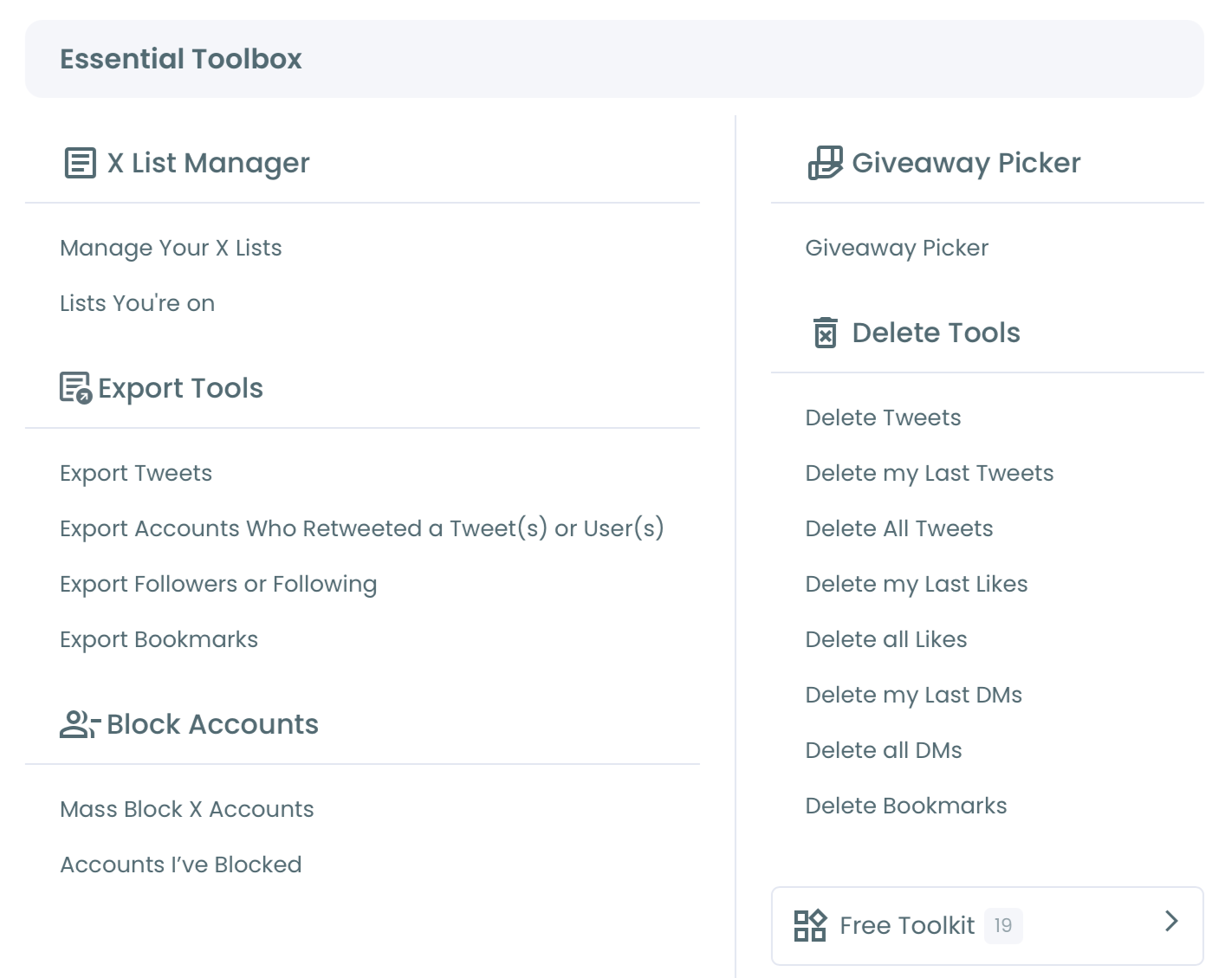
- Open the Essential Toolbox and select the Twitter Join Date Checker from the utility tools.
- Type the username into the search field. Use letters, numbers, and underscores only; the interface adds the `@` for you.
- Click Search and read the result. The confirmation line shows the exact creation date and the day of the week the account was registered.
That order holds up because the login authorizes official API access first, the search runs against real X data rather than a scraped estimate, and the single-line result is clean enough to screenshot straight into a report. Skip the connection step and no compliant tool can read the date for you.
Video walkthrough: the Twitter Join Date Checker returning an exact creation date and weekday for a single handle.
At a glance: connect, open the checker, search the handle, read the dated result. No archive download, no month-and-year guesswork.
The Bottom Line
An X (Twitter) account creation date lookup replaces a vague "Joined 2019" with a precise, dated, weekday-stamped fact you can act on. That precision is what makes join date a real credibility signal instead of a curiosity, whether you are vetting a single account or spotting a cluster of same-day registrations.
Because Circleboom works as an official X Enterprise Developer, the lookup reads authorized data, so your own account stays safe and compliant the whole time.
→ Check an X account's exact creation date
Common Questions About Account Age
Does X show the exact date an account was created?
No. A public X profile shows only the month and year under the bio, and the region setting sits behind the joined date rather than the day itself. To see the exact calendar date and weekday, you need a lookup that reads X's underlying data.
Can I check the creation date of an account that isn't mine?
Yes, as long as the account is public. The checker returns the creation date for any public Twitter/X username, which is what makes it useful for vetting accounts you don't control. For accounts that carry a checkmark, cross-referencing the creation date with Twitter verification status adds another layer of confidence.
Is join date enough to tell if an account is fake?
Not on its own. A recent creation date is a flag, not a verdict. Read it alongside follower quality and posting history; you can also search Twitter accounts by join date to compare an account against others created in the same window.
How do I confirm an account's identity beyond its age?
Pull its numeric account ID, which never changes even when the handle does. The Twitter ID Finder returns that ID in seconds, giving you a second fixed reference point alongside the creation date.



%20account%20creation%20date%20lookup%3A%20find%20any%20account's%20exact%20join%20date)

