
X says accounts may be permanently removed after prolonged inactivity, but that policy does not promise a predictable purge schedule. The important distinction is between X deciding whether an account is inactive and you deciding whether a quiet account still belongs in your following list.
Does X delete inactive accounts automatically?
X may permanently remove accounts for prolonged inactivity, but public posting silence does not prove an account is inactive under X's login-based policy. Circleboom identifies low-activity accounts you follow on X through official Enterprise APIs so you can review them yourself.
→ Does X delete inactive accounts
That short answer contains two different decisions, and separating them prevents most bad cleanup choices.
What X's inactive account policy actually says
X's inactive account policy asks people to log in at least once every 30 days to keep an account active. It also says accounts may be permanently removed because of prolonged inactivity.
The word "may" matters. The policy describes a possibility, not a published promise that every account silent for a certain number of days will disappear on a known date. X also says inactivity is determined by login behavior, which other users cannot see.
A quiet public profile and an inactive account are not identical things.
An account might read posts, monitor messages, or log in without publishing. From the outside, it can look abandoned even though X still sees private activity. Conversely, a profile with old posts might genuinely have been left behind.
This is why waiting for platform deletion is not a reliable following-list strategy. If your goal is a more relevant timeline, use Circleboom's inactive-account review to assess the public signals available to you. Do not assume X will eventually erase every quiet profile.
Platform deletion and following-list cleanup are different
Platform deletion is an enforcement or account-lifecycle decision made by X. Following-list cleanup is a personal network decision made by you.
The two actions have different evidence, owners, and outcomes:
| Question | X inactivity policy | Your following audit |
|---|---|---|
| Who decides? | X | You |
| What is the key signal? | Login activity, which is private | Public posting, account age, tweet frequency, and relevance |
| What happens? | An account may be removed | You may keep, whitelist, export, or unfollow it |
| Is the timing predictable? | No published purge schedule | You choose when to review and act |
That ownership boundary is the load-bearing answer to does X delete inactive accounts. X can remove an account under its policy, but users should not treat that possibility as an automatic cleanup service for their own networks.
There is another useful distinction: inactivity is not the same as fakery. A real person can stop posting, while an automated account can post constantly. If authenticity is the concern, use a Twitter Bot Checker rather than treating silence as proof of manipulation.
Why public silence is an imperfect signal
Public activity is observable, but it is incomplete. X explicitly notes that not all signs of activity are publicly visible. That single policy detail changes how a responsible audit should work.
I treat inactivity as a review flag, not a verdict. A low-posting profile may still be:
- an official source that publishes only during emergencies;
- an archived project account with useful historical posts;
- a client, partner, or contact who mostly reads;
- a niche expert who posts rarely but with high value;
- a protected account whose recent activity is not visible to everyone.
The practical question is not simply, "Has this account posted lately?" It is, "Would removing this follow reduce the value of my network?" That question protects strategically quiet accounts while still surfacing follows that no longer serve a purpose.
This also explains why a visible inactivity label should never trigger an unreviewed removal. Classification narrows the work. Human context completes it.
How Circleboom identifies inactive accounts you follow
Circleboom's Inactive Following view examines public account signals such as account age, tweet count, posting frequency, recency patterns, and engagement classification. It retrieves account data through official X Enterprise APIs and presents the results in a sortable table.
The view can show:
- names and usernames;
- join dates and tweet totals;
- follower and following counts;
- follow ratios;
- activity classifications.
You can then combine inactivity with other evidence:
- profile quality;
- verification status;
- bio terms;
- location and language;
- engagement.
The tool reduces a large following list to a reviewable decision set. It does not claim access to private login records.
That distinction keeps the workflow aligned with X's own explanation of inactivity. Circleboom helps you locate low-activity follows using public signals; X alone determines account inactivity for platform-policy purposes.
For accounts that clearly no longer matter, review and unfollow inactive accounts in controlled batches. For broader cleanup after an event or growth campaign, the Mass Unfollow page explains the separate bulk-unfollow workflow.
How to review inactive accounts with Circleboom
Use this four-phase process to identify low-activity follows, preserve important exceptions, and apply only the decisions you have reviewed. The purpose is not to remove every quiet profile. It is to turn a vague feeling that your network is stale into a documented, reversible review before the unfollow itself.
Open Circleboom Twitter securely
- Log in to Circleboom Twitter and connect the X account you want to audit.
- Confirm that you are working with the correct X profile before reviewing any account list.
Circleboom is listed among X's Enterprise customers and uses the supported API connection to retrieve account information from X.
Navigate to the inactive following view
- Open the Followers-Following menu from the Circleboom dashboard.
- Choose Inactive Following to load the low-activity accounts in your following list.
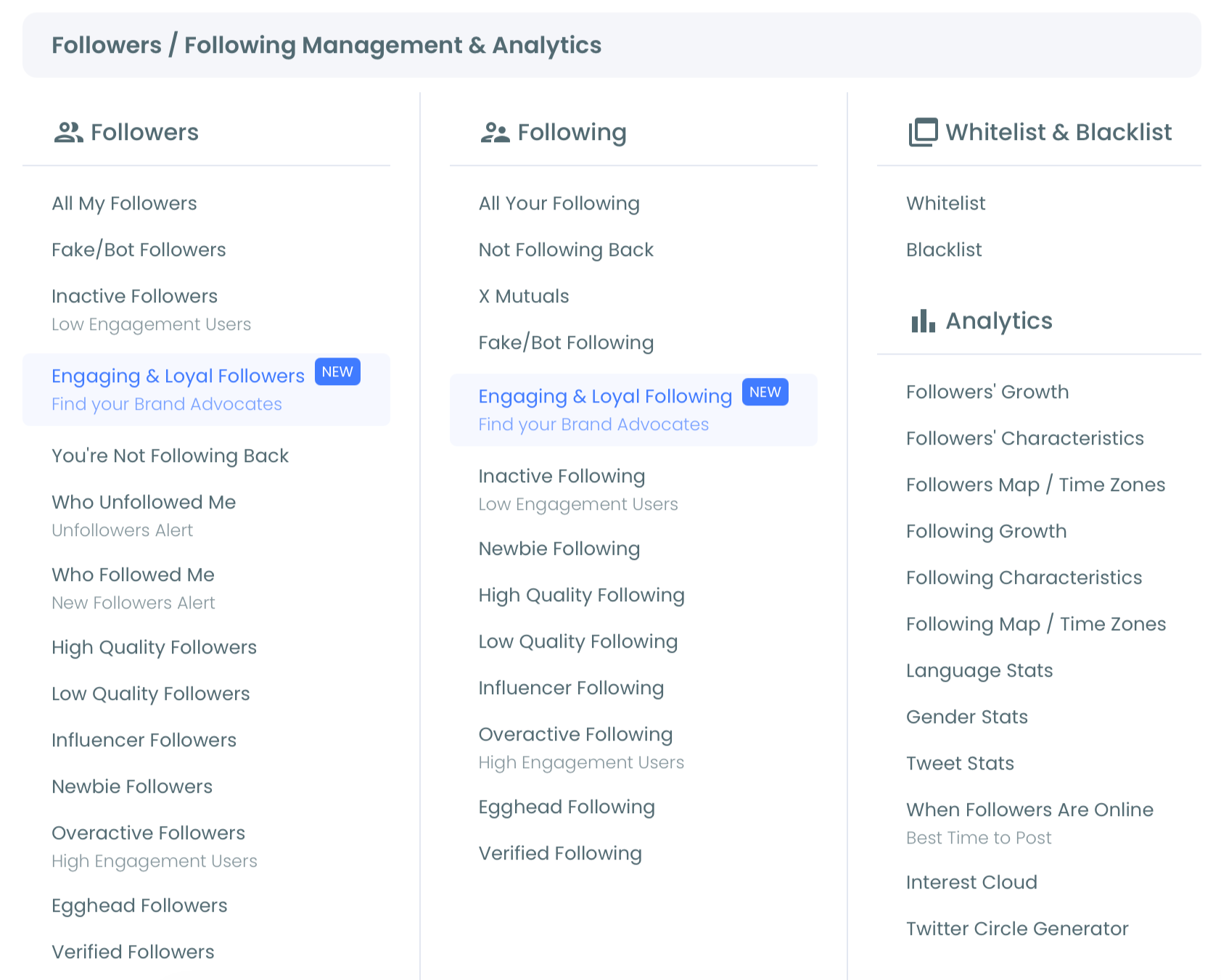
The initial classification is a starting segment. Do not treat the whole result set as one decision.
Filter and protect the exceptions
- Sort by tweet count, join date, engagement, or follow ratio to expose the clearest stale follows.
- Add bio, name, language, location, follower-count, or verification filters when they help explain why an account matters.
- Whitelist official sources, clients, partners, archived references, and other low-frequency accounts you intend to keep.
The Active Filters bar shows the exact segment currently on screen. Check that bar and the selection count before you take an action.
Export and unfollow gradually
- Export the remaining segment when you need a pre-cleanup record or team approval.
- Select only the accounts you have reviewed, then confirm the unfollow action.
- Let the process run within X's platform limits rather than trying to force a rapid removal.
Circleboom processes unfollows through official APIs at up to 50 actions per 15-minute window and approximately 800 per day. When a daily limit is reached, processing can resume the following day. Limits can change at the platform level, so gradual handling is safer than treating a maximum as a target.
The safest sequence is classify, filter, whitelist, export, select, and confirm.
That sequence preserves the context a one-click purge would destroy. It also leaves you with a record of what you reviewed and why.
Policy-to-practice demo: see how Circleboom turns public activity signals into an inactive-following review before any unfollow is confirmed.
Which inactive accounts should you keep?
Keep an inactive account when its future or historical value exceeds the small cost of retaining the follow. That is a judgment about purpose, not merely frequency.
Official agencies, service-status profiles, research archives, former colleagues, and specialist analysts often publish irregularly. Their low volume can be a feature rather than a flaw. Whitelisting them prevents the same accounts from consuming attention during every later audit.
An account is a stronger unfollow candidate when several weak signals agree:
- it posts rarely and no longer matches your interests;
- it came from an expired campaign, event, or follow-back phase;
- its profile is incomplete and its tweet count is unusually low for its age;
- it contributes no relationship, research, customer, or archival value;
- it remains non-reciprocal when reciprocity matters to your strategy.
This multi-signal rule creates information gain beyond the basic policy answer. X's inactivity policy tells you what X may do. A network audit tells you what you should do, and that requires relevance alongside activity.
For a deeper framework, who to unfollow on Twitter considers the decision beyond a single label.
If the concern is a stale network specifically, unfollow dead Twitter accounts focuses on dormant follows.
What happens when X deletes or you unfollow an account?
When X removes an account under its own policy, the profile can cease to be available on the platform. That is not an action Circleboom controls, schedules, or predicts.
When you unfollow an account, you change only your follow relationship. You do not delete the other person's account, posts, or data. Circleboom cannot automatically reverse an unfollow, so the export and whitelist steps matter.
The difference sounds elementary, but it prevents a common strategic error: confusing platform housekeeping with audience management. X maintains the platform. You maintain the relevance of your network.
If you are planning a larger review, the need to unfollow inactive Twitter accounts explains why stale follows accumulate.
The article on how to unfollow inactive Twitter accounts and remove fake accounts helps separate low activity from suspicious quality signals.
A safer monthly audit routine
A recurring light review is usually better than a rare, aggressive purge. It limits the number of ambiguous accounts you must judge at once and makes your decisions easier to explain.
Use a simple monthly or quarterly cadence:
- Open the Inactive Following view and inspect the current segment.
- Preserve important exceptions with the whitelist.
- Add a second relevance or quality signal before removing anyone.
- Export the final selection when a record would be useful.
- Unfollow in controlled batches and stop when the reviewed set is complete.
The goal is not the smallest possible following count. The goal is a following list whose size reflects an active, relevant network.
That creates a cleaner analytical baseline too. When dormant follows are removed, the remaining network is easier to segment by interests, relationships, and engagement. You can spend attention on active sources rather than repeatedly inspecting accounts that have contributed nothing for years.
The cadence also exposes drift early. A campaign may add dozens of temporary follows that make sense for one month but not for the next year. Reviewing soon after the campaign ends lets you remember the original purpose, protect the relationships that developed, and retire connections that never became useful. Waiting several years removes that context and makes every account harder to judge.
Your next move
X may remove an account after prolonged inactivity, but it does not publish a dependable timetable you can use to manage your own following list. Public posting silence also cannot reveal the private login signal X uses for its policy.
Your practical next actions are clear:
- treat inactivity as a review flag rather than proof;
- protect quiet accounts that retain strategic value;
- combine activity with relevance and quality signals;
- export when you need a record;
- unfollow gradually within platform limits.
Questions about X inactivity and cleanup
Does not posting for 30 days mean X will delete an account?
No. X's public policy uses login activity, not visible posting frequency, and says prolonged inactivity may lead to permanent removal without promising an automatic 30-day deletion.
Can Circleboom tell whether someone logged in recently?
No. Circleboom evaluates public account-age, tweet-frequency, recency, and engagement signals through official X Enterprise APIs; private login history is not presented as part of the audit.
Will an account know that I unfollowed it?
X does not ordinarily send a direct notification for a standard unfollow, although the account owner may notice by checking the relationship or using monitoring tools.
Can I undo a bulk unfollow in Circleboom?
Circleboom does not automatically reverse an unfollow. Whitelist important accounts and export the reviewed segment before acting so you retain a reliable record.