
If your Likes tab has become a record you no longer want public, the frustrating part is not finding the heart icon. It is realizing that a one-by-one action does not scale to years of activity.
What this guide gives you.X lets you undo a like from an individual post.X does not document a native control for selecting and unliking a whole history at once.Circleboom can process thelike.jsfile in your X archive, then let you filter and permanently remove the likes you approve.
Built on Circleboom’s Delete All Likes feature and delivered through official X Enterprise APIs. Start with does X have a bulk unlike feature.
Does X have a bulk unlike feature in its own interface?
No native, documented bulk-unlike button appears in X’s ordinary Likes interface. X’s own help page for liking posts describes undoing a like by clicking or tapping the liked icon on a post. That is a useful action when you know the post. It is not a batch-selection workflow.
So the practical answer to does X have a bulk unlike feature is two-part. X provides the individual undo action. A separate account-management workflow is needed when the job is a history review rather than a single correction.
That distinction sounds small until the account has thousands of likes. A Likes tab is both a public-facing engagement record and, for many people, an improvised reading list. Removing everything without deciding what should survive can erase useful references along with unwanted associations.
Circleboom Twitter approaches this as a review problem. Its Delete All Likes feature uses your own X archive rather than relying only on the subset of likes that a live interface can show.
Bulk unlike is not one decision. It is a rule, a review, and then a permanent action.
For a recent-history alternative, see unlike every tweet you have ever liked. The size of the job changes the right method.
The capability gap is bigger than one missing button
When someone asks, “does X have a bulk unlike feature?”, they often mean one of three different things:
- They want to remove a handful of accidental likes.
- They want to clear a date range, topic, or old campaign.
- They want a full reset of the public Likes tab.
Those are different scopes. The first can be handled natively. The second needs a way to define a rule. The third needs a private record of what will disappear before the public record changes.
X confirms that liked posts can be viewed from the Likes tab on your profile, with a caveat for protected accounts. That makes the visible tab useful for spot checks, but it is a poor substitute for a searchable, full-history decision process.
The information people miss is that “bulk” does not have to mean “delete blindly.” An archive-based workflow can support a complete reset or a narrow removal based on a stated rule.
That rule can use dates, keywords, usernames, hashtags, languages, media types, or engagement ranges.
If your decision is mobile-led and only a small set is involved, unlike all tweets on iPhone covers the device-specific starting point. A phone is fine for a few known posts. It does not turn an old history into an audit.
What Circleboom’s bulk-like cleanup can cover
Circleboom’s Delete All Likes tool helps when the real question is, “does X have a bulk unlike feature that can reach my older likes?” It works from the like.js data inside the archive you download from X.
Use the archive to choose a scope
That gives you a decision screen rather than a long session of scrolling. After Circleboom processes the file, all uploaded likes are selected by default, but filters and a Protect List let you narrow the set before approval.
Here are the choices worth making before you press anything permanent:
- Full reset: remove the entire uploaded like history.
- Date rule: remove likes from a prior job, campaign, or period.
- Topic rule: match a keyword, username, or hashtag.
- Exception rule: protect customer praise, research, partner posts, or milestones.
- Format rule: focus on posts with or without media, or on a selected post type.
The stronger use of a batch feature is selective, not maximal. A public figure preparing for a new role may need to remove a broad old category while retaining partner endorsements. A team account may need a reviewer to approve a campaign boundary before any likes are removed.
Circleboom’s approach also lets you upload the same like.js file for separate runs. Likes already removed are excluded, so a careful first pass does not prevent a second, narrower cleanup later.
Keep a second pass separate from the first
That is useful when the original question changes after review.
A person may start with “remove everything before 2022,” discover a set of partner posts in that period, and choose a second pass built around a narrower keyword or author rule. The archive does not make the judgment for them, but it keeps a revised judgment from becoming a new scrolling project.
For a small, touch-first cleanup, delete Twitter likes on iPhone can be the better fit. Use that route when the items are known. Move to the archive when the work depends on remembering what the visible tab may not show quickly.
When the decision rule is ready, remove old likes with Circleboom so the selection is based on the record, not on where a scrolling session happens to end.
For a reference-preservation mindset, see your most liked tweets before you decide what your Likes tab should no longer contain. The posts with the most social value may deserve a deliberate keep decision.
How to use a bulk unlike workflow without over-deleting
To use a bulk-unlike workflow safely, request your X archive, keep a copy, upload only its like.js file to Circleboom, define the scope, and approve the final count only after review. The process uses your data record to make a large operation inspectable.
Watch: an archive-based way to remove X likes in bulk
The workflow below is deliberately ordered. It keeps the irreversible action at the end, after you have had a chance to preserve useful material and challenge your first instinct.
Start with the account record, not the visible tab
- Log in to Circleboom Twitter with the X account whose likes you intend to review, then open the Delete All Likes workflow.

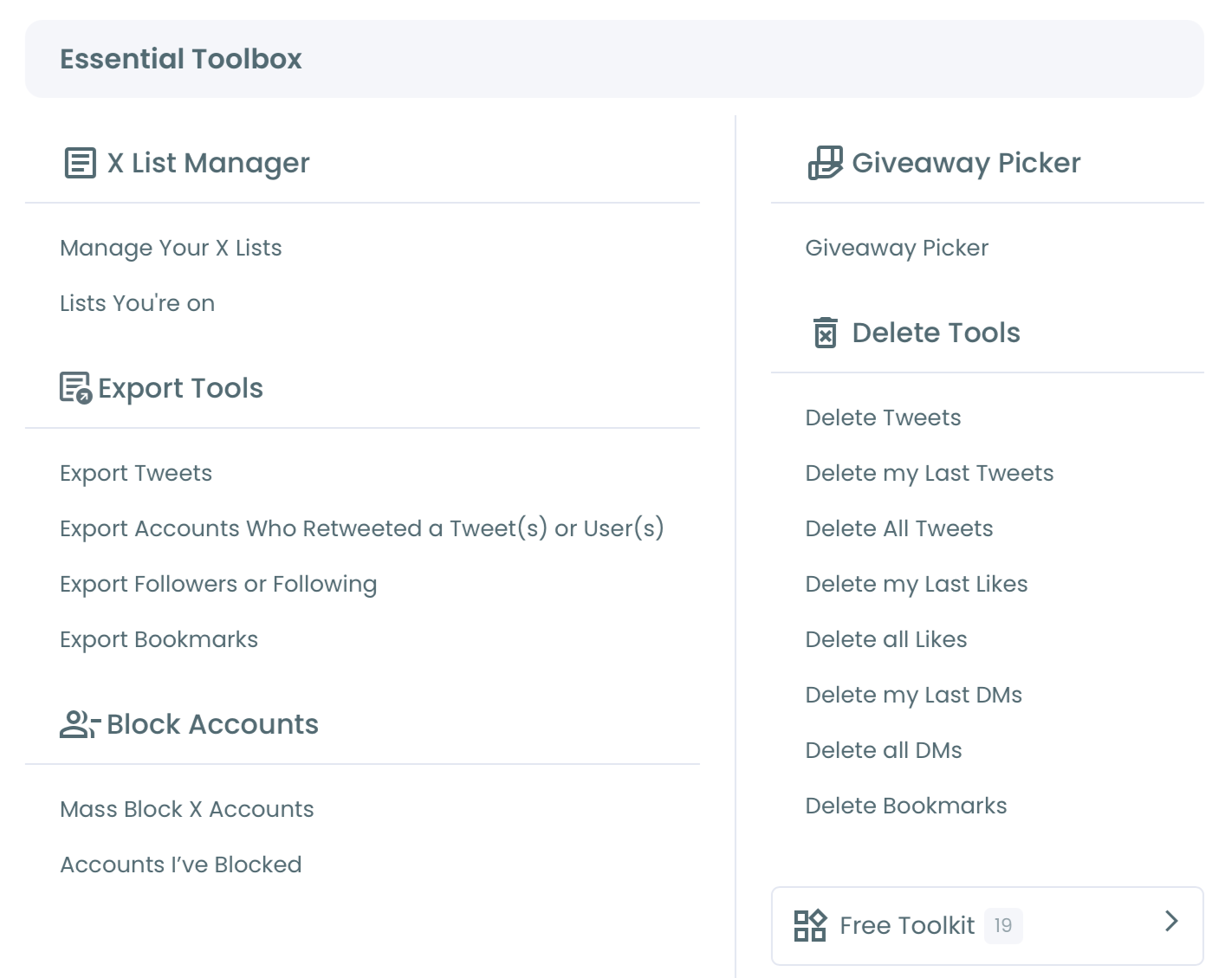
- Open the Essential Toolbox menu and choose the Delete Likes tools that lead to the archive upload flow.
- Request and download your X archive, then locate
like.jsinside the extracted archive folder. Upload that file, not the archive ZIP, and verify it belongs to the connected account.
The archive is your evidence of what existed before deletion. Store it somewhere you can find later, particularly if likes have doubled as research or a record of prior community work.
Define the removal rule before approving it
- Choose whether the job is a full reset or a filtered cleanup. Narrow with dates, text terms, authors, hashtags, language, media type, or engagement limits when a smaller rule meets the real need.
- Add valuable posts to the Protect List before you proceed. Keep a short list of testimonials, customer messages, partner content, or personal references you may want to revisit.
- Review the Approve & Delete count, confirm the scope, and start the permanent deletion only when the number matches the rule you intended.
That sequence makes the answer to does X have a bulk unlike feature more useful than a yes-or-no comparison. It turns a large action into a documented decision: archive first, filter second, protect exceptions, then approve.
At a glance: use the archive to see the full record, use filters to state the rule, and use the approval count as the last safeguard.
Why an archive matters when old likes are the problem
The visible Likes tab invites an item-by-item mindset. It is good for an accidental tap. It is weak for a cleanup that reaches back through different versions of your professional or personal identity.
An archive changes the question from “what can I find while scrolling?” to “what pattern no longer belongs on this account?”
The pattern may be a former client, a retired product name, a topic you no longer want attached to your public profile, or activity before a date.
Treat permanence as the final stage
This is also why does X have a bulk unlike feature should not be answered with a promise of instant erasure. Removing a like is permanent. It cannot restore a useful reference, and it does not guarantee that screenshots, reposts, or external copies of a post disappear elsewhere.
The safe promise is narrower: you can make the set visible, state the rule, and check the count before the action begins. That is enough control for a permanent cleanup.
For a full, no-scroll approach, the best app to delete Twitter likes at once offers another explanation of the archive-based route. The relevant decision is still scope, not just speed.
If your likes are only one part of an account reset, Delete All Tweets is a separate operation for your own posts. Treat those as separate reviews. Liking a post and publishing a post create different kinds of public record.
Is an archive-based bulk unlike workflow safe?
It can be safe when safety means authorization, review, and clear expectations. The tool should act only on an account you control, and the person approving a large cleanup should understand that unlikes cannot be automatically restored.
Circleboom uses Enterprise API access for applicable account actions and is listed in X’s Enterprise customer directory. That is a concrete trust signal, but it does not replace the account owner’s responsibility to set the right deletion rule.
Use a second reviewer when the account represents a company, public organization, or client. Ask them to check the date range, keywords, protected posts, and final count. For a personal account, the same discipline can be a brief note that explains why a category was removed.
Avoid the full wipe if a targeted cleanup answers the actual concern. Archive-based filtering exists precisely because a history can contain both liabilities and value.
When the scope is settled, bulk unlike old X likes through a reviewed archive workflow rather than trying to turn the native heart icon into a bulk-management tool.
A better answer than “yes” or “no”
Does X have a bulk unlike feature? X offers the individual unlike action, while Circleboom provides an archive-based way to define, inspect, and remove a larger set of likes. That boundary is useful because it separates a quick correction from a history-level cleanup.
The best outcome is not an empty Likes tab by default. It is a Likes tab that reflects a decision you can explain.
→ Delete all X likes with Circleboom
Common questions about bulk unliking on X
Can I unlike every post at once on X?
X’s help documentation explains how to undo an individual like. For a full-history cleanup, Circleboom can process the like.js file from your X archive, then let you approve removal of all or filtered likes.
Does Circleboom delete likes older than the recent visible history?
Yes. Circleboom works from the like.js file in your X archive, so the cleanup can cover likes across the account history represented in that archive rather than only a recent on-screen subset.
Can I keep certain liked posts during a bulk cleanup?
Yes. Use the Protect List for liked posts you want to retain, then apply filters and review the final count before permanent removal.
Can I reverse a bulk unlike run?
No. Unlike actions are permanent. Keep the downloaded archive as your private record and inspect the proposed count before confirming deletion.