The eyewitness you need is already inside your search results. They are sitting under four hundred rows of commentary, and every default sort on every platform will keep them there.
Sort by engagement and the top of the page fills with people who watched the event on a screen. Sort by recency and it fills with people still arguing about it a week later.
The person who was standing in it posted once, collected eleven likes, and slid off the page before you opened the tab.
That is the cost of running an event search the way most tools teach you to run it. A story built from the loud layer quotes reaction. A story built from the early layer quotes experience, and only one of those survives a fact-check.
How do journalists find sources on Twitter who actually witnessed an event?
Narrow the search to the hours the event happened, then read the results by posting time instead of by popularity. Circleboom collects public historical X posts inside any custom date window and shows the account behind every post it pulls.
→ find sources on Twitter as a journalist
How I find sources on Twitter as a journalist, step by step
The run I use while an event is still moving.
Open the archive instead of the feed
- Log in to Circleboom Twitter using the handle your byline sits on.

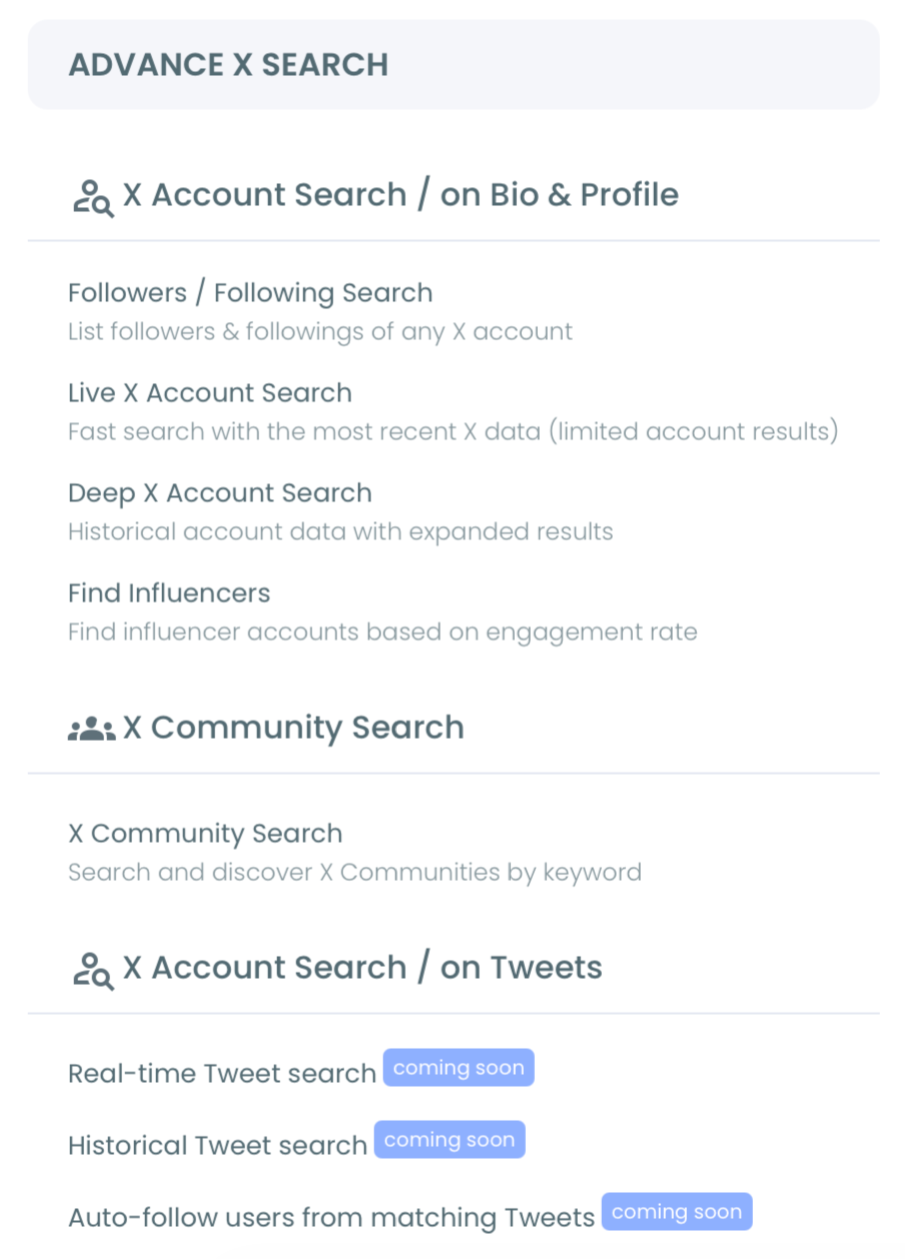
- Take the Advanced X Search menu, where Historical Tweet Search waits.
- Write the query the way a witness would write the post. Not the name the story ended up with. People at a scene write "the bridge is closed" and "everyone is being moved off the platform," not the phrase a newsroom coined for it three hours later.
Cut the window down to the event itself
- Set a custom date range around the first hours, not the first week. Preset ranges cover 30, 60 and 90 days plus a full year, and a custom field takes whatever dates you type. A twelve-hour window is a different dataset from a seven-day one, and it is the one you want.
- Add exclusions before you add more keywords. The exclude field takes the words the coverage settled on afterward, which is the fastest way to drop everyone who is writing about the event rather than from it. A language setting does the rest on any incident outside your own, where the international layer is secondhand by definition.
Read the rows in the order they were posted
- Sort the Created At column ascending. Every column header in the results grid is sortable, and Created At carries the date, the time and the relative age of each post. Ascending puts the earliest matching post at the top of page one, which is the closest thing to a chronological reconstruction you can get.
- Switch to the profile view once you have a shortlist. Look for "Display Profiles of this search," which converts your matching posts into a deduplicated roster of the accounts that wrote them, carrying follower counts, join dates and an activity classification.
That order matters because each step narrows a different axis. Logging in buys official access. The window bounds the event. Exclusions strip the noise layer. The chronological sort is what raises the witness above the pundit. Reverse any two of them and you are back to reading a popularity ranking.
Quick recap: connect, open Historical Tweet Search, write the query, bound the window, filter out commentary, sort by time, then pivot to accounts.
Why does the eyewitness post never reach the top of a Twitter search?
Because the ranking that decides what you see is built from engagement, and engagement arrives late.
A post from inside an event has almost no distribution at the moment it matters. The author has a few hundred followers, no one has quoted them yet, and the algorithm has no signal to work with.
Six hours later, an account with a large following writes a summary of what happened, and that summary collects the likes, the reposts and the position at the top of every search tab.
By the time you search, the summary outranks the source it was built from.
That is the whole problem in one sentence, and it is why a keyword search inside a ranked feed is the wrong instrument. You need to find event sources on X by querying the archive directly rather than accepting whatever the app decides to show you.
Our walkthrough of how to search old tweets on Twitter covers the same shift for a single account's history.
What the first hour of an event actually looks like in the results table
Thin, misspelled, and low on likes.
Run a twelve-hour window on a real incident and the earliest rows share a shape:
- Short posts.
- Present tense.
- Named streets and platform numbers rather than the official location.
- Frequent typos, because people write differently when something is happening in front of them.
- Impression counts in the hundreds, and reply counts of zero.
Those signals read as low quality to a ranking system. To a reporter they read as presence.
The results grid puts all of it on one row: the post text, an icon that opens the original on X, the timestamp, and six engagement figures running from impressions through replies. The Name column carries the profile photo, the display name, the handle and the location the account lists.
The location field in that first column is often the fastest confirmation you will get all day.
None of this replaces verification. It just gets you to the small number of accounts worth verifying instead of the large number worth ignoring. If your event was tied to a place rather than a topic, you can also search Twitter by location and cross-reference the two result sets.
Screen recording: what a keyword query looks like when it runs against the historical archive rather than the live tab.
https://www.youtube.com/watch?v=ZRslhxkc43Y
Leave the engagement fields empty and let the window do the narrowing
The panel offers a floor and a ceiling on each of likes, reposts and impressions. On an event window, the useful setting for all six is blank.
That is not laziness. Every one of those fields narrows the result set by how a post performed, and performance is the exact axis that buried your witness in the first place.
Setting a threshold on it, in either direction, keeps you inside the same measurement you came here to escape.
A twelve-hour bound does the same job on a dimension nobody was competing on. It throws out more irrelevant volume than any threshold, and it throws it out by when a thing was said rather than by how it landed.
Where a threshold earns its place again
The moment the window stops being tight, the calculus flips.
A search that reaches across a year is looking for signals inside an enormous pile, and there a floor is doing real work: it is the difference between a readable set and an unreadable one. Hunting a buying signal or a competitor complaint across months is precisely the job an engagement threshold was built for.
Event sourcing is the opposite shape. The window is already small enough to read, so a threshold has nothing left to remove except the thing you came for.
Narrow on time when you have a time. Narrow on engagement when all you have is a keyword.
Widening the window is where I get this wrong. Stretch a scene search from twelve hours to a week because the first pull looked thin, leave the engagement fields blank as before, and the set stops being readable.
The fix is a tighter window and a sharper query, not a number in the likes field.
Circleboom is an official X Enterprise Developer company. The posts and the engagement counts come from X's own Enterprise data, not from a scraper guessing at what a page showed.
When you are about to put a stranger's words into a story, the provenance of the row you found them in stops being a technicality.
Reaching the person after you have found the post
A public post is findable. It is not an invitation.
The account you just pulled out of an archive did not publish that sentence expecting a reporter to read it eight months later, and nothing about the search changes that.
Kadia Tubman's Reuters Institute research on how newsrooms use user generated content puts it plainly. The best practices for interacting with a source are not the same as they were before social media.
What the tool does is narrow. It tells you who said something, when, and from what account.
It does not tell you whether that person wants to talk, whether they were a minor at the time, or whether the post they wrote in the middle of a bad hour is something they would stand behind now.
That judgment stays with you. Circleboom will happily hand you a CSV of four hundred accounts, and the right number to actually contact is usually under ten.
What the export gives you before you send a single message
The account export is built for that shortlist rather than the whole pull. Every row arrives with the bio, the listed location, the join timestamp and three counts: posts, following, followers.
Four flags ride along beside them, covering protected status, verification, dormancy, and which kind of verified badge the account holds.
Reading those fields beats opening four hundred profiles by hand. Our roundup of Twitter tools for journalists and authors covers the rest of the desk work.
Somewhere here you stop searching and start deciding who to write to. That is the moment to pull sources on Twitter from an event window rather than a whole month. A narrow window produces a list short enough to actually read.
Before you write to anyone, it is worth checking whether you can understand if a Twitter account is authentic at all. An account created the week of the event, with a stock photo and no history, is a different proposition from one that has been posting from the same neighborhood for six years.
The story a beat needs is often the drift between two windows
One event window tells you what was said in the hours it happened. Two windows tell you what happened to the account of it afterward.
That second reading is where a lot of follow-up reporting actually comes from. Run your keyword set against the first hours, then run the same set against the last week. The difference between the two is the narrative moving:
- Names entering the vocabulary.
- Claims hardening into facts.
- The phrase a newsroom coined displacing the words the people at the scene used.
For the recent half you want a real-time tweet tracker pointed at the same terms. A keyword stream running forward covers the current conversation that a dated pull is not built to reach.
Neither window is the story on its own. The gap between them frequently is, and that only shows up if you kept the first pull.
That drift reading serves the beat as a whole, not just one story.
The same query will find Twitter users by the city in their profile. Cover a place rather than a topic and that standing list is worth building now. The next incident then costs you an hour instead of a day.
What a good source list looks like
Give this two weeks and the change is not that you find more sources. It is that you stop finding the same five accounts every time.
The five accounts a popularity-sorted search returns for any event in your beat are the five accounts everyone else's search returns too. That is why three outlets quote the same person on the same day.
Sorting an event window by time instead of by reach breaks that loop, and the names you come back with stop being the names that were already on television.
The rest is discipline. Keep the windows narrow. Keep the engagement fields empty. Verify before you write, and contact fewer people than the export offers you.
Then run the next one from the archive rather than the timeline, and search historical X posts for sources the way the story deserves.
Questions reporters ask after the first run
How far back can I search for posts about an old event?
Presets run to a year back, with 30, 60 and 90-day options below that, plus a free-text window for anything else. How much of a distant period is actually available is set by what X's Enterprise index holds for those dates, so a window from several years ago often returns thinner than an equally wide one from last month.
Will a post the author later deleted still show up?
No. Only publicly available posts are returned, and deleted, private or protected posts cannot be retrieved. That cuts both ways for a reporter: an empty result is not proof that nothing was said, only proof that nothing retrievable was said.
Does re-opening a search cost me again?
No. Searches consume GetTweetTokens in proportion to how many posts you collect, and every completed run is kept in a search log you can open again at no further cost. Exporting draws on the balance separately, so check what is left before downloading a large account list.