
How many of the accounts in a city search are actually buyers?
In a housing market, far fewer than the result count suggests, because the people who put property words in an X bio for a living are agents, brokers, loan officers, stagers, and photographers.
Buyers almost never describe themselves as buyers, which is why real estate leads do not sit at the top of a city query.
What a city search on X really hands you.A list of accounts whose profile location text contains the string you typed.A second pass on bio words, follower counts, follow ratio, and join date.A table you can grade, blacklist, and export before you follow anyone.
Circleboom searches X accounts by keyword and narrows them by profile location on Twitter through Enterprise-grade X API access. Check what your own market returns with real estate leads on Twitter by city.
How to find real estate leads on Twitter in your city, step by step
Seven moves, and the order carries the whole method.
Reach the search that reads the location field
- Log in to Circleboom Twitter with the profile you work under. The search reads public accounts, so the size of your own audience has no bearing on what comes back.
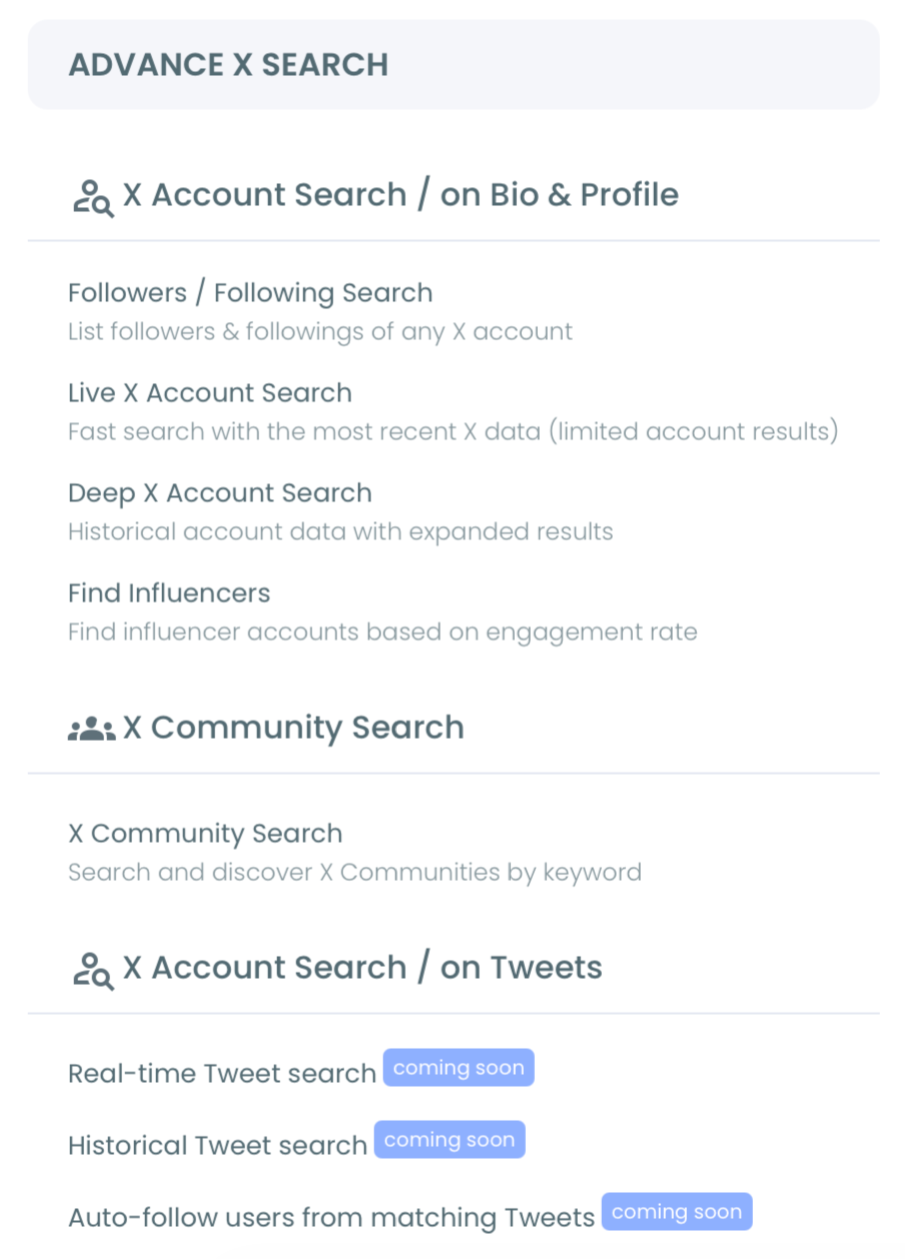
- Move into Advanced X Search and begin an account query on a single keyword. What comes back is a table of profiles rather than a feed of posts, and that difference is what makes everything below possible.
Clear your own trade out of the way first
- Search the words your competitors use, then blacklist what comes back. Run "realtor," "real estate agent," or your local brokerage names, apply your city in Filter by Location, select the rows, and use the bulk Blacklist action.
- Start a second search on the language a mover uses, not the language you sell in. Phrases like "relocating," "moving to," "first home," or "school district" describe a situation rather than a job title.
- Open Filter Options, hide blacklisted accounts, and set the numeric bands. The Whitelisted & Blacklisted control drops the professionals you just tagged. The numeric bands for followers, followings, posts, ratio, and account age all stack as AND conditions on top of your city string.
Grade the survivors before you act on them
- Sort the table by a column that separates a person from a business. Every column header sorts, so one click on Followers or Follow Ratio moves the brokerage accounts and the local news feeds to one end of the list.
- Move the shortlist somewhere durable. Add to List builds an X List you can watch without following anyone, and the CSV export carries Location, Bio, CreatedAt, and every follower number alongside each account.
Each move exists to protect the one after it.
Blacklisting the trade first stops the second search competing with itself. The numeric bands do the grading you would otherwise do by opening forty profiles. The export dates the shortlist, so next month you can tell which accounts are new.
Quick recap:
- Authorize the account you will act from.
- Run the trade query, then blacklist the result.
- Run the mover query with your city in Filter by Location.
- Hide blacklisted accounts and add follower, ratio, and join-date bands.
- List or export the survivors.
Why does a city search on X return so many agents?
Because a bio describes an occupation, and buying a house is not an occupation.
Everyone in the local property trade has a professional reason to write the city and the category into their profile. It is how they get found.
A person who is quietly planning to move next spring has no such reason, and usually writes nothing about it at all.
That asymmetry is the whole problem with a raw city query in this niche. The accounts most optimized to be found by your search are the accounts least useful to you.
Your competitors have done your keyword research for you, and they are sitting at the top of your results.
The workable move is to treat the trade as a set you remove, not a set you sort past. Circleboom keeps the Blacklist label across sessions, so a professional you tag today stays hidden the next time you run that market.
The same pattern shows up in Twitter real estate hashtags. The tags with the most volume are the ones agents post into, not the ones buyers read.
What the location field is, and what it is not
A profile location on X is a line of text a person typed about themselves, and nothing validates it.
X documents this in its own developer reference. X's API data dictionary describes the user object's location field as "the location specified in the user's profile, if the user provided one."
The same entry adds that "as this is a freeform value, it may not indicate a valid location." The example value X prints in that table is 127.0.0.1.
So the field can hold a metro area, a state, a country, a joke, a loopback address, or nothing at all.
Why that hits property harder than most niches
That matters more in property than in most categories, and the reason is specific to the trade. The field is optional, so it sorts your market by who wanted to be findable in a place rather than by who lives there.
An agent completes it because their business depends on being found locally. A buyer completes it only when the city is part of how they already see themselves.
So a populated location line tells you something real about attachment to a place, and every buyer who left the box empty stays invisible to the query no matter how good your string is.
Circleboom reads that field through the API access it holds as an official X Enterprise Developer company. Nothing is scraped, nothing is guessed, and the account you run the search from is never exposed to a policy problem.
Open search Twitter by location and see how many accounts in your market wrote the city at all.
A place plus a purpose, never a place alone
A location match on its own is a coincidence. Two conditions have to hold before an account counts as a real estate lead worth your attention.
The first is the place claim: the profile location string contains your city, your metro, or a neighborhood inside it.
The second is the purpose signal: something in the bio or the recent posting behavior suggests a move, a search, or a life event that comes with one.
Neither condition proves anything by itself. Together they narrow a city of accounts down to a shortlist you can read in twenty minutes.
What the two conditions do to your row count
The arithmetic is friendlier than it sounds.
Say a search on your metro returns 2,000 accounts and a third of them carry a trade word in the bio. The blacklist pass takes roughly 660 rows off the table before you read a single profile.
Apply a follower band and a join-date floor to what is left and you are usually looking at a few dozen accounts, which is a list a person can genuinely work.
Be blunt with yourself about what that shortlist is. It is a set of people who might be earlier in a housing decision than average. It is not a pipeline, it is not qualified, and nobody in it has asked to hear from you.
Any comparison of Twitter location search tools comes down to which one lets you add the second condition, because the first one is available anywhere.
Reading the table before you follow anyone
The account table carries enough profile signal to sort people from businesses without opening a single profile.
Each row carries the display name and handle with the location line beneath it.
After that come the lifetime post total, the account's age in days, how many accounts it follows, how many follow it back, the ratio those two figures give, and an activity classification of Active, Moderate Active, or Inactive.
Four reads do most of the work:
- A very high follow ratio with a low tweet count usually means a broadcaster, not a resident.
- A join date measured in decades with a thin post history often means a dormant account.
- A following count far above the follower count is common for people, rare for brands.
- An Inactive classification means the account will not see your reply anyway.
What lives in the CSV and not on the screen
The CSV is the version of the table you can keep.
Every selected row arrives with its ProfileId and Username, the display name and location line, post and follow counts in both directions, the quality booleans, Verified_Type, an account creation timestamp, and the full Bio text.
That last column is the one agents underuse. A bio you skimmed on screen becomes searchable text in a spreadsheet, so the relocation language you could not filter for inside the tool becomes a sort you can run afterward.
On screen: the keyword-to-account search that turns a market query into a table of named profiles.
https://www.youtube.com/watch?v=OAbQZmQ1z2Q
There is a second search waiting inside the rows. Search Twitter Bios and Profiles works the bio text rather than the location line, which is where the school-district and relocation language usually sits.
What acting on the list costs, and why the pace is the point
Following is capped, and the cap tells you what the tool is for.
The queue releases 50 follows a quarter hour and stops at 400 in a day, picking itself back up when the next day begins. A city with three thousand matching accounts is not a follow campaign. It never was.
That constraint is a feature in a market where reputation is local and permanent. An agent who mass-follows a metro area is visible to every other agent in it.
Lists cost nothing and notify nobody
The cheaper move is the X List. Adding accounts to a list changes no relationship, sends no notification, and gives you a running feed of the market you can read for months while a housing decision plays out.
Our Twitter List Manager holds those lists and lets you rebuild them from a later search.
The export is the other durable artifact. Export Twitter Accounts writes the filtered set to CSV on the token system, with the remaining token count shown next to the button before you spend it.
Once the list exists, it needs something to receive. A real estate social media content planner turns a watched market into a reason for those accounts to notice you first.
Start with local real estate leads on X in one city rather than three. Open the second market only after the first one produces something you would call a conversation.
Your first hour on Monday
Pick your path by how many real estate leads your market actually holds on X.
If your city query returns a few hundred accounts and most of them are the local trade, spend the first hour on the blacklist pass. You are building a permanent filter, and it only gets built once.
If the query returns thousands, skip following entirely for the first month. Build two X Lists, one for the trade and one for everyone else, and read them the way you read a local paper.
Watching who among the best real estate Twitter accounts actually gets replies in your market tells you more about local demand than any follower count will.
If the query returns almost nothing, that is an answer too. Your market may live on another platform, and finding that out in an afternoon is worth more than a year of posting into an empty room.
Whichever path fits, the first run is the same one. Kick off your own market with city-filtered real estate leads on Twitter and read the table before you decide what it is worth.
Common questions about finding real estate leads on X
Can I search a city I do not live in?
Yes. The location box is a typed string checked against another typed string, so nothing ties it to your own account or your own region. Agents working a second market, or a relocation corridor between two cities, usually run both strings separately and compare the two tables.
Do the accounts I blacklist find out?
No. Blacklisting is a private label inside Circleboom, not an action taken on X. It does not block, unfollow, or remove anyone, and nothing about it is visible from the outside. It exists so a professional you have already screened out stays screened out the next time you run that market, which is what makes the trade pass worth doing once rather than every quarter.
Is it safe to message everyone the search returns?
Nothing in the result set is permission to message anyone, and X's own spam behavior is not the only thing to worry about in a market where your name is your business. Treat the shortlist as a watch list first, engage publicly where it is welcome, and let a direct message come after there is a reason for one.