The Twitter algorithm is no longer a black box. In January 2026, X published the code behind its For You feed on GitHub, and it shows a system that pulls posts from accounts you follow and from accounts you don't, then ranks them with a Grok-based transformer that predicts how likely you are to like, reply, repost, or mute each one.
The practical takeaway is simple: post things your audience will actually respond to, at times they are online, and avoid anything that makes people scroll past or hide you.
For years, every explanation of how the Twitter algorithm works started with a disclaimer. Nobody outside the company really knew.
People guessed. Hashtags matter. Links get punished. Post at 9 a.m. Never edit. Some of it was true, a lot of it was folklore, and all of it was impossible to check.
Then X put the code on GitHub. Not a blog post about the code, not a summary for advertisers, the actual repository. Anyone can open it and read how a post travels from "published" to "showing up in someone's For You tab."
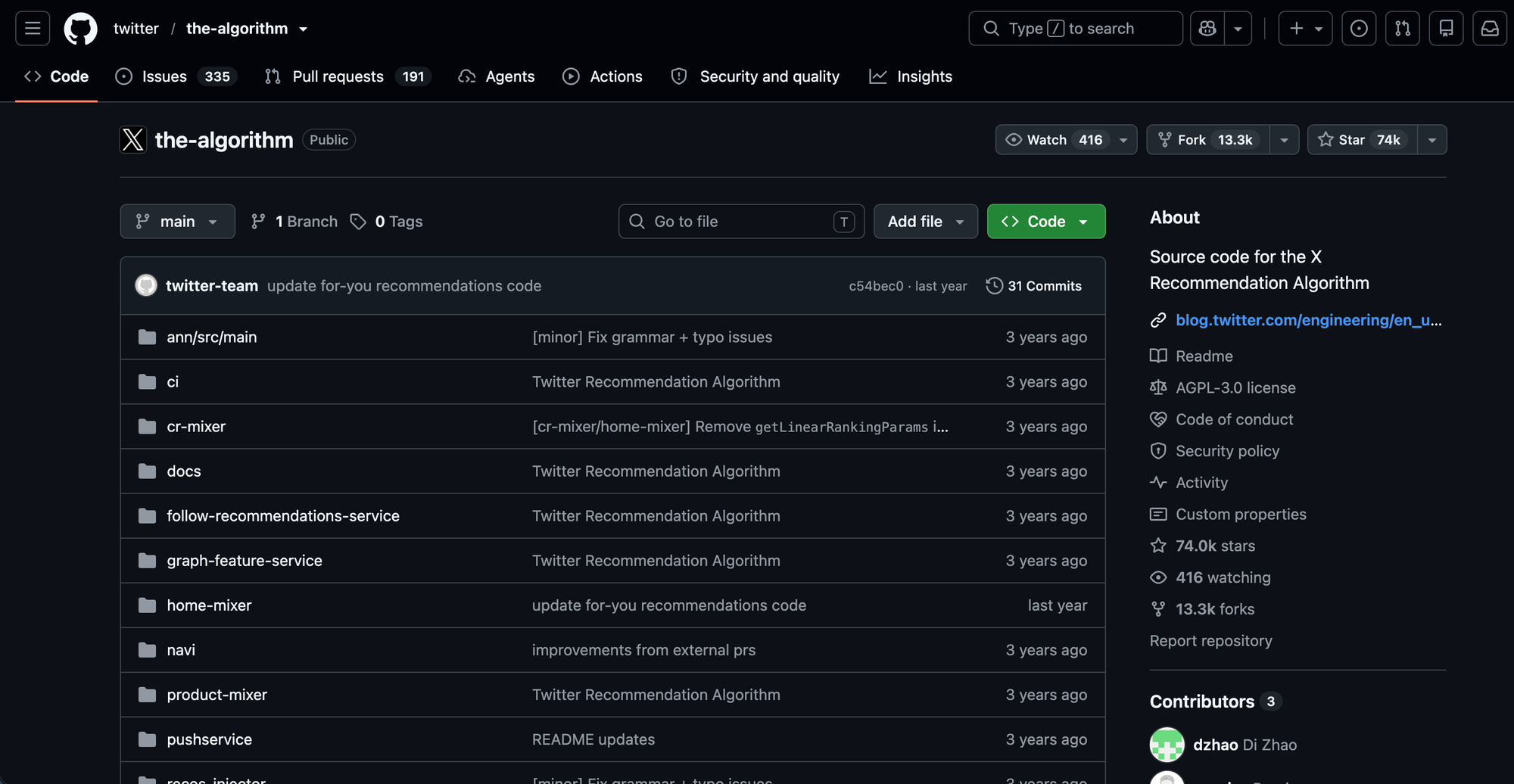
Reading it is useful. Acting on it is a different job, because the code tells you what the system rewards but not how your own audience behaves. That part comes from your account data.
With Circleboom Twitter, you can see when your followers are online, which of your tweets earned the most engagement, and schedule new posts into the windows where the algorithm has the best chance to pick them up.
From a 2023 code dump to a living repository
This is not the first time the algorithm went public. On March 31, 2023, Twitter released a large part of its recommendation code in a repository called the-algorithm. We covered that first release when it came out in Twitter algorithm code is open now.
Twitter will open source all code used to recommend tweets on March 31st
— Elon Musk (@elonmusk) March 17, 2023
That release was a snapshot. It had dozens of hand-tuned features, heuristics, and services stitched together, and it went stale quickly.
The 2026 version is different in three ways:
- It is a new system. The repository now lives at xai-org/x-algorithm, and X Engineering announced it as "powered by the same transformer architecture as xAI's Grok model."
- It gets updated. X committed to refreshing the repository every four weeks. The August 2026 update added configuration parameters, visibility filtering and labeling systems, and Phoenix training code. The September 2026 update added compliance visibility information to the "Under the Hood" reports.
- It is mostly learned, not hand-written. Instead of engineers deciding that a photo is worth X points and a link is worth Y points, the model reads your recent engagement history and predicts what you will do.
📌 Some parts are still private. The documentation says certain rule sets and prompts stay unpublished to make gaming the system harder. So the code explains the ranking logic, not every safety rule.
How the Twitter algorithm works, step by step
The For You feed runs through a service called Home Mixer. It works like an assembly line with clear stages.
1. Finding candidates. Out of hundreds of millions of daily posts, the system gathers a small pool for each viewer. Posts come from two places:
- In-network: a component called Thunder keeps recent posts from accounts you follow in memory, ready to serve.
- Out-of-network: Phoenix retrieval turns viewers and posts into vectors and finds the closest matches. SimClusters adds posts from communities you engage with, and a shared list of popular recent posts fills the gaps.
2. Filtering. Before anything is scored, the pool gets cleaned. Duplicates, old posts, your own posts, posts from accounts you blocked or muted, and posts you already saw are removed.
3. Scoring. This is the heart of it. The Phoenix model predicts the probability of nearly twenty different actions for every candidate post.
The positive ones include likes, replies, reposts, quotes, shares through DM or link, clicks on the post, profile, link, or photo, video views, dwell time, and follows. The negative ones include "not interested," muting the author, blocking the author, reporting, and simply not stopping to look.
The final score is a weighted sum of those probabilities. Positive actions push it up, negative actions pull it down.
4. Adjusting. Three rules reshape the ranked list:
- Author diversity. After an author's first post in your feed, each additional post from the same author gets multiplied by a decaying factor. Ten posts in a row from one account will not all rank high.
- Out-of-network discount. Posts from accounts you don't follow get a multiplier below 1.0. Followed accounts start with an advantage.
- New-author boost. Authors with few impressions get lifted toward better positions, which gives smaller accounts a real shot.
5. Final checks and blending. Visibility filtering runs again on the selected posts, conversations get deduplicated, and then a second pipeline mixes in ads and recommendations.
⚠️ One detail matters more than it looks. During scoring, candidate posts cannot "see" each other. Each post is scored only against the viewer's context. Your post is not competing with the post next to it in the model. It is competing against how interesting it looks to that specific person.
What this means for the tweets you post
The code changes how you should think about reach. Here is what actually follows from it.
Engagement is predicted, not counted. The weights multiply a viewer's predicted probability of liking or replying, and that prediction is driven heavily by the viewer's own past behavior. A post does well when it looks like the kind of thing a person has engaged with before. Generic content built for everyone fits nobody's history.
Negative signals are real penalties. Mutes, blocks, reports, and "not interested" clicks are predicted and subtracted. Rage bait that earns replies but also earns mutes is a bad trade. So is a timeline full of spammy follow-for-follow behavior. The Shadowban Test is worth running if reach drops suddenly, and our guide on how to prevent a Twitter shadowban covers what to avoid.
Your followers are your starting advantage. Out-of-network posts get discounted, so your first distribution happens inside your own audience. If a large share of that audience is bots or inactive accounts, the first wave goes to people who never react. Cleaning fake and bot followers makes that first wave land on real people.
Posting floods hurt you. The author diversity rule means a burst of posts in one hour mostly competes with itself. Spacing posts across your audience's active windows works better than dumping them at once.
Dwell time and video watching count. Time spent on a post and video viewing are predicted actions. A clear opening line and a strong first few seconds of video both help. Video Analytics shows where viewers drop off in your videos.
Timing still matters, just indirectly. Thunder serves recent posts from followed accounts. If you post when nobody is online, the post ages before anyone engages, and early signals feed the predictions for everyone else. Our guide to the best times to post on social media goes deeper.
Turning the open source algorithm into a posting routine with Circleboom
Knowing how the Twitter algorithm works is half the job. The other half is knowing your own audience, and that is where Circleboom Twitter fits. Circleboom is an Official X Enterprise Developer and works directly with X's official APIs, so every number it shows comes from real X records. No scraping, no password sharing, fully compliant with X's API policies.
Here is how it lines up with what the code rewards:
- When Followers Are Online shows a day-by-hour chart of when your followers are active, and its "Pick All Best Times" button adds those peak slots to your posting queue.
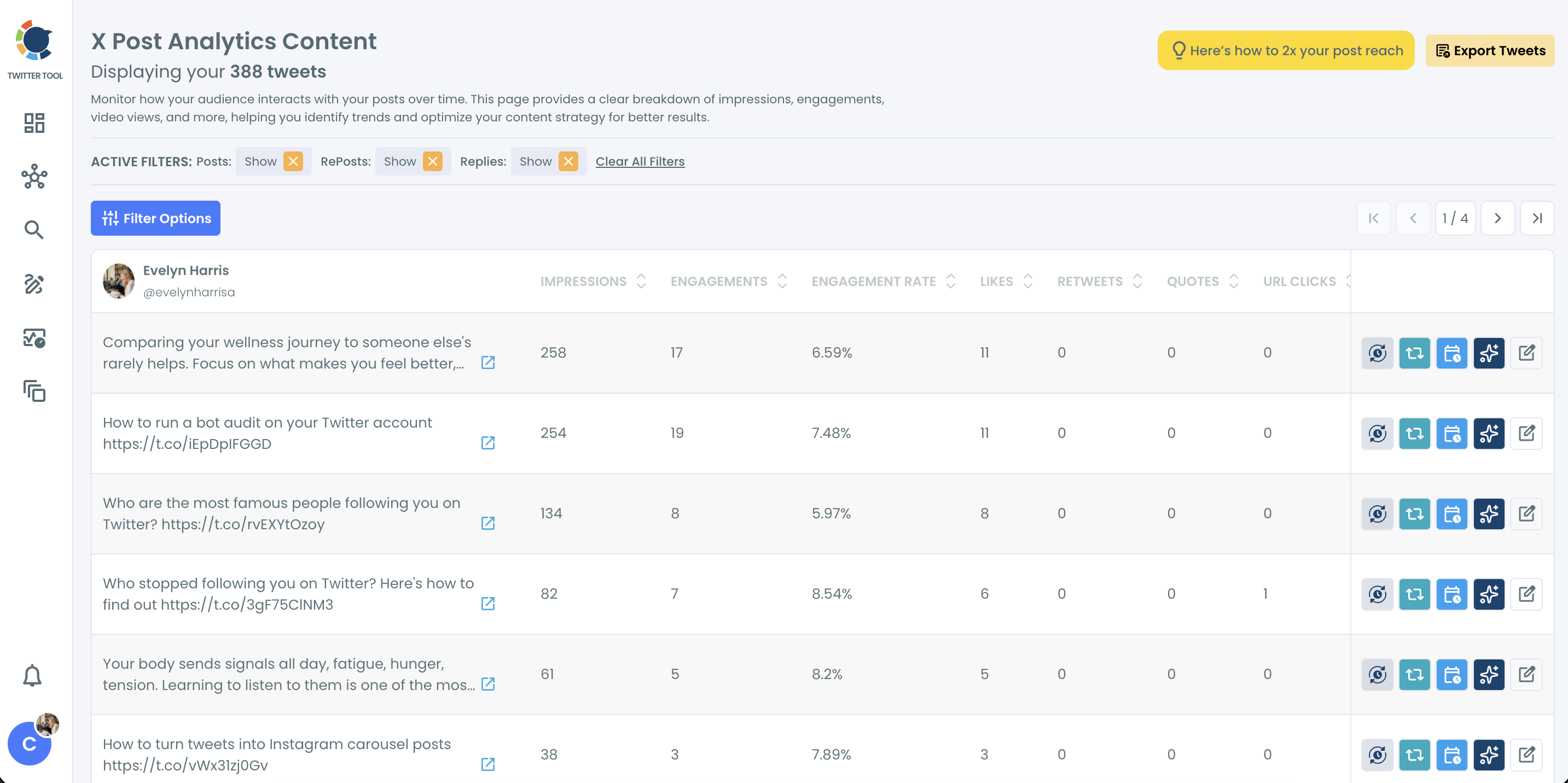
- Post Engagement Analytics ranks your tweet history by impressions, likes, reposts, replies, bookmarks, and link clicks, so you can see which topics and formats your audience really responds to.
- X Post Planner lets you schedule posts into Best Time to Post slots and set Auto Retweet, so a tweet gets a second window for followers who missed the first one.
- AI Writer with the My Style option learns from your past tweets and writes new posts in your voice, which keeps your content consistent with what your audience already engages with.
- Engaging & Loyal Followers shows who interacts with you most, the people whose engagement history makes them most likely to see and react to your next post.
Since the Twitter algorithm ranks posts on predicted engagement from your audience, these tools give you the audience side of the equation the code leaves out.
How to post for the X algorithm with Circleboom
Step 1: Connect your account. Log in to Circleboom Twitter and connect your X account.
Step 2: Check when your followers are online. Open When Followers Are Online. Bigger bubbles mean more followers active in that hour.
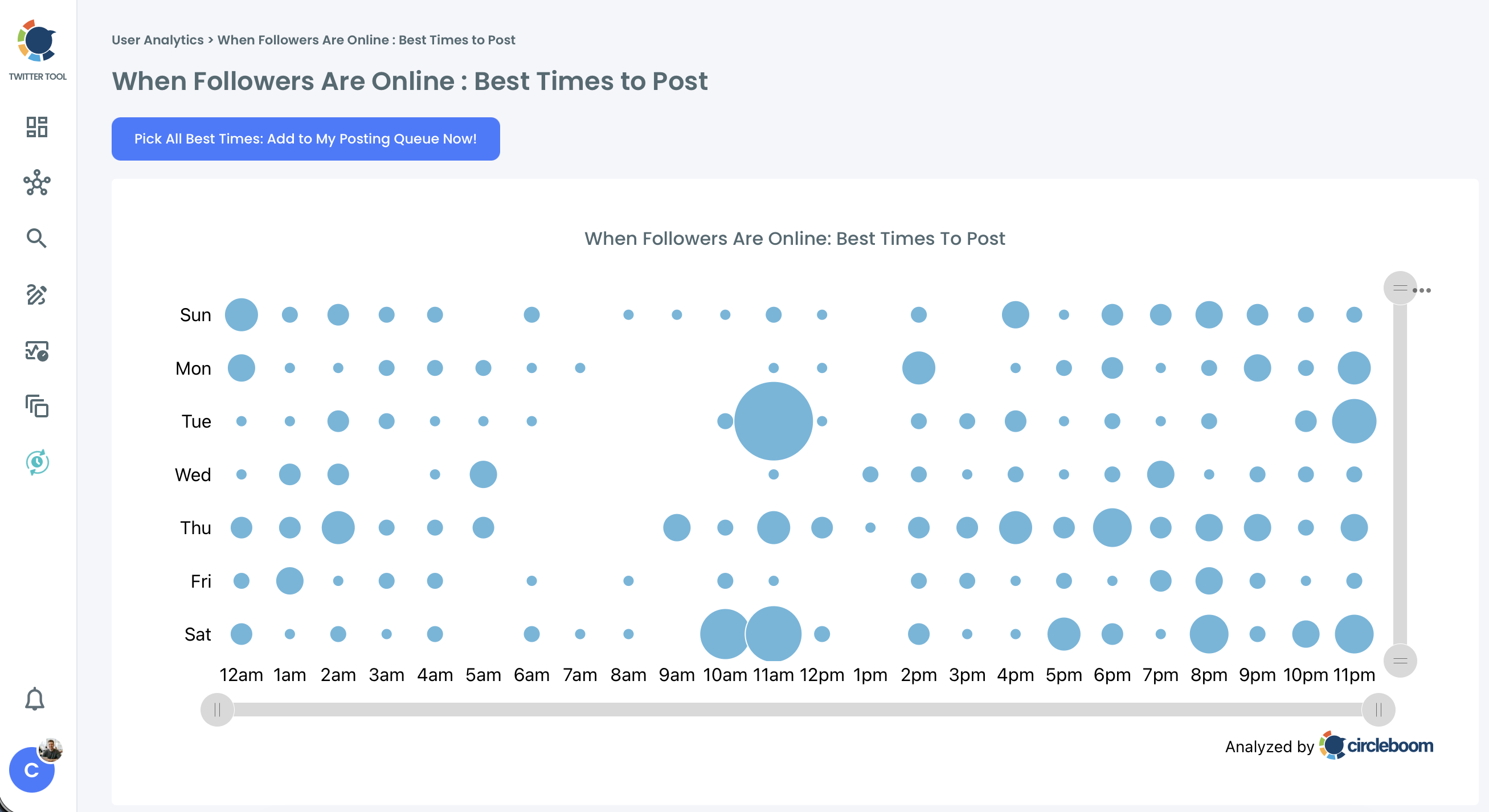
Click "Pick All Best Times: Add to My Posting Queue Now!" to add those peak slots to your queue. If your audience is spread across countries, check Followers' Map / Time Zones too.
Step 3: Find what already worked. Open Post Engagement Analytics and sort your tweets by engagement. Look at the top performers and note the topics, formats, and opening lines they share.
Step 4: Write the next post. Open the X Post Planner and use AI Writer with My Style, or start from trending content in Inspiration. Build on the patterns from your top tweets instead of starting from zero.
Step 5: Schedule it in a best time slot. Choose a Best Time to Post slot while scheduling and set Auto Retweet if you want the post to resurface later. Space your posts across different windows so they don't compete with each other.
Why this matters more than it looks
Guessing costs more now. When the algorithm was secret, everyone was guessing equally. Now that the logic is public, accounts that act on it pull ahead of the ones still following old myths.
A weak audience caps your reach. The first distribution of every post goes to followers. If they are inactive, the post collects no early signals, and the model has little reason to show it to anyone outside your network. Tools like Tweepcred Calculator and our breakdown of the hidden X algorithm and TweepCred help explain why account quality still shapes reach.
One bad habit undoes a lot of good posts. Content that triggers mutes and blocks drags your predicted scores down. It is easier to avoid that than to recover from it.
Old content can still teach you. Your best tweets are the clearest map of what your audience wants. If old tweets no longer represent you, you can clean them up with Delete All Tweets and check whether deleting tweets affects the algorithm before you do.
If you feel your feed is stuck showing the wrong things as a viewer, resetting your Twitter algorithm is a separate topic worth reading.
FAQ
Is the Twitter algorithm really open source?
Yes. X published its For You recommendation system on GitHub at xai-org/x-algorithm in January 2026 and updates it regularly. A few rule sets and prompts remain private to reduce gaming, but the ranking pipeline, scoring logic, and filters are public.
How is the 2026 algorithm different from the 2023 release?
The 2023 release was a one-time snapshot of a system built on many hand-tuned features. The 2026 system uses a Grok-based transformer called Phoenix that learns from engagement history and predicts actions directly. It also gets regular updates instead of sitting untouched.
Does the X algorithm favor accounts I follow?
Yes. Posts from accounts you don't follow get a multiplier below 1.0 during ranking. That means your followers are the first and most important audience for every post you publish.
Do likes count more than replies?
The score is a weighted sum of predicted actions, and the weights multiply each viewer's own predicted probability. So there is no fixed "a reply equals X likes" rule that applies to everyone. What matters is how likely your specific audience is to take each action on your post.
Can posting too often hurt my reach?
It can reduce the value of each post. The author diversity rule applies a decaying factor to every post after an author's first one in a viewer's feed. Spreading posts across the times your followers are online works better than posting many at once.
How can I see when my followers are online?
Circleboom's When Followers Are Online feature shows a day-by-hour chart of your followers' activity. You can add the peak slots straight to your posting queue.
Final thoughts
For a long time, how the Twitter algorithm works was a question answered with rumors. Now the code is public, and it says something pretty grounded: show real people things they are likely to engage with, don't annoy them, and give them a chance to see it while they are online. The code can't tell you who your audience is or when they scroll. Circleboom Twitter fills that gap with your own follower activity, your own top tweets, and a scheduler that puts the next post in the right window.
Start planning posts around what the algorithm actually rewards:
https://circleboom.com/twitter-management-tool/twitter-user-analytics/best-time-to-post-on-twitter