
The audit was running in the background when the founder asked the first hard question. "If 18 percent of our followers are inactive and 6 percent are probable bots, what is our real audience size?"
The dashboard had finished the fake-and-bot pass and was halfway through the inactivity scan. The numbers were preliminary, the underlying math was straightforward, and the answer was visible in 45 seconds: 76 percent of the published follower count, which translated to about 27,400 followers who were live, human, and reachable.
The audit reframed the next week's content brief. The reach assumptions had been based on the published follower count; the corrected baseline shifted every campaign calculation by 24 percent. The conversation that should have been a half-hour follower-count celebration became a 45-minute strategy meeting about what to do with the more accurate number, which turned out to be more useful than the inflated one.
A defensible X account audit covers four dimensions in one pass: live follower percentage (subtract suspended and deactivated), fake-and-bot share (compound-signal detection), inactive percentage (last-activity recency), and engagement quality (compound loyalty signal). The Circleboom workflow runs all four through the official X Enterprise APIs, produces a single audit report, and exports the underlying CSV for downstream analysis. → Run a full account audit
Why a Single-Dimension Audit Is Not Enough
A single-dimension audit (fake followers only, or inactive followers only) is the default failure mode because it answers half the question and leaves the operator with an incomplete picture. The fake-follower count tells you how much of the audience is inauthentic; the inactive-follower count tells you how much of the audience has functionally left the platform; the engagement-quality signal tells you how much of the remaining audience is actually paying attention. None of the three alone produces a defensible reach baseline.
The compound audit answers the question the operator actually has: what is the live, reachable, engaging audience size, and how does it compare to the published follower count? The compound answer is what supports the next campaign brief, the next quarter's growth target, and the next investor or executive update.
Circleboom's piece on a quick one-minute Twitter audit to find your real followers covers the speed-side case for a multi-dimensional audit and shows that the compound test does not have to be a half-day project to be useful.
What the Four Dimensions Should Actually Cover
A defensible account audit measures four dimensions, each of which contributes a separate signal to the final reach baseline.
The first dimension is the live-follower percentage. Some published-follower-count entries are suspended accounts, deactivated accounts, or accounts X has flagged but not yet removed. Subtracting these produces the live denominator from which all other percentages are calculated.
The second dimension is the fake-and-bot share. A compound test (account-creation age, posting-frequency anomaly, default profile-image flag, reply-to-original ratio) produces a probable-bot percentage that is more defensible than any single-signal test. The compound output is a probability, not a binary; operators usually take the top quartile as the bot cohort.
The third dimension is the inactive percentage. Accounts that have not posted, replied, or otherwise engaged with the platform in the prior 90 to 180 days are functionally outside the reachable audience even though they remain in the follower count. The threshold is adjustable; a 180-day window is the typical conservative starting point.
The fourth dimension is the engagement-quality signal. Followers who engage at three or more events in any 30-day window across multiple engagement types form the loyal core; followers who engage occasionally are the broader audience; followers who never engage are the deadweight tail. The engagement-quality breakdown produces the structural picture of how much of the reachable audience is actually paying attention.
Circleboom's piece on fake-followers audit on Twitter covers the bot-side dimension in detail, and the framing about why the compound bot test beats a single-signal test transfers cleanly to the full four-dimension audit.
How to Audit Your Own Twitter Account Step by Step
The full audit runs in two phases: the audit pass, then the reach-baseline calculation. The first run takes 25 to 45 minutes depending on follower-list size; subsequent runs are faster because the saved configuration does most of the work.
Phase 1: Run the Four-Dimension Audit
Log in to Circleboom Twitter
- Log in to Circleboom Twitter with the X account you want to audit. OAuth keeps the credentials with X.

Open the Follower-Following menu
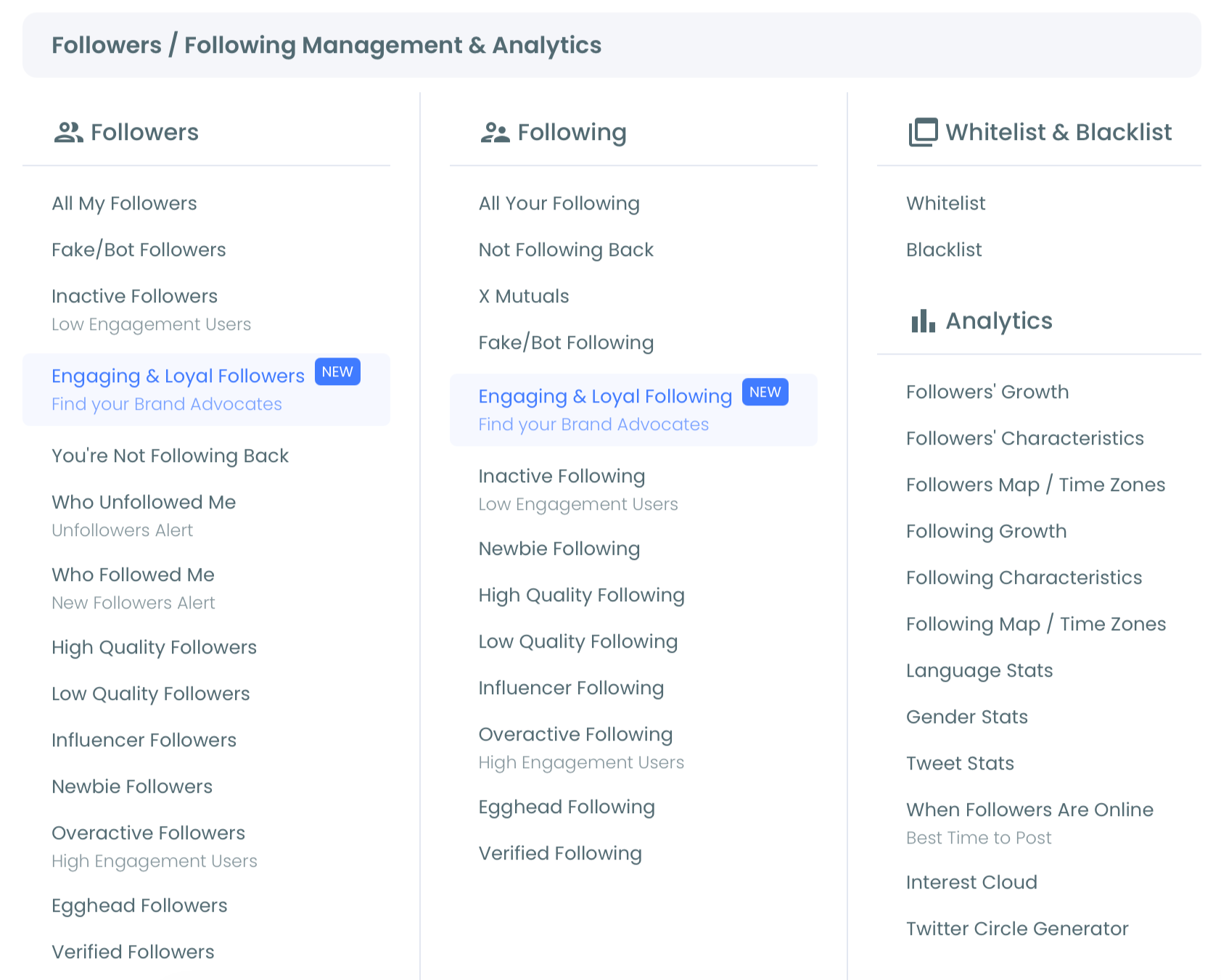
- Open the Follower-Following menu in the left navigation. The audit-related reports (All Followers, Fake/Bot, Inactive, Engaging & Loyal) all live under this surface.
Run each dimension's report in sequence
- Run each dimension's report in sequence: All Followers (for the live-follower denominator), Fake/Bot Followers (compound bot test), Inactive Followers (90 to 180-day recency threshold), and Engaging & Loyal Followers (compound engagement signal). Each report produces its own count and percentage; the four reports together produce the full audit picture.
Phase 2: Compute the Reach Baseline
Combine the four dimensions into a single reach calculation
- Combine the four dimensions into a single reach calculation. Start with the published follower count, subtract the not-live percentage to get the live denominator, subtract the bot percentage from there, subtract the inactive percentage from what remains, and the result is the live-and-active follower count. The engaging-and-loyal subset is a further breakdown within that count.
Export the underlying CSV for downstream work
- Export the underlying CSV for downstream work. The export captures username, user ID, and the per-dimension flag set (live, bot-probability, inactive flag, engagement tier). Open in Google Sheets or Excel for the segmentation and reach-modeling work that follows.
Update the reach baseline used in campaign briefs
- Update the reach baseline used in campaign briefs. The published follower count is the marketing-facing number; the audit-derived live-and-active count is the planning-facing number. Most operators keep both numbers in the brief template and reference the audit number for forecast math.
The six-step sequence is the full workflow. The four-dimension audit produces the data; the reach-baseline calculation turns the data into the number the campaign brief needs.
Video walkthrough: the four-dimension audit, the reach calculation, and the brief integration.
What the Audit Produces
The output is a per-dimension breakdown of the follower base, a reach baseline that adjusts the published follower count for inactive, fake, and not-live accounts, and a CSV export that supports any downstream segmentation or modeling work. The audit replaces the published-count assumption with a measured-baseline reality.
The Circleboom workflow uses the official X Enterprise Developer access for every dimension of the audit. The data is policy-compliant and the column structure is stable.
Two adjacent surfaces extend the workflow. The Twitter unfollow tool landing covers the action-side workflow when the audit reveals a large inactive cohort that should be cleaned. The Twitter bot checker landing covers the focused bot-side audit when the operator wants to drill into the bot-percentage dimension separately.
Related Circleboom reading on the account-audit theme.
- Twitter metrics: the complete dashboard on the broader metrics-tracking context that complements the audit.
- Tweet activity: the complete guide to Twitter analytics metrics and insights on the post-engagement side that pairs with the audience-quality audit.
Where the Audit Goes Next
A first full audit typically reveals that the live-and-active audience is 60 to 80 percent of the published follower count on an account that has accumulated followers over several years. The split is wider on older accounts and tighter on younger ones, with the typical inactive-percentage being the largest single drag on the baseline.
The audit informs three downstream decisions. The first is the reach baseline used in campaign-forecast math, which shifts to the audit-derived number rather than the published one.
The second is the cleanup priority, which usually targets the largest non-live cohort first (inactive followers in most accounts; bot followers in accounts that purchased growth or attracted significant bot interest). The third is the growth target recalibration, which moves from "grow the follower count" to "grow the live-and-active subset," a structurally more useful metric.
By the third monthly audit, the workflow is on a maintenance cadence. The audit takes 20 minutes; the saved configuration produces the four reports automatically; the reach baseline updates with each run. Run a full account audit and the published follower count stops being the planning baseline.
Still Wondering?
How does the audit handle followers whose status changed during the audit window?
The audit takes a snapshot at run time, so a follower who was active in week one and went inactive in week eight appears in whatever state their most recent activity reflects. The next month's audit will catch the state change and reclassify the follower accordingly. Operators who need fine-grained state-change tracking typically save each monthly CSV and run the differential against the prior month.
What percentage of fake or inactive followers is normal for an established account?
A 5 to 10 percent fake-or-bot share is typical for accounts that grew organically; accounts that purchased growth or ran heavy paid campaigns often show 15 to 30 percent. A 15 to 25 percent inactive share is typical for accounts older than three years; younger accounts show smaller inactive percentages because their audience has not had time to drift dormant. Audits that surface numbers significantly above these ranges usually point to a specific growth pattern worth investigating.
Can the audit run against an account I do not own?
The audit's public-data dimensions (live percentage, inactive recency from public posting data, bot probability from public profile signals) work against any public X account. The private-data dimensions (precise engagement quality against the operator's own posts) only work against the operator's own account. Most competitor-side audits use the public-data subset, which is sufficient for the comparative analysis most operators need.
How does the audit interact with X's own analytics?
X's native analytics surface aggregated metrics about the operator's posts and audience but does not provide row-level follower-quality data or compound bot-probability signals. The Circleboom audit is row-level and compound-signal-based, which complements the platform's native analytics rather than replacing them. Most operators use both: X analytics for post-performance, the audit for audience composition.
What happens to the audit if my account grows or shrinks significantly between runs?
The audit normalizes against the current follower count at run time, so a growth or shrink event between runs simply shifts the absolute counts proportionally. The percentages remain comparable across runs as long as the underlying audience composition is similar; a major composition shift (a viral spike, a follower purge) will produce a noticeable percentage change that is worth investigating.