
Can you schedule a Twitter poll the same way you schedule an ordinary tweet?
Not inside X itself, which is why most polls get posted whenever their author happens to remember one.
How do you schedule a Twitter poll?
Build the poll inside a scheduler that supports the native poll widget, then drop it into your calendar like any other post. Circleboom attaches an X poll of up to four answer options to a tweet, sets its running time, and publishes it at the minute you pick through official API access.
→ schedule Twitter polls
Why X gives you no native way to schedule a poll
X treats polls as a compose-time object, not a plannable one.
The poll widget appears in the composer, you fill in the choices, and the post goes out immediately.
There is no draft state for it, and the scheduling control that works on plain tweets does not carry the poll along with it.
That gap has a predictable cost.
Polls stop being a content format and become an impulse.
They fire on a Sunday night because someone thought of a good question in the shower, land in front of a fraction of the audience, and collect forty votes that tell you nothing.
The workaround most accounts settle on is a calendar reminder, which moves the friction rather than removing it.
The better fix is to schedule a Twitter poll in advance alongside the rest of the week's posts.
Then the question goes live at a moment you chose on purpose.
Timing matters more for polls than for almost any other format, because a poll has a deadline built into it.
A question that opens while your audience is asleep loses a chunk of its window before anyone sees it. The same effect shows up in how the timing of your Twitter poll affects participation.
What changes when a poll sits in your content calendar
A scheduled poll stops competing with your memory and starts competing for attention on its own merits.
Circleboom's Poll Generator creates native X polls inside the post editor and schedules them alongside your regular tweets, so a weekly audience question becomes a fixed slot instead of a lucky accident.
The company behind it is an official X Enterprise Developer. That is why the poll publishing on your behalf is a real native poll rather than a link to an outside voting page.
Your followers vote inside the tweet, the percentages render in the timeline, and nothing about the post signals that it was queued days earlier.
Placement is the second thing you get back.
Once you can schedule X polls, you can point them at the moment they are useful. That might be the week before a product decision, the midpoint of a content series, or a quiet stretch where a one-tap format restores interaction.
Circleboom's best time to post on Twitter report tells you which windows your own followers actually occupy.
That pairing is the whole argument for planning polls rather than improvising them.
Picking a window from your own follower data beats copying a generic chart. Circleboom covers how to determine your best time to post on Twitter in detail.
One habit makes the difference: build the poll and its follow-up post in the same sitting, while the reasoning behind the question is still fresh.
Poll scheduling with Circleboom, start to finish:
https://www.youtube.com/watch?v=TLRA28S_9dU
To schedule a Twitter poll, open the X Post Planner editor and attach a poll through the poll icon. Fill in two to four answer choices, set how long voting stays open, then schedule the tweet the way you would any other post.
The poll clock starts when the post publishes, not when you build it.
The nine steps below run that sequence in three phases.
How to schedule Twitter polls step by step
Open the editor where the poll actually lives
- Log in to Circleboom Twitter and connect the X account the poll will publish from.

- Open the X Post Planner menu, which holds every composing and scheduling control for the account.
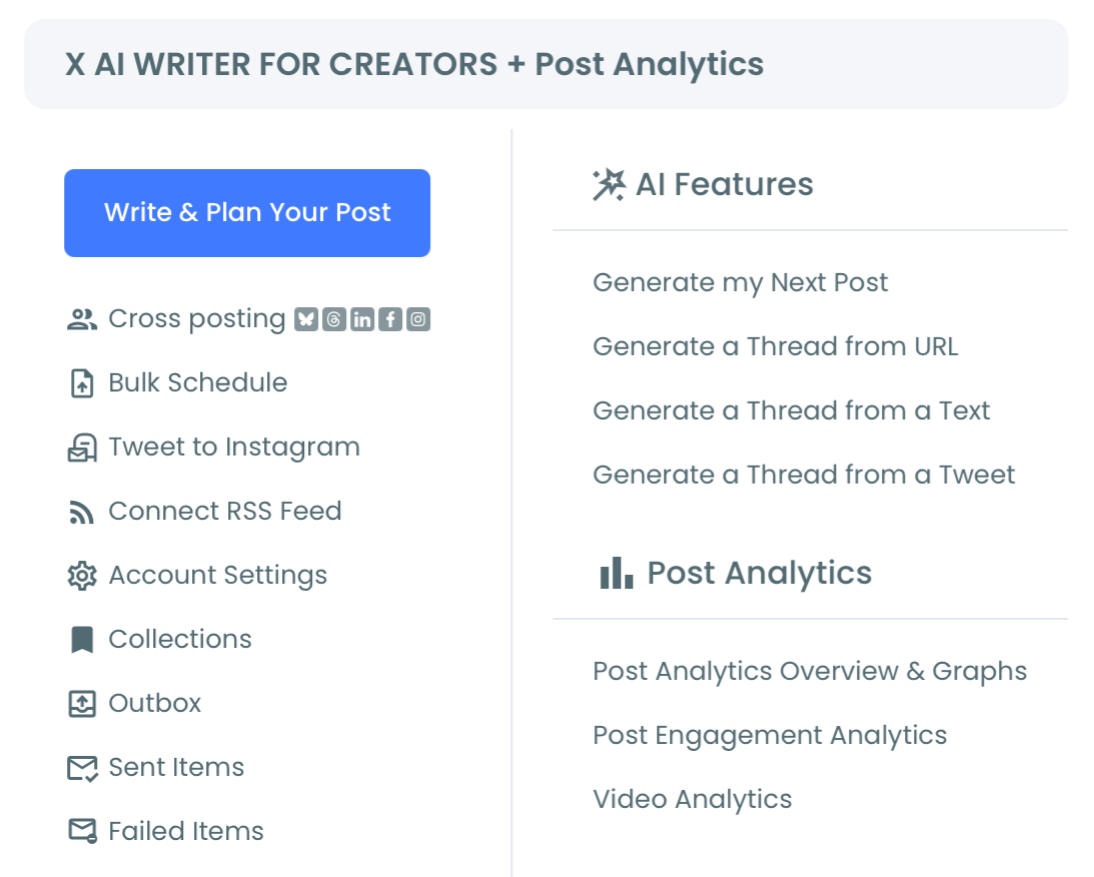
- Start a new post and click the poll icon in the editor toolbar. It is the bar chart icon, and it opens the Add Poll panel inside the same editor, so you never leave the composer.
Write options your audience can answer in one tap
- Type your answer choices into the Choice fields. X allows up to four, and each one is capped at 25 characters, with a live counter showing how much room is left.
- Remove any choice you do not need with the minus button beside it. Two options is the minimum for a valid poll, and a two-way question often reads more cleanly than a padded four-way one.
- Set the running time with the Days, Hours, and Minutes dropdowns. The default is one day, the ceiling is seven days, and the floor is five minutes. Match the window to the decision you are making, not to the maximum available.
Attach the poll and place it in the calendar
- Click Add to attach the poll to the tweet. The poll is not attached automatically, so skipping this leaves you with a plain text post at publish time.
- Write the tweet text above the poll widget. This is where the question itself goes, since the choices only carry 25 characters each and cannot hold the framing.
- Pick your publish time and schedule the post. Scheduled polls need to sit at least 15 minutes in the future, and the voting window opens the moment the tweet goes live.
That order holds up because each phase removes a way the poll can fail.
The login earns official API access so the widget publishes natively. The writing phase forces the 25-character limit into view before you commit to wording you cannot edit later.
And the Add click is the one action separating a real poll from an empty tweet.
Quick recap: open the planner, attach the poll, write two to four choices, set the duration, then schedule.
What the poll format will and will not let you do
X sets the rules for polls, and Circleboom schedules inside them rather than around them.
Everything below happens in the X Post Planner, the same editor your ordinary tweets go through.
Knowing the boundaries before you write saves you from a published poll you cannot fix.
The structural limits are short enough to hold in your head:
- Two options minimum, four maximum, 25 characters each.
- Voting runs from five minutes to seven days, and the length is locked once published.
- A poll cannot share a tweet with an image, GIF, or video.
- Votes are anonymous, so you see percentages and never individual voters.
- Poll options cannot be edited after publishing, only deleted and reposted.
The last one is the one that stings.
A typo in Choice 3 means deleting the tweet and starting over, which throws away whatever votes and replies had already accumulated.
Scheduling helps here in a way that is easy to miss: a poll queued for tomorrow morning can be reread tonight, and rereading is what catches the overlapping option or the missing answer.
The no-media rule shapes strategy too.
Since the poll widget occupies the media slot, a poll cannot lean on a chart or screenshot to carry context, and everything the reader needs has to fit in the tweet text above it.
X's own help centre guidance on polls documents the same structural rules from the platform side.
Which polls are worth putting on the calendar
Not every question deserves a scheduled slot, and the ones that do share a shape.
They ask something you cannot already answer from your own analytics, and they offer choices a follower can pick between without thinking twice.
Three kinds earn their place reliably.
The first is a decision you are genuinely undecided about.
Which of two names reads better, which topic to cover next, which format your readers want more of. The answers change what you publish, so the votes carry weight beyond the post itself.
The second is a temperature check on something your audience has an opinion about but rarely says out loud.
A question about a platform change, a tool everyone complains about, or a working habit gives people a low-cost way to declare a position. Those polls tend to pull replies as well as votes, because a percentage split invites people to explain their side.
The third is a setup for the post that follows.
Ask on Tuesday, publish the answer on Thursday, and the second post arrives with an audience already invested in it. That continuity is the strongest argument for scheduling both halves at once rather than hoping you remember to write the follow-up.
What all three avoid is the poll that exists only to fill a slot. A question with an obvious winner produces a lopsided split and no information.
If you cannot name what you would do differently depending on the outcome, the slot is better spent on something else.
Is it safe to schedule a Twitter poll through a third-party tool?
Yes, when the tool publishes through official API access rather than automating a browser session.
That distinction is the whole safety question.
A scheduler with sanctioned write access posts on your behalf the same way the X app does, and the poll that lands is indistinguishable from one composed by hand.
Circleboom sits in that first category, and the poll it publishes to your X account is a native poll object rather than a workaround. Nothing is scraped, no credentials are re-entered anywhere outside the official login flow, and the account keeps the same standing it had before you queued anything.
The practical risk with polls is editorial, not technical.
A leading question or a set of overlapping options produces votes you cannot interpret, which is a wasted post rather than a dangerous one.
If your engagement is soft across the board and not only on polls, the causes usually sit upstream. Circleboom's notes on how to improve your Twitter engagement rates work through them.
Vote counts are also relative rather than absolute.
A hundred votes on a small account can be a strong result while the same hundred on a large one is a quiet one. That is the reasoning behind what is a good engagement rate on Twitter.
What to do with your first scheduled poll
A poll is the cheapest question you will ever ask your audience.
The only thing standing between you and a regular cadence of them is the fact that X will not hold one for later.
Circleboom removes that constraint by building the poll inside the X Post Planner editor and publishing it at your chosen minute.
Start with one question you genuinely want answered, give it a two-day window, and schedule it into a slot when your followers are actually reading.
Then use the result.
The follow-up post that opens with what your audience told you is easier to write than anything you would have invented. It slots naturally into the AI-powered X post scheduler workflow you are already running.
→ Schedule your next Twitter poll
Common questions about scheduling Twitter polls
Can I schedule a Twitter poll from the X app itself?
No. X only lets you attach a poll at the moment you compose the post, and the scheduling control does not carry the poll widget with it. A scheduler with official write access is the only route to a poll that publishes later, and Circleboom explains the mechanics in can I schedule a Twitter poll.
When does the countdown on a scheduled poll start?
At the moment the tweet publishes, not when you build or queue it. A three-day poll scheduled for Thursday morning closes Sunday morning, so plan the window around when you need the answer rather than around your drafting day.
Can I fix a typo in a poll option after it goes live?
No. Poll options are locked once the tweet is published, and the only correction available is deleting the post and reposting a fixed version, which discards the votes already cast. Reading a scheduled poll once more before its publish time is the cheapest safeguard there is.
Do polls actually earn more engagement than normal tweets?
They usually do, because voting costs one tap while replying costs a sentence. That lower barrier is why polls work as a recovery format during quiet stretches. Circleboom breaks the tactic down in how to use Twitter polls to increase Twitter engagement.