
Political posts age worse than almost anything else on a timeline.
A take that felt ordinary during one election week reads very differently three years later, and X keeps the whole record searchable for recruiters, clients, journalists, and anyone with a screenshot habit.
Scrolling back through eight years of posts to find them by hand is the part nobody finishes.
What this walkthrough gives you.A path to political posts that sit far past the 3,200-post API window.Keyword, hashtag, date, and engagement filters that isolate political content and leave the rest alone.A Protect List step so the posts you still want stay live.
Circleboom reads your X archive file and removes the matching posts from your Twitter account through official API access.
→ Delete political tweets
Why political tweets are the hardest posts to clean up on X
Political content spreads across your history in a way that ordinary posts do not. Sports takes cluster around seasons. Work updates cluster around launches.
Political posts show up during primaries, debates, votes, court rulings, protests, and every news cycle in between, which means they are scattered across years rather than parked in one window you can scroll to.
The second problem is reach. X's own timeline only lets you scroll back so far before it stalls, and the platform's API caps retrieval at the most recent 3,200 posts.
If you have been active since 2016, the posts you most want gone are usually the ones you cannot even load.
That gap is why a bulk cleanup that only touches recent activity misses the point.
Circleboom's archive-based path exists for exactly this case, reaching posts on X that your Twitter timeline will not scroll back to. That is where you remove political tweets in bulk instead of tapping through them one at a time.
There is also a judgment problem. Not every political post deserves deletion, and blanket wipes destroy things worth keeping.
Circleboom's own what to delete and what to keep makes the same argument from the other side. The goal is a cleaner record, not an empty one.
What counts as a political tweet on your X timeline
Define the target before you touch a filter.
"Political" is a fuzzy category, and a keyword list that is too broad will pull in posts you never meant to remove.
Most people are working with some mix of these:
- Posts naming candidates, officials, or parties.
- Posts carrying campaign or movement hashtags.
- Replies and quote posts arguing about a news event.
- Retweets of political accounts you no longer want attached to your profile.
- Posts tied to a specific election week or vote.
Write the list out before you start.
A concrete list of names, hashtags, and handles turns a vague intention into a filter you can actually run, and it stops the cleanup from sliding into a full timeline wipe you did not intend.
Borderline cases are worth deciding in advance too. A post about a policy that affects your industry may read as professional commentary rather than partisanship, and a joke about a debate may read as neither.
Rather than agonizing over each one mid-run, set a rule: anything you would not want quoted back to you in a meeting goes, everything else stays.
Retweets deserve their own decision. Many accounts carry far more political retweets than original political posts, because amplifying was easier than writing.
Circleboom treats posts, retweets, and replies as separate checkboxes, so you can clear the retweets and keep your own words if that is the split you want.
If you are not sure how much political content you are carrying, the walkthrough on how to find politics tweets covers the discovery side before any deletion happens.
How to delete political tweets step by step
Watch the keyword filter in action: this clip shows the same filter field you will use to target candidate names, hashtags, and handles.
The flow runs in three stages: get the archive, filter it, confirm the count.
Get your archive and open the delete workspace
- Log in to Circleboom Twitter and connect the X account you want to clean.

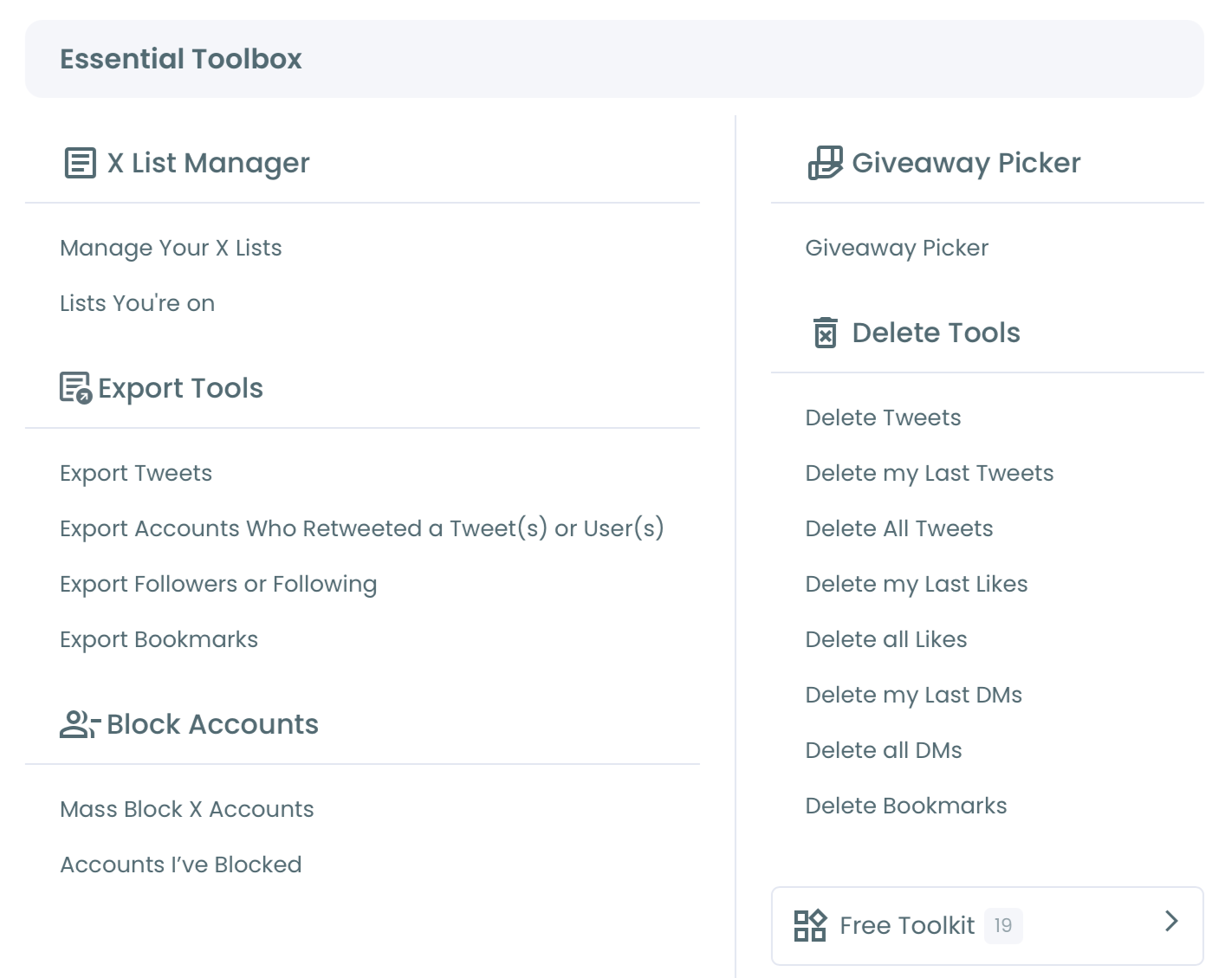
- Open the Essential Toolbox menu and select the Delete All Tweets workspace inside it.
- Request your data archive from X in your account settings. X generates it and delivers the download link within roughly 24 to 48 hours, and the platform's own instructions for downloading your X archive cover where the button lives.
Upload tweet.js and set the political filter
- Upload the tweet.js file from your unzipped archive folder, not the full ZIP. It has to come from the same X account linked to your Circleboom subscription, or the upload will not process.
- Enter your political keywords, hashtags, and handles in the keyword filter. It searches post text, @mentions, and #hashtags, so a candidate name catches both the posts that mention them and the replies aimed at their account.
- Set a date range when the content clusters around known events. Start and end dates are inclusive and default to the first and last post in your uploaded file.
Protect what stays, then confirm the count
- Add posts you want to survive to the Protect List using the add option on Step 3. Anything on that list is excluded from the run.
- Read the Approve & Delete panel on the right. It shows the exact number of posts, retweets, and replies that the current filter combination will remove.
- Click "Delete my Tweets" once the count matches what you expect.
That order is what keeps the operation safe.
The archive gets you past the 3,200-post ceiling before you filter, the keyword and date filters narrow the target before anything is selected, and the Approve & Delete count catches a filter that was broader than intended.
Deletion is permanent, so the review step is not optional.
Filters that make political tweet cleanup precise
The keyword field does most of the work, but it is not the only lever. Circleboom exposes several filters on the same screen, and combining two or three is what separates a targeted cleanup from a blunt one.
Engagement range is the most useful second filter. Political posts that never got traction are usually safe to clear without a second thought, while a post with hundreds of replies may be worth reading before you decide.
You can set minimum and maximum like counts, and the same range control exists for retweets. That is the approach behind Circleboom's take on how to mass delete tweets based on popularity.
Combining filters without over-deleting
Media type is the other one people forget.
Political content often travels as screenshots and reaction images rather than text, and filtering for posts with media attached catches the ones a keyword search would miss entirely.
Language is available too, defaulting to All. It matters if you posted about politics in more than one language, or if you want to clear content from a period when you were posting in a language your current audience does not read.
You can also run the same file more than once.
Circleboom removes already-deleted items before applying filters, so you can upload tweet.js on Monday for candidate names, upload the same file on Friday for hashtags, and nothing gets processed twice.
That makes a cautious, multi-pass cleanup practical instead of exhausting. It pairs well with a narrower run like delete tweets by keyword when you only want one term gone.
For accounts where the political content sits in one identifiable era, the Twitter archive eraser path handles date-bounded history the same way. The step-by-step version of that flow is covered in how to delete tweets by date.
Back up before you delete political tweets
Run the export before the deletion, not after.
The archive you downloaded from X is the only surviving record once the run completes, and political posts are exactly the category where you may later need to prove what you actually said rather than what someone claims you said.
Keep the unzipped archive folder somewhere you will still find it in two years. A cloud folder or an external drive both work; a downloads folder you clear every month does not.
Verify the file opens before you upload it. An archive that failed to download completely will still unzip, and discovering that after the deletion has already run is the worst possible time to find out.
There is a second reason to pause here.
Some political posts are load-bearing for your account in ways that are easy to forget. A thread that got quoted by a journalist, a correction you issued publicly, or a post that a client references in an email chain all have value beyond the opinion inside them.
Read the ones with real engagement before you decide. The Protect List exists for precisely this group, and it turns the operation from an all-or-nothing wipe into a reset with exceptions.
If the account is owned by a company or shared with a team, tell them first. A political cleanup on a brand account changes the public record, and a teammate finding out from a follower's screenshot is a worse conversation than a five-minute heads-up.
Once the backup is verified and the Protect List is built, you can wipe political tweets from your timeline with the confidence that nothing irreplaceable is inside the batch. Accounts planning a wider reset after the political pass often follow it with the full sweep described in delete all tweets instantly.
Is it safe to delete political tweets on X?
Yes, when the deletion runs through sanctioned access rather than a scraper.
Circleboom is an official X Enterprise developer, so every deletion request travels through channels X itself authorizes. Your account never touches the suspension risk that comes with unofficial workarounds.
Two things are worth knowing before you commit.
Deletion is permanent and cannot be reversed, so the archive you downloaded is your only remaining record of what was there. Keep that folder somewhere safe rather than throwing it out once the run finishes.
The second is that other people's posts are outside your control. Quote posts, replies, and screenshots from other accounts that referenced your deleted content can still exist on X afterward. Circleboom's post on why deleted tweets still show up covers the caching and third-party side of that in more detail.
Anything that pointed at a deleted post stops working. Embedded posts on other sites go blank, links in newsletters and articles dead-end, and a thread someone cited loses its source.
If any of your political posts were ever quoted by a publication or linked from a page you control, check those references before the run rather than discovering them broken afterward.
Large runs also take time, because API rate limits still apply during execution. Leave the browser open until the process finishes rather than closing the tab halfway through.
What to do next
Political cleanup goes wrong in one of two ways: people either put it off until a screenshot forces the issue, or they panic and wipe everything including posts that were doing real work for them.
The archive path avoids both, because it gives you reach into old content and precision about which of it goes.
Work through it in this order:
- Request your X archive today, since the 24 to 48 hour wait is the only part you cannot speed up.
- Write your keyword list while you wait: names, hashtags, handles.
- Decide separately whether retweets and replies are in scope.
- Build a Protect List for anything you want kept.
- Run a narrow pass first, check the result, then widen it.
→ Clear political posts from your archive
What to know before you start
Can I delete political tweets from years before the 3,200-post limit?
Yes. The API-only path stops at your most recent 3,200 posts, but the archive file X generates contains your full history regardless of age or volume. Uploading tweet.js is what extends the cleanup back to your earliest political posts.
Will deleting political tweets remove them from Google search results?
Not immediately. The post is gone from X once the run completes, but search engines and third-party caches can hold a copy until they recrawl the page. Circleboom's walkthrough on how to delete tweets from Google search covers what you can do to speed that along.
What if my keyword filter catches posts I want to keep?
Add them to the Protect List before you run the deletion. The Approve & Delete panel updates as you adjust filters, so you can watch the count drop as protections are applied and stop before anything is removed.
Do I have to delete my retweets of political accounts too?
That is your call, and Circleboom keeps it separate. Posts, retweets, and replies are three independent checkboxes on the filter screen, so you can clear amplified content while keeping your own writing, or the reverse.