
You can delete retweets containing a specific keyword without removing your original posts: use your X archive, select ReTweets only, and filter the uploaded record by the word, @mention, or hashtag that defines the cleanup. The safe part is the scope. A keyword identifies a subject; the ReTweets setting identifies the type of action you are willing to remove.
Manual cleanup: scrolling finds only the Reposts you happen to notice. Archive filtering: Circleboom narrows your account record to keyword-matched Reposts through official X Enterprise APIs, so you can inspect the exact set before a permanent action.
→ Delete retweets containing keyword
Review the exact match list before you confirm.
Why keyword cleanup needs a ReTweets-only boundary
A keyword search is not automatically a deletion rule. The same campaign name can appear in an old original announcement, a reply to a customer, and a Repost of someone else's post. If your aim is to withdraw old endorsements or distribution activity, selecting ReTweets while leaving Tweets and Replies out is what keeps the action aligned with that aim.
X can undo one Repost from the post menu. Its official Repost guidance explains that undoing a Repost removes it from your timeline, not the source post from X. That works for a single recent item. It is a poor audit method for a discontinued product name that appears across years of history.
The archive route answers a better question: “Where did I associate this account with this term?” It is more reliable than deleting whatever happens to be visible while you scroll today. Circleboom can delete retweets containing keyword matches after you choose the post type and filter.
Separate the subject from the action type
A keyword is a hypothesis. The selected list is the evidence.
Before deleting, write down the variants you expect to find: the former brand name, product spelling, campaign hashtag, old handle, and common abbreviations. Search each as a separate review pass if the names are not interchangeable. A term such as “Spring” can be a campaign label in one Repost and ordinary language in another.
When that vocabulary is ready, run a keyword-matched Repost review instead of letting a broad timeline view decide the scope for you.
What the archive-based filter can search
Circleboom’s Delete All Tweets workflow reads the tweet.js record from the X archive. It can filter tweet text, @mentions, and #hashtags, then separately limit the action to Tweets, ReTweets, or Replies. That combination is useful because the keyword answers which subject and the post-type control answers which account activity.
X provides instructions for requesting and downloading your archive. Keep the ZIP file before any cleanup. It is your local record of what you reviewed, even though it is not a restore button for content removed from the live account.
The archive approach also matters for older profiles. Circleboom’s feature documentation states that its archive workflow reaches beyond the recent API-accessible 3,200-post window. An old Repost may not be easy to find in the profile interface, yet it can still matter to a reader who sees it through a direct link or a historical search.
If your real rule is temporal rather than topical, use delete tweets by date instead.
If you want every Repost gone, delete retweets is the more direct destination. Mixing those goals with a keyword rule is how a narrow cleanup turns vague.
How to delete retweets containing keyword matches
To delete retweets containing a keyword, connect the matching X account, upload its tweet.js file, choose ReTweets alone, run the keyword filter, and approve only after the count and exceptions make sense. Here is the flow in order.
Open the account you intend to clean
- Log in to Circleboom Twitter with the X account that published the Reposts.

- Request the X archive from account settings if you do not already have a current copy.
- Store the downloaded ZIP somewhere you can find after the cleanup.
Using another account’s file is not a shortcut. The uploaded tweet.js file must belong to the account connected to the Circleboom subscription. That pairing protects the basic identity boundary of an archive deletion.
Upload the post record, not the archive package
- Open Essential Toolbox and upload
tweet.jsfrom the archive folder rather than the full ZIP.
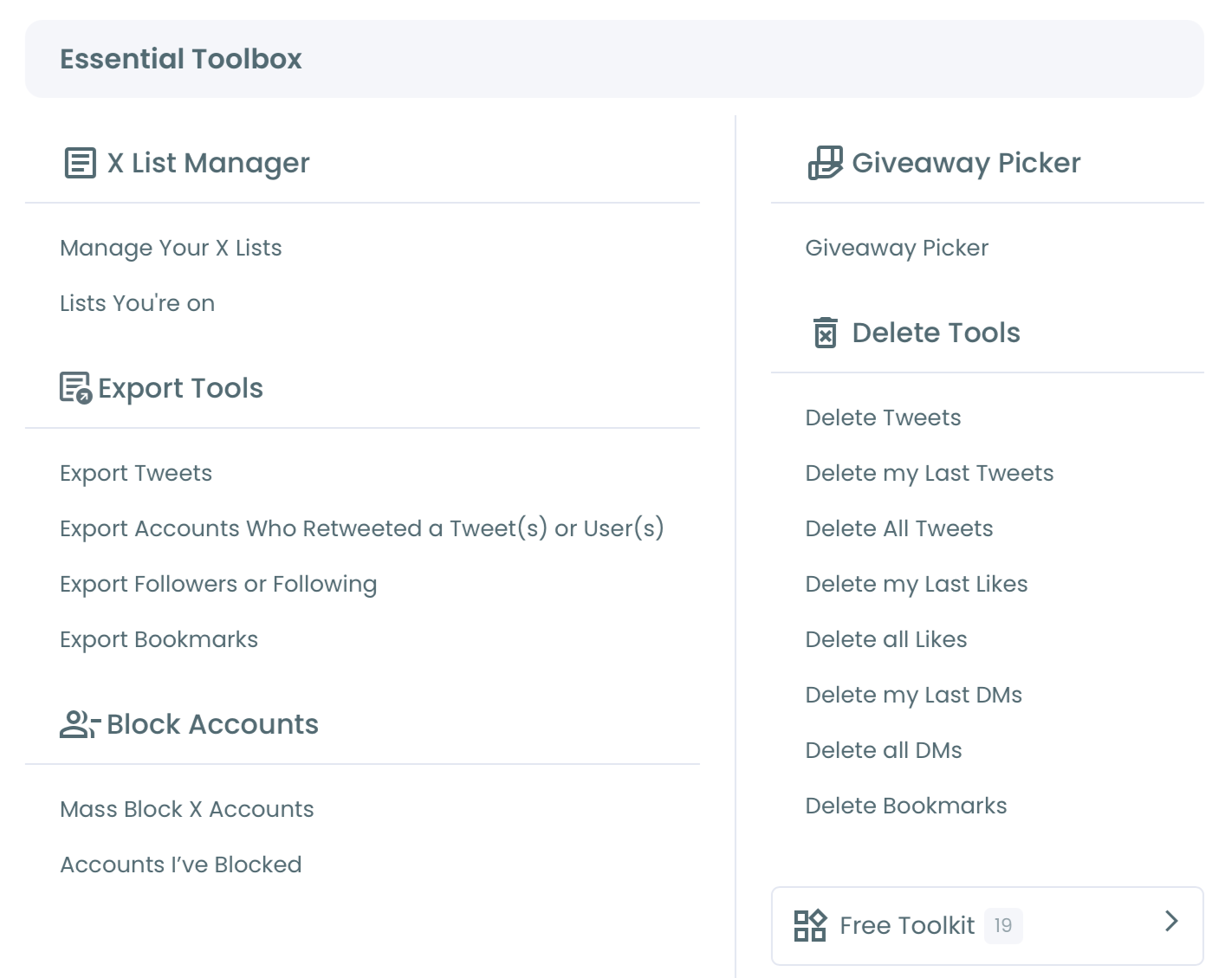
- Check the uploaded total before you begin filtering.
The total is a useful sanity check, not proof that every selected item should go. Circleboom can remove already-deleted items from a later upload of the same file, so you can handle a former product name in a separate pass instead of stacking unrelated rules into one action.
Limit the action to ReTweets and enter the term
- Clear Tweets and Replies, leaving ReTweets selected.
- Enter the keyword, @username, or #hashtag in the keyword filter.
- Review the matching entries and their count in the Approve & Delete panel.
Keyword matching is where careful wording matters most. Search a former brand with and without punctuation. Test a hashtag separately from a plain-language word. If an old handle changed, search both handles. Do not assume one string captures every reference, and do not broaden a term simply because the first result count seems low.
Protect exceptions before confirming a permanent action
- Add any Reposts you need to keep to the Protect List.
- Read the final count as a question: “Would I be comfortable explaining every one of these removals?”
- Choose Delete my Tweets only when the list answers yes.
The deletion is permanent. Save examples or notes for material that has legal, customer-support, partnership, or historical value. Removing your Repost does not remove the original author’s post, other people’s replies, quote posts, screenshots, or copies outside your account.
Keep the browser open and stay logged in to the connected X account until Circleboom reports that the approved deletion has finished.
Video: filtering old X posts by keyword
A practical keyword plan that avoids false matches
Good cleanup terms are specific enough to explain. A previous company name, a discontinued service, an election tag, or a former client handle is easier to evaluate than a broad topic word. Start with the exact label. Only add a synonym after you inspect what the first search missed.
Use a small worksheet before you enter anything:
- Primary term: the name or phrase that directly identifies the subject.
- Variants: spacing, punctuation, old spellings, and hashtags.
- Must-keep contexts: reposts that document a partnership, announcement, or public correction.
- Scope boundary: ReTweets only, plus an optional date range if the topic changed over time.
This approach prevents a common mistake: treating every mention as endorsement. A Repost may have been used to criticize, report, or answer a discussion. Read enough context to decide whether the association is actually one you want removed.
For a detailed look at using terms and tags in a cleanup, see how to delete tweets by keywords and hashtags.
When your requirement is date-led instead, delete all retweets of specific dates explains why a calendar boundary can be clearer than a word.
Why staged filters are safer than one giant search
An archive can support repeated, narrow passes. That is useful when you are removing several former campaigns or brands. Run one keyword, protect exceptions, verify the result, and only then move to the next term. The same archive file can be uploaded again; the workflow excludes items already deleted.
Staging creates an audit trail in your own notes. Record the term, the date, the selected count, and any protected item. A team account benefits from this discipline because another person can see why a Repost disappeared. A solo account benefits too: it keeps a stressful cleanup from becoming an irreversible guessing exercise.
Use a platform-integrated workflow, then still review it
Circleboom is listed in X’s Enterprise customer directory and works through official X Enterprise APIs. That is relevant when a tool is acting on account content. Trust does not eliminate the need to review a destructive selection; it means the workflow has a clear platform-integrated basis rather than asking you to run an unknown script against your profile.
If a source post is unavailable or its owner has blocked you, see deleting retweets when blocked by the tweet owner.
If your broader task includes reactions as well, old leftover retweets and Twitter likes explains why they should be reviewed as separate queues.
Review the matches as account context, not just text
The same keyword can carry different meanings in different periods. A Repost from a product launch may be a useful piece of account history. The same product name in a later complaint, endorsement, or breaking-news Repost may create a very different association. Read the source, the date, and the account that published it before you decide it belongs in the deletion queue.
For organizations, agree on the rule before a person presses approve. A short note such as “remove Reposts promoting Product A before its retirement, retain service notices and corrections” tells the reviewer what to protect. It also avoids the awkward result where a cleanup removes a post that a support, sales, or legal colleague still needs to reference.
Filters by date, language, media type, likes, and Repost count can narrow the list further. Use them only to solve a clear problem. A date range helps when the term was acceptable during one partnership but not another. A language filter helps only when account metadata reliably separates the material. More controls do not automatically mean a better rule.
Treat a surprisingly high or low count as a signal to investigate. A high count may show that the term is broader than expected. A low count may mean that former names, hashtags, or handles were missed. You can cancel the review, adjust the vocabulary, and upload the same archive again without turning a search experiment into a deletion.
The final panel is where speed gives way to judgment.
What happens after you remove the matches
Your visible association with the selected Reposts is removed from your X profile. The original content remains with its author. Search engines, cached views, embedded posts, screenshots, and third-party services may refresh on their own schedules, so do not interpret one stale display as a reversed deletion.
Check the live profile and sample the terms in X after the action has completed. If the next keyword is substantially different, start another filtered pass. Do not jump from a handful of disputed Reposts to deleting every historical post merely because the first task was satisfying.
The strategic result is a timeline that better reflects the account’s present position while preserving the original posts and replies you intentionally left out. For a brand, that distinction matters: a curated public record can keep proof and context without continuing to distribute obsolete messages.
Questions about keyword-based repost deletion
Can I delete retweets containing a keyword but keep my own posts?
Yes. In Circleboom, select ReTweets and clear Tweets and Replies before applying the keyword filter. Review the final count and Protect List before deletion because keyword matches can include more context than you expect.
Does deleting my repost delete the original post?
No. It removes your Repost action from your account. The original post remains controlled by its author, as X explains in its official Repost help.
Can I search hashtags and @mentions too?
Yes. The archive filter searches tweet text, @mentions, and #hashtags. Run each important variant separately if the cleanup depends on a former name or campaign tag.
Can I undo the deletion later?
No. Treat the live deletion as permanent. Keep the X archive and make notes or copies of any material you may need for reference before approving it.
Keep the keyword rule narrow and defensible
The best keyword cleanup fits in one sentence: “Remove my Reposts of this discontinued product, except the launch correction.” That rule is narrow enough to review and clear enough to repeat if another spelling appears later.
Use the archive as your backup, use ReTweets as the content boundary, and use the approval count as the final pause. When the selection is genuinely the one you mean, remove keyword-matched retweets with Circleboom.