
To delete tweets that contain a specific word on Twitter, load your posting history into a filter, match the word, check what the match caught, and remove the result in one action. X itself has no control like that, so the word sits on your timeline until something with official API access takes it off.
What this walkthrough gets you.A test that tells you which Circleboom path your word needs before you touch a filter.The filter pairing that isolates one word without dragging in posts you meant to keep.The one habit that keeps an over-broad keyword from turning into a permanent loss.
Circleboom filters and deletes tweets containing any word, @username, or hashtag on X through official X API access. Start with delete tweets by keyword on Twitter.
Why Twitter gives you no way to delete tweets by word
X ships no bulk delete at all, by word or by anything else.
X's own instructions for removing posts walk you through one post, from its own menu, with no search box and no multi-select.
That design is fine when you regret a single thing you wrote yesterday. It stops working the moment the thing you regret is a word you used casually for two years.
Think about what that actually looks like. An old employer's name. A handle you no longer want associated with yours. A product line you discontinued. A phrase from a campaign that read well then and reads badly now.
The word is scattered, not clustered. It does not sit in one date range or one thread, which is exactly why scrolling for it fails.
Circleboom solves this by pulling your posts into a table you can filter, so a word becomes a query instead of a scavenger hunt on Twitter.
A dry run helps when you are not sure how often the term shows up. You can search the specific words a Twitter account said first, get a count, and decide whether this is a five-post problem or a five-hundred-post problem before you go anywhere near a delete button.
If the scattered-word problem is the one you have, the fix lives here: delete tweets with a specific word on Twitter.
Does the word live inside your last 3,200 posts?
Run this test before you open anything, because it decides which of two Circleboom paths you need.
X's API hands a third-party tool up to your 3,200 most recent posts. Circleboom's Delete My Last Tweets works inside that window straight from the live API connection, with no archive file involved.
Everything older than post number 3,200 is invisible to that path, and reaching it needs Delete All Tweets, which works from the tweet.js file inside your X data archive.
So the question is arithmetic, not preference: how far back does 3,200 posts reach on your account?
Take three illustrative accounts, using round posting rates rather than measured ones:
- Post 40 times a month and 3,200 posts covers roughly the last six and a half years.
- Post 5 times a day and it covers a little under two years.
- Post 15 times a day and it covers about seven months.
Now put your word on that timeline. If the last time you used it falls inside that reach, the live-API path is enough and you can start in minutes.
If your word belongs to a job you left four years ago and you post a dozen times daily, the archive path is the only one that sees it. X says the archive may take a few days to prepare, so the cleanup becomes a multi-day job rather than a ten-minute one.
Nobody tells you to run this check first, which is why so many keyword cleanups end with "it only deleted some of them." They did not delete some of them. The tool never saw the rest.
Both paths carry the same Keyword / Username or Hashtag filter, so the workflow below reads the same either way. Only the loading step changes.
When your word straddles the boundary
Plenty of accounts sit in the awkward middle, where the term appears both last month and five years ago. You do not have to pick one path.
Run the live-API path first and clear everything the API can reach today. That takes the recent, most visible instances off your profile immediately, which is usually the half that actually bothers you.
Then request the archive, and run the same keyword through the archive path when the file arrives.
The second pass is cleaner than it sounds, because Circleboom strips already-deleted items out of the uploaded file before applying filters. Your first run does not get repeated, and the same tweet.js can be re-uploaded later with a different word if a second term comes to mind.
For the related boundary problem of filtering by when something was posted rather than what it said, Circleboom also lets you delete tweets by date. The same 3,200 logic applies there.
How to delete tweets with a specific word on Twitter in three phases
The sequence below runs in three phases: load your posts, narrow them twice, then keep a record before anything is removed. Roughly seven clicks, and the risky one is last on purpose.
Two minutes on screen: the keyword field being typed, applied, and the row count dropping before a single post is removed.
https://www.youtube.com/watch?v=4eayAXQdLbs
Get your posts on screen before you filter anything
- Log in to Circleboom Twitter and authorize your X account through the official OAuth screen.

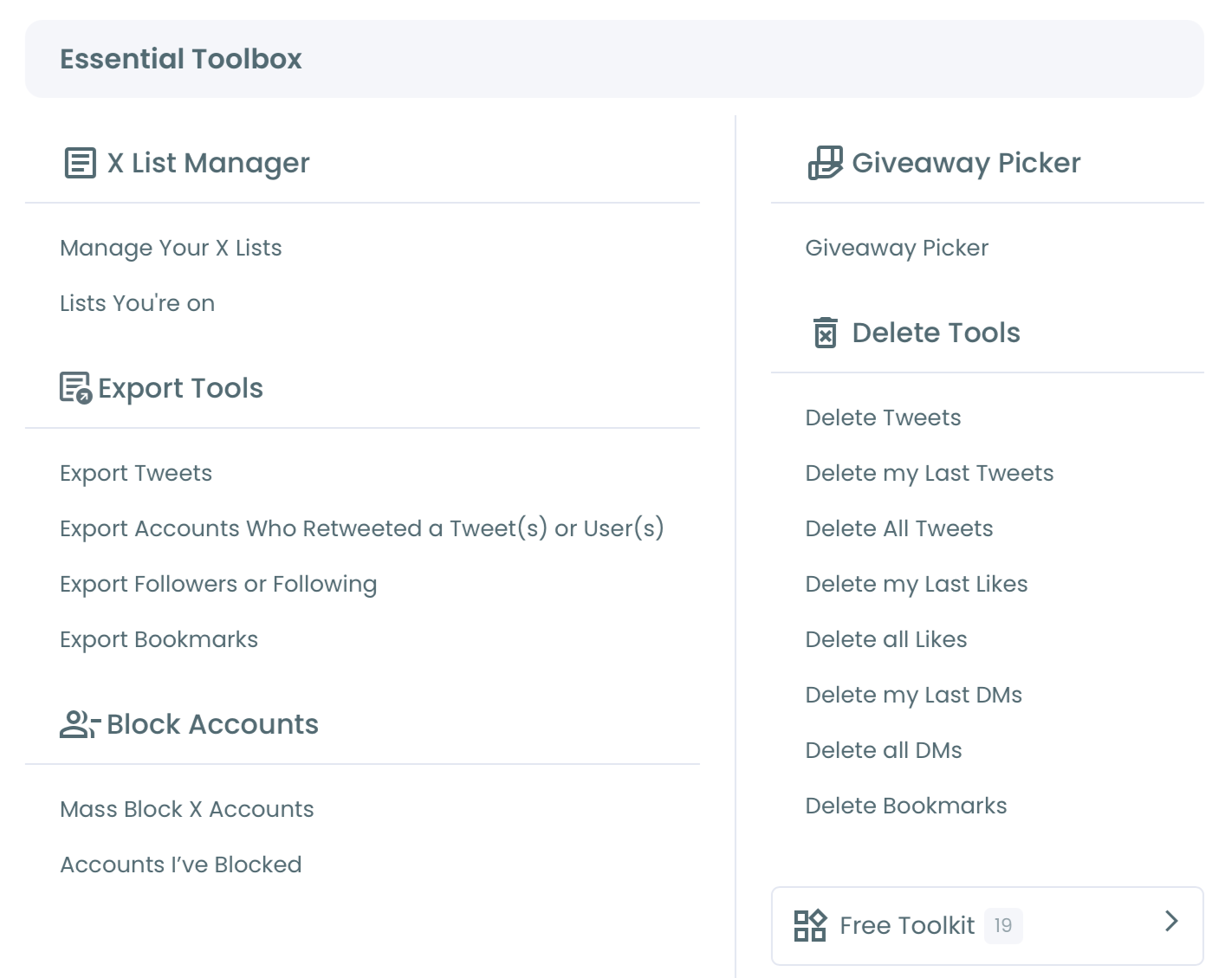
- Open the Essential Toolbox menu and pick Delete Tools, then My Tweets.
- Choose the path your 3,200 test pointed to. My Tweets loads up to your latest 3,200 posts directly, with no upload. If your word predates that window, switch to the archive route and upload the tweet.js file from your X data archive instead.
Narrow to the word, then narrow again by date
- Type your term into the Keyword / Username or Hashtag box and press Apply Filters. The table redraws to matches only, and the header count tells you how many posts your word actually touched.
- Add a date range on top of the keyword. This is the pairing that matters: the word tells the filter what to look for, the dates tell it where to stop looking. A term you only used during one campaign year should never be hunted across your whole history.
Save the evidence, then delete
- Export the filtered list to CSV using the Export button, which shows your remaining token count beside it. The CSV keeps the text, engagement figures, dates, and links of everything about to go.
- Delete the filtered set. Delete All removes every post currently loaded in the table, and Delete Selected removes only the rows you ticked. Both are permanent, with no undo anywhere in Circleboom or on X.
The ordering matters for one reason: every step before the delete button narrows the blast radius, and every step after it is unrecoverable.
Loading first means you see scope. Filtering twice means you see a smaller scope. Exporting means the scope is written down somewhere before it stops existing.
If you want the record to be fuller than one filtered view, Circleboom's standalone export tweets run pulls a wider set to CSV before you narrow anything. That is the version to use when the deletion is large enough that you may want to check what went months later.
One warning worth repeating on its own line, because it is the single commonest way people delete more than they meant to.
Every post the table loads arrives pre-selected. The page opens with everything ticked. If you type a word but never press Apply Filters, the loaded set is still your whole recent history, and a confident click on Delete All takes all of it.
What your profile looks like after the keyword sweep
The word is gone from your account's public timeline and from X's index for that account, and the posts around it are untouched.
That last half is the whole point of filtering by keyword instead of nuking a date range. A full reset costs you the posts that earned you followers, the answers you gave customers, and the threads people still link to.
A keyword sweep costs you one recurring term and the posts built around it.
Circleboom pulls and removes those posts as an official X Enterprise Developer company. That status has a concrete consequence here.
The delete calls run against X's own endpoints, so the posts come off X's servers rather than being hidden inside a browser view that leaves them live to everyone else.
There is a middle option worth knowing before you commit. Some posts do not need deleting so much as updating.
Circleboom can rewrite old tweets with AI when the idea is still fine and only the wording has aged. That is often the right call for posts that earned real engagement and carry the offending word almost incidentally.
Compare the trade-offs in the best methods to delete tweets if you are still weighing edit against erase.
Ready to run it? Open remove tweets containing a word and start with the keyword box.
Is it safe to delete tweets by keyword on X?
Yes, with two caveats that have nothing to do with account safety.
The operation itself is ordinary API traffic, paced by X's own rate limits. Large batches take time, and the browser tab needs to stay open until the run finishes. Nothing about it puts the account at risk.
The two real caveats are about what you lose. Replies and quote tweets from other accounts that referenced your deleted posts stay where they are, because that content belongs to those accounts.
Search-engine caches also lag behind, so a removed post can linger in results for a while. That gap is covered properly in delete tweets from Google search.
The word "permanent" gets used loosely around this topic, and it is worth reading a precise answer rather than assuming. Circleboom's rundown on whether you can permanently delete tweets separates what leaves X's servers from what survives elsewhere.
One more thing people ask about and rarely check: whether the cleanup itself affects reach. The honest answer is that removing low-value posts does not punish you, and the reasoning is laid out in does deleting tweets affect the algorithm.
Summary
Deleting tweets that contain a specific word on Twitter takes four decisions: which path reaches your word, what the keyword box matches, what date range holds it, and whether you exported before you clicked.
Get those four right and a term you have been embarrassed by for years comes off your profile in one afternoon, while every post you were proud of stays exactly where it is. Get them wrong in one particular way, by trusting the pre-selected checkboxes, and you lose a great deal more than a word.
The filter is free to try, and the export costs you nothing but a token.
Leftover questions after a keyword deletion
Can I delete tweets by keyword without deleting my whole timeline?
Yes, and that is the entire reason to filter first. Applying the Keyword / Username or Hashtag filter redraws the table to matching posts only, so the delete action touches that subset instead of your full history.
What happens if my keyword matches more posts than I expected?
Narrow it before you act. Stack a date range, a post type, or a language on top of the keyword and re-apply, or use Delete Selected and tick rows by hand instead of clearing everything loaded.
Do deleted tweets disappear from Google as well?
Eventually, not instantly. The post comes off X immediately, but search engines re-crawl on their own schedule, so a cached copy can survive in results for a while after the original is gone.
How long does a large keyword deletion take?
Longer than you would like, because X's API paces the requests. A few hundred posts clear quickly; several thousand can run for a stretch, and the browser needs to stay open until it finishes.
Can I get the tweets back after Circleboom deletes them?
No. Deletion through the X API is permanent, and no tool can reverse it. The CSV you export before deleting is the only record of what was removed, which is why the export step sits ahead of the delete step rather than after it.