
The deletion job was already 600 posts into a 1,800-candidate queue when the operator opened the activity log to check progress. The job had been started the prior evening, paced through one rate-limit window overnight, and was working through the second window now. The log showed every deletion with its timestamp and the platform's response code, and the running tally was tracking the expected pace within the published API limits.
The next decision was whether to extend the queue with the trailing 90-day window's new zero-engagement candidates before the current job finished. The answer was no, because mixing maintenance candidates into the cumulative-cleanup queue makes the activity-log audit harder to parse and risks confusing the categories. The maintenance pass would run separately later in the week, and the current job would finish on its current scope.
What does a defensible bulk-delete workflow look like once it is running? It runs through the official X Enterprise APIs at the platform's published rate limits, processes the reviewed candidate list in pace-aware batches, records every deletion in the activity log, and respects the four standard exclusion rules across the entire job. The Circleboom workflow handles all four properties by default. → Bulk-delete zero-engagement X posts
Why the Activity Log Is the Operator's Most Important Artifact
The activity log is not a vanity dashboard; it is the audit trail that supports any external question about the cleanup. A regulator asking why specific posts were deleted, a customer asking why a thread is no longer visible, an internal stakeholder asking what the cleanup accomplished, all of these questions have defensible answers when the activity log exists and ambiguous answers when it does not.
The log captures four data points per deletion: the post identifier, the timestamp of the deletion, the platform's response code, and the filter or exclusion rule that surfaced the post as a candidate. The four data points together reconstruct the deletion decision for any specific row, which is the structural property that makes the audit defensible.
Circleboom's piece on auto-deleting all tweets covers the auto-scheduled variant of the same cleanup, and the framing about why the activity log matters even more in unattended runs applies one-to-one.
What "Already Running" Looks Like in Practice
A cleanup job that is already running has five operational properties that the operator can verify in the activity log.
The first property is rate-limit compliance. The job's request pace stays within the platform's published per-minute and per-day caps, with comfortable headroom. The log shows the running totals against the caps at any point.
The second property is exclusion-rule enforcement. The four standard exclusions apply uniformly across the entire job, not just the reviewed first 50. The log shows the skipped-post reason codes (exclusion-protected, already-deleted, post-suspended) for any row that did not delete.
The third property is queue-state preservation. If the job is paused (operator-initiated or rate-limit-boundary-driven), the queue state is preserved and the job resumes from the last completed row when restarted.
The fourth property is per-row determinism. Each row's outcome depends only on the row's own data, not on the runtime order. A row that would have deleted at the start of the queue will also delete at the end of the queue, given the same exclusion rules.
The fifth property is API-response transparency. Platform-side response codes are logged verbatim, so any unusual error pattern surfaces directly rather than being hidden behind an aggregated success-or-failure flag.
Circleboom's piece on the old tweet deleter pattern covers the speed-side variant of the same workflow, and the framing about deterministic, auditable execution transfers cleanly to the strict-zero variant.
How to Delete Zero-Engagement X Posts in Bulk Step by Step
The workflow runs in two phases: the candidate audit, then the rate-limited deletion job. First-time setup takes 30 to 50 minutes; subsequent runs are faster.
Phase 1: Build the Candidate Audit
Log in to Circleboom Twitter
- Log in to Circleboom Twitter with the X account whose archive you want to clean.

Open the Essential Toolbox menu
- Open the Essential Toolbox menu in the left navigation and find the Delete Tools section.
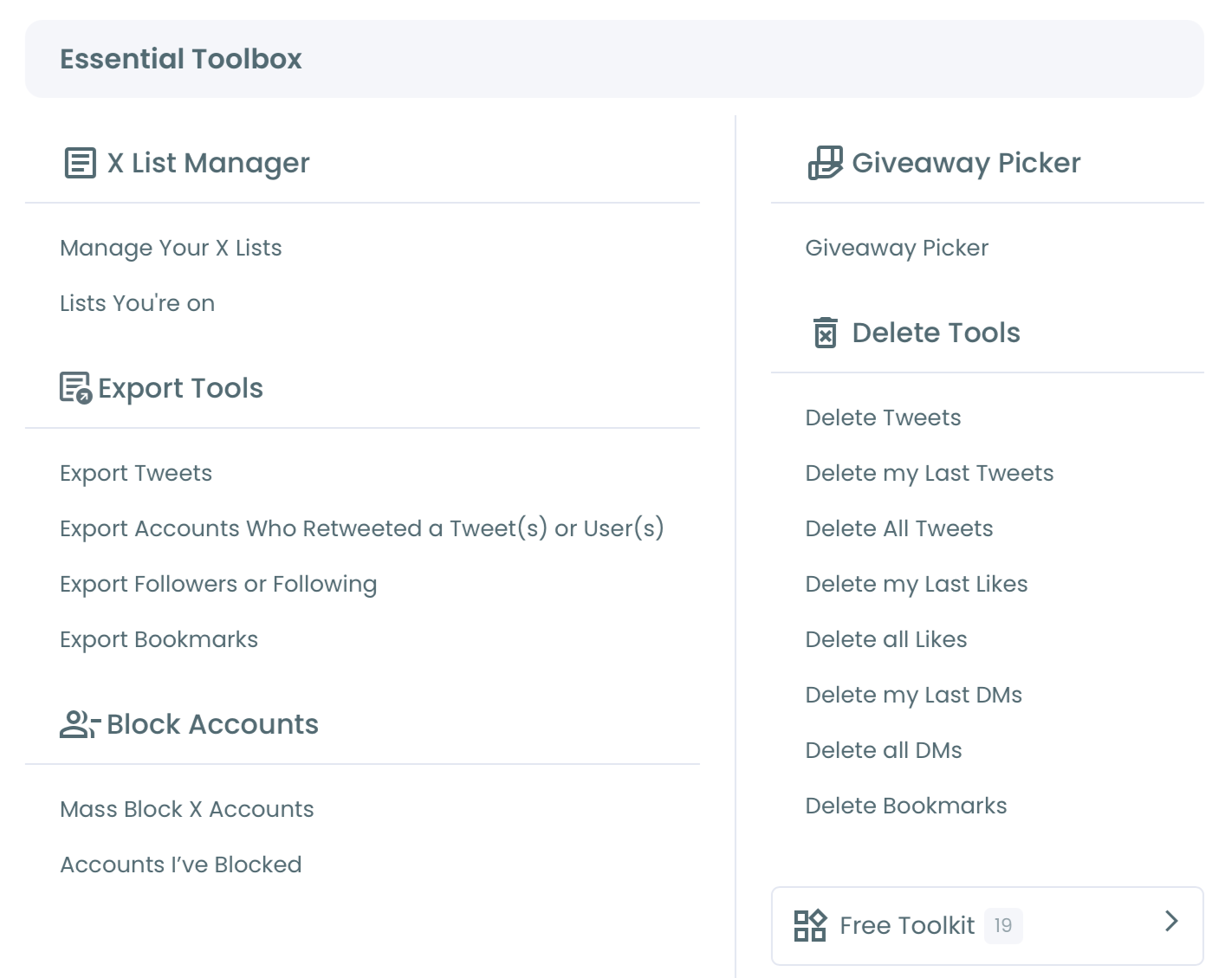
Apply the strict-zero filter with the four-rule exclusion
- Apply the strict-zero filter (zero likes, zero replies, zero reposts, zero quote posts across the 90-day post-life window) with the four standard exclusion rules enabled and any custom protections added.
Phase 2: Run the Job and Audit the Log
Queue the reviewed list and start the rate-limited job
- Queue the reviewed list and start the rate-limited deletion job. The pipeline paces requests inside the platform's published limits and runs in the background. The dashboard shows the running progress and the activity log updates row by row.
Monitor the running job through the activity log
- Monitor the running job through the activity log. Most operators check progress at one or two natural pause points (lunch, end of day) rather than watching the log in real time. The log captures everything the operator needs to verify the run.
Audit the completed log the next morning
- Audit the completed log the next morning. Confirm row counts (deleted, skipped, error); confirm the skipped-post reason codes; document any patterns that should inform the next run's exclusion rules.
The six-step sequence is the full workflow. The candidate audit produces the queue; the rate-limited execution and the activity log together provide the defensible audit trail.
Video walkthrough: the running deletion job, the rate-limit pacing, and the activity-log audit.
What the Workflow Produces
The output is a cleaned archive, a complete activity log with per-row outcomes and platform response codes, a saved configuration for the next maintenance run, and a defensible audit trail that supports any external question about the cleanup decisions.
The Circleboom workflow uses the official X Enterprise Developer access for both candidate identification and deletion execution. The activity profile is normal API usage, and the rate limits are respected by default.
Two adjacent surfaces extend the workflow. The delete all Twitter replies landing covers the reply-side strict-zero variant for operators whose cleanup needs include the reply archive. The delete tweets by language landing covers the multilingual variant for accounts whose archive spans multiple languages.
Related Circleboom reading on the bulk-delete theme.
- Delete low-engagement tweets on mobile, fast, safe, and easy on the mobile-side execution of the same workflow.
- Should you delete your old tweets: learn what to delete and what to keep on the operator-side judgment about which posts belong in the cleanup.
Why the Activity Log Earns Its Keep
The reason the activity log matters is that it converts a cleanup operation into a documented decision sequence. The cleanup itself is a one-time event; the activity log is the durable artifact that supports any subsequent question, audit, or review.
The log's value compounds with each run. The first run's log is the baseline; the second run's log is the comparison; the third run's log is the trend. Operators with multi-quarter cleanup histories can read the log sequence to verify that the cleanup workflow is stable, the exclusion rules are catching the false positives, and the deletion pacing is respecting the platform's limits.
That is the load-bearing reason the workflow includes the log as a first-class artifact rather than a side-effect of the job. Bulk-delete zero-engagement X posts and the cleanup becomes a documented decision rather than an undocumented operation.
What People Ask About Zero-Engagement Cleanup
How long does the cleanup job typically take to finish?
Most cleanups of 1,500 to 3,000 posts finish inside a single overnight window because the X API's deletion rate limits permit comfortable batching at that scale. Larger cleanups (5,000+ posts) split across two or three overnight windows; the queue preserves state between windows, so the job resumes automatically when the rate-limit window refreshes.
What happens if a post in the queue fails to delete?
The activity log records the failure with the platform's response code, and the job continues to the next row. Common failure modes are already-deleted posts (the post was removed before the job processed it), suspended-account posts (the platform suspended the account after the post was queued), and rate-limit-boundary posts (the request hit a window edge). Each failure is non-blocking and the log shows the cause.
Can I pause the job mid-run?
Yes. The operator can pause the running job at any rate-limit boundary, which the dashboard surfaces as a pause control. The queue state is preserved; resuming starts from the next un-processed row. Most operators pause only when an unexpected issue surfaces (a row that should have been excluded but was not, an activity-log pattern that needs investigation).
How does the job handle posts that the platform's own systems are also processing?
Race conditions between the operator's cleanup and the platform's own background processing are rare but possible. The activity log records the platform's response code for each row, so a row that the platform deleted between candidate generation and deletion execution shows up as an "already deleted" outcome rather than as an error. The job continues normally.
What is the right rate-limit headroom to leave?
The Circleboom workflow runs with comfortable headroom by default, typically using 60 to 80 percent of the per-minute and per-day caps. The headroom matters because it leaves room for the operator's other API-using activities (analytics queries, follower-tracking, audit refreshes) to run concurrently without colliding with the deletion job.