
Most people go looking for a way to export Twitter lists on the day they are about to break one. A list has grown into an unusable 1,400 accounts, or it needs splitting into two, or it belonged to a campaign that ended last month.
The membership is about to change, and there is no undo on X.
Circleboom exports every member of an X list to a CSV file, pulling the complete profile record for each account through official Enterprise APIs. The download works on lists you own and on any public list on X.
→ export Twitter lists
The sequence matters more than the click, and one step in it is almost always skipped.
The point where an X list stops being recoverable
Three operations end a list's current composition, and none of them can be walked back:
- Deleting a list removes it and every member association permanently.
- Moving accounts to another list strips them from the origin, since a move is a remove and an add executed together.
- Bulk-removing members after a quality filter clears them out with no queue to restore from.
X does not version this. There is no revision history on a list, no trash bin, and no export path in the interface, which means the only surviving copy of a membership is the one you made yourself.
Circleboom writes that copy as a CSV from the X List Manager, using the same authenticated account that owns the list. The read is a normal API call rather than a workaround, so it behaves the same on a 40-member list as on one at the platform ceiling.
None of the three operations above warns you about this beforehand. The confirmation dialogs ask whether you are sure about the action, not whether you have a copy of what the action is about to overwrite.
Scale makes it worse rather than better. X's own platform ceilings put 5,000 members on a single list and 1,000 lists on an account, both documented on X's help page about account limits. Rebuilding 3,000 hand-picked accounts from memory is not a task anybody completes.
The cost is not just the names. It is the reasoning: why those accounts, in that grouping, under that label.
Circleboom's post on how many accounts can I add on Twitter lists is a sanity check on that ceiling. Past a certain size, the reasoning behind a list stops being reproducible.
Why the backup never happens in the moment
Timing is the other half of the problem. The moment you decide to restructure a list is usually the moment you are already mid-action, with a filter applied and a selection made. Nobody stops there to think about backups, which is why the export belongs at the start of the session rather than somewhere in the middle of it.
Sometimes the account set you care about is a following list rather than a hand-built one. Export Twitter Following List covers that shape of the same problem.
What a Twitter list export actually contains
The CSV holds sixteen fields per member, and only a handful of them are visible anywhere in X.
Identity and profile text come across first: ProfileId, Username, Name, Bio, and Location. Then the network numbers: CountTweets, CountFriends for following count, and CountFollowers. Then verification, split into IsVerified plus a Verified_Type value of blue, business, government, or none.
The interesting half is what Circleboom computes and attaches:
- IsFake, flagging accounts with spam-shaped signatures.
- IsInactive, flagging accounts with little or no recent posting.
- IsEgghead, flagging accounts with no profile photo.
- IsOveractive, flagging unusually high posting frequency.
- IsProtected, flagging accounts whose posts are locked.
Those five columns turn a membership file into an audit you can sort.
CreatedAt closes the record with a full account creation timestamp, which is how a wave of accounts registered in the same week becomes visible in a list you thought was organic.
None of this exists in the list view on X. There you get avatars, names, and a scroll bar. When you export your Twitter list members to CSV, you get the columns that let you decide something.
Why Verified_Type is worth more than IsVerified
The two verification fields answer different questions, and mixing them up costs you precision.
IsVerified is a boolean. Verified_Type splits that boolean into blue, business, government, or none. That is the difference between "this account paid for a checkmark" and "this account is an organization." For a press list, a partner list, or an outreach list, the distinction changes who you contact and how.
Sorting a 900-member list by Verified_Type usually produces a much smaller business-and-government slice than people expect, and that slice is often the real reason the list exists.
One practical note on freshness: membership data refreshes on a 24-hour cycle, and the overview page prints the last sync time. Changes made directly on X inside that window may not be in the file yet.
How many export tokens does a large Twitter list use?
Exports draw from a token balance, and the draw scales with the number of members in the file.
The remaining balance is printed next to the Export button before you commit, so the number is never a surprise after the fact. A 200-member list costs a fraction of what a 4,800-member list costs, which changes how you should sequence a session.
Two habits follow from that.
The first is to filter before exporting rather than after. Pulling all 4,800 rows and deleting most of them in a spreadsheet spends tokens on data you discarded. Applying the quality and engagement filters in Circleboom first means the file arrives already scoped.
The second is to batch by purpose. If three lists feed the same report, export all three in one working session while your criteria are consistent, rather than returning weekly with slightly different filters and paying again each time.
Here is the arithmetic in plain terms.
Say you keep four monitoring lists averaging 600 members each. Exporting all four unfiltered moves roughly 2,400 member records. Filtering each one down to active, non-spam accounts first might cut that to 1,500, and the 900-record difference is capacity you keep for the next list rather than spend on rows you were going to delete anyway.
Token spend also argues for building lists well in the first place. A list assembled from a filtered segment needs far less cleanup at export time than one grown by hand over two years, which is the upstream half of this problem. Circleboom's walkthrough on how to add people to Twitter lists in bulk covers that side.
How to export Twitter lists step by step
The process, in order, from a cold login to a downloaded file.
Full walkthrough: where the Export button sits inside X List Manager and what the token counter does as the file builds.
https://www.youtube.com/watch?v=VvGU13mvRoo
Connect the account that owns the list
- Log in to Circleboom Twitter and authorize your X account through official OAuth.

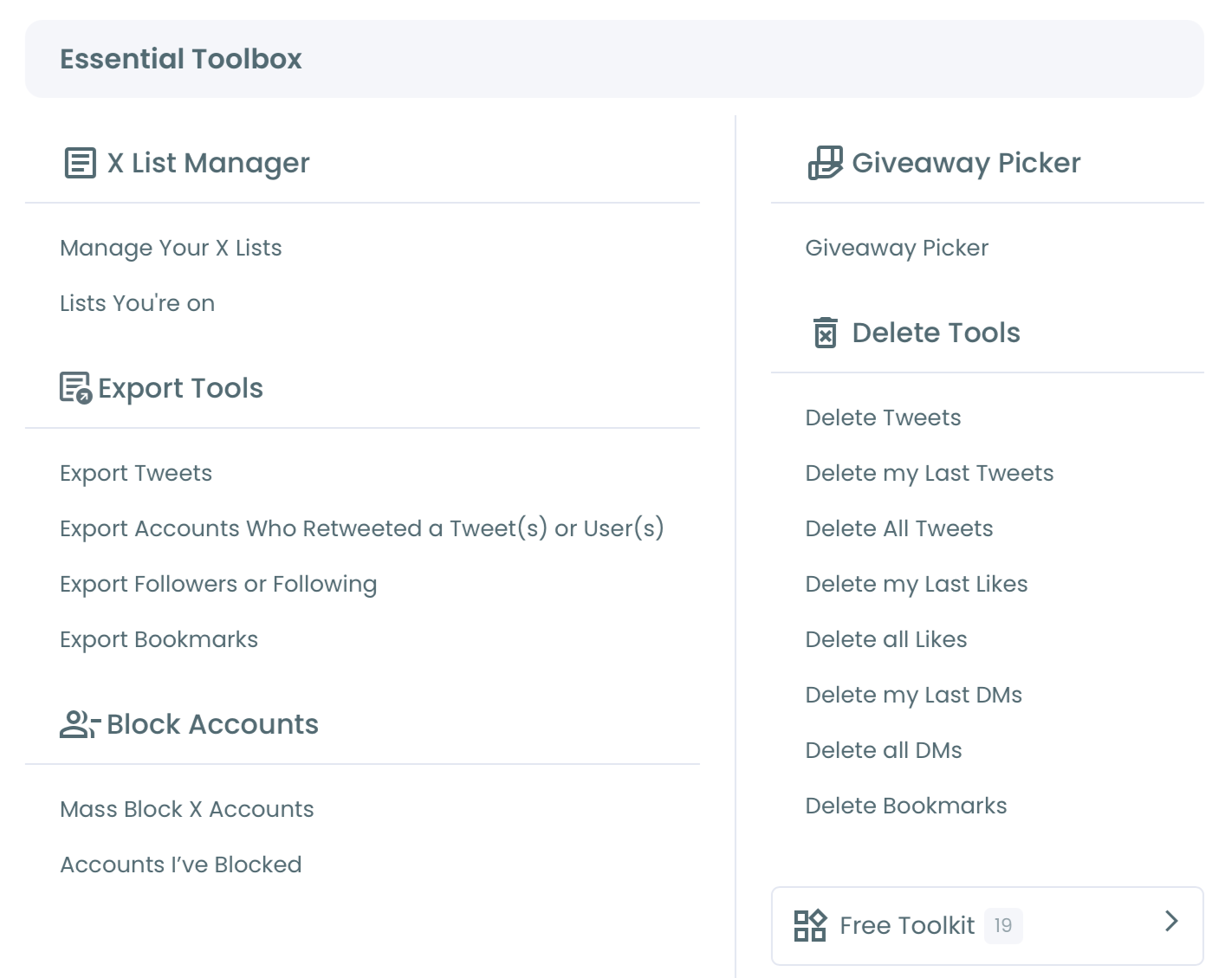
- Go to Essential Toolbox and choose X List Manager from the menu.
Confirm you are exporting the right membership
- Read the sync status line on the list overview page. It states when the membership was last refreshed, which tells you whether recent changes made on X are already reflected.
- Open the list from the card grid. A private list carries a lock badge and a public one does not, so the card tells you the visibility and the size together before you go further.
Filter, then spend the tokens
- Set your conditions in the Filter Options panel. Everything stacks as an AND condition, from the quality flags through verification, the numeric ranges, account age, engagement banding, language, and profile location, and each one you switch on appears as a removable chip above the table.
- Click Export and confirm against the remaining token count beside the button. The file downloads with one row per member and one column per field.
That ordering is doing real work. Checking the sync line first prevents exporting a stale membership, opening the list confirms scope before anything is spent, and filtering ahead of the click decides the file's contents while it is still free to change your mind.
Once the file is down, the list itself is safe to restructure. Splitting, pruning, and renaming all become reversible in practice, because the original composition sits on your disk.
Nothing here runs through a browser extension either. Export is a direct API read, unlike the removal and blocking operations that stage a queue and need Chrome open while it drains.
So it is the one bulk action you can start and step away from. Worth knowing before you export a Twitter list to CSV on a list near the member ceiling.
If you need to rebuild a list from scratch afterward, how to create Twitter lists with just a few clicks covers the fast path.
What you can do with the file that you cannot do inside X
A CSV moves. A list view does not.
Once the membership is on disk, it becomes:
- An import into a CRM.
- An X Ads custom audience upload.
- A tab in a reporting deck.
- A shared document a colleague can review without needing access to the X account.
None of those handoffs are possible while the data is trapped behind an infinite scroll.
It also becomes comparable. Two exports of the same list taken a quarter apart, opened side by side, show exactly which accounts left, which went inactive, and how the verified share moved. That comparison is the closest thing X offers to a health metric for a hand-built audience.
And it becomes searchable in ways X is not. Finding every member whose bio mentions a role, a city, or a product is a spreadsheet filter once the bios sit in a column. Doing the same inside X means reading profiles one at a time, which is part of why how to search for Twitter lists is a question people keep asking.
There is a governance angle too, and it matters more in teams than solo accounts. A list that only lives inside one logged-in session is undocumented infrastructure. When that person changes role or leaves, the group they built becomes unreadable to everyone else, even though the accounts are still sitting there.
A dated CSV in shared storage turns a personal habit into something the team owns.
If your content archive matters as much as your audience, Export Tweets applies the same portability logic to posts rather than accounts.
Your export checklist before touching an X list
Run these five in order and no restructure can cost you anything you cannot get back:
- Confirm the sync timestamp is recent enough to trust the membership.
- Apply the quality and engagement filters you actually want in the file.
- Check the remaining token balance against the member count.
- Export and open the CSV to verify the row count matches the list.
- Only then delete, split, merge, or bulk-remove.
The whole sequence takes a couple of minutes on a list of any size. That is a poor trade against rebuilding a hand-built audience from nothing.
Step four is the one people drop, and it is the only step that catches a bad export.
A file with 812 rows against a list card reading 1,400 means a filter was tighter than you intended, and you would rather learn that with the list still intact than after the restructure.
Circleboom runs the whole path as an official X Enterprise Developer. The export is a sanctioned read of your own data, not a scrape that might break next month. That matters most for lists you plan to export on a schedule, since a method that survives the next API change is the only one worth building a habit around.
Get the file first. Then break the list.
→ save a Twitter list as a spreadsheet
Still wondering?
Do exports work on private X lists?
Yes, on private lists you own. You authenticated the account, so Circleboom reads its own private lists normally. Private lists belonging to other users are a different case: the API does not return them at all, so there is nothing to export.
Can I rebuild a list on another account from the CSV?
Yes. The Username column is the portable part, and Circleboom accepts manually entered usernames when creating a list, so a CSV exported from one account becomes the source for a list built on another. The quality flags do not travel with it, but the membership does.
Do I lose tokens if a download fails partway?
Token consumption is tied to the export operation rather than to your browser finishing the download, so re-running a failed export is not free. Filter the list down before the first attempt and keep the tab open until the file lands.