
X has no follow button for hashtags, and the workaround almost every other article recommends has quietly stopped being dependable. X's own help page for saved searches now says the feature is not available on x.com. The Save control went missing from the web client earlier this year, and nothing was announced about it.
Three things this page settles.Why a hashtag on X cannot be followed the way an account can.A two-layer setup that survives the next change to X's search interface.The filter settings that keep a busy hashtag readable instead of unusable.
Circleboom's Keyword and Hashtag Tracker watches any hashtag on X and gives you back both the matching posts and the deduplicated accounts behind them. Everything begins at how to follow a hashtag on Twitter.
Why X has no follow button for hashtags
A hashtag on X is a search query, not an object. Instagram and LinkedIn both treat a hashtag as an entity with its own page, its own follower count, and a subscribe relationship you can create in one tap. X treats #marketing as shorthand for a string of text that appears inside posts.
That difference is the whole answer. There is nothing on X's side to attach a follow relationship to, because the hashtag is not a thing that exists between posts. It is a filter applied to a stream.
So the feed you want has to be assembled rather than subscribed to. Every real method for following a hashtag on X, including the one you are about to set up, is some version of "run this query repeatedly and keep the results somewhere I can return to."
Readers who want the short version of the mechanics can read follow a hashtag on Twitter alongside this walkthrough. The rest of this article is about the part that guide cannot cover: what to do now that the default workaround has weakened.
Some readers already know they want a standing feed rather than a one-off search. If that is you, skip ahead and track hashtags on Twitter with a query that runs on a schedule instead of on your memory.
The saved-search workaround is no longer dependable
Saved searches were the standard answer for a decade, and they have stopped being a safe recommendation. X's help page on saving searches now states that saved searches are not currently available on x.com.
Users reported the Save this search option disappearing from the web client during the first half of the year, with similar reports on Android. Nothing about that removal was announced.
That matters more than the removal itself.
Any hashtag method that depends on a single interface affordance is a rental, not an asset.
The affordance can be pulled in a release you never see. Your saved queries stop appearing, and the monitoring routine you built around them fails silently. You do not get an error message. You just stop seeing the hashtag.
The same fragility applies to the other common suggestion, which is a dedicated column in X Pro. Columns work today.
They also depend entirely on one product surviving in its current shape, and they live inside a paid tier that has changed pricing and packaging more than once.
A more durable approach separates the two jobs that "following a hashtag" actually bundles together. One job is discovering which accounts use the hashtag. The other is reading what they post, on an ongoing basis.
Those are different problems, and the second one has a native solution X has kept stable for years. For the discovery half, a structured Twitter hashtag search and trend search beats scrolling the hashtag page by hand.
Follow the people who use the hashtag, not the hashtag
X Lists are the stable half of the setup. Hand-pick a set of accounts, and a List gives you a timeline that carries their posts and nothing else.
You can pin a List to the top of your home timeline so it sits one swipe away, and you can follow a List without following any of the accounts inside it. X documents the ceilings on X Lists generously: up to 1,000 Lists per account, each holding up to 5,000 members.
Read that against the hashtag problem and the reframe writes itself.
You cannot follow a hashtag on X, but you can follow the people who use it.
Subscription needs something permanent on the other end of it. A search string is not that. A List is.
The catch is obvious the moment you try it manually. Building the List requires knowing who posts under the hashtag, and that roster is exactly what the hashtag page will not give you in usable form.
Scrolling #SaaSMarketing for twenty minutes gets you a handful of usernames, most of them the loudest rather than the most relevant, and no way to filter out the accounts spraying the tag at everything.
That is the gap a hashtag tracker closes. Circleboom searches X posts by content through official Enterprise access, then pivots the result into a deduplicated account view you can act on in bulk. One button sends the selected profiles straight into an X List. If you manage several of these, the Twitter List Manager keeps the memberships editable without hunting through X's own List settings.
The two layers do different work. The List is your reading surface and it belongs to your X account, so it keeps working regardless of what happens to search UI. The tracker is your discovery engine, and it refreshes the List's membership as new accounts start using the hashtag.
How to follow a hashtag on Twitter with Circleboom
Screen recording: what the account view looks like once a hashtag query resolves into a list of real posters.
To follow a hashtag on Twitter with Circleboom, you run the hashtag as a query inside Advanced X Search, then move the people who wrote the matching posts into an X List you can pin. The query is repeatable and the List is permanent, which is why the pairing outlasts any single interface change. The seven steps below run in three phases.
Build the query before you build the feed
- Log in to Circleboom Twitter and authorise the handle you want the query to run under.
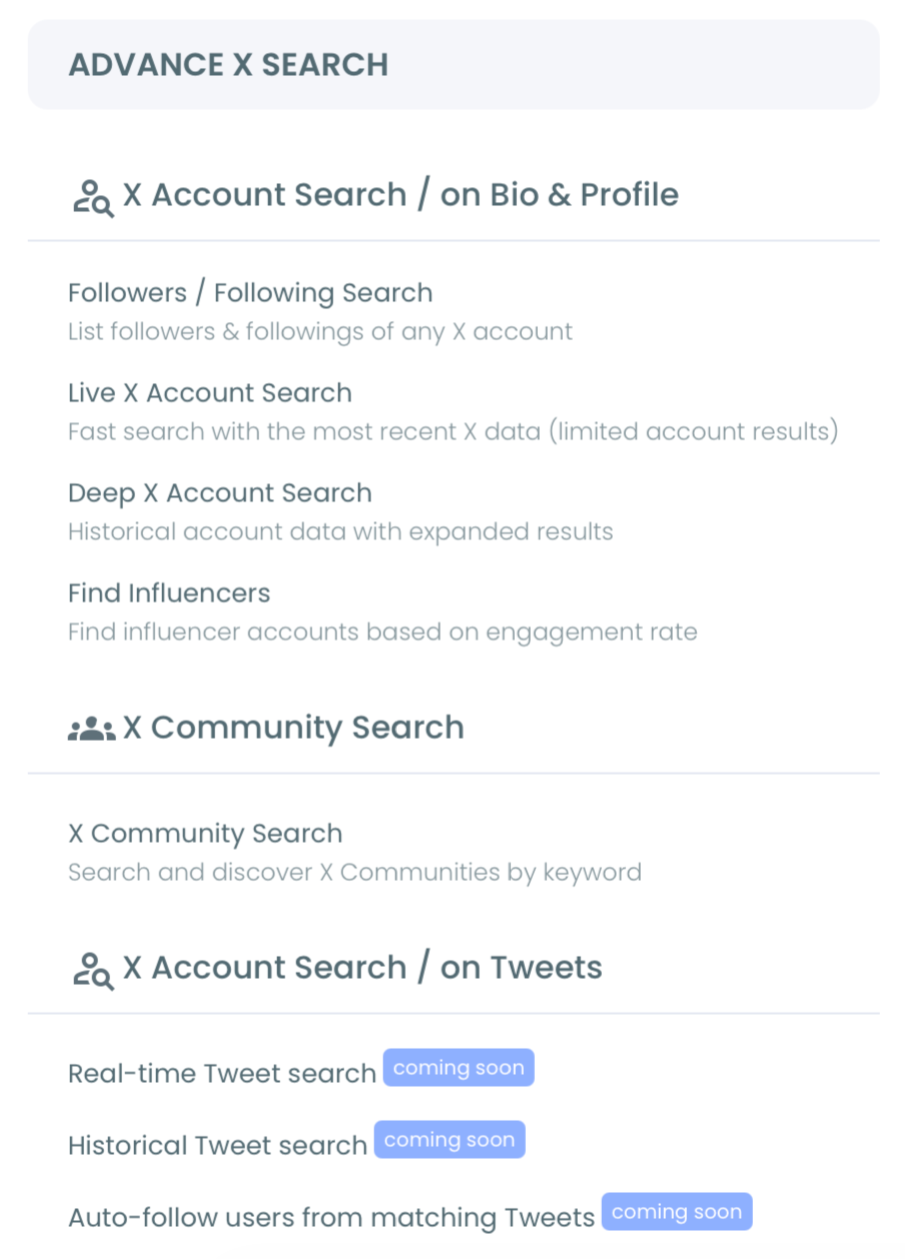
- Open the Advanced X Search menu and choose between Real-time Tweet Search and Historical Tweet Search.
- Describe the hashtag you want to watch in plain language, then confirm the query chips Circleboom builds from your description before you run it.
Narrow the stream so the hashtag stays readable
- Open Filters and set the boundaries: language, exclude terms, media type, replies on or off, and verification status.
- Set a minimum engagement threshold on likes, retweets, or impressions so low-signal posts never enter the result set.
Turn the result into a feed you can return to
- Switch to the profile view using the Display Profiles button, which converts the matched posts into a deduplicated list of the accounts that wrote them.
- Select the accounts worth keeping and use Add to List to push them into an X List, or export the set as CSV for use outside X.
That ordering is what makes the setup hold. The login earns official API access before any data moves. The filters cut the noise while the result is still a query rather than a permanent feed, and the List step converts a one-time search into something X itself will keep serving you.
Reverse any two of those and you end up with a List full of accounts you will mute within a week.
At a glance: query, filter, pivot to accounts, save as a List.
Circleboom is an official X Enterprise Developer company, which is the reason this workflow can read hashtag history at all. Scraping tools guess at coverage and break when X tightens access.
Enterprise access returns the posts that actually exist, and each one arrives carrying its real numbers: impressions, likes, retweets, quotes, bookmarks, replies. The Keyword and Hashtag Tracker page shows the query builder and the account view side by side if you want to see it before committing time to it.
One warning worth stating before you run a wide query. The bigger the pull, the more GetTweetTokens it costs, and exporting is billed on top of that, so an unfiltered hashtag spends your balance on noise. Set the filters first, then raise the collection count.
Is the hashtag happening now, or did it already happen?
Pick the search mode by when the conversation lives, not by which one sounds more advanced. Circleboom splits hashtag collection into two modes, and choosing wrong is the most common reason a hashtag feed comes back thin.
Real-time Tweet Search starts from a date you nominate and keeps gathering as new posts land. That is the mode for a conference hashtag while the conference is running, a launch hashtag from the hour you announce, or a campaign tag you want to watch as it spreads. The value decays fast: an account posting under an event hashtag is worth reaching while the shared context still exists.
Historical Tweet Search looks the other way, sweeping a period you choose that can run from the past month to a full year or any custom span. That is the mode for a recurring industry hashtag, a competitor's campaign tag you missed, or any question shaped like "who has been using this tag consistently."
Because the account view deduplicates, an account that posted forty times under the tag appears once. That is what you want when the output is a List rather than a reading queue.
Both modes return the same two views of the same result set, so the mechanics you learn in one transfer to the other. Running both against the same tag separates a real ongoing community from a one-week spike, and trending hashtags on Twitter shows how differently those two shapes behave.
Before you commit a hashtag to a permanent List, it also helps to know how much volume it actually carries. The Twitter hashtag counter answers that in one pass, and a tag with thirty posts a month does not need a monitoring workflow.
What changes once the hashtag has a home
The reading experience stops depending on your memory. A pinned List loads in one tap and shows only the accounts you approved, which means the hashtag stops being something you remember to check and becomes something you see. That is the difference between monitoring a topic and intending to monitor a topic.
The second change is quality. A hashtag page shows you everything, including the accounts that attach the tag to unrelated promotion. A List built from a filtered query shows you the subset that cleared your engagement floor and your exclude terms. The same hashtag stops behaving like a firehose and starts behaving like a shortlist.
The third change is that the account list itself becomes an asset. Those accounts are prospects, potential collaborators, competitors, or community members depending on what you searched for. Export them and they are a CRM import. Keep them in a List and they are an ongoing relationship map. The keyword and hashtag tracker walkthrough covers what people do with that export once they have it.
None of this requires you to follow anyone. The List reads without a follow, which keeps your following count clean while your monitoring gets sharper.
Four steps to a hashtag you actually read
Set this up once and the hashtag stops being a tab you forget to open.
- Run the hashtag through Advanced X Search and check the volume before you build anything.
- Apply language, exclude, and engagement filters until the result reads like a feed, not a dump.
- Pivot to the account view and push the keepers into a dedicated X List.
- Pin the List, then re-run the query monthly to catch accounts that joined the conversation late.
Questions people ask about hashtag following
Can I get suspended for using a hashtag tracker on X?
No, provided the tool reads public posts through sanctioned access rather than scraping. Circleboom queries public X posts through Enterprise-grade API access, so nothing in the hashtag workflow touches an endpoint X has not authorized. The actions that carry account risk are bulk follows and bulk blocks, not reads.
How often should I re-run the hashtag query?
Monthly is enough for a stable industry tag, weekly for an active campaign, and daily during a live event. The List keeps serving posts between runs, so re-running is about adding new accounts rather than refreshing content.
What if the hashtag is too broad to be useful?
Narrow it with exclude terms and an engagement minimum before you narrow the hashtag itself. A tag like #AI becomes workable once you exclude the promotional language you never want to see and require a floor of a few likes per post. If that still leaves thousands of accounts, pair the broad tag with a second keyword rather than switching tags entirely.
Can I do this for a hashtag I do not post under myself?
Yes, and that is the most common use. Monitoring a competitor's campaign tag, an industry event tag, or a community tag you have not joined works the same way, because the query reads public posts regardless of who wrote them.