
Crypto giveaways pull the highest entry volume and the highest bot density of any giveaway format on X. That mix breaks the one thing a giveaway has to produce: a result nobody argues with. A prettier shuffling animation does not fix that. A defensible entrant list does.
What a draw needs before randomness matters.The complete entrant list, not the partial preview X shows under a post.Eligibility conditions checked by software instead of by eye.Account-quality filters applied before the draw, not after the complaints.
Circleboom collects every qualifying entrant from your giveaway post on X and draws winners at random once the pool is clean, reading that entrant data through official X Enterprise APIs. Start with the crypto giveaway winner on Twitter workflow.
Why crypto giveaway draws on X get argued with
The dispute almost never lands on the randomness. It lands on the list.
Open a giveaway post on X and the engagement list you can scroll is a sample, not a register. It renders a slice of the accounts that reacted, the order shifts between visits, and none of it can be sorted or filtered.
So when an organizer says "I picked randomly from the likes," the honest description is a pick from whatever happened to load. That is a real selection method and an indefensible one, because two people scrolling the same post never see the same set.
Circleboom reads the complete engagement record behind a giveaway post on X, so the pool you draw from is the pool that actually entered.
Crypto audiences arrive pre-loaded with suspicion, and they have earned it. The FTC's guidance on fake prize and sweepstakes scams trains people to read every "you won" message as a probable con. Your honest draw gets filtered through that same reflex.
Then there is the condition problem. Most crypto giveaway rules stack requirements: repost, reply, tag two friends, follow the host.
Verifying four conditions against a few thousand accounts by eye is impossible, not merely slow. Organizers skip the check, someone notices the winner never followed, and the campaign spends its next week defending itself instead of promoting itself.
The cost of getting this wrong is rarely the prize. It is the next campaign.
An audience that watched one draw go sideways treats the following announcement as marketing rather than an invitation, and entry numbers show it immediately. Trust in a giveaway program compounds in both directions, which is why the second campaign is usually the one that reveals whether the first was run properly.
→ draw a crypto giveaway winner on X
Bot entries make it worse. A giveaway with a token prize attracts automated entries the way a faucet attracts scripts, and if a bot wins, the announcement post becomes the evidence against you.
Running a Fake Twitter Account Checker pass on your own audience before the campaign launches tells you roughly what share of the incoming pool will be junk. That number is worth having in advance, because it sets your expectation for how much the filters should remove. The same discipline that makes how to run a successful Twitter contest work applies double when a wallet address is the prize.
Is a random picker enough for a crypto giveaway on Twitter?
No. Randomness is the last of three layers, not the first.
A random number generator is only as honest as the array you hand it. Feed it a partial, unfiltered, unverified list and it will faithfully return a random element of the wrong set.
The work that makes a crypto giveaway winner on Twitter defensible happens in the three ordered layers before the draw runs.
Layer one is completeness. The pool has to contain everyone who actually entered. Circleboom retrieves the full participant list for your giveaway post through X's Enterprise data access rather than the scrollable preview, which is the difference between a draw over your entrants and a draw over a sample of them.
Circleboom is an official X Enterprise Developer company, so that retrieval runs inside X's own rules with no scraping and no workaround.
Layer two is condition matching. You pick which engagements count, then decide how they combine.
All Conditions means an entrant must satisfy every box you ticked, which is the high-engagement bar most token giveaways advertise. Any Conditions means one qualifying action is enough, which widens the pool for reach-focused campaigns. A separate checkbox requires that the entrant follows the host account.
The condition people get wrong most often is the tag-a-friend count. Rules copy says "tag two friends," the campaign gets configured with a mention requirement of one, and half the eligible pool never met the published bar. Set the number the rules printed, then leave it alone.
Layer three is account quality. This is where the pool stops being a headcount and starts being an audience. Circleboom's filter panel scores each collected participant across several categories:
- Follower quality flags: egghead, protected, fake or spam, inactive, overactive.
- Numeric ranges: follower count, following count, tweet count, follow ratio.
- Join date windows, which catch accounts created the week your giveaway launched.
- Verification status, detected language, and profile location.
- Free-text search across bio and display name, plus whitelist and blacklist lists.
Filtering those accounts out is not gatekeeping. An entry submitted by a script was never a person choosing to enter, so removing it returns the pool to what your rules described in the first place. If your giveaway is part of a broader push around how to grow a crypto community, the filtered pool doubles as a cleaner read on who is genuinely paying attention.
What to publish alongside the winning X handle
Decide what the announcement will show before you run anything, because that decision determines what you need to collect.
An announcement that links the source post, restates the eligibility conditions in the words the rules used, and names the selection method gives your audience something to check. One that shows a handle over a confetti graphic gives them something to doubt.
The sequence matters here: you cannot publish a parameter you never recorded.
X's guidelines for running promotions belong in that pre-flight read. One clause carries most of the weight for a token giveaway: entering through multiple accounts is out of bounds, and hosts are expected to say so in their own copy. Print that line and you inherit a defensible position instead of arguing for one after the winner is named.
→ Twitter giveaway winner selection
Keep the exported participant grid as your record. If the result is ever questioned, the pre-draw export shows exactly who qualified at the moment of selection, with account-level fields attached.
That habit matters most for accounts running recurring campaigns, where each clean draw makes the next one easier to promote. Teams working through crypto marketing strategies for meme coins tend to discover this after the first disputed round rather than before it.
A Twitter Bot Checker pass on the accounts that followed during the campaign window closes the loop. A follow requirement reliably pads the follower count with entries that never engage again, and knowing the size of that spike keeps your engagement rate honest in the next report.
How to pick a crypto giveaway winner on Twitter, step by step
Video walkthrough: the eligibility conditions and quality filters being set before a single winner is drawn.
The flow runs in two stages: collect and qualify, then filter and draw.
Collect the entrants and lock the conditions
- Log in to Circleboom Twitter using the profile that published the campaign.
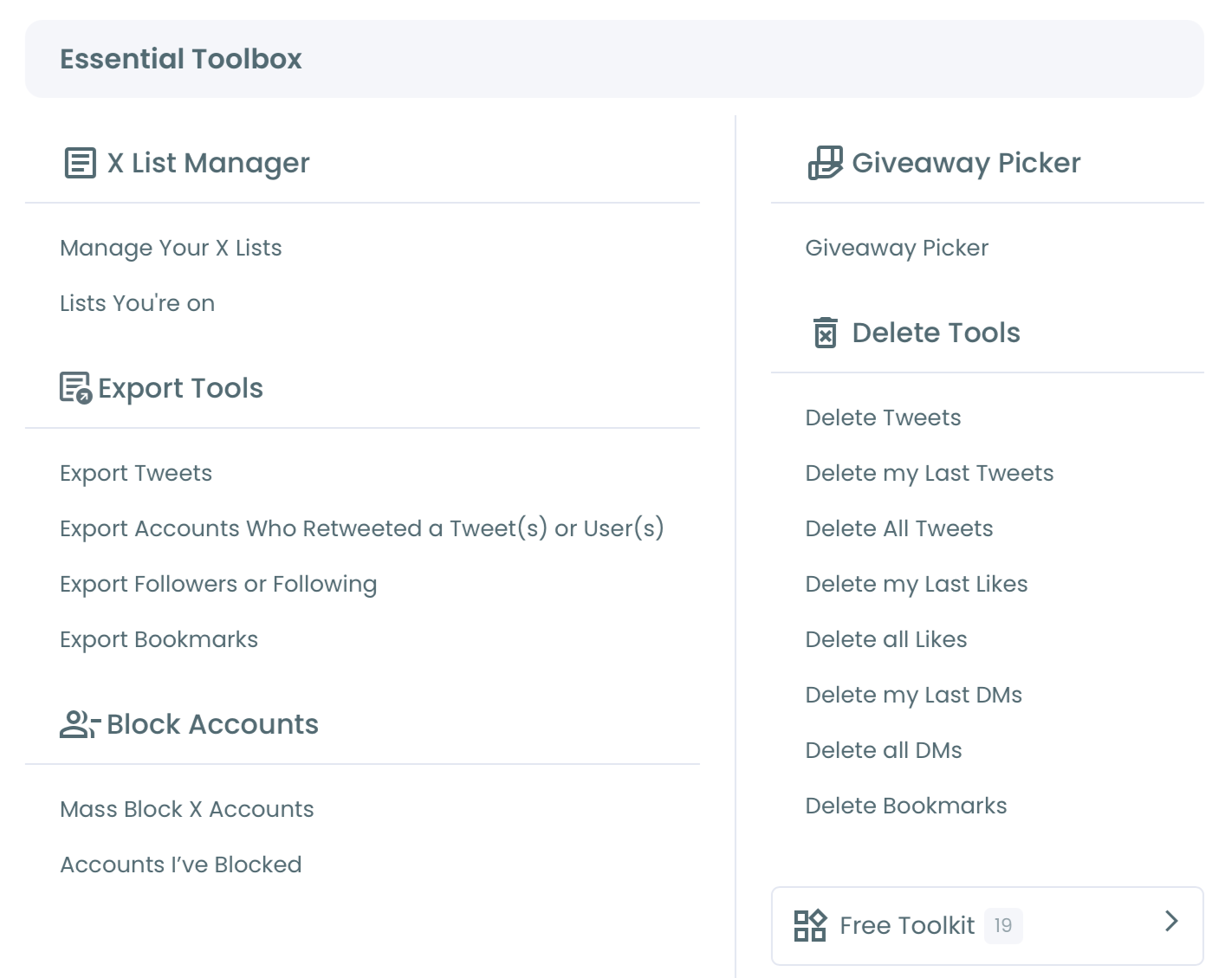
- Go to Essential Toolbox and pick Giveaway Picker, then choose "Create a new Smart Giveaway."
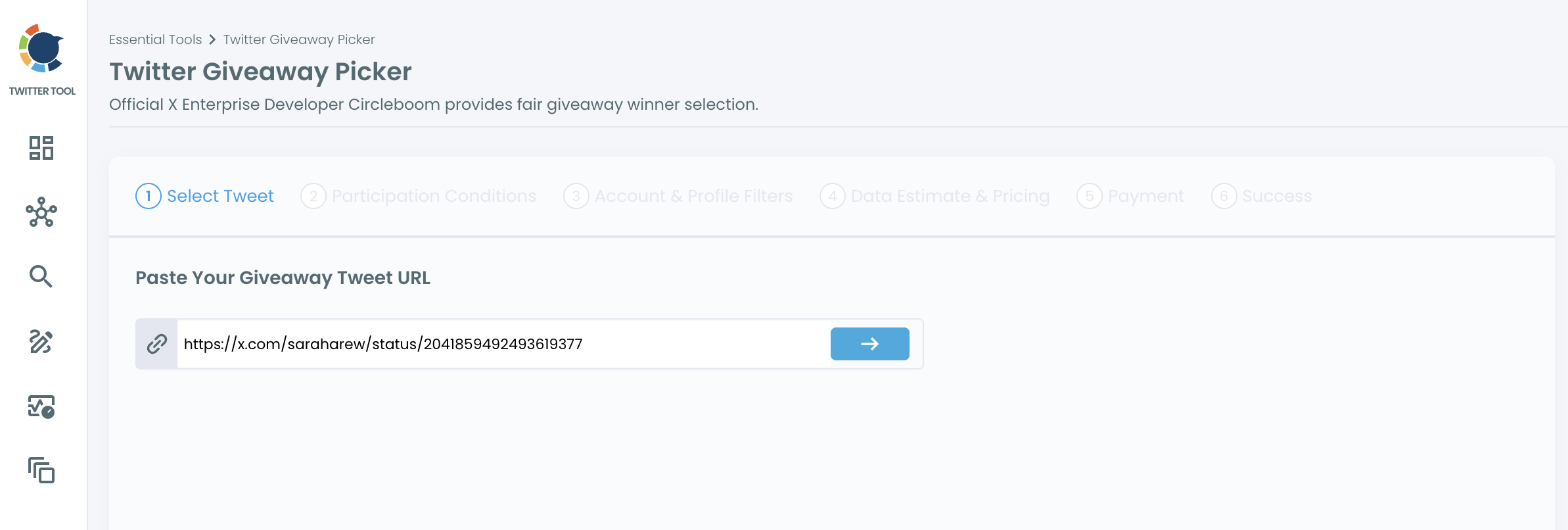
- Paste the giveaway post URL and read the preview panel before you continue. It echoes the post text with its repost, reply, and like totals, which is how you catch the common mistake of pointing a campaign at a quote of the announcement instead of the announcement.
- Set the participation conditions to mirror your published rules. The qualifying actions on offer are repost or quote, reply, like, and tag-a-friend with a minimum mention count. Pick the match type next, then add the follow requirement if your rules asked for one.
Run the collection at the cutoff your rules published, not whenever you remember. Participation data is a snapshot of the moment the campaign runs, so an entry that lands afterward sits outside the pool and cannot be folded back in.
Filter the pool, then draw
- Apply the account and profile filters once collection has finished rather than before it. Seeing the raw count first, then the count after the fake, spam, and egghead filters run, leaves you with two numbers instead of one assertion.
- Set the number of winners and substitutes, review the eligible count and the filter summary in the draw modal, then run the draw. Circleboom builds a branded winner card with the selected handles, ready to download or post straight to X.
That order is what makes the result hold up. Collection before conditions means you never argue about who was in the room. Conditions before filters means eligibility is settled on your published rules rather than on taste. Filters before the draw means a bot can never be the name on the card.
Reverse any two of those and you are back to defending a decision instead of showing one.
One boundary belongs in the rules copy from the start. A campaign is tied to a single post URL, so a giveaway pushed through three separate announcements needs three campaigns.
The follow requirement carries a second boundary: it is checked against the connected account alone. That bites when you promised entrants they should follow a partner project. Creators building a personal profile around this, the audience covered in how to be a crypto influencer, usually run partner conditions as a manual side check.
Quick recap:
- Connect the host account.
- Load the giveaway post and confirm the preview.
- Set conditions and match type from your published rules.
- Filter the collected pool, then draw winners and substitutes.
A checklist for your next Twitter giveaway
Run the next giveaway backwards from the announcement you want to publish.
- Write the eligibility rules before the post goes live, in the same words the conditions will use.
- Collect at the published cutoff time.
- Filter after collection, never before it.
- Draw substitutes alongside winners, so an unreachable winner does not stall the reveal.
- Publish the parameters with the card.
One thing to know before the first run: once winners are drawn, that draw is final inside the campaign. Changing a filter afterward means rebuilding the campaign from the same post URL, which is exactly why the filter step belongs in front of the draw rather than behind it.
Do that four times and the credibility stops being something you argue for. It becomes the reason entry numbers climb on the fifth campaign.
→ pick your crypto giveaway winner on Twitter
What people ask
Is it safe to run a giveaway draw through a third-party tool on my X account?
Yes, when the tool holds official platform access rather than scraping around it. Circleboom connects through standard OAuth and pulls giveaway engagement data through X's Enterprise data access, so your account is never asked for credentials and no unofficial workaround touches it.
How do I stop the same person entering from several accounts?
No draw tool can prove two handles belong to one person, so treat this as a rules problem first. X's promotion guidelines already ask hosts to bar multi-account entries, so put that line in your published rules and give yourself grounds to disqualify.
The account filters are the practical screen. A follow-ratio range paired with a join-date window removes most of the throwaway profiles a single entrant would spin up, because those accounts share a shape even when they do not share a name.
What happens to entrants a filter removes?
They stay in the participant grid, marked as excluded rather than deleted, so the export you keep still shows them. That distinction is what lets you demonstrate later that a filter was applied to a real entry, instead of leaving an audience to wonder whether the entry was ever collected.
What if the winner never replies to claim the prize?
Announce a claim window in the rules and move to the first substitute when it closes. Because that substitute was drawn from the same filtered pool in the same pass, the fallback stays inside the process your audience already saw, which is what stops a reassignment from looking like a do-over.
Do entrants have to follow me for the follow condition to be checked?
The follow condition is evaluated against the account connected to Circleboom, so it verifies follows of the host account only. If your rules asked entrants to follow a second account, that part needs a manual check, or a rules rewrite that keeps every condition on the account actually running the draw.