
I stopped choosing accounts by reading bios about two years ago, and the follow-back rate was the reason. A bio tells you what somebody once wrote about themselves. A tweet posted three days ago tells you they are still here, still interested, and still checking notifications.
What this method gives you.A list of accounts that posted about your exact topic inside a date window you set.Quality columns on every row, so you can drop bots before following anyone.A paced follow batch that respects X's limits without you watching a clock.
Circleboom runs the whole sequence on X through sanctioned Enterprise data access, from live tweet match to executed follow. Start by working out who to follow on Twitter from posted content instead of profile text.
The follow-back problem nobody names
Most advice about who to follow on X answers the wrong question. It hands you a list of famous accounts, tells you to check the suggestion rail, and stops there, as if the goal were a nicer reading experience.
For anyone growing an account, the goal is reciprocity. You follow someone hoping they look back.
That reframes the whole task. You are not curating a feed, you are selecting an audience, and the selection criteria for those two jobs are completely different.
X itself is optimizing for the first job. Its published notes on X's account recommendation system describe a ranking model tuned toward accounts you are likely to follow and engage with. Nothing in that objective involves whether the candidate might follow you.
So the rail gives you good reading and bad reciprocity. Fair trade, wrong tool.
The manual alternative is to search a keyword, open the account results, and start following. That is closer, and it is where most people land when they get serious about who to follow on X. It still has one flaw, and it is a big one.
Our earlier answer to who should I follow on Twitter walks the account-search route in full, which is worth reading if you have never tried it deliberately.
Why a bio keyword is a weaker signal than a timestamp
Account search matches profile text. Profile text is a self-description, written once, updated almost never.
Somebody who wrote "SaaS founder" into their bio in 2020 still matches that keyword today, whether they sold the company, changed direction, or quietly stopped logging in. The keyword survives. The behavior it described may not.
Tweet search matches something harder to fake: a post with a date on it.
A timestamp proves presence. A bio proves nothing except that somebody typed a word once.
The distribution of posting activity makes this decisive. Pew Research Center's look at how US adults on X use the site found that 20% of U.S. adults there produced 98% of all posts from that group.
Sit with that ratio for a second, because it decides your follow-back rate before you press a single button.
A bio-keyword list samples from everybody who ever wrote the word, so the overwhelming majority of it is drawn from the 80% who barely post. A tweet-match list samples only from people who posted inside your window, which means it draws almost entirely from the active fifth.
You are not comparing two lists of similar quality. One is mostly dormant accounts with the right words in their profile; the other is people who were on the platform this week.
That is the whole information gain here, and it is why Circleboom observes a follow-back ratio above 35% when users select their audience through tweet-matching search rather than untargeted follows. That number is our own observed product data, not an industry benchmark.
Want to see the difference before committing? Run one query through search Twitter accounts and one through tweet search on the same keyword. Then compare how many accounts in each list posted in the last month.
What to actually type into the tweet search
The phrasing you search for decides who you find, and the instinct most people follow is wrong. Searching your industry term returns your competitors. Searching the language your audience uses returns your audience.
Three query shapes do most of the work.
Pain-point phrasing finds people describing the problem you solve, in their own words rather than yours. Somebody posting "spent all morning cleaning bot followers again" is a better follow than somebody whose bio says "social media manager," because the first one told you what they care about this week.
Comparison and recommendation phrasing finds people mid-decision. Posts that ask for suggestions, name two options, or announce a switch all mark a moment when attention is available and a new follow gets noticed.
Event and moment phrasing finds people bound by shared context. Conference hashtags, launch names, and industry incidents produce short bursts of posting from exactly the accounts most open to connection while the moment is live.
Run three or four candidate wordings as small collections first. The one returning the most distinct active posters is your real keyword, and it is usually not the one you would have guessed.
How to find who to follow on Twitter, step by step
Watch the search build: plain-language query in, filtered list of active accounts out.
https://www.youtube.com/watch?v=HjtbpQysbYo
The process, in order, across six steps and two phases.
Point the search at live tweets instead of bios
- Open Circleboom Twitter and connect the X account you want to grow through official OAuth.

- Go to the Advanced X Search menu and choose Real-time Tweet Search from the discovery modes.
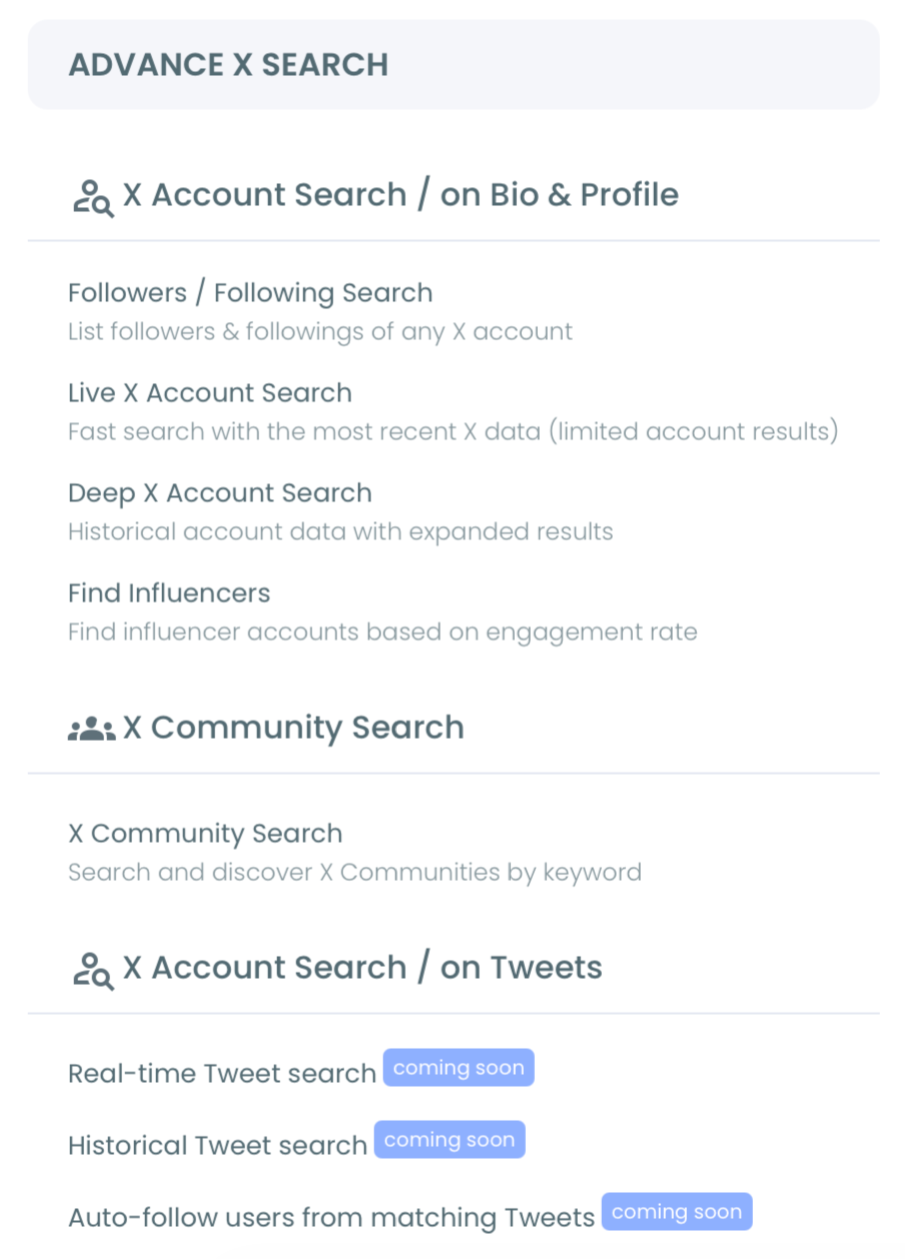
- Describe the tweet you are looking for in your own words, accept or edit the refined query the interface proposes, then set a start date and the number of tweets to collect.
Collection anchors forward from the start date you pick. Last 24 Hours suits a live event; Last 7 Days is the sensible default for ordinary audience building; anything past 30 days starts behaving like a historical search and loses the recency edge.
Filter the accounts, then run the follow batch
- Apply the filters before you read a single profile. The panel narrows the stream on several axes at once:
- Exclude terms that drag in the wrong meaning of your keyword.
- Set a language so you can read what you are following.
- Set minimum likes or reposts to drop low-signal chatter.
- Restrict to verified accounts when credibility outranks volume.
- Turn replies off if you only want people posting their own take.
- Switch to the profile view using the "Display Profiles of this search" control, which swaps the tweet list for the deduplicated accounts behind it.
- Select the accounts worth following and press Follow. Circleboom queues them at 50 follow actions every 15 minutes, up to 400 follows per day, then resumes automatically the next day.
That order is load-bearing. Filtering before the profile view means the account list arrives pre-cleaned, and reviewing before the follow means nothing executes that you have not looked at. Reverse those two and you spend your daily follow budget on accounts that matched your keyword by accident.
Quick recap:
- Connect the account through official OAuth.
- Search live tweets, not bios.
- Filter the stream before reading profiles.
- Review the account rows, then follow in batches.
Circleboom is an official X Enterprise Developer company, so the collection and the follow queue both run on sanctioned access rather than a scraper. That is what lets the batch pause and resume against real rate limits instead of guessing at them, and it is the difference between a bulk operation that finishes and one that gets your account flagged.
Everything above exists to make one decision faster: choose who to follow on Twitter based on what people are saying right now.
Reading the account table before the batch runs
A keyword match is a starting point, not a verdict. The account view gives you six columns to judge each row, and two of them do most of the work.
Follow ratio is the first. An account following 12,000 people with 300 followers is running a follow-back scheme of its own, and it will unfollow you within the week.
Tweet count paired with join date is the second. An account created last month with 4,000 posts is automated; an account created in 2011 with 40 posts is dormant regardless of what it just tweeted.
The engagement classification column compresses the rest into three bands. Active accounts are worth the follow, moderate ones are a judgment call, and inactive ones are the reason untargeted follow campaigns underperform.
Whitelist anything valuable while you are in the list. A whitelisted account is protected from every future bulk action in Circleboom, which matters more than it sounds when you run a cleanup pass six months later and cannot remember why you followed somebody.
For topics that keep producing new candidates, the Real-time Tweet Tracker keeps the stream accumulating, so you return to a refreshed pool instead of re-running the query.
If you have ever tried the blunt version of this tactic, our notes on follow for follow with verified Twitter accounts cover why reciprocity built on shared topics outlasts reciprocity built on a deal.
Four mistakes that flatten the follow-back rate
Deciding who to follow on Twitter this way is simple enough that most of the damage comes from small execution errors rather than a wrong strategy. These four account for nearly all of it.
Setting the window too wide. A 90-day start date feels safer because it returns more accounts. It also reintroduces exactly the problem tweet search was supposed to solve, because someone who posted eleven weeks ago is closer to a bio match than a live one. Seven days returns fewer accounts and better ones.
Filling the daily ceiling because it is there. Four hundred is a limit, not a target. Once a search stops producing genuinely relevant rows, the remaining allowance is not free upside, it is a slow leak in your own follow ratio.
Treating a collection as a permanent list. Live tweets get deleted, edited, or made private within minutes of posting. A result set collected two weeks ago has already drifted, and following from it means reaching people whose context has closed.
Following and then going quiet. A follow buys you one look at your profile. If the last post there is three weeks old, the visitor leaves and does not come back, which turns a well-targeted batch into a wasted one.
The pattern behind all four is the same. Each one trades a bit of precision for a bit of volume, and the follow-back rate is a precision metric, so every trade costs more than it appears to.
How many people can you follow on X in one day?
Circleboom processes 50 follow actions every 15 minutes, with a ceiling of 400 follows per day, and resumes on its own the next day when that ceiling is reached. You do not need to stagger anything manually or keep a tab open to babysit the queue.
The pacing exists because X reads speed as intent. A hundred follows in a minute looks like a script; the same hundred spread across half an hour looks like a person working through a list.
Volume is rarely the actual constraint anyway. Most people run out of genuinely relevant accounts long before they run out of daily allowance, which is a good sign rather than a bad one. A 120-account day built from tweet matches beats a 400-account day built from a bio sweep, both in follow-backs and in what your following list looks like afterward.
Our walkthrough on how to get 1000 followers on Twitter fast puts the follow tactic next to the posting cadence that has to run alongside it.
The short version
Choosing who to follow on Twitter by bio is a habit inherited from a version of the platform that no longer exists. Profile keywords are static, most accounts holding them are dormant, and X's own suggestion rail is tuned to extend your existing circle rather than to find people who might reciprocate.
Tweet matching fixes the sampling problem at the source. Search live posts, pivot to the accounts behind them, filter on ratio and activity, then follow in paced batches inside official limits.
The payoff shows up as a follow-back rate above 35% in Circleboom's own product data, and as a following list that stays worth reading a year later.
The mistake I still see most often is treating the daily ceiling as a target instead of a limit, which undoes the targeting inside a week. Our older take on finding new Twitter accounts in a click covers the shortcut version if you want something to run today.
→ find accounts to follow on X
Questions before your first search
Should I run a bio search or a tweet search first?
Tweet search first, then bio search to fill the gaps. Tweet search answers who to follow on Twitter with active accounts, and a follow-up bio search on the same keyword catches the well-known names in your niche who happen not to have posted inside your window.
Do searches cost anything beyond a subscription?
Live tweet collection consumes GetTweetTokens in proportion to how many tweets you collect, and exports draw from the same balance separately. The remaining count sits next to the export control, so check it before running a large collection rather than discovering the limit mid-search.
Can I keep the account list outside Circleboom?
Yes, the profile view exports to CSV with every column intact, including follower count, follow ratio, join date, verification type, and bio text. That file works as a prospect list, an ads custom audience, or a record of the segment before you act on it.