
The dashboard was open to the engagement-rate column, sorted high to low, and the operator was three minutes into the weekly content review when the pattern surfaced. Four tweets from the prior six months were sitting above 8% engagement rate, well above the account's 2.3% baseline.
The rest of the table dropped to 3% or lower within two screens of scrolling. The decision that mattered next was not which new tweets to write, but which of those four winners to re-queue for the coming week.
The Tuesday morning slot had historically been the account's strongest publish window, and the engagement-history data showed the four top tweets had originally landed in that same window. Rescheduling them into the upcoming Tuesday slots was a five-minute job, and the projected response was a 3-to-4x lift over a fresh post written from scratch. The arithmetic favored the rerun, and the operator clicked through to the queue.
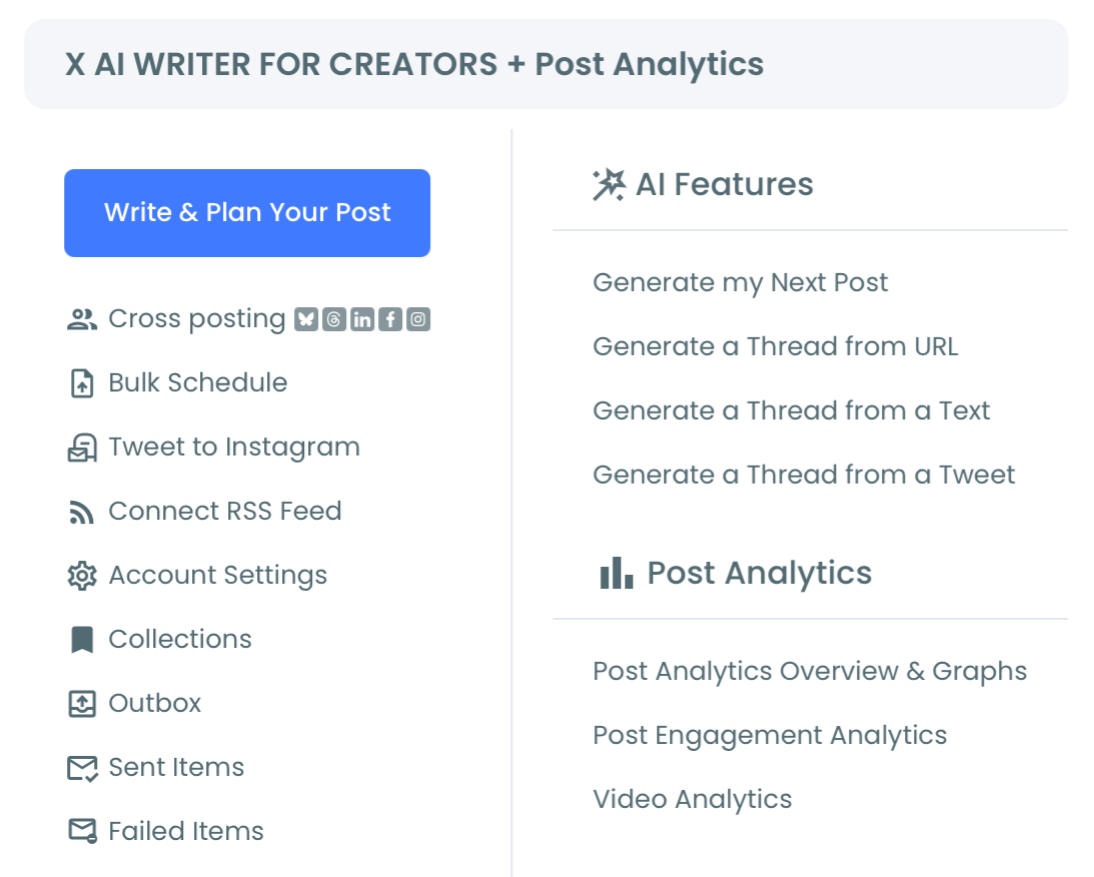
The reschedule workflow starts in Post Engagement Analytics, where the per-tweet table sorts by engagement rate, impressions, and reply count. Circleboom runs through the official X Enterprise APIs, pulls the engagement history, and re-queues the chosen tweet into the planner with the chosen publish time. → Reschedule your best old tweets in Post Engagement Analytics
Why Rescheduling Old Winners Outperforms Writing New Tweets
A tweet that earned an 8% engagement rate the first time it published has already been validated by the audience that follows the account today, or by a close approximation of that audience. The validation is the expensive input; the publish is the cheap output. Rewriting from scratch wastes the validation and forces the account to re-test what the past data already proved.
The arithmetic is structural. A fresh tweet starts at zero confidence about how it will perform; a top-performing past tweet starts at a known performance distribution. The platform's recommendation system weights early engagement heavily, and a tweet that earned strong signals once is more likely to earn them again than a tweet whose performance has never been observed.
Circleboom's piece on the evergreen tweet concept covers the theoretical case for content that holds value beyond its first publish. The data side of the argument is consistent: 20 to 30% of any account's tweets carry most of the engagement weight, and those tweets are the ones worth rescheduling.
The reuse strategy also frees up the operator's content-creation budget. An account that publishes 14 times a week with all fresh content burns out within a quarter; an account that publishes 14 times a week with a mix of fresh content and rescheduled top performers can sustain the cadence for a year or more without losing engagement quality.
What Counts As a "Best Old Tweet" Worth Rescheduling
The phrase "best old tweet" is operationally meaningful only when measured against the account's own baseline, not the platform's. A 5% engagement rate is excellent for a 100,000-follower account and unremarkable for a 500-follower account; the comparison that matters is the tweet against the account's own median, not against a universal benchmark.
The four signals that identify a rescheduling candidate are engagement rate above the account's 90th percentile, evergreen subject matter that does not date itself, format that fits the current account voice, and audience overlap between the original publish moment and the planned reschedule moment. All four signals should be present; missing any one of them produces a reschedule that disappoints relative to the past performance.
The first signal is the strict numerical one. Sort the engagement-analytics table by engagement rate descending, and the tweets at the top of the list are the candidates. The Circleboom piece on what counts as a good engagement rate on X covers the per-account benchmarking math and is the reference for the 90th-percentile cutoff.
The second signal is the timing one. A tweet that referenced a specific event, news cycle, or seasonal moment has a short shelf life; a tweet that articulated a durable observation, useful framework, or evergreen tip has a long one. The reschedule candidates are almost always in the second category.
How to Reschedule Your Best Old Tweets Step by Step
The workflow runs in two phases: the analytics review, then the planner queue. The review takes 10 to 15 minutes for a 90-day window; the queue takes 5 minutes per tweet.
Phase 1: Identify the Rescheduling Candidates
Log in to Circleboom Twitter
- Log in to Circleboom Twitter with the X account you publish from. OAuth keeps the credentials with X directly and pulls the engagement history from the past 90 days into the analytics table.

Open the Post Engagement Analytics dashboard
- Open Post Engagement Analytics under the analytics menu and load the per-tweet table. The default sort is publish date descending; switch the sort column to engagement rate or impressions for the reschedule review.
Filter to the 90-day window and the post types that fit your voice
- Filter the table to the past 90 days and the post types that fit your current voice. Exclude reply posts and quote tweets if the rerun strategy is for original tweets only; include them if the strategy covers all formats.
Phase 2: Queue the Reschedule
Select the tweets above your 90th percentile engagement rate
- Mark the tweets above your 90th percentile for engagement rate. A 90-day window typically yields 8 to 12 candidates for an account that publishes 10 to 14 times a week, which gives the operator a working pool for the coming month of rescheduled slots.
Send the candidates to the planner queue with the chosen publish times
- Send the candidates to the planner queue and pick the publish times against the audience-online data. The Tuesday morning slot is the historical winner for many accounts, but the calibrated answer is whatever the account's prior engagement history identifies as the strongest window.
Confirm the queue and let the scheduled publish run
- Confirm the queue and let the scheduled publish run. The planner publishes at the chosen moment, the engagement starts accruing, and the per-tweet analytics record the new performance for the next reschedule cycle.
The six-step sequence is the full workflow. The analytics review is the longer phase; the queue itself is short.
Video walkthrough: re-using top tweets to boost engagement on X.
What the Rescheduling Strategy Produces Over a Quarter
The output is a content calendar that runs at the account's chosen cadence with 25 to 40% of the slots filled by rescheduled top performers and the remaining 60 to 75% filled by fresh content. The mix is operator-tunable, but the rescheduled portion typically lands in that band because the supply of true 90th-percentile tweets is finite and refreshes only as the account publishes new winners.
The compounding payoff lands in two places. The first is the engagement-rate average for the calendar, which lifts measurably as the rescheduled tweets pull the average up. The second is the operator's time, which shifts from constant new-tweet generation to a mix of strategic review and selective new-tweet writing.
The Circleboom piece on seeing tweet analytics covers the data-side workflow that supports this review, and the framing about which metrics drive reschedule decisions transfers directly.
Two adjacent surfaces extend the reschedule workflow. The Post Analytics overview landing covers the full per-tweet analytics suite for operators who want the broader engagement view, and the content performance analysis landing covers the comparative view that helps identify which content patterns deserve rerunning.
Related Circleboom reading on the reschedule theme.
- Repost a tweet on the mechanics of putting an older tweet back into circulation and the choice between literal repost and rescheduled rerun.
- Twitter hacks to grow your Twitter engagement on the broader engagement-growth tactics that pair with the rescheduling strategy for compounding results.
Where the Workflow Goes Next
A first month of rescheduled tweets usually produces enough data to calibrate the reschedule cadence for the account. The pattern is usually one reschedule for every three fresh tweets, but accounts with deep historical archives (two years or more of publishing) sometimes run at a one-to-one ratio with no engagement penalty, because the supply of evergreen winners is large enough to sustain the cadence.
By the third month of the workflow, the operator has a working library of 30 to 50 rescheduling-eligible tweets, a publish-window calibration that maximizes response, and an engagement-rate average that has lifted noticeably above the pre-workflow baseline. Reschedule your best old tweets in Post Engagement Analytics and the calendar stops being a weekly content-generation grind and starts being a sustainable mix of fresh writing and proven reruns.
Common Questions About Rescheduling Tweets
How long should I wait before rescheduling a top-performing tweet?
The conservative window is 60 to 90 days between the original publish and the reschedule. Shorter windows risk audience overlap where the same followers see the tweet twice in quick succession; longer windows are safe but reduce the cadence of the reschedule program. Most accounts settle on the 60-to-90-day window after the first quarter of running the workflow and find that the audience treats the rerun as a fresh publish at that distance.
What if my best old tweets are time-sensitive and would not make sense to repost?
Time-sensitive tweets do not belong in the reschedule pool. The reschedule candidates should be evergreen by definition: durable observations, useful frameworks, recurring tips, audience-relatable framings. If the only top-performing tweets in the account's history are time-sensitive, the workflow shifts from rescheduling to studying those tweets for patterns and writing new evergreen tweets that imitate the structure without the time peg.
Should I edit the tweet before rescheduling or post it word-for-word?
Word-for-word is the default if the tweet was a winner and the framing still fits the current voice. Light edits are appropriate if the account voice has shifted, a link in the tweet has gone stale, or a specific number or reference would benefit from a refresh. Major rewrites usually mean the candidate should be treated as a new tweet inspired by the past winner, not as a reschedule.
How many old tweets can I reschedule in a single week without the audience noticing the pattern?
Most accounts can safely fill 25 to 40% of weekly publish slots with rescheduled content before the audience starts noticing the reruns. The threshold varies with audience attention level and content variety; high-engagement audiences and visually distinctive content pull the threshold down, while broad-reach audiences and text-heavy content allow a higher proportion.
Does the platform penalize tweets that have been rescheduled or republished?
No. The reschedule publishes through the sanctioned API endpoint as a fresh post; the platform treats it as a new publish and scores its engagement signals independently. The audience that saw the original may recognize it, but the recommendation system does not flag rescheduled content as duplicate or low-quality.