
Searching posts on X is really three different operations wearing the same name, and picking the wrong one is why a search that should have worked comes back empty.
The native search box answers "what is being said right now." A live collection answers "what has been said since this date, under my rules." A historical query answers "what was said during a window that has already closed." Circleboom searches public X posts across a chosen date range through official X Enterprise APIs, then separates the matching posts from the unique accounts that wrote them.
→ search posts on X
The scope you need is decided by your question, not by the interface you happen to have open.
What each search scope actually covers
The three scopes differ in what they can reach, not just in how they look.
Native search reads the index X exposes in its own interface. It is instant, it costs nothing, and it is the right answer for a quick look. Its weakness is that it is built for browsing, so the result is a feed you scroll rather than a set you can count, filter, and export.
Live collection starts from a date you choose and gathers public posts forward from there. The unit of work is a defined collection with a known size, so the question shifts from "what can I see" to "what matched my rule, and how many."
Historical search queries a window that has already closed. This is the scope people assume native search covers and it usually does not, because native results thin out quickly as you go back.
That last gap is the one worth internalizing. If your question involves anything older than the recent past, the native box will make the conversation look smaller than it was.
This is the moment most people start looking for a way to search X posts properly instead of scrolling. The scope problem is not solved by scrolling harder, because the index being read is the same one either way.
For a closed window specifically, Circleboom's Twitter historical data view is the one that reaches past what the recent index will surface.
The broader walkthrough in Twitter advanced search is a good primer on the operator syntax that all three scopes share.
Why post search beats profile search for finding people
There is a second reason to search posts rather than accounts, and it changes what the tool is for.
People do not describe their problems in their bios. They describe their job title in the bio and their actual situation in a post. An account whose bio says "operations lead" tells you a category. An account that posted "we are finally replacing the spreadsheet we have been patching for two years" tells you a moment.
Circleboom treats that difference structurally. A post search returns two linked views of the same result: the matching posts, and a deduplicated list of the unique accounts that authored them. You read the evidence first, then decide whether the account behind it is worth anything to you.
Bios describe identity. Posts describe intent, and intent is dated.
That dating matters more than it first appears. A post from last week expressing a need is a live signal. The same sentence from three years ago is a historical fact about someone who has probably already solved the problem.
Sometimes the question is about one account rather than everyone. For that narrower case, can you search specific words a Twitter account said is the better starting point.
Picking the scope from the question
Match the scope to the shape of what you are asking, and most of the difficulty disappears.
- Monitoring a launch, an event, or a live complaint: live collection from a recent start date.
- Reconstructing a past campaign, incident, or debate: historical search across that window.
- Checking whether something is being discussed at all: native search, thirty seconds, no tooling.
Two failure modes account for most wasted effort. The first is running a historical question through a live tool. It returns a thin recent slice that reads as "nobody talked about this." The second is running a live question through a historical window, which hands you stale accounts that moved on months ago.
There is a third scope question people forget. Whether you need to be logged in at all.
What a signed-in user sees differs from what is publicly visible, so Twitter search without an account is worth a look when you are checking how your own content appears to an outsider.
How to search posts on X with a date range
To search posts on X across a defined period, open Advanced X Search, pick the live or historical route, describe the posts in plain language, then set the date range and collection size. Filters narrow the result, and the post view is read before the account view. The date range is the control that decides what the result can possibly contain.
Seven actions, grouped so the scope decision happens before any collection is spent.
Choose the route and the window
- Log in to Circleboom Twitter and connect the X account that will run the search.

- Open Advanced X Search and pick Real-time Tweet Search for a forward collection or Historical Tweet Search for a closed window.
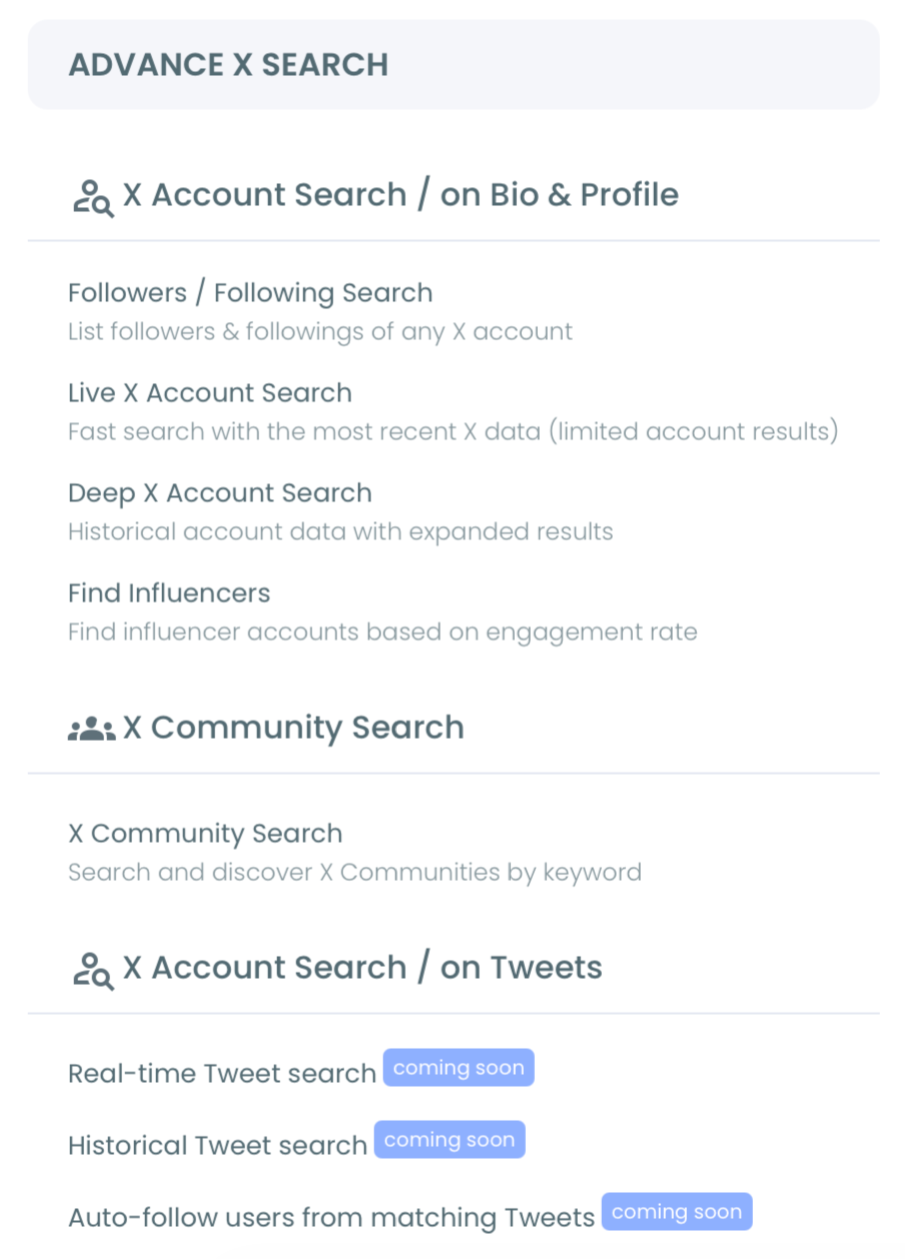
- Describe the posts you want in plain language, then accept or edit the refined query the interface suggests. Write what you are looking for, not just the keyword.
- Set the date range and collection size. Last 30, 60, or 90 days, a year, or custom dates. Collection size governs how many posts are gathered, which is not the same as how many unique accounts you end up with.
Narrow, then read before you act
- Apply filters for language, exclusions, replies, links, verified status, media type, and engagement minimums. Every filter you add is a sentence you could say out loud about the result.
- Read the posts in tweet view with their impressions, likes, reposts, quotes, bookmarks, replies, and creation time. This is where you find out whether the query caught the meaning or just the word.
- Switch to the profile view once the post set looks right. Accounts are deduplicated there, so one prolific poster stops looking like a crowd.
That order works because each step is cheaper to undo than the one after it. Fixing a query costs a retry, fixing a filter costs a click, and acting on a badly scoped account list costs your reputation with the people you contacted.
A detail worth knowing: searches are stored under a search log and can be revisited without spending tokens again. Re-opening a result is free, so there is no reason to rush the review.
See it live: how one plain-language query becomes a dated post set and then a deduplicated list of the accounts behind it.
Write the query in the vocabulary of the window
The single biggest cause of a disappointing search is a query written in today's words aimed at yesterday's conversation.
Product names get rebranded. Features get renamed. The shorthand a community uses for a complaint rarely survives two years intact, and the official term for a problem usually arrives long after people started complaining about it. Search a 2022 window with 2026 vocabulary and the result comes back thin, which looks like evidence of silence and is actually evidence of a mismatch.
Before running a historical query, spend a few minutes reconstructing how people actually wrote at the time:
- The product or event name as it was branded then.
- The competing terms that ran alongside it, misspellings included.
- The phrasing people used before an official name existed.
Live queries have the inverse problem. A term that is currently everywhere will pull in enormous volume that has nothing to do with your question, because a word in wide circulation attracts jokes, spam, and unrelated senses of the same phrase. Exclusions do more work than keywords here, and the fastest way to find the right exclusions is to read thirty results and notice what keeps appearing that you did not want.
There is a cheap test for whether a query is well aimed. Run it, read twenty results at random, and ask whether they sound like the conversation you were trying to find.
If they read as generic, the query is matching the word and missing the meaning.
A thin result is more often a vocabulary problem than an evidence problem.
The strategic version of this, choosing which terms are worth tracking at all, is covered in the power of search and keyword strategy.
Reading the numbers without overreading them
Every returned post carries metrics, and they are the easiest thing on the screen to misuse.
Engagement counts are snapshots taken when the post was collected, not live values. A post that has been climbing all morning is frozen at whatever it was when your query ran, which is fine for comparison inside one collection and misleading the moment you treat it as current.
Impressions are per-post and cannot be summed into reach. The same audience sees several posts in a conversation they are following, so adding impressions across a result set counts those people repeatedly, sometimes many times over.
And a low-engagement post is not a low-value post. The most useful result in a research set is often something with four likes, written by someone describing a problem precisely, which is exactly the post an engagement threshold would have filtered out.
Use engagement minimums to prioritize what you read first. Do not use them to define what exists.
For tuning which controls actually change your result, Twitter advanced search filters is the reference for what each one does.
What a post search cannot tell you
Circleboom is a verified Enterprise partner of X, which is what makes structured retrieval across a real date range possible rather than scraped. That access defines the ceiling honestly, and the ceiling is worth stating.
Results cover publicly available posts matching your query inside your window. Protected accounts, deleted posts, and content that is otherwise unavailable will not appear, and their absence is not evidence that the conversation did not happen.
A thin result therefore has two possible causes, and they need different fixes:
- The conversation genuinely was small.
- Your query used vocabulary the conversation did not use.
The second is far more common than people assume, especially across a historical window where product names, feature names, and community shorthand have all moved on since.
There is also a boundary on what a match licenses. An account appearing in your results published a matching public post. It did not opt into contact, and a post from a closed window says even less about the present than a recent one does.
The deeper-history case is covered in search Twitter history, which is the right read before you scope a query at anything older than a year.
Make the search reproducible
To search posts on X in a way that survives review, write down the query, the scope, the dates, the filters, and the collection size before you run it. That record is what lets you repeat the search next quarter and compare like with like rather than against a memory of what last time looked like.
Start from the question, choose the scope that can contain its answer, then let the filters do the narrowing.
→ search X posts by keyword and date
Common questions about searching X posts
Can I search posts on X from several years ago?
Yes, through a historical query with a custom date range. Native search thins out quickly going back, which is why older windows need the historical route rather than the search box.
Why did my search return fewer accounts than posts?
The profile view deduplicates authors. One account posting forty matching times produces forty rows in tweet view and a single row in profile view.
Does a post search return every matching post?
No. Coverage is limited to publicly available posts within your query, filters, and window. Protected, deleted, and unavailable content is out of reach for any tool.
Should I filter by engagement when researching?
Use it to decide reading order, not to define the result set. Precise, low-engagement posts are frequently the most useful thing a research query finds.