

The accounts that don't follow you back are the ones you follow whose profile never shows a "Follows you" badge in return. On X you can confirm this one profile at a time, and that method stops working the moment your following list passes a few hundred accounts.
Manual: open every profile you follow and hunt for the "Follows you" badge, one account at a time, across your whole list. Circleboom: Circleboom lists every account you follow that doesn't follow you back on X in one sortable table, pulled through official X API access.
→ see accounts that don't follow you back
The table also tells you which one-way follows are worth keeping.
Most people treat this as a tidiness question. It is really a math question. Every account you follow but that never followed back sits inside your following count, and that count is governed by rules X enforces on your account. The fastest way to find who doesn't follow you back on X is a single filtered list, not a manual profile-by-profile check.
Checking by hand fails quietly. You get through the first screen of profiles, lose your place, and never reach the accounts that actually need review. The blog post how to see who is not following back on Twitter walks through why the manual route breaks down and what replaces it.
Why the Accounts That Don't Follow You Back Actually Matter
X caps every account at following 5,000 accounts, and past that point your ability to follow more is throttled by your own follower-to-following ratio. You can read the exact mechanics in X's follow limit and ratio rules. The practical effect is simple: non-reciprocal follows eat into a ceiling you cannot raise by wishing.
A skewed ratio also changes how new visitors read your profile. An account following 4,000 and followed by 400 signals undiscriminating follow behavior before anyone reads a single post. Trimming the one-way follows that carry no content value is the cleanest way to correct that signal.
Many of the worst offenders are also inactive, which is why this cleanup pairs so naturally with the move to unfollow inactive Twitter accounts. An account that neither follows you nor posts anymore is pure weight on your ratio.
There is a second reason to act carefully rather than aggressively. X's rules prohibit "follow churn," the pattern of following and unfollowing large numbers of accounts to inflate reach. The goal is a reviewed, gradual cleanup of genuine non-followers, not a blind mass-purge that trips abuse detection.
The accounts that don't follow you back are not automatically worthless. They are simply the segment with the weakest relationship signal, which makes them the right place to start a review.
The Two Kinds of Accounts That Don't Follow You Back
Every one-way follow falls into one of two groups, and they call for opposite responses.
The first group is intentional. You followed a journalist, an industry publication, a competitor, or a public figure precisely because their posts are worth reading, and you never expected a follow-back. These accounts belong in your following list regardless of reciprocity.
The second group is residue. These are leftovers from a follow-for-follow campaign, a rapid expansion phase, or a stretch of less selective following that never gave anything back. They carry no content value and no relationship. This is the group a cleanup targets, and it often overlaps with what a fake followers audit on Twitter turns up.
Telling the two groups apart by eye is the hard part, and it is exactly where a filtered list earns its keep. Sorting by activity and follow ratio pushes the residue to the top and leaves your deliberate follows untouched.
Circleboom identifies these accounts and enriches each one with engagement tier, follow ratio, and account age, so you review by value instead of by reciprocity alone. Because Circleboom is an official X Enterprise Developer, every list is pulled through sanctioned access, so your account stays inside X's rules the entire time.
How to See Accounts That Don't Follow You Back on Twitter (Step by Step)
Step-by-step demo: how the non-follower list renders and how the filters separate keep-worthy one-way follows from dead weight.
To see accounts that don't follow you back, connect your X account, open the Not Following Back view, then filter that list by engagement and follow ratio before you act on any account. The sequence below runs that loop in two short phases.
Connect your account and open the non-follower list
- Log in to Circleboom Twitter and connect your X account with official OAuth.
- Open the Follower & Following menu from the dashboard.
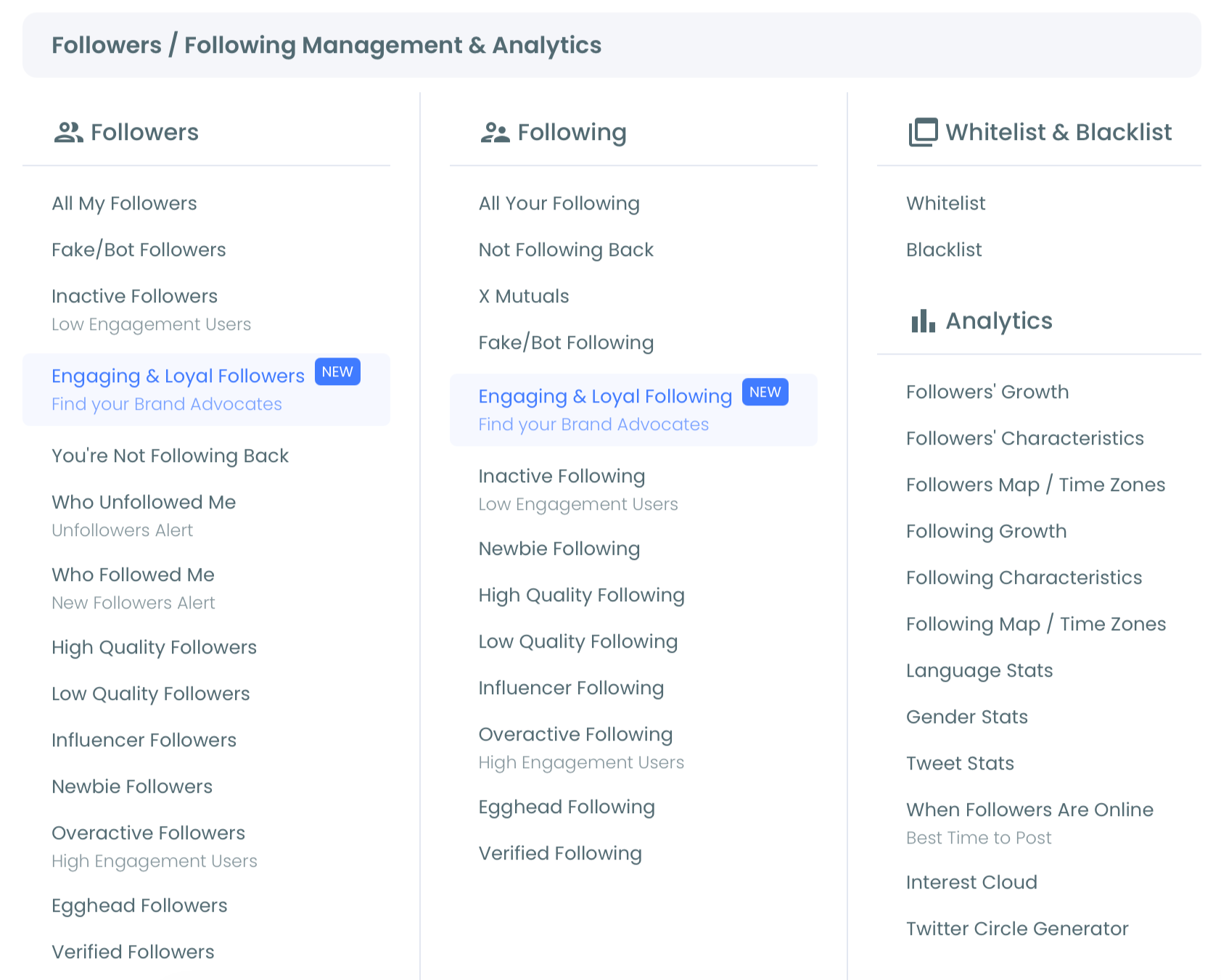
- Select Not Following Back under Audience Insights to load every account you follow that has not reciprocated.
Filter the list and clean it safely
- Apply the engagement, follow ratio, and join date filters to separate intentional one-way follows from low-value residue left over from old follow-for-follow phases.
- Whitelist the accounts you want to keep, such as reporters, brands, and competitors you monitor, then select the remaining accounts and run a gradual Unfollow.
That order is what keeps the cleanup safe. Connecting first earns official access, filtering narrows the list to defensible candidates, and whitelisting protects the sources you follow on purpose before any bulk action runs. Skip the filter step and you risk unfollowing a reporter you meant to keep.
At a glance: connect, open Not Following Back, filter by value, whitelist keepers, unfollow the rest gradually.
Unfollowing is paced to protect your account. Circleboom processes 50 unfollow actions every 15 minutes and up to 800 per day, and staying near 100 to 150 accounts per session keeps you well clear of X's automated detection. If you want the account-safety reasoning in depth, how to unfollow Twitter accounts without getting suspended covers it.
Which Non-Followers to Keep and Which to Cut
Reciprocity is one signal, not the only one. A journalist, an investor, an industry publication, or a competitor you track may never follow back and still earn a permanent spot in your following list.
The strongest cut candidates share several traits at once:
- They never followed back.
- They post rarely or read as inactive.
- Their follow ratio is very low.
- Nothing in their bio or name is relevant to you.
When those signals stack, the account is almost always residue from a past growth experiment rather than a source you chose deliberately. You can move borderline sources you still value into a Twitter List instead of unfollowing, so they leave your main feed without leaving your radar.
The oldest of these are usually inactive as well. The post on the need to unfollow inactive Twitter accounts explains why a silent account still drags on your reach long after it stops posting.
Before you cut anyone, it helps to confirm your real two-way relationships. The Twitter Mutuals checker shows exactly who reciprocates, so you never mistake a genuine mutual for a one-way follow.
For the ones you decide to remove, Circleboom is the calm way to check who isn't following you back. You act on the whole segment in one pass, instead of clicking through profiles until you lose patience.
Your Non-Follower Cleanup Checklist
Run this the next time your following count feels heavier than your follower count:
- Open Not Following Back and read the full one-way list.
- Filter by inactivity and low follow ratio to surface the weakest follows.
- Whitelist the sources you follow on purpose.
- Unfollow the low-value remainder in gradual, rate-safe batches.
Done in that order, the cleanup improves your ratio without costing you a single source you actually wanted.
If you want to double-check the reciprocity math one more way, how to check mutual followers on Twitter is a useful companion. When you are ready, spot the accounts not following you back and start with the weakest segment first.
Questions About Non-Followers
Can I see everyone who doesn't follow me back at once?
Yes. Circleboom cross-references your following and follower lists through official X APIs and returns every non-reciprocal account in one table, so you never check profiles individually.
Is it safe to unfollow the accounts that don't follow back?
Yes, when it is done gradually. All actions run through official, sanctioned X API access within platform rate limits, and pacing your batches keeps you clear of the "follow churn" behavior X restricts. Whitelist important accounts first.
Should I unfollow every account that doesn't follow me back?
No. Many one-way follows, like news outlets, analysts, and competitors, are worth keeping for their content even without a follow-back. Filter by engagement and relevance before deciding.
Will unfollowing change my follower-to-following ratio?
Yes. Removing non-reciprocal follows with no content value lowers your following count, which improves the ratio new visitors see when they land on your profile.
How many accounts can I unfollow in a day?
Circleboom processes 50 unfollows every 15 minutes and up to 800 per day. Staying around 100 to 150 per session is the safest pace for account health.






%20users%20are%20not%20following%20you%20back%3F)
