
Most people open a competitor's follower list, scroll for twenty seconds, and close the tab none the wiser. The names load in the order they arrived, the page stops feeding you after a couple of screens, and there is nothing to sort or filter.
The list is public, and it is still unreadable.
What this walkthrough gives you.The exact retrieval flow, from username to filtered segment, in under three minutes.A gate for deciding whether a given account's follower list is worth pulling at all.The filter stacks that turn 25,000 raw accounts into a few hundred that matter.
Circleboom retrieves any public X account's complete follower or following list over its official X Enterprise Developer access and renders it as an enriched, filterable table. Start with search someone else's Twitter followers.
Why the X follower list you scroll is the wrong sample
A public follower list is ordered by arrival date, which is the least useful ordering X could have chosen.
The accounts that followed most recently load first, the page appends a few dozen more as you scroll, and then the loading stalls long before a large list is exhausted.
Nothing about that ordering correlates with what you came to find out. The most valuable follower on a 25,000-account list might have arrived in 2019 and is sitting somewhere you will never scroll to.
There is a second problem underneath the first. Even if X handed you every name, the profile view gives you no way to tell a dormant account from an active one, or a real audience member from a follow-for-follow collector.
You would be reading 25,000 handles with no signal attached to any of them.
Both problems have the same fix: get the list out of the scroll and into a table.
Circleboom requests the full public list from X and returns it with a quality profile on each row, which is the difference between browsing names and reading an audience. Once you can see another account's Twitter followers with sorting and filters attached, the ordering stops mattering because you control it.
How to see someone else's Twitter followers step by step
The retrieval itself is short. Give Circleboom a public username, choose a direction, and it hands back every account in that list with tweet count, account age, follow ratio, the follower and following totals behind that ratio, and an activity classification already attached.
Once your own account is connected you can open any public account's follower list in a couple of clicks.
X's own developer documentation for the followers lookup endpoint describes the same paginated retrieval model, which is why a complete large list arrives in batches rather than instantly.
See it live: the moment a raw public follower list becomes a sortable table with quality signals attached.
https://www.youtube.com/watch?v=egy4xi4tex4
The flow, in order, across three phases.
Connect your account and open the search
- Open Circleboom Twitter Management and sign in with X through the standard authorization screen.

- Select Advanced X Search from the dashboard menu. This is where the account-level search tools sit.
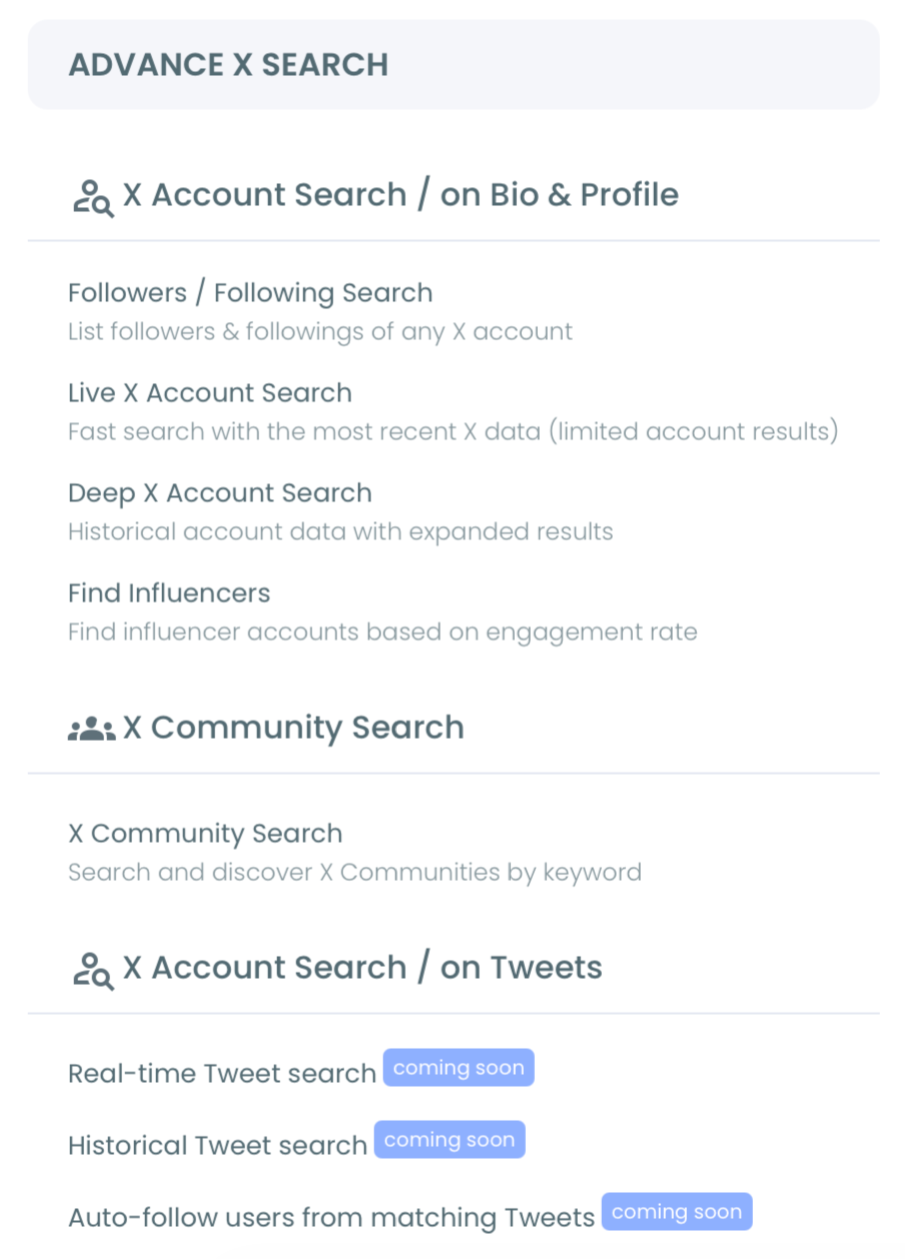
- Type in the username of the account you want to read. Leave off the @ symbol; the field takes the handle exactly as it appears in that account's profile URL.
Pull the list and read its shape
- Select Show Followers or Show Following. Those two lists answer questions with almost nothing in common, and the section on direction below covers how to choose.
- Sort by follow ratio ascending before you filter anything. Bots and follow-collectors cluster at the weak end of that sort, and thirty seconds there tells you whether the audience is worth filtering at all. Our write-up on what a Twitter follower scraper actually does explains why those low-ratio rows carry more information than the headline count above them.
Narrow to the segment you will act on
- Open Filter Options and set your quality floor. Hide eggheads, fake and spam patterns, and inactive accounts, which removes the noise layer in one pass.
- Add the criteria that define your target using Find in Bio & Name, follower count range, and location. Every criterion you add behaves as an AND rather than an OR, so the result set only ever narrows.
That sequence works because each step narrows the decision the next step has to make.
Sorting before filtering tells you which filters are worth setting, and setting the quality floor before the targeting criteria means you are never evaluating a bio keyword on an account that was never real.
Quick recap:
- Connect your X account and open Advanced X Search.
- Enter the username and pick followers or following.
- Sort by follow ratio to read the list's shape.
- Filter for quality first, then for your target profile.
The clicking is the easy part.
What decides whether the exercise produces anything worth reading are the two judgments sitting either side of it: which account you point it at, and which of that account's two lists you pull. Both are below.
Which X account's follower list is worth pulling
Not every account is a good source, and this is the step almost everyone skips. Your output is capped by the quality of the seed account you start from.
A seed account earns the pull when it clears these four points:
- Topical tightness. The account posts about one thing. A general-interest celebrity's followers tell you nothing about a niche.
- Audience size in range. Somewhere between a few thousand and a few hundred thousand. Below that the sample is thin, above it the audience is too general to read.
- Real engagement on posts. Replies and quotes, not just impressions. An account with a bought audience passes that audience straight to you.
- Adjacency, not identity. Direct competitors work, but so do complementary accounts your buyer already follows.
Compare three to five seed accounts before you commit to one.
Accounts that appear across several relevant follower lists are the strongest prospects in any of them, and the overlap is the signal that no single list gives you. Compare Twitter X Accounts does that overlap math directly if you would rather not do it by eye.
One hard constraint sits over all of this. Protected accounts return nothing, to any tool, ever.
If the seed account protects its posts and you are not an approved follower, there is no list to pull, and the practical answer is to find a public account covering the same subject instead.
Followers or following: which X list to pull
Choosing the direction is a real decision, not a default. The two lists answer questions that have almost nothing in common, and picking the wrong one wastes the whole exercise.
A follower list tells you who chose to listen to that account. That is the audience: prospects, customers, community members, and the people you would want in front of your own content.
A following list tells you who that account chose to listen to. That is their information network: the analysts they trust, the partners they work with, the competitors they watch.
For research on a person rather than a market, the following direction is almost always the richer read.
Both directions run through the same retrieval path and both are capped by the same public-account rule. Our own notes on how to scrape a Twitter following list cover the following direction in more depth if that is the one you need.
Filter combinations that turn a raw list into a segment
The filters are only useful in combinations, and three combinations cover most real work. Each one is a different question asked of the same list.
The prospect stack. Find in Bio & Name set to a role word like "founder" or "recruiter", minimum follower count around 500, activity tier set to Active. This produces people who describe themselves the way your buyer does and are still posting.
The influence stack. Follow ratio minimum around 3, follower count minimum in the thousands, verification filter on. Accounts many people follow and that follow few back are the ones whose attention is worth something.
The cleanup stack. Follow ratio below 0.1, tweet count under 10, inactive classification on. Nobody uses this to find prospects. You use it to measure what proportion of a seed account's audience is padding, which tells you how much to discount its follower number.
Run the cleanup stack on a competitor before you believe their audience size. A list where a third of the accounts have no photo, no posts, and a ratio under 0.1 is a smaller market than the headline suggests.
Filters apply across the whole dataset, not just the visible page, and the Active Filters bar shows every criterion in force. Check it before acting, because a forgotten filter is the most common way a segment ends up wrong.
Getting the list out of X and into a spreadsheet
Export when the segment needs to live somewhere other than Circleboom. The CSV carries a row per account with profile ID, username, display name, location, bio, tweet count, following and follower counts, verification status, quality flags, verified type, and the date the account was created.
That file drops straight into a CRM, an ads custom audience, or a shared sheet a team can work through. It also serves as a dated snapshot, which matters because follow relationships change constantly and nothing reconstructs a list after the fact.
Exports are priced in tokens against the row count of the file. Circleboom shows what a pull will draw down before it runs, so a large list never surprises you afterwards, and filtering first means you pay for the segment rather than the raw population.
If a spreadsheet is the destination, read how to export Twitter followers to a spreadsheet once before your first large pull.
Working from an X List you built rather than a whole account? Export List of Followers on Twitter runs the same export against list members.
Is pulling someone else's X follower list safe for my account?
Yes, when the data comes through licensed API access rather than a browser automation. This is the distinction that decides everything, and it is invisible from the outside because both approaches produce a CSV that looks the same.
Browser extensions and scrapers work by driving a logged-in session at speed, which breaks X's terms and puts the account running them at risk of rate-limiting or suspension.
Licensed retrieval asks X's own endpoints for public data and receives it inside documented limits. X publishes an Enterprise customer directory naming the companies granted that level of access, and Circleboom is on it.
One thing to check before you install anything: several popular follower-export extensions ask for permissions far beyond what the job needs. The comparison of Twitter follower export Chrome extensions goes through what each one actually requests.
Which of the three paths fits your task
If you only need to check whether a handful of specific people follow an account, stay in X. The native scroll plus the search box on the followers page is faster than any tool for a lookup that small.
To judge an audience, pull the list into a table, sort by follow ratio, and read the shape before you filter. Ten minutes gives you a defensible read on whether that audience is real.
If you need the segment outside X, filter first and export second. The filtered file costs fewer tokens, imports cleaner, and does not need a second pass in a spreadsheet to be usable.
For the two paths that leave X, the first move is the same one.
→ View someone's Twitter followers
Reader questions
How long does a large follower list take to retrieve?
Small and mid-size lists return in seconds. Accounts with hundreds of thousands of followers retrieve in batches through the API, so the wait scales with list size and the row count you receive may land under the account's displayed follower number.
Can I follow the accounts I find without leaving the results?
Yes. Follow, unfollow, whitelist, blacklist, and Add to List all run per-row or on a checkbox selection from the same table. Bulk follows are paced at 50 every 15 minutes, up to 400 per day, and Circleboom resumes automatically the next day.
Can I look for one specific handle inside the retrieved list?
Yes. The Find in Bio & Name field searches the retrieved dataset rather than the visible page, so a single handle or a bio phrase comes up right away even on a list too long to page through. That is usually quicker than the search box on X's own followers page.
What happens if the account is private?
Nothing is returned. Protected accounts keep their follower and following lists visible only to approved followers, and that restriction applies at the platform level to every tool, including this one.
Should I export the whole list or a filtered segment?
Filter first in almost every case. A filtered export costs fewer tokens, produces a file you can act on immediately, and avoids the spreadsheet cleanup pass that a raw 25,000-row list always needs.