
Run an unfiltered auto follower for one week and the bill is not a suspension notice. It is a following list of two thousand accounts you did not choose, a timeline you no longer read, and several hundred slots gone from a ceiling X will not raise until your own follower count catches up. That damage is quiet, it compounds, and no throttle setting prevents any of it.
What a criteria-gated setup gives you.A follow list built from filters you define, not from whoever matched a keyword.Batches released at 50 follow actions every 15 minutes, up to 400 a day, with automatic resume.A confirmation step and a visible account count before any follow leaves.
Circleboom applies those gates to X accounts through official API access. Start with the Twitter auto follower setup below.
What an unfiltered auto follower actually costs you
The cost of indiscriminate following lands in four places, and only one of them involves X's enforcement systems.
The first is the ceiling. X allows 5,000 total follows before your own follower count starts governing how many more you can add, so every speculative follow spends a slot that a deliberate one could have used.
The second is your feed. A timeline stuffed with accounts you never evaluated stops being a research tool, which quietly removes the main reason you were on the platform.
The third is cleanup debt. Every non-reciprocating account you followed on a hunch becomes work later. That is why so many people who start with automated following end up searching for bulk follows and bulk unfollows on Twitter a month afterwards.
The fourth is the enforcement risk everyone talks about, and it is genuinely real. But it is the last one on the list, not the first, and treating it as the only cost is how people end up with a "safe" tool that still wrecks their account.
I have watched this play out enough times to have a rule about it. Anyone shopping for Twitter auto follow on the basis of how slowly it runs is optimizing the wrong variable.
The rule X actually enforces
X's rules single out following that is bulk, aggressive, or indiscriminate, and the third word is the one doing the work. Indiscriminate describes who you followed. It says nothing about how quickly you followed them.
That reading is consistent with how X frames its automation development rules, which permit automated actions but not automated actions taken without regard to relevance or consent.
A paced run against an unfiltered list is still an indiscriminate run. It just takes longer.
Pacing does two useful things and one useless thing. It keeps you inside the technical ceilings, and it prevents the burst pattern that automated detection catches most easily. What it cannot do is make an arbitrary follow look deliberate, because the deliberation happens at selection time or it does not happen at all.
The enforcement side gets a longer treatment in can mass follow and unfollow on Twitter result in suspension. Worth reading before a first run.
Which leads to the practical question: what does a filtered setup look like in the product?
How to set up a Twitter auto follower, step by step
Watch the flow: how the filter panel narrows a raw keyword result before a single follow is queued.
The process, in order, across three phases.
Connect the account and pick a discovery feature
- Log in to Circleboom and authorize the X account you want to grow through official OAuth.
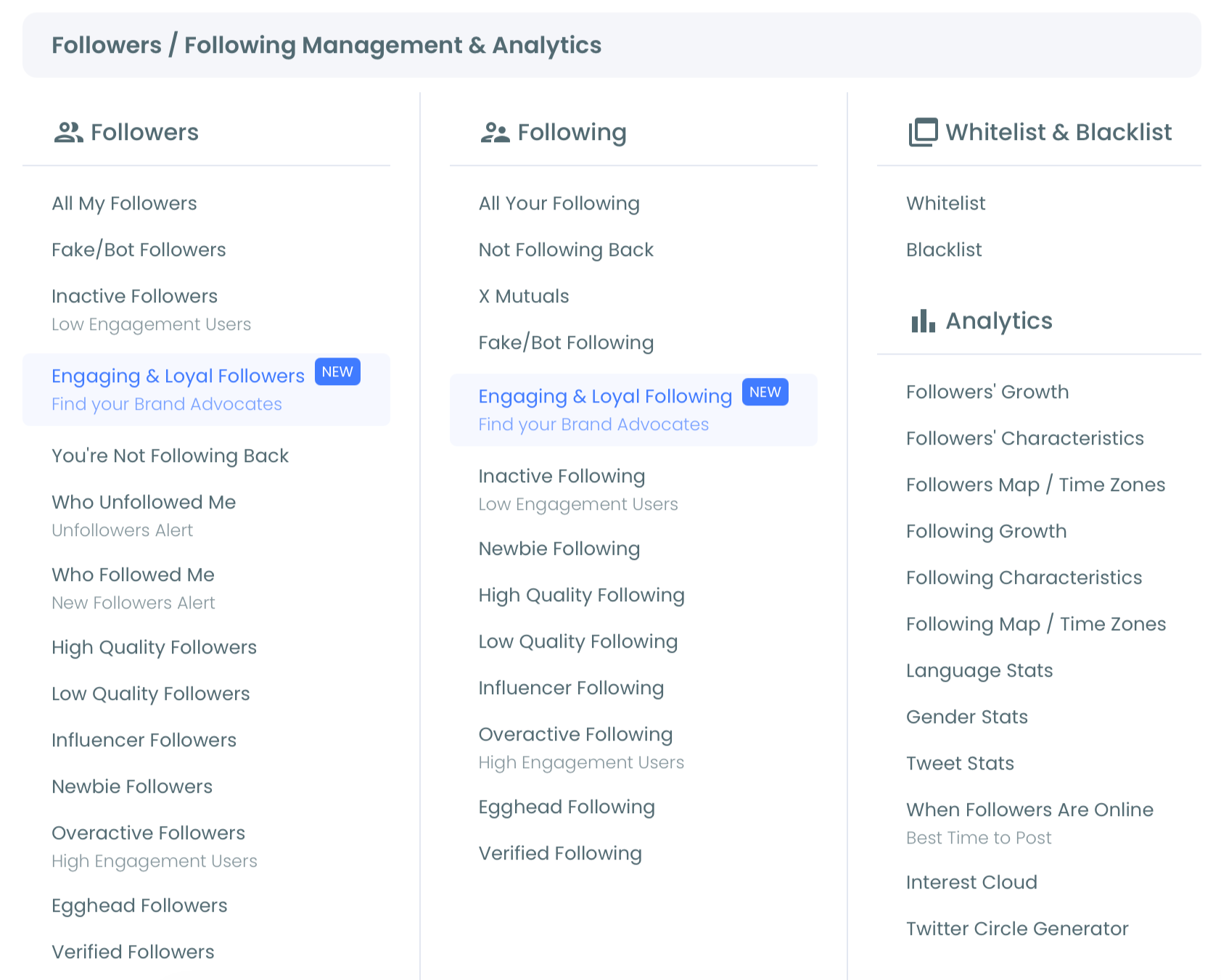
- Open the Follower and Following menu, which is where audience segments, quality classifications, and the bulk action layer all live.
- Choose the discovery feature that matches your intent. A keyword account search for people active on a topic, a real-time tweet search for accounts posting right now, your own not-following-back list for reciprocity, or a competitor's follower base for borrowed relevance.
Set the gates before anything follows
- Open Filter Options and apply your quality conditions. The panel carries follower count, following count, tweet count, follow ratio, join date, engagement tier, verification status, language, location, and a bio and name text search. Every active condition applies as AND, so each one you add narrows the set rather than widening it.
- Whitelist the accounts that must never be caught by a bulk action. Whitelisting is permanent until removed and applies across every feature in the product, so partners, customers, and anyone you would be embarrassed to auto-follow or auto-unfollow can be protected once and forgotten.
- Export the filtered segment as CSV before you act on it. Export consumes tokens and takes seconds, and it leaves you the only record of what the segment contained at the moment you ran it.
Release the batch under X's limits
- Read the Active Filters bar, select the rows, and confirm. The bar lists every applied gate as a removable chip, and the bulk button shows the exact count in scope before it becomes clickable. Circleboom then processes 50 follow actions every 15 minutes, up to 400 per day, pausing at the ceiling and resuming the next day on its own.
That ordering holds up because each step protects the one after it. Authorizing first puts every request on sanctioned API access. Filtering before selecting means the selection can only contain accounts that already qualified. Whitelisting and exporting before confirming give you a safety net and a record. And the pacing keeps the release inside the ceilings X publishes rather than testing them.
Quick recap:
- Connect the X account through official OAuth.
- Pick the discovery menu that matches your intent.
- Set quality gates, whitelist, and export.
- Confirm the batch and let the pacing run.
Everything above is available inside Circleboom's auto follow on X workflow.
How the rate limits actually behave
The pacing is not a slider you tune, and knowing the real numbers changes how you plan a run.
Follows release at 50 actions every 15 minutes, up to 400 in a day. That daily figure is not arbitrary. X documents a 400-account daily follow limit at the platform level, alongside the 5,000-account total cap that holds until your own follower count grows. Circleboom paces to those published ceilings rather than probing them.
Unfollows run on the same 15-minute cadence but a higher daily allowance, at 50 every 15 minutes up to 800 a day. The asymmetry is useful to know when you are cleaning up an old list, because removal capacity is roughly double the rate at which you can add.
When a daily ceiling is reached mid-queue, the run pauses and picks up the following day automatically. Nothing is lost and nothing needs restarting, which means a 1,200-account target set is a three-day job you set once rather than three sessions you have to remember.
One consequence people miss: because the queue survives a pause, there is no advantage to splitting a large list into manual chunks. Staging the whole filtered set once and letting the pacing handle it produces the same result with fewer chances to lose track of what you already followed.
Plan target-set size against the daily ceiling, not against your patience. A list of 300 finishes inside a day. A list of 3,000 is a week-long commitment, and if it is that long, the filters probably need another pass before it is worth committing to.
Which discovery menu should feed it?
Pick the discovery feature by how fresh the signal needs to be, because that single question resolves most of the choice.
Keyword account search matches your term against bios and recent posts and returns accounts currently active on the topic. Use it when you want people who describe themselves a certain way, or who have been posting about something lately. It is the default starting point for niche audience building.
Real-time tweet search collects live posts from a start date you choose (last 24 hours, last 7 days, last 30 days, or a custom range) and extracts the accounts behind them. Use it when the signal is an event rather than an identity: a launch, a conference hashtag, a competitor's public incident, a buying question posted this week.
This is also the feature that carries a continuous auto-follow mode, where Circleboom keeps pulling accounts behind newly matching posts and following them as they appear. Set engagement minimums and account-quality filters before switching that on. A continuous run inherits whatever gates existed when it started, and nothing you add afterwards applies retroactively.
Your own segments are the most underrated of the three. Running gates against your not-following-back list produces a target set of accounts that already follow you, which is a fundamentally warmer ask than any cold keyword result. There is a dedicated walkthrough of auto-following back on Twitter if that is your main use case.
Borrowing a competitor's audience sits in the same family, and how to automatically follow another account's followers on Twitter covers that variant specifically.
Mistakes that turn a good setup into churn
Four mistakes account for most of the bad outcomes I see, and all four happen before the follow button is ever pressed.
Running a broad pass "just to see." The exploratory first batch is the one that creates the cleanup debt, because nobody goes back and undoes it. Set the gates on run one.
Filtering on follower count instead of follow ratio. Follower count tells you how big an account is. Follow ratio tells you whether it follows everyone, which is the signal that actually predicts a low-value follow.
Skipping the whitelist. Whitelisting takes one pass and protects those accounts across every bulk operation in the product permanently, including unfollow and block operations you have not planned yet.
Treating unfollow as the other half of the strategy. Following in order to unfollow is churn, and churn is the pattern the rules describe most directly. Pruning genuinely dormant accounts months later is a different activity, and a Twitter Follower Audit is the honest way to decide who qualifies.
Reusing a filter preset that has gone stale
A fifth mistake is subtler than the other four, and worth its own heading. People set the gates once, get a good result, and reuse the same filter preset across a completely different target set months later. Audiences drift, niches shift, and a follow-ratio floor tuned for one keyword pool is not automatically right for another.
Re-read the filtered table before every run, not just the first one. It takes a minute and it is the only check that catches a stale preset.
Circleboom is a verified Enterprise partner of X, which handles the infrastructure side of compliance: sanctioned API access, rate handling, automatic pause and resume. The selection side stays yours, and that is the half these four mistakes live in.
If a past run already went wide, clean before rebuilding. Working through unfollow inactive Twitter accounts first gives you honest headroom against the 5,000 ceiling.
Run Who Unfollowed Me on Twitter alongside it. It shows which of those follows were never going to hold in the first place.
Wrapping up
A Twitter auto follower is safe when the list it acts on was built deliberately, and unsafe when it was not. The pacing, the confirmation step, and the daily ceiling are all worth having, but they are the floor of a safe setup rather than the substance of one.
The substance is the filter panel. Follow ratio, tweet count, engagement tier, and join date do most of the work on almost any target set. The test of whether you tightened them enough is simple. A filtered list should be short enough to read row by row before you act on it.
Nobody can promise you follow-backs, and any tool that does is selling other people's decisions as a feature. What criteria-gating changes is whether the ask makes sense to the person receiving it.
→ Start auto-following on X with your own criteria
What to know before you start
How long does a full run take to finish?
At 50 follow actions every 15 minutes, a 400-account daily batch releases across roughly two hours of processing. Larger target sets spread over multiple days, and the queue pauses at the daily ceiling and resumes on its own without you reopening anything.
What criteria should I set on a first run?
Start with a follow-ratio floor, a minimum tweet count, an engagement tier of Active or Moderate Active, and a join-date window that excludes very new accounts. Those four conditions remove most low-value accounts on almost any target set, and you can add language, location, or verification once you see what the base filter leaves behind.
Can I undo a batch of follows?
Yes. Unfollow works per row or in bulk, at 50 actions every 15 minutes up to 800 a day. Undoing is slower and less pleasant than filtering properly the first time, which is the argument for spending your attention on the gates rather than on the recovery path. Export the segment before you reverse it, so you keep a record of what was there.