
How do you clear the accounts with no profile picture out of your Twitter following list without losing the real people hiding among them? Most cleanup advice answers the first half of that question and skips the second.
The default avatar is the fastest low-quality signal to read on X, and it is also the easiest one to read wrong.
What this walkthrough gives you.One view that isolates every account you follow with no profile photo on Twitter.A sorting rule that splits that segment into three groups before you unfollow anything.A paced unfollow run that respects X's limits and protects the accounts you meant to keep.
Circleboom pulls your entire Twitter following list through official X API access and isolates every account that never uploaded a profile photo, with tweet count, join date, follow ratio, and engagement tier attached to each row. Start where that segment lives: unfollow no profile picture accounts on Twitter.
Is a missing profile picture on Twitter really a bad sign?
A missing profile picture is a reason to look, not a reason to act.
It tells you an account skipped the single easiest setup step on the platform. It does not tell you whether a person is behind it.
Plenty of real people never upload an avatar. They read, they bookmark, they follow a few hundred accounts, and they almost never post.
Pew Research Center's analysis of U.S. adults on Twitter found that the top 25% of users by tweet volume produced 97% of all tweets. The remaining three quarters posted a median of nothing at all across a three-month window.
That is the population your no-photo filter keeps catching.
Silent is normal on X. Silent plus empty is the thing worth removing.
The practical problem is scale. You cannot open two hundred profiles one at a time to decide which is which, and X gives you no filter for it.
Circleboom's Egghead Following view handles that half. It lists every no-photo account you follow in one sortable table, so you can clear the default-avatar accounts from your following list in a single pass.
Circleboom builds that segment from your live Twitter following list and attaches tweet count, join date, and follow ratio to every row, so the avatar stops being the only thing you are judging on.
One distinction matters before you start. The same avatar signal exists on both sides of your network, and the two cleanups have different stakes.
Removing a no-photo follower changes your audience metrics, which is what how to remove egghead Twitter followers covers.
Unfollowing a no-photo account changes your feed and your public following list, and it costs you a relationship you chose to build in the first place.
The three groups hiding inside your no-photo segment
Every no-photo account you follow belongs to one of three groups, and the group it belongs to is written in its join date and its tweet count. Read those two columns together and the segment sorts itself.
Most cleanup advice stops at "combine the missing avatar with other signals." That advice is correct and almost useless, because it never says which signal to read first.
Read the join date first. It splits the segment faster than anything else in the table.
Never-built accounts
A never-built account joined X recently, has almost no tweets, and has never had a photo. The profile was created and abandoned inside the same week, or it was created by something that had no intention of building a profile at all.
These accounts cluster around specific dates in your following list. Usually right after a growth push, a follow-back campaign, or a viral thread that pulled in a wave of new registrations.
Sorting by Joined descending inside the Egghead Following view brings the whole wave to the top. The same date-based reading is what makes search Twitter accounts by join date useful across every other cleanup you run.
Set Tweet Count to a maximum of ten and a recent Join Date range, and what remains is the group that needs no individual review. If it never posted and never finished a profile, it is not going to.
Went-dark accounts
A went-dark account is the opposite shape. Old join date, a real tweet history that stops at some point, and no avatar today. Something changed after you followed it.
This is the group that gets misread most often, and it is the reason a blanket unfollow is a bad idea.
An old account with hundreds of tweets and no current photo is usually a person who quit the platform, rebranded and never finished, or lost the account. None of those are bots, and one of them may come back.
Check the follow ratio and the last activity before deciding. A dormant account that used to matter to you is worth keeping if the cost of keeping it is one dead row in a list you rarely scroll.
The Twitter Join Date Checker gives you the account-age half of that read without leaving the cleanup flow.
Quiet readers
A quiet reader has an old or mid-age account, a real bio, a modest following count, low tweet volume, and no avatar. They are consuming the platform rather than performing on it.
They are also the accounts you will regret unfollowing, because they are frequently the ones who actually read what you post.
A follower who never tweets still sees your timeline.
Whitelist these before you run anything in bulk, and the rest of your cleanup passes will skip them permanently.
If the three-way split feels close in a borderline case, weight the bio.
A written bio with no photo is a person who started the profile and got bored. An empty bio with no photo is a profile nobody ever intended to finish, which is the same pattern that shows up in list your low quality friends and followers.
How to unfollow no profile picture accounts on Twitter, step by step
Where the Egghead Following view sits and where the unfollow control sits, in one recording.
https://www.youtube.com/watch?v=29tyR1SA4T8
The flow runs in two phases: build the segment, then sort it before you act on it.
Load the no-photo segment out of your following list
- Log in to Circleboom Twitter and connect your X account. Authorization runs through official OAuth, so your password never touches Circleboom.

- Open the Follower and Following management menu from the dashboard. Every following-side segment lives here, including the no-photo view.
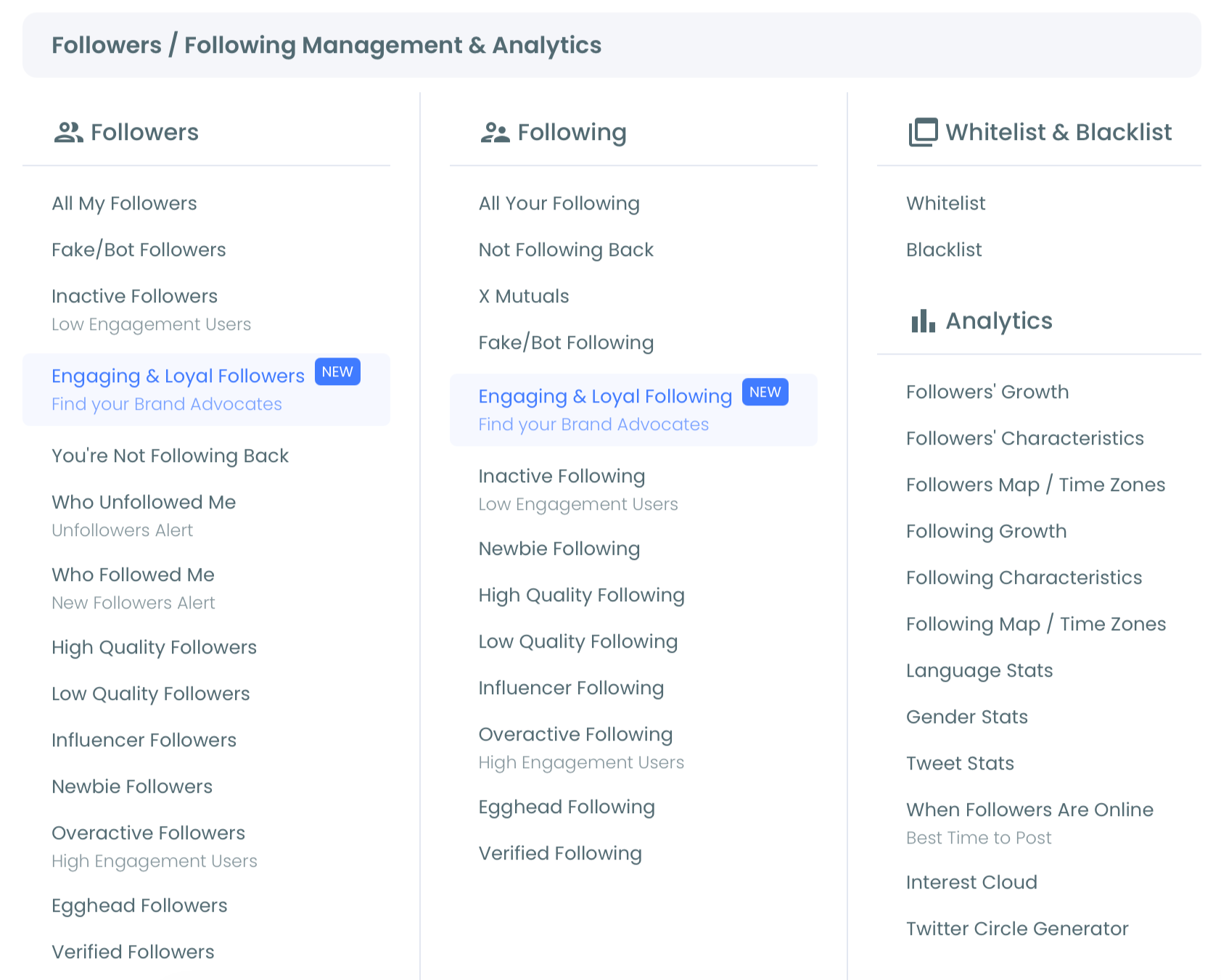
- Select Egghead Following from the Following group. Circleboom retrieves your full following list and shows only the accounts with no custom profile photo, each row carrying Name, Tweets, Joined, Following, Followers, Follow Ratio, and an activity classification.
Sort the segment before you unfollow anything
- Sort by Joined, then by Tweets using the column headers. Clicking a header sorts ascending, clicking again reverses it. Two sorts are enough to separate the never-built accounts from the went-dark ones.
- Whitelist the quiet readers with the shield icon on each row, or select several and use the bulk Whitelist option under Add to List. That shield is what carries your exceptions through every later cleanup, not only this one.
- Select the confirmed weak accounts and click Unfollow. Circleboom processes 50 unfollows every 15 minutes, up to 800 per day, and pauses automatically when the quota is reached. Staying in the 100 to 150 range per session keeps you well clear of X's automated detection.
That order is what makes the pass safe rather than fast. The login earns official API access before anything touches your account, and the menu narrows you to the following side so you never confuse it with a follower cleanup.
From there the Egghead filter cuts a list of thousands down to a reviewable segment, the sort separates the three groups, and the whitelist locks in your exceptions before a single bulk action runs.
Move the whitelist step after the unfollow and it protects nothing.
If you only remember four things:
- Connect with official OAuth.
- Open the Follower and Following menu, then Egghead Following.
- Sort by Joined and Tweets.
- Whitelist the real accounts, then unfollow the rest in paced batches.
What a clean following list actually buys you
A following list without abandoned accounts changes two things you can see and one you cannot. Your timeline stops carrying dead weight, your public Following tab stops looking unvetted, and the next quality pass you run starts from a smaller, cleaner base.
The public half matters more than people expect. Anyone evaluating you, a client, a partner, a hiring manager, clicks Following and reads it as a list of your judgment calls.
A column of default avatars reads as follows collected without thought.
Circleboom is an official X Enterprise Developer company. Every unfollow here is a real API call paced against X's published limits, not a browser script clicking buttons faster than a human could.
That distinction is why bulk cleanup is safe to run at all. It is worth reading Twitter rules to remember before unfollowing before your first large batch, because the account-level risk sits entirely in pacing.
Once the no-photo pass is done, the same segment logic carries into the next one. Low quality followers and friends on Twitter covers the accounts that kept a photo but fail on every other measure.
The whitelist you just built travels with you into that pass and every one after it. When you are ready, unfollow no profile picture accounts on Twitter and keep the exceptions you flagged.
Your next move
Which path you take depends on how your segment actually looks once it loads.
If most of your no-photo accounts have recent join dates and near-zero tweets, you have a follow-wave problem. Filter by Join Date and Tweet Count, select the block, and unfollow it in one paced batch. The same wave usually shows up in your newly created Twitter accounts view, so run that next.
If most of them are old accounts with real tweet histories, you have a dormancy problem instead. Sort by Tweets descending, keep anything with a bio you recognize, and unfollow only the ones that stopped posting years ago.
And if the segment is small, under fifty accounts, skip the filters entirely. Open each profile, decide in five seconds, whitelist or unfollow. Manual review beats any filter at that size.
→ Remove no profile picture accounts on X
Questions the walkthrough left unanswered
Will the account be notified when I unfollow it?
No. X sends no notification for an unfollow, and there is no unfollower log on the platform. The account can discover it by checking your profile, which almost nobody does.
How many accounts can I unfollow in one session?
Circleboom's own ceiling is rarely the binding constraint here; your habit is. Keep each sitting in the 100 to 150 range and spread sittings across days, because X applies limits of its own that vary by account age and posting history.
Can I undo a bulk unfollow if I remove the wrong accounts?
Not in bulk. Unfollow is irreversible through Circleboom, and previously followed accounts cannot be re-followed automatically as a group. That is exactly why the whitelist step sits before the unfollow step rather than after it.
Does unfollowing no-photo accounts improve my engagement rate?
Not directly. Your engagement rate is calculated against your followers, not the accounts you follow, so unfollowing changes your feed rather than your metrics. The indirect benefit is that a cleaner timeline makes it easier to see and reply to the people who actually matter.
What if a real contact of mine has no profile picture?
Whitelist them the moment you spot them. The whitelist label is permanent until you remove it, and it protects that account from every bulk operation in Circleboom, so you never have to re-decide the same case on your next cleanup pass.