The hardest part of reading investor intent on X is that the platform erases the timeline. A venture capitalist's profile shows who they follow right now, but never when each follow happened or what arrived this week. That missing history is exactly where the early signal lives, because a fund's new follows often mark research that precedes a check by weeks.
To track VC Twitter follows to spot investments early, you need a system that records a fund's following list on a schedule and reports each new account with a date attached to it.
A follow is a dated decision worth reading.X shows the current following list but keeps no history of changes.Circleboom Twitter snapshots that list and reports each new follow with a timestamp.Clustered new follows in one category often precede an investment.
Set up dated tracking once and let the signal come to you: track VC Twitter follows to spot investments early.
The problem: X has no follow changelog
X provides no record of when an account followed someone or what it followed recently. There is no history view, no notification when a tracked account adds a follow, and no way to compare today's following list against last week's. For anyone using investor behavior as signal, this is a serious gap, because the signal is the change, not the static list.
Manual tracking does not scale. Checking a fund partner's following list by hand means opening the profile repeatedly and trying to remember who was new, which collapses past one or two accounts and produces no dated record. The information you want, what did this investor start following and when, is simply not available on the platform.
Circleboom Twitter closes the gap by recording the data the platform discards. Listed among the approved X Enterprise API developers, it captures snapshots of a public account's following list at scheduled intervals, computes the difference between snapshots, and reports the specific accounts that are new since the last check. The output is a dated stream of follows rather than a memoryless list.
Why a VC's new follows carry signal
A follow is a deliberate choice to direct attention, and investors in tech, crypto, and finance are highly active on X. When a fund partner starts following a founder, that choice frequently reflects research already underway. The signal strengthens when several follows cluster in one category inside a short window, because a burst of related follows looks like diligence rather than casual browsing.
The strongest pattern is convergence. When two or more investors you track independently follow the same young account in the same period, the market is forming an opinion that has not yet been priced or announced. A single follow is weak evidence. A cluster across multiple funds is a signal worth acting on, and reading it requires the dated record that only continuous tracking provides.
How to track VC Twitter follows to spot investments early
The process below sets up dated tracking on an investor and turns their following activity into a readable signal. Follow the steps in order.
Configure the tracking subscription
- log in to Circleboom using your X account, or register if you do not yet have one.
- Navigate to the Monitoring menu, the section that holds Circleboom's account-tracking tools.
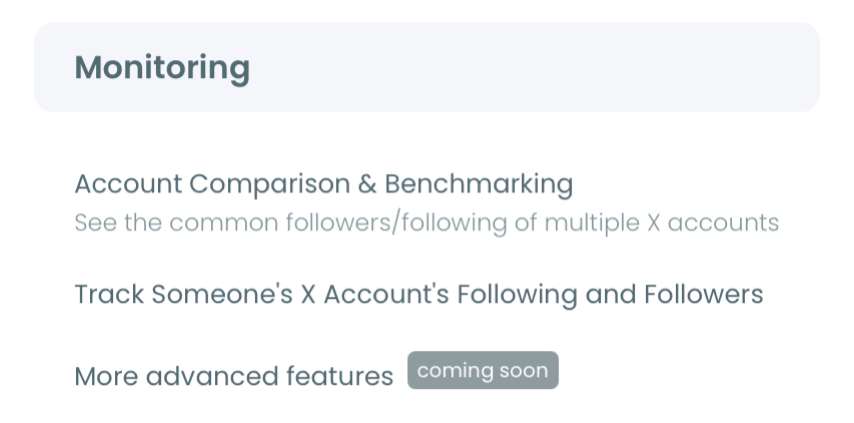
3. Enter the X username of the investor or fund partner, then validate it to confirm the account is public and trackable.
4. Select Followings as the tracking option, since outbound follows are the research signal rather than inbound followers.
Set the rules and alerts
- Enable Track Recent Following to be notified whenever the investor begins following a new account.
- Choose an alert preference: daily or weekly email digests, or dashboard-only review.
- Confirm the plan and activate the rule, which begins snapshots and consumes one Tracking Token for the account.
After activation, the dashboard records a dated bar chart of new follows and a profile grid for each account the investor adds, building a continuous record from the start date forward.
What the tracking report contains
It helps to know the exact shape of the output before you start reading it. The dashboard has two parts, and each answers a different question. The activity chart plots volume: blue bars mark new follows by day across the whole tracking period, a scrollable timeline lets you move through the date range, and a toggle hides or shows the recent-following series so the view stays clean.
The results grid answers the identity question. For every newly followed account it lists the fields you need to judge relevance fast:
- NAME, with display name, username, and profile image for quick recognition.
- JOINED, the account creation date, which separates new accounts from established ones.
- TWEETS, FOLLOWING, and FOLLOWERS counts, the size and reach of each account.
- FOLLOW RATIO, a quick read on whether the account is a broadcaster or a listener.
- ACTIVE and INACTIVE engagement metrics, flagging whether the account is live.
A date-picker dropdown filters the grid to a specific day or window, and an inline search scans name, username, and bio so you can isolate the accounts that fit your thesis. When you export, this same structured data downloads as a CSV, giving you a dated, portable record rather than a screenshot.
How to read the dashboard for signal
Once tracking runs, interpretation matters as much as setup. The dashboard presents both the volume of follow activity and the identity of each new account, and the goal is to separate genuine signal from routine follows. Work through the data deliberately:
- Open the dated bar chart and look for spikes, clusters of new follows in a short window.
- Scan the profile grid for accounts that fit a single thesis or category.
- Cross-reference the same target across other investors you track for convergence.
- Note sequences, such as a founder followed first and their team shortly after.
- Export the relevant period when a signal fires, creating a dated record for your notes.
Choosing which investors to track is part of the method, and so is understanding the network behind each one. Before committing a tracking rule, it helps to inspect a fund's existing connections with a Twitter following list viewer, which shows who an investor already follows so a new follow stands out against that baseline. To understand the overlap between several funds you watch, find common followers between Twitter accounts reveals the shared accounts that often sit at the center of a convergence signal.
Circleboom's Twitter user analytics gives you the structural picture of any account you plan to track, and a Twitter follower search lets you dig into a specific account's existing followers when a tracked signal points you there. The concept of power followers then helps you weight which newly followed accounts carry the most influence when a signal fires.
This short walkthrough shows the tracking workflow applied to an account's activity:
Acting on a detected signal
Tracking has value only when a detected follow leads to action. The grid under each tracked account supports direct steps: open a newly followed founder's profile, follow the account to enter their network, or add it to a watchlist for ongoing observation. Many research and BD teams maintain such a watchlist and review it on a regular cadence.
The value compounds with time. A single week produces a snapshot, while several months produce a behavioral fingerprint of how a fund researches, making each new signal easier to interpret in context. Over a quarter, you begin to recognize a partner's rhythm: how often they follow, in which categories, and how a burst of new follows tends to precede a public move. That context is what turns raw deltas into a forecast you can trust.
For teams comparing tools, this method sits alongside guidance on a good app to monitor Twitter activity, which frames where dated follow tracking fits among broader monitoring options. The distinction that matters is memory: most tools report the present, while signal work depends on a record of what changed and exactly when.
Choosing a tracking cadence and budget
Two practical decisions shape how much signal you get and what it costs. The first is cadence. Tracking runs on scheduled snapshots, and email alerts fire only when a snapshot detects new activity, so a quiet fund never spams your inbox. For investment work a weekly digest is usually the right setting, because the signal develops over weeks and daily emails mostly add noise. If you are watching a fast-moving account around a known event, you can tighten the rhythm, much as you would when you decide how to track your Twitter followers daily, weekly, or monthly.
The second decision is budget. Each active tracking rule consumes Tracking Tokens on its schedule, and a rule pauses automatically when the balance hits zero, so a roster of ten investors costs ten rules worth of tokens. Exporting draws on a separate Export Token balance, which means downloading a flagged period never eats into your tracking capacity. Knowing both balances up front keeps the practice sustainable, and it is the kind of trade-off worth weighing against general social media monitoring tools before you commit a roster.
A worked example: reading a fund's diligence
Picture tracking a developer-tools fund whose activity is flat for a month. On a Tuesday the dashboard logs a new follow on an unfamiliar founder, then by Friday two more follows land on engineers whose bios point at the same stealth company. The chart shows a three-bar spike inside one week, and the grid shows all three accounts joined recently and share a thesis. That sequence, founder first then early team, is the classic shape of diligence, and the dated record lets you point to the exact day each follow arrived. This is the same convergence read others describe when they recount tracking CZ's following to catch early crypto signals, applied to a venture thesis instead of a token launch.
Action checklist
Run through these steps to put dated investor tracking in place:
- Build a roster of 5 to 10 active investors in your category.
- Set up a Followings tracking rule on each, with Track Recent Following enabled.
- Choose weekly email digests to keep noise low and signal focused.
- Review the dashboard for clusters and convergence across funds.
- Export and act on any period where a signal fires.
→ set up investor follow tracking on X
Tracking Questions Answered
Is tracking a VC's follows allowed?
Yes, tracking uses only public data and complies with X platform rules. You are observing information already visible on a public profile, organized and dated so the pattern becomes readable, with no notification sent to the tracked account.
How current is the follow data?
Tracking relies on scheduled snapshots rather than a real-time stream, so a new follow appears at the next check instead of the instant it occurs. For investment signals that develop over weeks, this delay has no practical impact.
Can I track followers and following for the same investor?
Yes, but each requires a separate tracking rule and subscription. Set up Followings first to capture the research signal, then create a second rule for Followers if you also want to watch who is joining the investor's audience.
What happens if I pause tracking?
Pausing stops new snapshots but preserves the existing dashboard history, so your dated record stays intact. You can resume later, and canceling a subscription may affect data retention depending on your plan terms.
Could the tracker miss a follow on a very large account?
It is possible on accounts with very large follower or following counts, where API limits can mean the snapshot works from partial list data and a small change is occasionally missed. For typical investor accounts this is not a concern, and for high-volume accounts the reliable signal is convergence across several funds rather than any single follow.
Do tracking and exporting use the same tokens?
No, they draw on separate balances. Active tracking rules consume Tracking Tokens on their schedule, while downloading results to CSV consumes Export Tokens, so exporting a flagged period never reduces how many accounts you can keep tracking.