
You want to run your X account from one place: see who follows you, judge whether those accounts are worth keeping, and act on the answer without opening a hundred profiles by hand. Native X won't let you do any of that. A real Twitter account manager tool exists to close that exact gap, and this guide walks the full workflow.
A Twitter account manager tool pulls your entire follower base into one filterable dashboard so you can audit, segment, and act in bulk. Circleboom is the Twitter account manager tool that scores and cleans your X followers through sanctioned, official-API access, no scraping, no risk.
→ run a full Twitter audience audit
The rest of this guide shows you the data X hides, then the four steps to act on it.
Why Native X Can't Manage Your Audience
The problem isn't that you lack data. It's that X shows you the wrong data and hides the part you need. You get a follower count, a reverse-chronological list, and a monthly summary. None of that tells you whether an account is real, active, or worth a follow-back.
Look at what X withholds at the per-follower level. Click into any follower and you see a photo, a handle, and a bio.
You cannot see their account age, their follow ratio, their lifetime tweet count, or whether they have ever engaged with your posts, the four signals that actually separate a real follower from dead weight. X's own post activity dashboard reports aggregates like impressions and new-follower totals, not a per-account breakdown you can sort.
There are three concrete gaps that make hands-on management impossible on native X:
- No way to filter your followers by quality, activity, or account age.
- No native list of who recently unfollowed you, confirmed as of late 2025.
- No clean, row-by-row follower export, the dashboard shows curves, not a spreadsheet.
That last point is the quiet killer. Without a structured export or a filter, every audience decision happens one account at a time. For anyone past a few hundred followers, auditing by hand stops being a task and becomes a wall. This is the real reason a counter was never going to manage anything, and why a dedicated account audit dashboard is the missing layer.
A clean audience matters beyond vanity. When a brand vets you for a partnership or a journalist sizes up your reach, they read audience composition, not the headline number. A base padded with bots undercuts every one of those evaluations.
How a Twitter Account Manager Tool Fills the Gap
A Twitter account manager tool does one thing native X can't: it turns your follower list into a dataset you can sort, filter, and act on in bulk. That single capability is what separates managing an account from merely posting to it.
Here's how the data layer works. Circleboom retrieves your complete follower and following list through the official X API, then computes the signals X never exposes, tweet count, account age, follow ratio, an engagement tier, and a composite quality score for every account. An undifferentiated list becomes a table you can rank by any column.
Trust matters most at the moment you're about to act on your own audience. Circleboom runs entirely as an official X Enterprise Developer company, so every fetch and every bulk action moves through sanctioned, policy-compliant access. Your account stays inside X's rules with no suspension risk, the opposite of the scraping tools that put your login on the line.
Once the data is enriched, the same dashboard lets you act. Circleboom segments your followers into fake, inactive, high-quality, influencer, and engaging groups, then lets you follow back, remove, block, add to Twitter lists, or export any segment in bulk. You filter a group and act on the whole thing in seconds instead of clicking through profiles.
Two related views deepen the picture. To map the relationships in your base, X follower demographics and insights shows mutuals, non-followers-back, and who recently left.
To grade the accounts themselves, follower and following quality scoring ranks your base so you protect the strong segment and trim the weak one. The case for managing your audience as a unit keeps returning to the same idea: composition over count, not the raw follower number.
How to Run Your X Audience with a Twitter Account Manager Tool
The workflow is four moves, all from one dashboard: connect, audit, filter, act. Each step builds on the last, and the order is what keeps the whole thing safe.
Connect and load your full audience
- Log in to Circleboom Twitter and connect your X account with official OAuth. Authentication is policy-compliant, so nothing about this step exposes your account.
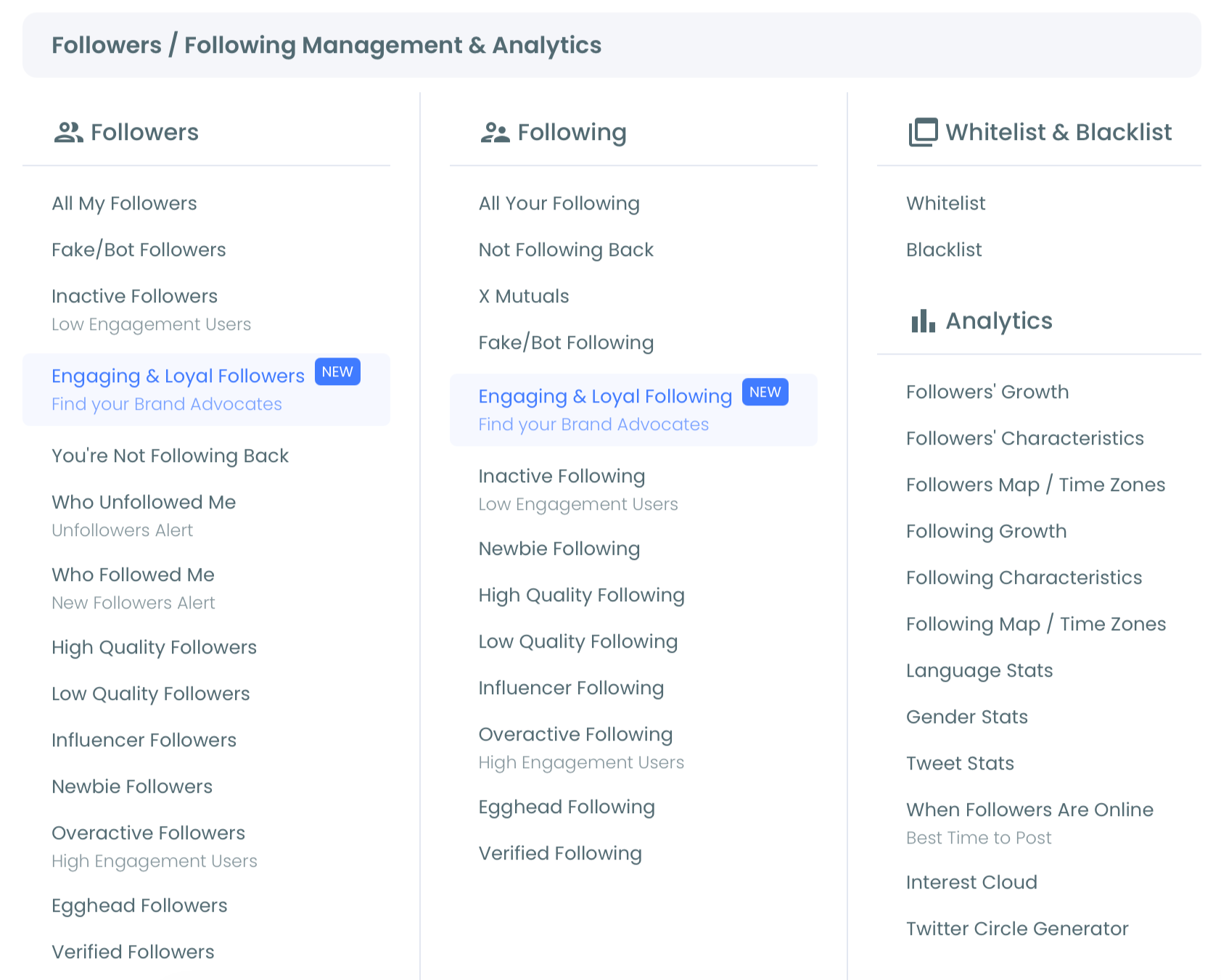
- Open the Follower & Following Management and Analytics menu to load your entire follower and following base as a sortable, filterable table with enriched data on every row.
Audit, filter, and act on a segment
- Sort and filter to isolate one segment at a time: fake and bot accounts, inactive followers, low-quality accounts, your influencers, or your engaging-and-loyal advocates. Sorting by follow ratio ascending floats the most suspicious account structures to the top, where a quick scan confirms them at a glance.
- Whitelist the accounts you want to protect, then act in bulk on the rest. Follow back real accounts, remove or queue the low-quality ones, add valuable accounts to a Twitter list, or export the segment to CSV. Bulk follows run at about 50 per 15 minutes and pace themselves automatically, so the operation stays gradual and within X's limits.
That order is what makes the workflow hold up. The login earns official-API access, the audit reveals the per-follower data X never shows, the filter narrows scope before you act, and the whitelist protects what matters. Skip the filter and you're back to a blind sweep across a count you can't see.
See it live: how the audience and inner-circle view exposes the followers actually driving your growth, in one Circleboom dashboard.
Quick recap:
- Connect with official OAuth.
- Open the Follower & Following menu to load the table.
- Sort by follow ratio and filter to one segment.
- Whitelist, then run the bulk action.
What Running Your Audience Actually Changes
Once you act on segments instead of a number, the math behind your account shifts. Engagement rate is interactions divided by follower count, so every dead account in your base inflates the denominator and tells the algorithm your content underperforms.
Run the arithmetic. If 30% of a 10,000-follower base is inactive or fake, that's 3,000 accounts dragging your visible engagement rate down while contributing nothing. Trim that segment and the same posts read as far stronger to the algorithm, because the denominator now reflects real people. No new content required, just a managed base.
The deeper payoff is compounding. Real, engaged followers extend your reach, which pulls in more accounts like them, which extends reach again. A clean base feeds that loop; a noisy one stalls it. Management is what keeps the loop turning, which is why a recurring Twitter follower tracker habit beats a one-time cleanup.
This is also where the manual approach quietly fails. Trying to remove dead accounts by hand on native X means opening each profile, guessing at its quality with no signals, and removing one at a time, which most people abandon after twenty accounts. A Twitter account manager tool collapses that into a filter and a button.
Build the Habit Around These Workflows
Managing an account is a recurring loop, not a single pass, and a few connected workflows make it stick. Once you've run your first audit, these are the natural next moves:
- Clear out dead weight with a mass unfollow of inactive accounts so your following list reflects accounts you actually care about.
- Understand why those silent followers hurt you with the case for removing inactive Twitter accounts, which connects audience hygiene to reach.
- Catch fakes before they settle into your baseline with a regular fake followers audit, especially after a viral post pulls in bots.
Each workflow handles a different sub-decision, and together they turn one cleanup into a system that runs every month or two with a few clicks.
Your Account-Management Checklist
Running your X audience from one place is a short, repeatable routine. Here's the checklist to keep:
- Connect your account and load the full follower and following table.
- Sort by follow ratio and quality to spot the weak segment.
- Whitelist partners, customers, and high-value contacts first.
- Act in bulk: follow back, remove, list, or export, paced safely.
Do that on a regular cadence and your follower count stops being a vanity number and becomes an audience you actually control. The data X hides is exactly the data you need, and one dashboard puts it in front of you.
→ start your Twitter audience audit
Questions People Ask About Managing a Twitter Account
Do I need X Premium to use a Twitter account manager tool?
No. Circleboom retrieves and enriches your follower data through its own official-API access, so you get per-follower signals, filters, and bulk actions whether or not you pay for X Premium. Native X gates its deeper analytics behind Premium on desktop; this workflow doesn't.
Can I see who unfollowed me with this kind of tool?
Yes. Native X has no unfollower list, but Circleboom tracks follower changes over time and shows you exactly who left and when, so a sudden count drop becomes a specific, dated list of accounts instead of a mystery.
Is bulk removing or unfollowing accounts safe for my X account?
Yes. Every action runs through Circleboom's official X API access as an Enterprise developer and paces within X's rate limits, about 50 actions per 15 minutes, with a whitelist step to protect accounts first. That keeps your account compliant and clear of suspension risk.
How often should I run an audit?
Run one on a regular cadence, and always after a growth spike or a viral post, when fake and low-quality accounts tend to arrive in waves. A quick filter-and-clean pass keeps your engagement rate accurate and your base composed of real, active accounts.