

For two years I believed the most effective way to clean up my Twitter account was to delete everything and start over. I ran the math on it once: 6,000 tweets, a profile that no longer matched my work, and a free tool that promised a one-click wipe.
The wipe was the goal. The wipe was the mistake. The most effective method turned out to be the opposite of nuking the timeline, and it took me an embarrassingly long time to see why.
The most effective way to delete your own tweets is to filter by date, keyword, and engagement so you remove only the posts that hurt you and keep the ones that earned their place. Blind mass-deletion erases your liabilities and your proof in the same click. Circleboom deletes your own tweets on X precisely, retrieving up to 3,200 recent posts through the official X API so you select exactly what goes.
→ delete your own tweets
Keep reading for the filtering workflow that separates cleanup from a full reset.
Why "Delete Everything" Felt Right and Was Wrong
The instinct makes sense. When your timeline embarrasses you, the cleanest-feeling fix is to make all of it disappear. I had old hot takes, a campaign thread that aged badly, and a stretch of low-effort posting I did not want a recruiter to scroll through. Wiping the whole account looked like the fastest path to a clean slate.
Here is what I missed. Buried inside those 6,000 tweets were the posts that actually worked. A thread that brought in three client conversations. A reply that a well-known account quoted. Two posts that still pulled steady profile clicks a year later. Those were proof of credibility, and a blind wipe would have taken them out alongside the junk.
That is the gap nobody mentions when they sell you a one-click wipe. The volume of deletion is not what makes cleanup effective. The precision is.
You want to bulk delete tweets that drag your profile down while protecting the ones that prove you know what you are doing.
Effectiveness in tweet deletion is a targeting problem, not a volume problem.
The Two Methods That Failed Me First
Before the precise approach, I tried the two methods most people reach for. Both failed in ways worth describing, because the failure is exactly what points to the real answer.
The first was manual deletion. X gives you no native bulk tool. According to X's own help documentation on deleting a post, the only built-in path is to open each post, tap the menu, and confirm the delete, one at a time.
I deleted maybe 200 tweets that way over a weekend. I lost track of what I had already reviewed. I missed the bad ones and accidentally killed a good one. Manual scrolling does not scale past a few dozen posts.
The second was a free wipe tool. It connected to my account, churned for a minute, and stalled near 100 tweets. Free tools cap there because the platform only exposes a recent slice without an archive, and most of them have no filters at all. It was about to delete a high-performing thread when I closed the tab in a panic. That near-miss is what reframed the whole problem for me.
What Precise Deletion Actually Looks Like
The most effective way to delete your own tweets on Twitter is to treat your timeline like an audit, not a fire. You pull your posts into a view where you can see engagement next to each one, then you filter so only the liability tweets are selected for removal.
This is where Circleboom changed how I work. Circleboom retrieves up to your 3,200 most recent tweets directly through the official X API, then lets you filter that set by post type, date range, keyword, hashtag, language, and engagement thresholds before anything is deleted. The engagement filter is the part that protects you: set a minimum like or retweet count and your proven posts drop out of the selection automatically, so a cleanup run never touches the content that earned its keep.

Because deletion through the X API is permanent and cannot be undone, the tool you use has to read your data accurately and operate inside the platform's rules. Circleboom is an official X Enterprise Developer company, so it pulls your full, real tweet data through sanctioned access rather than the incomplete, unauthorized scraping that free wipe tools rely on.
That distinction matters most on an irreversible action. You want to be certain you are looking at the right tweets before you remove them.
Unlike scrolling through thousands of posts to delete them one by one, or letting a no-filter tool erase your whole recent timeline, this approach lets you keep the winners and remove the tweets that don't belong in a single, reviewed pass.
How I Delete My Own Tweets the Effective Way
The workflow I settled on runs in two phases: load and filter, then review and remove. It takes about fifteen minutes for a few thousand tweets, and the filtering is what makes it safe.
Load your tweets and set the protective filters
- Log in to Circleboom Twitter and connect your X account with official OAuth.
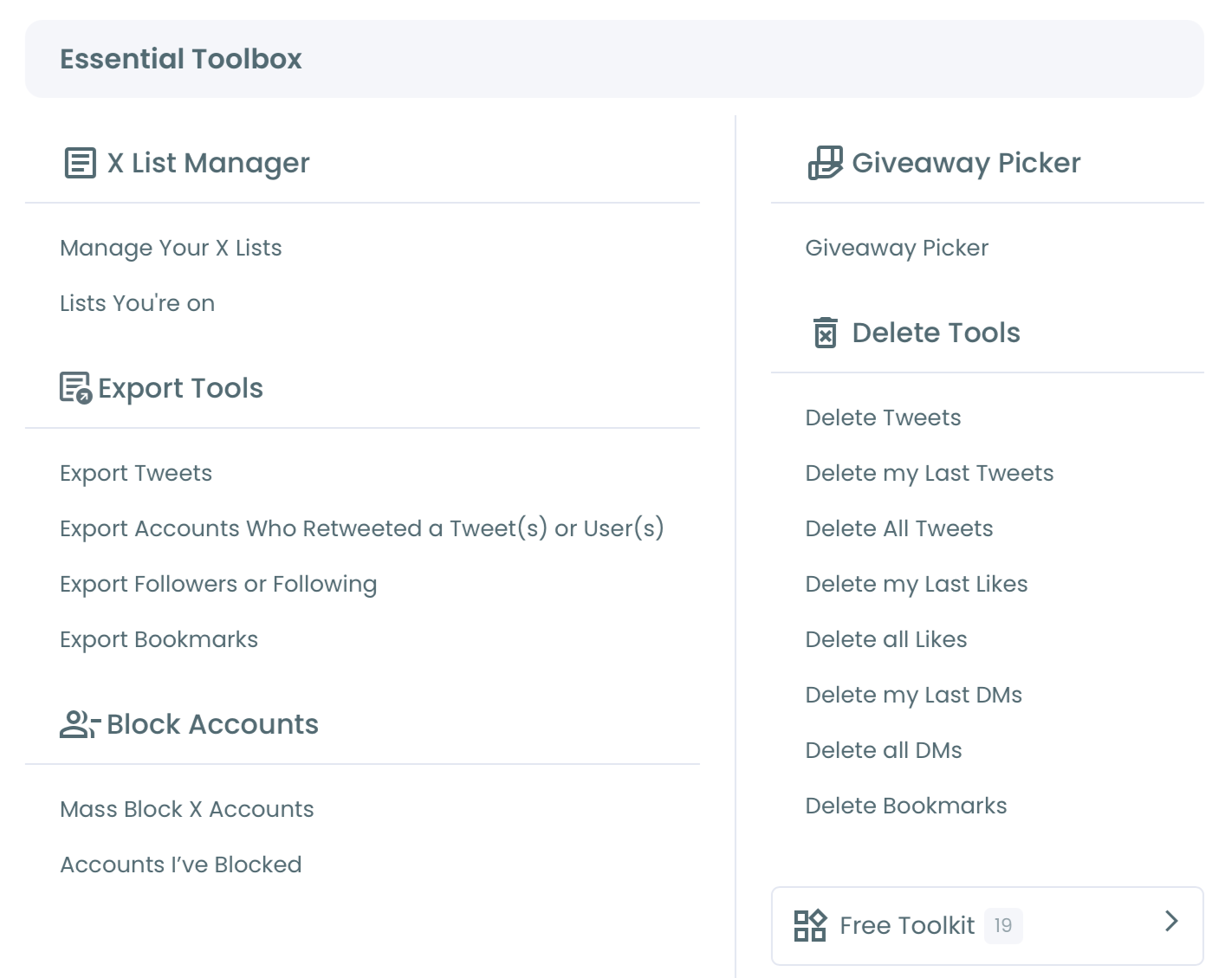
- Open the Essential Toolbox menu and choose the Delete My Last Tweets tool to pull in your most recent posts.
- Set a date range to scope the cleanup to the period that actually needs attention, like a campaign window or the months you would rather not show.
- Add keyword or hashtag filters to catch off-brand topics, an old project name, or a phrase you no longer stand behind.
- Set a minimum engagement threshold on likes or retweets so your high-performing posts are excluded from the deletion automatically.
Review the selection and delete with confidence
- Scan the filtered list against the impressions, likes, and replies columns to confirm only liability tweets remain selected.
- Export the selection as a CSV first if you want a record of exactly what is being removed, since deletion is permanent.
- Run the delete on the filtered set and let Circleboom process the batch within the platform's rate limits.
That order is what makes the process hold up: the login earns official API access, the filters narrow the scope before you act, and the engagement threshold quietly shields your best content so a single careless click can never wipe your proof along with your problems.
See it live: how date, keyword, and engagement filters narrow a full timeline down to just the tweets worth deleting.
The Difference Precision Made
After that first filtered run, my profile read like a deliberate account instead of a random scroll. The embarrassing campaign thread was gone. The low-effort filler from a rough quarter was gone. The client-winning thread, the quoted reply, the two evergreen posts, all of them survived, because the engagement filter never let them into the selection.
The change a recruiter or a prospect sees is not "this person deleted a lot." It is "this person posts things worth reading."
That is the result you cannot get from a blind wipe. A full wipe leaves a blank, suspicious-looking timeline that signals you had something to hide rather than something to show.
If you want to take the precision further, you can remove tweets by date for a specific bad stretch, or delete tweets by keyword to surgically pull a single topic out of your history.
For deeper reading on the trade-offs, Circleboom's guide on the best methods to delete tweets and its roundup of the best tools to delete tweets both walk through when each approach fits.
When speed is the priority and the volume is large, the same filtering logic lets you delete tweets within seconds once the selection is set. If a genuine full reset really is the goal, say for a rebrand, the archive-based path to delete all tweets on X covers history beyond the recent window.
The Bottom Line
The lesson I wish I had learned two years and 200 manually-deleted tweets earlier is simple. The hardest part of cleaning up your timeline is not removing enough. It is removing the right ones and leaving the rest alone.
The most effective way to delete your own tweets isn't deleting all of them. It's deleting only the ones that work against you. Filter by date, keyword, and engagement, protect your proven posts, and remove the liabilities in one reviewed pass.
→ clean up your tweet history the precise way
Questions Readers Ask
Is it better to delete all my tweets or just some?
For most accounts, deleting just the problem tweets is more effective. A full wipe erases your proof of credibility along with your liabilities and leaves a blank timeline that reads as suspicious. Filtering by engagement lets you remove the weak content while keeping the posts that earned their place.
Can I delete my own tweets without losing my best-performing posts?
Yes. Set a minimum like or retweet threshold in the filter before you select, and your high-performing posts are automatically excluded from the deletion. Only the low-engagement content inside your target window gets removed.
Is deleting tweets permanent?
Yes. Once a tweet is deleted through the X API, it cannot be recovered by Circleboom or any other tool. Review your filtered selection carefully, and export a CSV backup first if you want a record of what was removed.
How many tweets can I delete this way?
Circleboom retrieves up to your 3,200 most recent tweets directly through the API, no archive upload required. For history older than that recent window, you upload your X archive and run the same filters across your full timeline.






)