
An X List can solve a feed-organization problem without solving a profile-privacy problem. That is the starting point for anyone searching x private list hide following: create a private List to organize accounts you want to monitor, but do not expect the List to hide accounts you already follow.
X describes a private List as accessible only to its owner. A List is a custom timeline of selected accounts. Your Following list is a separate account relationship. Once those two surfaces are separated, you can design a clean system for research, business intelligence, or content planning.
Can a private X List hide who you follow?
No. A private List can give you a private timeline for accounts you need to watch, but it does not alter your Following relationship. Circleboom organizes X Lists through official Enterprise APIs, which lets you add, move, and remove List members in batches while keeping List privacy separate from follows.
→ x private list hide following
Start with the correct expectation
The direct answer is that a private X List does not hide your Following list. It hides the List itself from other users. If an account appears in your Following list, placing it on a private List does not change that fact. If you want to stop following someone, that requires an unfollow decision, not a List setting.
This is a useful constraint. It keeps you from building a workflow around a feature X does not offer.
X's X Lists says you can make a List private so it is accessible only to you, and it also says you can add people to Lists without following them. That second point is what makes private Lists valuable: you can monitor a category without making every account part of your ordinary feed.
Circleboom helps you build and maintain those categories on X. Circleboom lets you turn selected accounts from Following, followers, search, or entered usernames into a List through official Enterprise APIs. It does not rewrite X privacy settings or promise hidden follows.
Choose the job your List will do
A private List works best when it has a job that happens repeatedly. “Interesting accounts” is too vague. “Potential podcast guests,” “local reporters,” “product-feedback accounts,” or “weekly AI research” is specific enough to guide membership decisions.
That small naming decision becomes important later. A List that represents a workflow tells you whether an account belongs there. It also tells you when an account should move elsewhere. For example, a prospect can move from a research List to a customer List after a relationship changes. Circleboom's List Manager supports moving selected members between Lists, so the structure can follow your work instead of fossilizing.
Use privacy deliberately. A public List is a form of curation and may signal your interests or endorsements. A private List is better for internal monitoring, competitive research, sensitive outreach preparation, or a work-in-progress collection. The List setting protects the List, not every other activity on your X account.
For a longer look at the difference, are X Lists public explains why visibility should be chosen before you add members. The same principle applies whether you manage ten accounts or several thousand.
How to organize accounts into a private X List
The x private list hide following workflow has four parts: define the use case, enter the List Manager, build a reviewed member set, and audit the result. These steps keep organization work separate from any follow cleanup.
Define the member rule
- Write the List's purpose in one line.
- Set a simple inclusion rule, such as “accounts that publish primary research” or “customers who asked for product updates.”
- Decide whether members should be followed, listed only, or both.
- Note a removal rule so the List stays useful after the first build.
The third item is the privacy checkpoint. If you only need an account in a research timeline, add it to the private List without adding an unnecessary follow. If you want the account in your primary feed too, make that follow choice openly and independently.
Open the List Manager in Circleboom
- Open Circleboom Twitter and connect the X account that owns the List.

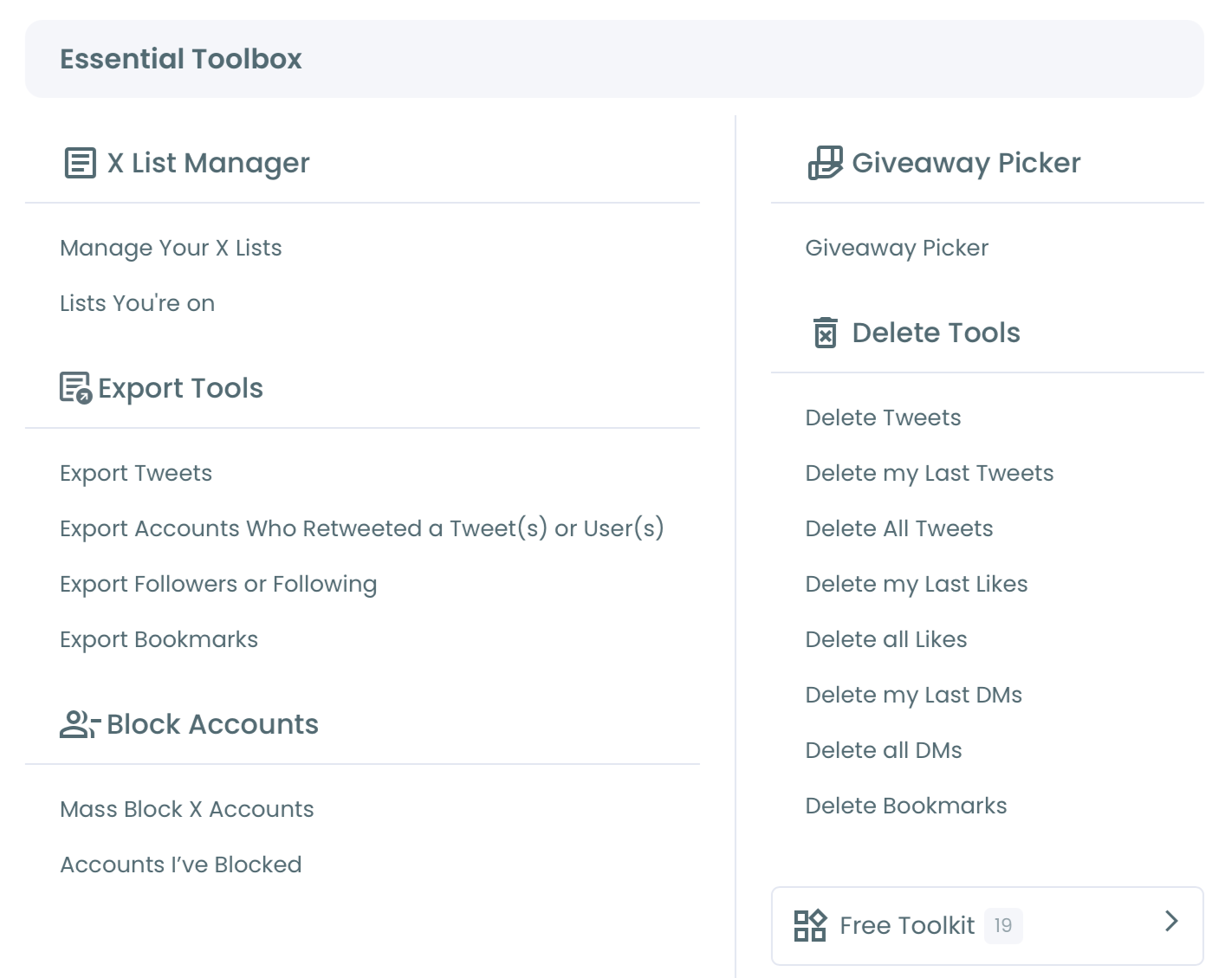
- Go to Essential Toolbox and select List Manager.
- Search the existing List grid before you create a new category. Review names, member counts, and public/private status so you do not produce a near-duplicate List.
The dashboard is useful because List maintenance is rarely a one-click job. You need to see the existing structure before adding another branch to it. Circleboom retrieves List data for the connected account and displays the current status, while data can sync within a 24-hour window. Check the displayed sync timing when a recent change on X is missing.
Create the private destination
- Create the List with a clear, non-sensitive name and description.
- Select private visibility before saving it.
- Confirm the lock marker in the List overview.
- Keep the List's scope narrow enough that a teammate could explain why every member is there.
Confirm that the visibility is set to private before you save the List, rather than treating the setting as an afterthought. X also limits each account to 1,000 owned Lists and each List to 5,000 accounts, according to its List help documentation. Clear categories beat a pile of overlapping micro-Lists.
Select accounts from a defensible segment
- Start from a source set: Following, followers, a search result, an influencer segment, or manually entered usernames.
- Apply filters that fit the List purpose, such as bio terms, location, language, follower count, verification, activity, or engagement.
- Inspect uncertain accounts before selecting them.
- Add the reviewed selection to the private List in bulk.
This is where List organization becomes better than random bookmarking. A competitor-monitoring List may require an industry term in the bio and a specific location. A customer-advocacy List may require high engagement and a known relationship. The filters let you start with evidence, then use human judgment on the edge cases.
Circleboom's List Manager supports bulk adds from relevant account datasets. You can also enter usernames when a source set is incomplete.
If you are building a repeatable outreach or monitoring process, how to create X Lists with a few clicks is a useful companion for the setup stage.
Maintain membership without confusing it with follows
- Open the private List on a regular review cadence.
- Filter members to identify inactive, off-topic, or low-fit accounts.
- Move accounts to a better List or remove them from the current List.
- Review Following separately if an account relationship needs to change.
The last step is where x private list hide following stays honest. Removing an account from a List does not unfollow it. Adding an account to a List does not follow it. The operations affect different records, so use them with different intent.
If you want a before-and-after record, export the relevant data. Circleboom can export List members from the List detail view.
You can export your Twitter Following list for a separate relationship audit. Export capacity is token-based, so look at the remaining balance before a large download.
A practical structure for teams and solo operators
Keep categories purposeful
The most durable private List systems use a small number of purposeful categories. You might keep a research List, an active-customer List, a partner List, and a “watch this quarter” List. The exact labels vary, but each List should answer a different recurring question.
Avoid copying your complete Following list into a private List just because it feels safer. That duplicates the noise without changing the follow relationship. Instead, use the List to create a narrower working set. The private timeline becomes the place you open during a task, while the main feed remains for accounts you deliberately follow.
There is a business benefit here. Separate Lists reduce the risk that a campaign or research focus disappears into a general feed. A communications team can check journalists before an announcement. A product team can listen to customer advocates without mixing that work with every creator they follow. A founder can keep a private peer List without turning their Following tab into an unplanned directory.
For business-specific examples, how to use X Lists for business shows how Lists support customer, competitor, and engagement workflows. Circleboom gives those workflows bulk member management, but your category rules are what make the result useful.
If you are unsure whether to split a large List, test the reading experience rather than the member count alone. A List earns its place when you can open it and know what you are looking for.
The experience of maintaining many categories in how many X Lists can you create makes the same point. More Lists are not automatically more organized.
Prevent duplicate List sprawl
Good List hygiene also reduces accidental duplication. Before adding a new campaign group, search existing Lists for a similar name, compare the member rules, and either revise the existing List or make the new scope clearly different. That discipline saves the next reviewer from having to guess which List is authoritative.
One more useful habit is to record why an account was added when the reason is not obvious from the List title. A short internal note or shared rule keeps the List from becoming a collection of unexplained names. It also makes future pruning more confident, because removal follows the original purpose instead of a vague impression.
Video walkthrough: adding multiple accounts to an X List
https://www.youtube.com/watch?v=jv0Lrzyqbfo
Privacy, safety, and account responsibility
Private List visibility is not the same as account privacy. X says only the owner can view a private List, while protected posts use another set of account settings and follower approval rules. Read X's public and protected posts guidance if the question is about who can read your posts rather than who can view a List.
Keep personal data out of List names and descriptions. Use account security, strong access controls, and a shared governance rule when several people manage the same brand account. If the List is tied to a campaign, write down its retention point: when the campaign ends, decide whether the List should be archived, revised, or deleted.
Circleboom is an official X Enterprise Developer. That official relationship matters because account and List changes should use authorized access, with the user choosing the records and confirming the action. Large member changes may take time and remain subject to X's platform-level limits; work from a reviewed selection rather than an impulsive bulk action.
The right outcome for X private list hide following
The right outcome is not a hidden Following list, because X private Lists do not provide that. The right outcome is a private, well-maintained reading and monitoring space that does not require you to follow every account in it.
Give each List a real job, set visibility before adding members, use filters to create a thoughtful segment, and treat follow changes as their own decision. That turns x private list hide following from a confusing search phrase into an accountable workflow.
→ create an organized private X List
Common questions about organizing X Lists
Can I change a public List to private later?
X lets List owners edit List details, including visibility options where available. Check the current visibility in X and in your List overview before treating a List as an internal workspace.
Will a private List hide an account from my Following tab?
No. A private List is a separate curated timeline. It does not hide, remove, or change an existing following relationship on X.
Do I need to follow List members to read their posts?
No. X says you do not need to follow an account to add it to a List. Protected accounts remain subject to their own approval rules, so you can only see protected posts if you are an approved follower.
How often should I review a private List?
Review it whenever the business purpose changes and on a regular cadence that fits the List's job. A campaign List may need weekly attention, while a long-term research List may need a lighter monthly review.