
Yes, you can search someone's tweets for keywords on X, and there are two very different ways to do it. One reads a known account's posts. The other starts from the words and hands you the accounts behind them. Most guides only teach the first and stop, which is exactly where the useful part begins.
Can you search someone's tweets for keywords on X?
Yes. X's own advanced search covers a known handle with the `from:username keyword` operator, but it thins out fast on older posts. Circleboom's Historical Tweet Search scans X's historical archive for any keyword and returns the accounts behind those posts, safely and within X's rules.
→ Search someone's tweets for keywords
The Short Answer, and Where Native Search Runs Out
X ships a keyword search in the box. Type a term, open the filters, and the `from:` operator narrows results to one account's posts containing that word. For a known handle over the last few weeks, X's advanced search guide documents the full operator set, and native search is enough.
The wall arrives on two fronts. Native search leans hard toward recent activity and quietly drops older matches without telling you. It also stops at the tweet, showing you posts rather than a clean, deduplicated list of the accounts behind them. These are the same traps behind the most common mistakes people make performing a Twitter search.
A keyword search is only useful if it ends in accounts you can act on, not paragraphs you have to skim.
If your goal is a research or outreach list, the early move is different. You want to search a user's tweets by keyword through a tool that keeps the historical depth. That distinction runs through the rest of this answer.
Which Method Should You Use?
The choice depends on what you already know and what you plan to do next.
- If you know the handle and only need to read recent posts, use X's native `from:username keyword` operator.
- If you need posts from a year or two ago, use a historical tool, because native search drops old matches.
- If you want the accounts behind the words as a list, use keyword-to-account discovery, not the search box.
Native search is a reading tool. It was never built to hand you a deduplicated, exportable set of profiles. That is the line between casually looking something up and building a repeatable research workflow. Once you cross it, the keyword stops being a question and becomes a targeting input.
Searching a Known Account vs. Discovering Accounts by Keyword
These are two separate jobs, and confusing them is why half-answers are so common.
The first job is narrow. You have a handle and you want the posts where that person mentioned a topic. The `from:handle keyword` operator answers it directly. The language people use when they search this way is captured well in this read on whether you can search specific words a Twitter account said.
The second job is wide, and native search barely touches it. Instead of one handle, you start from a keyword and ask which accounts have said it. People do not put their pain points in bios. They put them in posts. Someone who tweeted "still looking for a better scheduler" six months ago is a signal no profile search would reveal.
That reverse direction is the real gap. It turns a search into a prospect list, the same logic behind finding people with the same interests as you on X. It is only sharper here, because a keyword match beats a shared follow as a signal.
How to Search Someone's Tweets for Keywords on X
Circleboom's Historical Tweet Search runs a keyword query across X's historical archive, then moves you from matching posts to the deduplicated accounts that wrote them. The flow below runs in two phases: set up and scope the search, then pivot to the accounts.
Video walkthrough: how a plain-language keyword and a date range turn into collected historical tweets and their authors.
Set up the search and scope the archive
- Log in to Circleboom Twitter and connect your X account with official OAuth.

- Open the Advanced X Search menu and choose Historical Tweet Search.
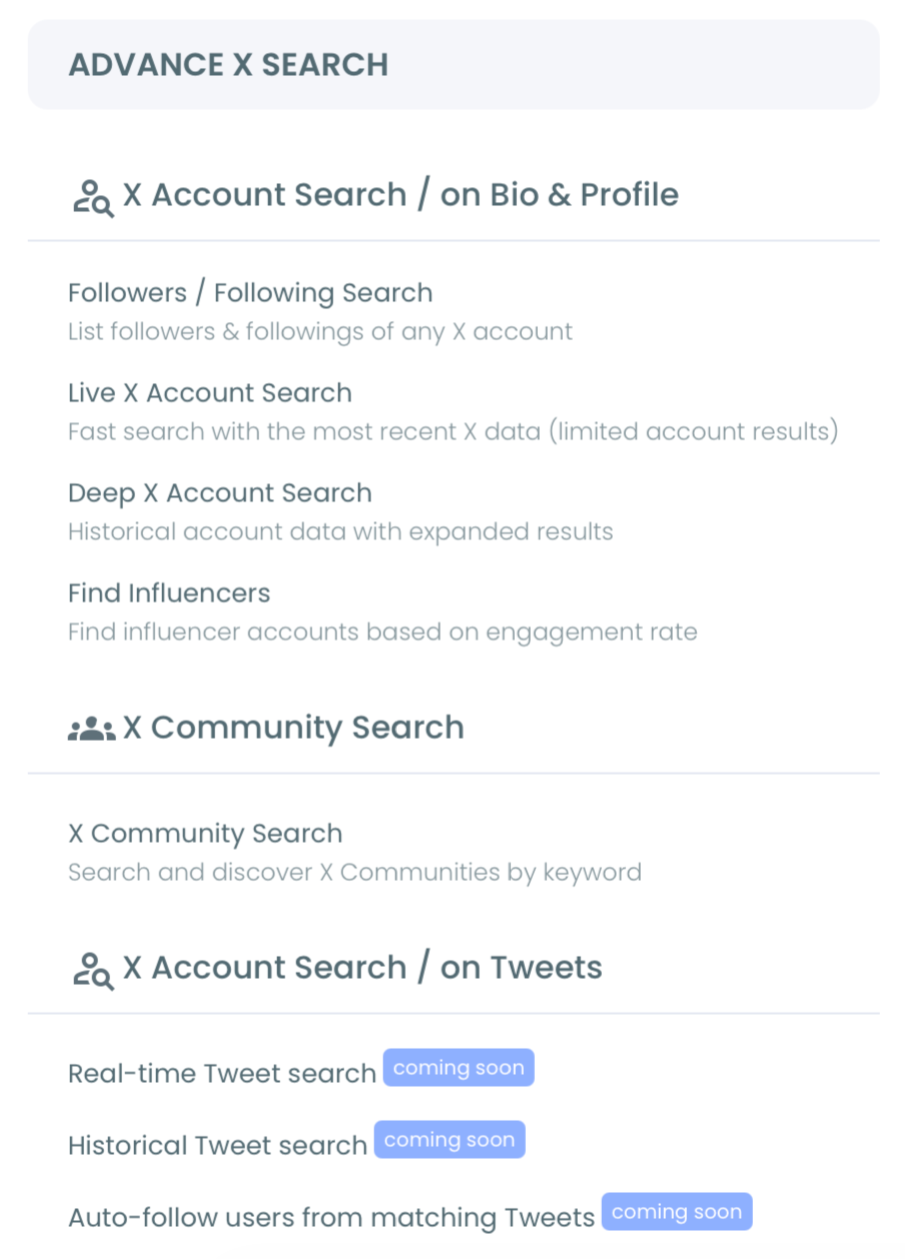
- Describe the tweets you want in plain language, then confirm or refine the AI-suggested query and add a `from:` account filter if you want one person's posts.
Narrow the results and move to accounts
- Apply filters for date range, language, engagement minimums, replies, links, and verified-only, so broad terms do not bury the signal.
- Select how many tweets to collect, run the search, then click Display Profiles to see the deduplicated accounts behind the matching posts.
That order matters because each step protects the next. The login earns official API access, the date range and filters cut noise before you act, and the profile view converts raw tweets into a list you can follow, add to a list, or export. Skip the filtering and a broad keyword returns volume without relevance.
You can also run the same terms against live conversation with the real-time tweet tracker. It is the fastest way to check whether an old topic is active again today.
What You Get Back: Tweets and the Accounts Behind Them
The output is two views of one result set. The tweet view shows each matching post with its impressions, likes, retweets, quotes, bookmarks, replies, and timestamp. The profile view shows the unique accounts, each with follower count, follow ratio, tweet count, join date, and an activity classification.
Every account in that profile view earned its place by something it actually posted. If 400 matching tweets come back from 250 unique accounts, you now hold 250 profiles who publicly stated the thing you searched for. No bio search produces that.
The filters are what keep the result sharp. Engagement minimums drop low-signal noise so you only keep posts that got real traction.
The date range does the heavier lifting. It lets you scope a search to a specific window, like the weeks around a competitor's outage or an industry event. That temporal precision reconstructs a conversation as it existed at a moment, not just the newest mentions of a term. Combine an engagement floor with a tight date range and you pull the most significant historical posts on a signal, instead of a flat pile of every stray mention that ever used the word.
From there you can export the set as CSV for a CRM or report. This is the whole reason to run a keyword search across the archive instead of scrolling: the output is people, ready to act on.
You can also layer network context by cross-referencing people who follow a certain account on Twitter. For deeper operator work on the search side, our Twitter Advanced Search filters cover the same query surface with more control.
Is It Safe to Search and Act on Tweets in Bulk?
The search itself only reads public data, so it carries no account risk. The caution sits on what you do next. Following a large historical list in one burst can trip X's spam detection, so space bulk actions out. Review the profiles first, too, because a keyword match does not guarantee the account is still active or still operated by the person who wrote the original post.
Circleboom keeps the read side clean because it is an official X Enterprise developer, pulling full, official data instead of scraping incomplete results from a workaround. That is the same reason its historical coverage holds up where native search quietly drops old posts. For the public-facing options and their limits, our walkthrough on Twitter search without an account covers the trade-offs too.
The Bottom Line
You can search someone's tweets for keywords on X, and the right method depends on your goal. For a known handle over a short window, the native `from:username keyword` operator is fine. For historical depth, keyword-to-account discovery, and an exportable account list, Circleboom's Historical Tweet Search is the tool built for the job. Give it a keyword and a date range, and the accounts behind the conversation come back ready to act on.
→ Find accounts from historical tweets
Frequently Asked Questions
Can I search a private account's tweets for keywords?
No. Only public tweets are searchable. Protected, deleted, or unavailable posts will not appear in native search or in Circleboom's historical results.
How far back can I search tweets by keyword?
Circleboom lets you pick preset windows like the last 30, 60, or 90 days and one year, or set a custom range. Historical coverage depends on what the X Enterprise API has indexed for that window, which reaches deeper than what native search reliably returns.
Does searching someone's tweets follow or notify them?
No. Searching is read-only and sends no notification. Follows, list adds, or other actions are separate steps you choose afterward, and only those interact with the account.
What is the difference between historical and real-time tweet search?
Historical search scopes to a past window and is built for depth. Real-time search tracks what is being posted now. Use historical to reconstruct old conversations and real-time to catch a topic as it happens.