
For years, creators were told one thing about Twitter/X:
“Never delete tweets. Every post is part of your digital footprint.”
That advice used to make sense.
In 2026, it’s quietly hurting accounts.
Today’s X algorithm is no longer sentimental. It doesn’t care how long you’ve been posting or how many tweets you’ve accumulated. It cares about signals, recent signals, repeated signals, and quality signals.
And here’s the uncomfortable truth:
If most of your tweets perform poorly, they don’t sit there harmlessly.
They actively shape how the algorithm evaluates everything you post next.
How can you know which tweets are pe⬇️
 Arif Akdogan
This article breaks down:
- why old, low-engagement tweets can suppress reach,
- what the data actually shows,
- and how creators are using strategic deletion (not panic deletion) to restore visibility, safely and intentionally.
If you are a creator on X and want to know about the latest developments regarding the algorithm changes, engagement strategies, payout boosts, etc., you can join Circleboom's X Creator Growth Lab Community and enjoy a free space to learn from and contribute to!

The Myth: “Keep Everything. More Tweets = More Authority”
The traditional logic went like this:
- More tweets = more history
- More history = more credibility
- More credibility = better reach
That logic is outdated.
X’s ranking systems now evaluate account-level performance patterns, not just individual tweets. This includes:
- how often your posts receive engagement,
- how consistently users interact with you,
- and whether your recent content signals relevance.
An account with 10,000 tweets but weak engagement often performs worse than an account with 1,500 tweets and consistent interaction.
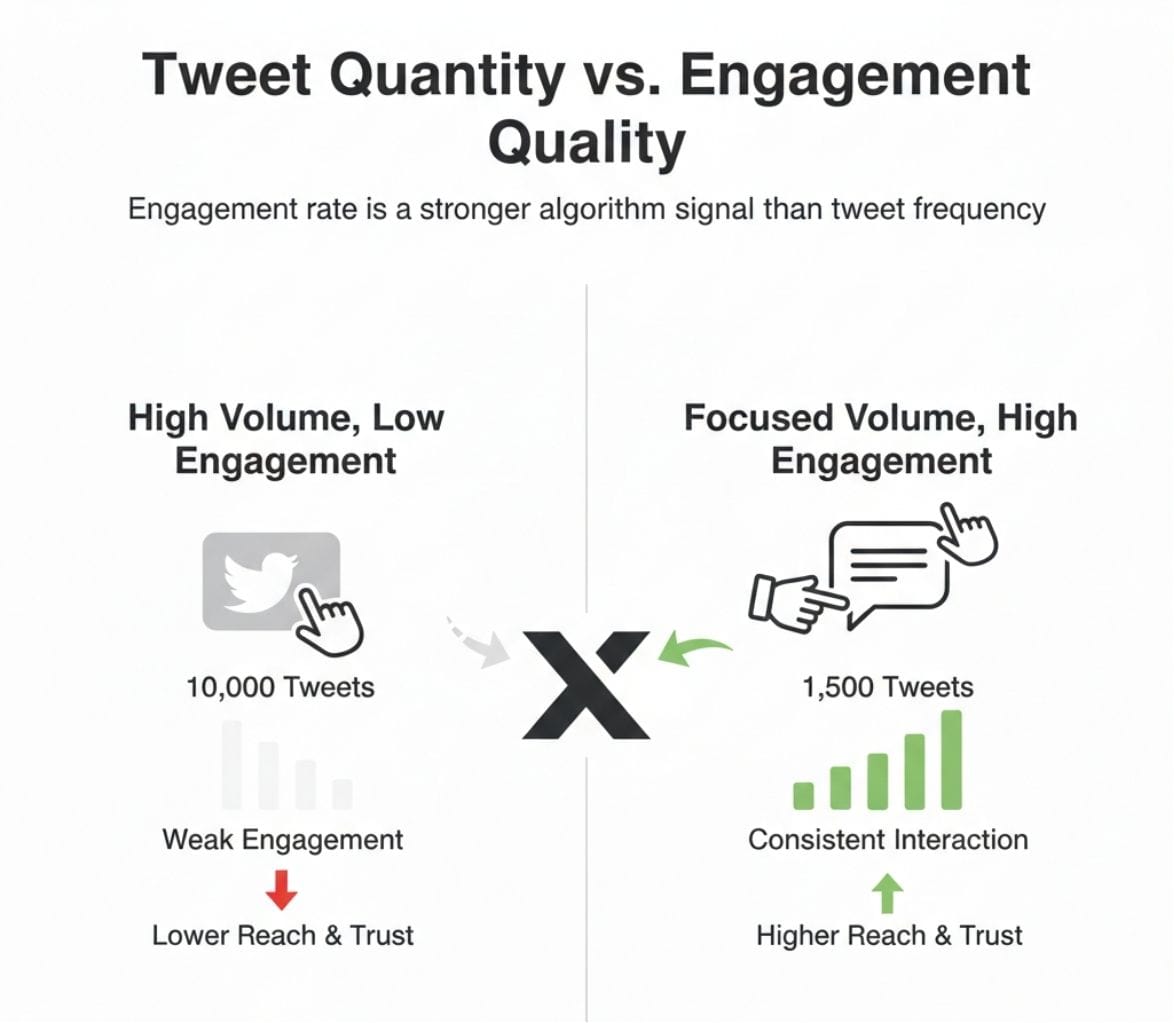
Quantity without response is no longer neutral.
It’s a negative signal.
The Reality: X Is a Quality-Weighted System Now
In 2026, X operates much closer to a quality-over-quantity model:
- Tweets with no engagement reduce your average engagement baseline.
- Repeated low-response posts condition the algorithm to expect low interest.
- Future tweets are distributed more cautiously as a result.
Creators often notice this as:
- sudden impression drops,
- slower engagement velocity,
- tweets dying within minutes unless manually boosted.
This happens even when content quality hasn’t changed.
The issue isn’t what you’re posting now.
It’s what your account history is teaching the algorithm.
The Data: Why Deleting Low-Engagement Tweets Works
Across multiple creator experiments and agency case studies, a clear pattern emerges:
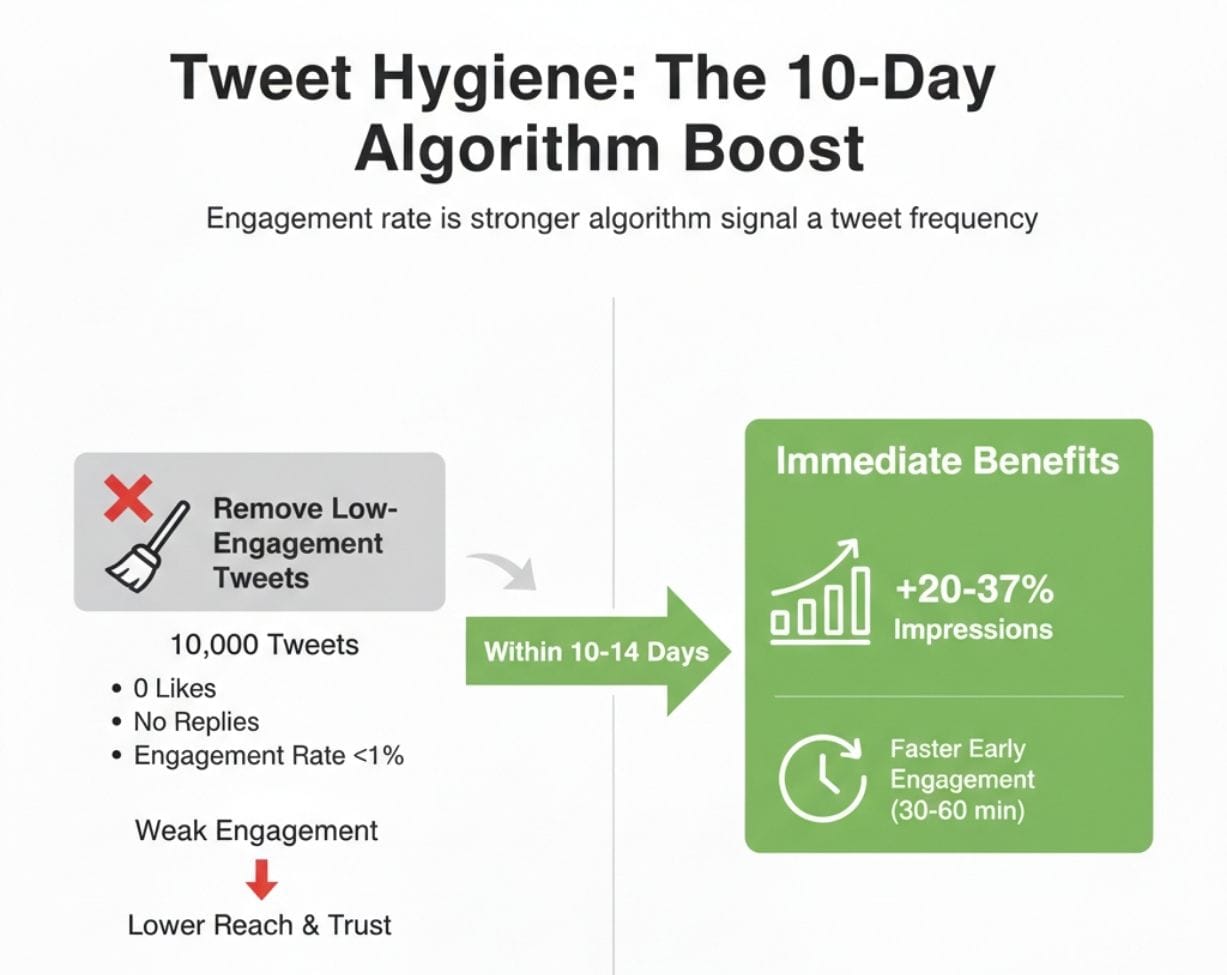
Accounts that remove low-engagement tweets, especially those with:
- 0 likes,
- no replies,
- or engagement rates below 1%
often experience:
- 20–37% increases in impressions on new tweets
- noticeable recovery within 10–14 days
- faster early engagement (first 30–60 minutes)
Why?
Because you’re improving what can be thought of as your Account Health Score:
- higher average engagement per tweet,
- fewer “dead” posts dragging down performance,
- cleaner engagement history.
In algorithmic terms, you’re telling X:
“When I post, people respond.”
That changes how cautiously—or confidently—your content is distributed.
Why Manual Deletion Is the Wrong Way to Do This
In theory, deleting old tweets sounds simple.
In practice, it’s miserable:
- endless scrolling back through years of content,
- guessing which tweets matter,
- risking accidental deletion of valuable posts,
- wasting hours for minimal impact.
Worse, manual deletion often leads to emotional decisions, not strategic ones.
This is where structured cleanup matters.
The Circleboom Clean-Up: Strategic Deletion Without Guesswork
Circleboom Twitter is built for controlled account hygiene, not reckless erasure.
Instead of deleting randomly, Circleboom allows creators to clean accounts based on data, not memory.

Bulk Delete Low-Engagement Tweets
You can filter tweets by:
- likes,
- replies,
- retweets,
- date ranges.
That means you can remove:
- tweets with zero engagement,
- entire batches of underperforming content,
- without touching posts that still generate value.
No scrolling. No guessing.
Keyword-Based Cleaning
Old opinions age badly.
So do outdated brand mentions, past collaborations, or topics that no longer align with your positioning.
Circleboom’s API-powered search lets you:
- find tweets containing specific keywords,
- filter by time period,
- delete them in bulk.
Keep in mind that the API provides a more accurate real-time data stream than the X interface itself. While the platform UI may experience lag, the API captures and reflects new developments instantaneously.
Circleboom has the official Enterprise API, we don't scrape data from X!
This is especially useful for:
- rebrands,
- creators shifting niches,
- businesses entering new markets.
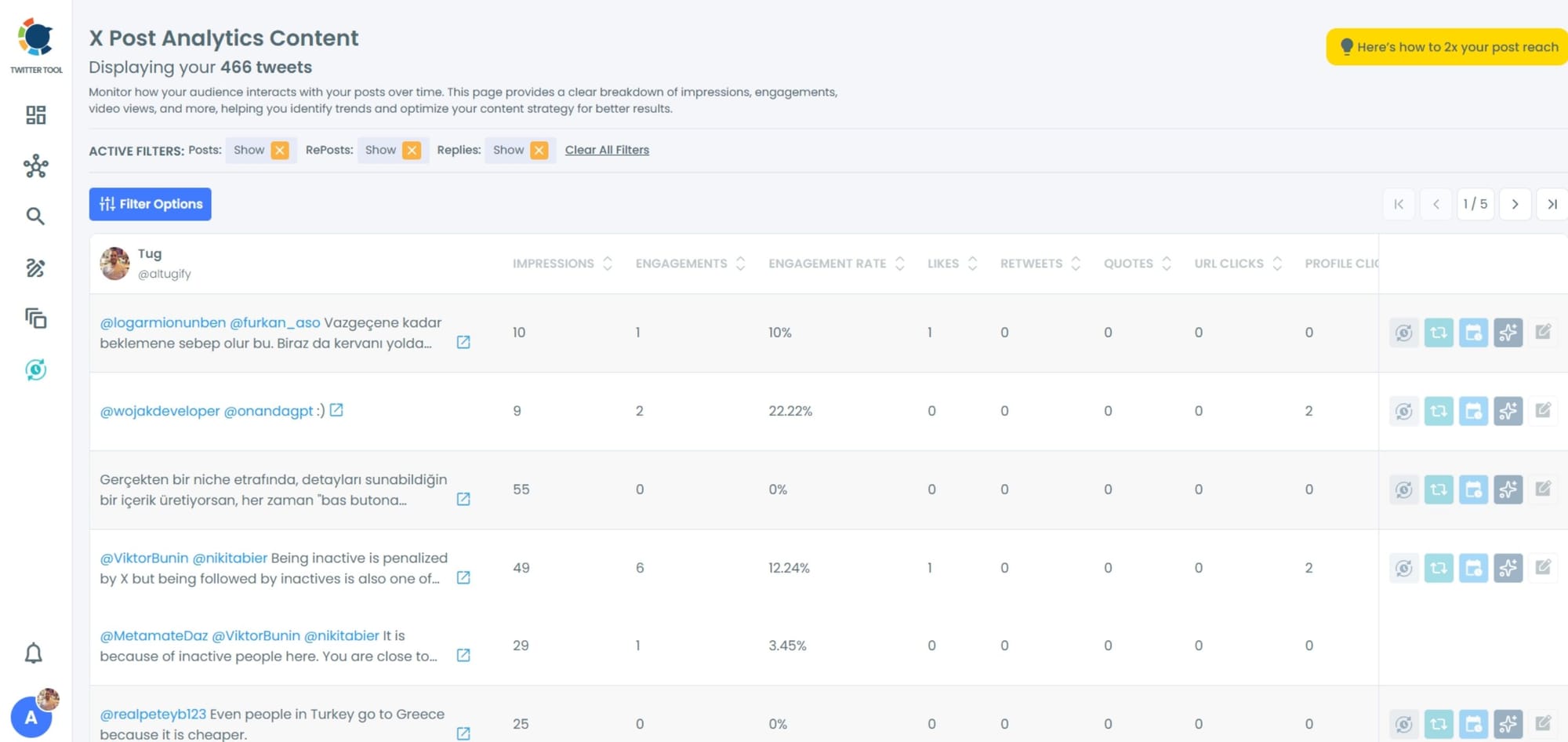
If you don't have X Premium or want to see more detailed tweet analytics, you can use Circleboom to get a detailed analytics page.
Here, you can evaluate your tweets by various metrics. For example, you can see tweets that generate profile clicks. You can see your tweets that are bookmarked by other users. These are very precious information to understand which tweets are truly performing well, which tweets are not!
It is not just about likes, there are quotes, URL clicks and many more analytics and all is available with Circleboom!
Keep in mind that the API provides a more accurate real-time data stream than the X interface itself. While the platform UI may experience lag, the API captures and reflects new developments instantaneously.
Circleboom has the official Enterprise API, we don't scrape data from X!
Algorithmic Reset Without Account Risk
You’re not deleting everything.
You’re removing dead weight.
By pruning low-signal content, your account sends a clearer message to the algorithm:
- higher engagement averages,
- stronger recent performance patterns,
- more confidence in distributing new tweets.
This is not manipulation.
It’s optimization.
Deleting Tweets Is Not “Hiding”. It’s Maintenance!
Think of your X account like a garden.
If 80% of the plants never bloom, they don’t just sit there harmlessly.
They absorb water, block sunlight, and lower the yield of everything else.
Deleting low-performing tweets is algorithmic gardening:
- you trim what no longer serves the system,
- you create space for stronger content to grow,
- you raise the overall health of the account.
The result isn’t erasure.
It’s clarity.
When Deleting Tweets Makes Strategic Sense
You should consider pruning content when:
- your impressions have dropped despite consistent posting,
- your timeline is full of zero-engagement tweets,
- your brand or voice has evolved,
- your engagement rate keeps declining month over month.
Leaving everything up isn’t transparency.
It’s neglect.
Final Verdict: Trim the Weeds, Let the Reach Grow
The idea that “every tweet must stay forever” no longer matches how X works.
In 2026:
- accounts are evaluated as systems,
- averages matter,
- weak signals compound.
Deleting strategically is not hiding your past.
It’s optimizing your present.
Tools like Circleboom don’t encourage reckless deletion; they make intentional cleanup possible, fast, safe, and measurable.
Trim the weeds.
Your next tweets will finally have room to grow.
FAQ: Deleting Tweets on X
Does deleting tweets hurt my account?
No. When done strategically, removing low-engagement tweets often improves reach by raising average engagement signals.
How many tweets should I delete?
There’s no fixed number. Many creators start with tweets that have zero engagement or <1% engagement rate.
Is bulk deletion safe?
Yes, when using approved tools like Circleboom that work within X’s API limits.
Should I delete viral tweets from years ago?
Not usually. High-engagement tweets still contribute positively to account history.
How fast can results appear?
Many creators notice improved impressions within 1–2 weeks, as new engagement patterns stabilize.