The search query was "Austin, TX" entered into the bio and profile search field at 11 a.m. on a Friday, and the results loaded within seconds: 4,200 accounts whose public bio or profile text contained the Austin reference, sortable by follower count, recency of activity, and bio-relevance match.
The operator was three minutes into a partnership-outreach prep session for a local event happening the following month, and the query had produced the working candidate pool that would have taken hours to assemble through manual searching or hashtag scrolling.
The next decision was filtering. Of the 4,200 candidates, the operator wanted accounts with at least 1,000 followers (event-relevance threshold), posting activity within the prior 30 days (engagement-likelihood signal), and bio keywords matching the event's theme. The three filters narrowed the pool to 312 accounts, which the operator exported to a CSV for outreach prioritization. The audit-to-export cycle took 8 minutes; the alternative manual research would have taken most of the workday.
The location-search workflow opens Search Twitter Bios and Profiles, which scans the public bio and profile-text fields of X accounts for the operator's search terms. The workflow runs through the official X Enterprise APIs and produces a sortable, filterable, exportable result set in seconds. Location terms (cities, states, countries, regions) work as direct queries; the operator can layer follower-count, activity-date, and topic-keyword filters on top. → Find Twitter accounts by location with bio search
Why Bio Search Beats Hashtag and Geotag Inference for Location Queries
Most operators attempting a location-based account search reach for two methods that do not work well: hashtag scrolling (looking for #austin or #atx and reading the accounts behind the posts) and geotag inference (checking whether a tweet has a geo-tag attached). Both methods fail at scale because they sample tweet behavior rather than account identity.
Hashtag scrolling produces accounts that happened to use the city hashtag on a specific post, which biases the sample toward currently-active users on that topic and misses the much larger pool of accounts based in the city that simply have not used the hashtag recently. Geotag inference is even thinner because most users do not geotag their tweets, and the geotag (when present) attaches to a single tweet rather than to the account-level identity.
Bio search produces a structurally different sample. The accounts in the result set have self-declared a location in their public bio or profile text, which is a stronger identity signal than any tweet-level behavior. The Circleboom piece on the best Twitter tool for Twitter location search covers the comparative framing of the search methods and is the right starting point for operators evaluating the options.
What the Location Bio Search Should Produce
A useful bio-search result set has three operational columns beyond the basic profile name: location text (the actual phrase from the bio that matched the query), follower count, and most-recent activity date. The three columns drive the three most common filtering decisions.
The location text matters because cities with common names (Springfield, Portland, Cambridge) often have multiple accounts in different states or countries; reading the full bio location text lets the operator confirm the right geographic match before adding the account to the outreach pool.
The follower count drives outreach prioritization. High-reach accounts in the target city get prioritized for partnership-style outreach; smaller accounts often work better for community-building or grassroots campaigns. Most operators sort the result set by follower count descending for the first pass.
The activity date filters out dormant accounts. A bio mentioning Austin doesn't help if the account hasn't posted in two years; the activity filter usually scopes to accounts active within the prior 60 to 90 days for engagement-likelihood reasons.
The Circleboom piece on the benefits of using Twitter geolocation maps for your business covers the geographic-visualization side that pairs with the bio search; the two views together produce both the list (bio search) and the map (geolocation visualization) for a complete picture.
How to Find Twitter Accounts by Location Step by Step
The workflow runs in two phases: the bio query, then the filter and export. Both phases together typically run 5 to 15 minutes per search.
Phase 1: Run the Bio Search
Log in to Circleboom Twitter
- Log in to Circleboom Twitter with the X account being used for the search. OAuth keeps credentials with X directly and supports the public-search workflow through the sanctioned API.

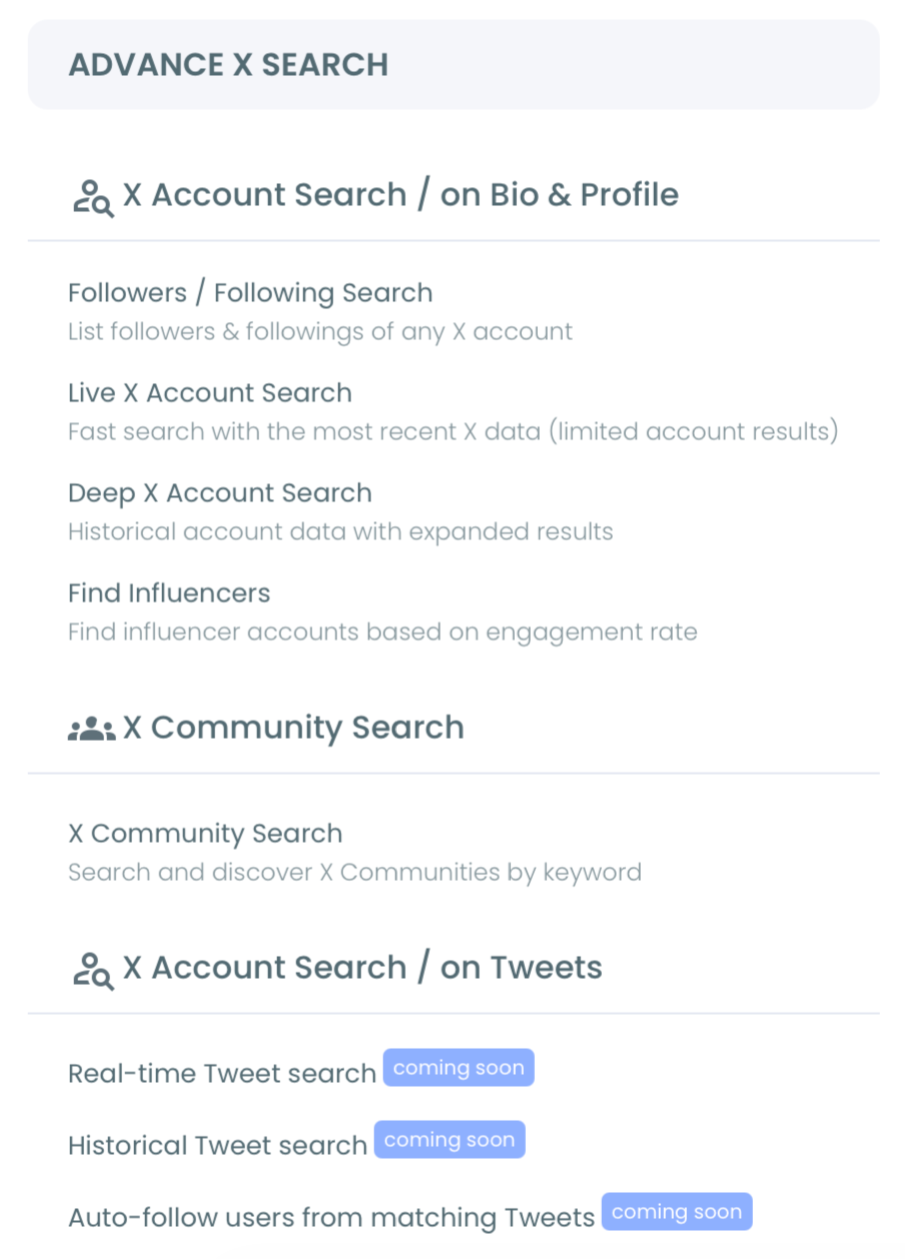
Open Search Twitter Bios and Profiles under the Advanced X Search menu
- Open Search Twitter Bios and Profiles in the Advanced X Search menu. The tool surfaces a search field, filter options, and a sortable result table.
Enter the location query
- Enter the location query. City names, state names, country names, and region names all work; quoted phrases scope to exact matches; multiple terms broaden the search. Adjust the query as needed based on the result-count feedback.
Phase 2: Filter, Sort, and Export
Apply the activity-date filter
- Apply the activity-date filter to scope to accounts active within the prior 60 to 90 days. Dormant accounts rarely engage with outreach and skew the candidate pool toward stale candidates.
Sort by follower count or topic relevance
- Sort the result set by follower count descending for outreach prioritization, or by topic-keyword relevance if the search included a topic term alongside the location term.
Export the filtered candidate list as CSV
- Export the filtered candidate list as CSV for use in outreach prep, partnership briefs, or campaign planning. The dashboard also supports adding candidates to a Twitter list or following the accounts directly.
The six-step sequence is the full workflow. The query design and filter application are the strategic steps; the publish-to-CSV is mechanical.
Video walkthrough: how to search Twitter bios and profiles to find targeted people by keywords.
What the Bio Search Unlocks for Location-Based Outreach
The output is a working list of accounts that have self-declared the target location in their public bio, sortable and filterable for the specific outreach use case. The list supports event marketing, regional sponsorship, local partnership pitches, and journalist outreach for region-specific stories.
The compounding payoff is operational. The first search establishes the candidate pool; subsequent searches in the same city refresh the pool with new accounts that have added the location to their bios since the prior search.
The Circleboom piece on whether you can find Twitter users who list their location in a particular city covers the recurring-search framing for operators who run location-based outreach on an ongoing basis.
Two adjacent surfaces extend the bio-search workflow. The Twitter Advanced Search Filters landing covers the broader filter suite for queries that combine location with other dimensions (topic, follower-count band, verification status). The Find Twitter Influencers landing covers the influencer-focused subset for operators who want high-reach accounts in the target location specifically.
Related Circleboom reading on the location-search theme.
- How to use Tweet Mapper for strategic social media planning on the mapping-side workflow that complements the bio search.
Where the Workflow Goes Next
A first location-based search usually surfaces enough candidates to support an outreach campaign for the target city or region. The operator runs the search on a recurring basis (monthly for active outreach pipelines, quarterly for occasional regional campaigns) to refresh the pool as new accounts add the location to their bios.
Find Twitter accounts by location with bio search and the location-based outreach research that took a full workday through hashtag scrolling and manual profile reading becomes a 10-minute structured query against a sortable result set.
Common Questions About Location Search
Does the bio search find accounts that have a location set in their profile location field but not in their bio text?
Yes. The search scans both the public bio text and the profile location field, so accounts that set their location in the dedicated field appear in the result set even if the bio text does not mention the location. The combined search produces a more complete result than either field alone.
How do I handle cities with common names that exist in multiple regions?
Common-name cities (Springfield, Portland, Cambridge) usually require a disambiguating term in the query: "Springfield, IL" rather than just "Springfield," or "Portland, OR" rather than just "Portland." The disambiguating term scopes the result to the intended geographic match and filters out the unintended matches automatically.
Can I search for multiple locations simultaneously, like accounts in both Austin and Houston?
Yes. Multi-term queries support OR semantics by default, so a search for "Austin, TX" OR "Houston, TX" returns accounts that match either location. Most operators handle multi-city campaigns by running separate searches for each city and combining the result sets, which makes the per-city counts easier to read.
What about accounts that don't list any location in their public profile?
Accounts without a public location are not findable through bio search. The bio search is location-specific by design; operators who want to find accounts that have engaged with location-specific content (rather than self-declared the location) usually combine the bio search with topic-keyword and engagement-history filters.
Does the search respect the privacy settings of accounts that mark their profile as protected?
Yes. The sanctioned API only returns publicly-accessible profile data; accounts that have set their profile to protected do not appear in the search result set unless the operator's account already has a follow relationship with them. The privacy boundary is platform-enforced and the bio search respects it automatically.