
The accounts that follow both you and a competitor are already in your market. They know the space, they are reachable, and you have no idea who they are, because X gives you no way to compare two follower lists. To find the common followers between two Twitter accounts, you need a tool that pulls both lists and computes the overlap, instead of leaving you to cross-reference thousands of names by hand.
Circleboom compares two X accounts and returns their shared followers in one report, so you can see audience overlap, find reachable growth targets, and judge how saturated a market really is.
→ find common followers between two Twitter accounts
Below: what the overlap reveals, and how to read it.
 infocircleboom.com
What Common Followers Actually Tell You
The overlap between two accounts' followers is a map of shared audience. When you compare your account with a competitor, the accounts that follow both are people already interested in your niche who know the alternatives. That group is your warmest possible audience.
The non-overlap is just as valuable. The accounts that follow your competitor but not you are your most reachable growth targets: they have already shown interest in the space, they just have not found you yet. Knowing exactly who they are turns vague "audience growth" into a concrete list.
Compared the other way, the overlap measures market saturation. If two big accounts in a niche share most of their followers, the market is tight and the same people are being reached repeatedly. A small overlap means room to grow. Either read replaces a guess with a number.
Why You'd Compare Two Accounts
There are several concrete reasons to run a comparison. The most common is competitive intelligence: see how much of a rival's audience you already share and how much you could still win. That single view reframes your growth strategy around real people instead of vanity goals.
Partnership fit is another. Before a collaboration, comparing two accounts shows whether their audiences overlap heavily, meaning you would mostly reach people who already know you, or barely, meaning the partner opens a genuinely new audience. The right answer depends on your goal, but you cannot choose without the data.
It also works for shared connections. Comparing two influential accounts reveals the people who follow both, the connectors who sit at the center of a niche. Those are often the most valuable accounts to engage, and the overlap is the fastest way to find them.
Why X Won't Show You This
X provides a static view of any account's followers and nothing more. There is no way to compare two lists, no overlap calculation, no export to cross-reference. You can look at one follower list at a time, and the moment you open a second, the first is gone from view.
Doing it manually is not realistic. Comparing two follower lists of any size by hand would mean exporting both and matching thousands of names, which is exactly the kind of task no one actually completes. The data is public on both accounts; the missing piece is the computation.
That gap is what an account comparison closes. It retrieves both lists through authorized access and returns the intersection, turning an impossible manual job into a two-minute report.
How Circleboom Compares Two Accounts
Circleboom is an official X Enterprise Developer company, so it retrieves both accounts' follower lists through sanctioned access rather than scraping.

Your account stays safe, and the overlap is computed from complete, authorized data instead of a partial scrape.
From there, the tool does the work. You enter two usernames, choose whether to compare followers or following, and Circleboom computes the intersection, returning up to 5,000 shared accounts in a sortable table. A comparison history panel saves your runs so you can revisit them, and you can follow, list, or export the overlap directly.
Watch how to find common followers between two accounts:
How to Find Common Followers Between Two Twitter Accounts
The whole process takes a couple of minutes. Follow the steps in order.
- Log in to Circleboom Twitter and connect your X account with secure OAuth.

- Open the Monitoring menu to reach the account comparison tools.
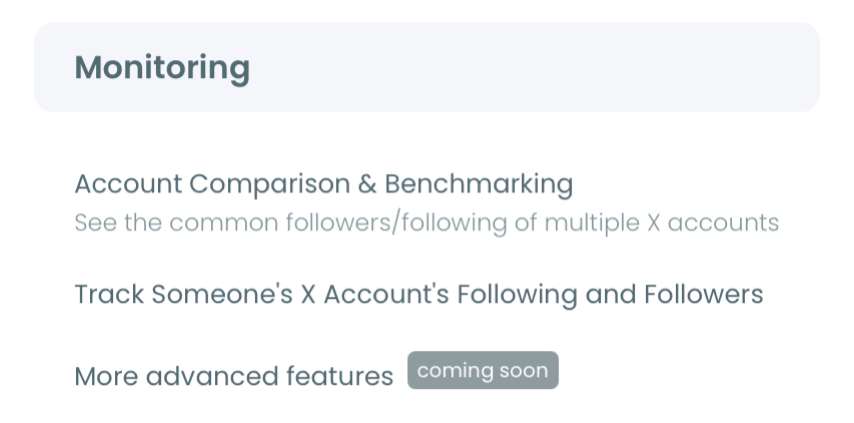
- Enter two usernames and choose to compare followers, then run the comparison.
- Review the shared accounts, then follow, list, or export the overlap.
Because the result is cached, you can rerun a comparison later to see how the overlap shifts, which is useful for tracking whether you are winning a competitor's audience over time.
Turn the Overlap Into a Growth Plan
A comparison is only useful if it changes what you do. The clearest move is to work the non-overlap: the accounts following your competitor but not you are a ready-made target list, already interested in the niche. Following and engaging with them is far more efficient than chasing cold audiences.
The shared followers are a different play. They already know both accounts, so the goal there is to win more of their attention with better content, not to introduce yourself. The walkthrough on finding common followers without coding and the deeper who-follows-whom analysis show how to read both groups.
Comparison also feeds wider research. Pair it with analyzing someone's followers to understand the overlap's makeup, and a dedicated competitor analysis to round out the picture. To see who already connects you, your mutuals view adds the personal layer.
Read the Comparison Beyond the Raw Overlap
The size of the overlap is the headline, but the composition is the story. A large overlap of highly engaged accounts means a competitive, attention-tight market; a large overlap of dormant accounts means the shared audience is less valuable than the number suggests.
Watch the asymmetry, too. If a competitor shares most of your audience but you share little of theirs, they are reaching people you are not, which tells you exactly where to focus. The context in why you cannot see all of someone's followers natively explains why this view is hard to get without a tool, and a deliberate read of the overlap turns a single number into a targeting strategy. X is a large, concentrated platform, as DataReportal's X stats show, so knowing exactly which slice you share with a rival is worth the two minutes it takes.
The Bottom Line
The common followers between two accounts are a map of shared audience and untapped opportunity, and X gives you no way to see it. An account comparison computes the overlap in one report, so you can find your warmest audience, your most reachable growth targets, and your real market saturation.
Compare the accounts, read the overlap and the gaps, and turn the result into a targeted plan.
→ Compare two accounts and find the overlap
Questions Readers Ask
Can I compare any two public accounts, or just my own?
You can compare any two public X accounts, including two competitors you do not own. Circleboom retrieves both public follower lists and computes the overlap, so you can study a market from the outside, not just measure your own audience against a rival.
Should I compare followers or following?
Compare followers to find shared audience and growth targets, which is the most common use. Compare following to see what two accounts both pay attention to, which is useful for mapping influence and shared interests. The tool supports both, so the choice depends on your question.
How many shared accounts can a comparison return?
Up to 5,000 shared accounts per comparison, displayed in a sortable table. That is enough to map the overlap of most accounts in full, and the result is cached so you can revisit or rerun it as the audiences change over time.
Can I act on the overlap directly?
Yes. From the results you can follow the shared or non-shared accounts, add them to a Twitter List, or export the whole set as a CSV. That turns the comparison from a one-time insight into a working target list for outreach or monitoring.