
Replies are the engagement signal that does not scale through passive consumption or shallow propagation. Each reply requires effort from the participant, which makes reply volume an honest measure of audience investment. Reply-based contests with verifiable winner selection produce 3 to 5 times the baseline reply rate. This guide walks through the structure, the prompt design, and the operational mechanics.
Quick Answer:Design a specific reply prompt with a relevant prize.Publish the campaign tweet with a 5-7 day deadline.Engage with replies as they come in.Select the winner with Circleboom Giveaway Picker, filtering for quality replies.The selection runs on the official X Enterprise API.
Why Replies Are Harder to Generate Than Other Engagement Types
The X engagement hierarchy goes from impressions (passive) through likes (single tap) and retweets (single tap with timeline commitment) to replies (typing required) and follows (long-term commitment). Each step up requires more investment from the participant.
Replies are at the difficult end of this hierarchy. The participant has to type something, which means investing thought and time. Most tweets earn 1 to 3 percent of their like volume as reply volume, reflecting the higher barrier.
The higher barrier is exactly why reply contests work. The contest provides the incentive to overcome the barrier. The same audience that would not reply to an open ask reliably replies to a contest with a relevant prize.
For broader engagement-rate context, the framework in what counts as a good engagement rate on Twitter X covers the reply-rate benchmarks.
The Three Required Elements of a Reply Contest
Element one: specific reply prompt. The campaign tweet asks a specific question that requires a substantive response. Generic "reply to enter" produces low-effort entries; specific prompts produce thoughtful ones.
Element two: relevant prize. The prize matches the prompt’s topic area. The match signals that the contest is a genuine conversation, not a generic engagement scheme.
Element three: verifiable winner selection. Without verifiable selection, participation drops as participants suspect the selection is biased. Circleboom Giveaway Picker provides the structural verifiability.
Each element is necessary. Generic prompts undermine the participation; mismatched prizes undermine the perceived authenticity; unverifiable selection undermines the trust calculation.
How Reply Prompts Drive Substantive Responses
The prompt determines the quality and quantity of replies. Three prompt types work consistently.
Question prompts. "What is your favorite X for Y?" The participant has a starting point and a clear scope for their response.
Experience prompts. "Tell us about a time you Z." The participant draws on personal experience, which produces substantive responses without specialized knowledge requirements.
Opinion prompts. "What is your take on X?" Works for topics where the audience has clear views; produces strong responses when audience opinions are well-formed.
Prompts that fail. Vague invitations ("reply with anything"). Overly technical questions ("what is the optimal parameter for X under Y constraints"). Closed yes-or-no questions that do not invite elaboration.
For accounts designing prompts, the principle is specificity with elaboration room. The prompt gives a starting point; the response space is genuinely open within that.
Step-by-Step: How to Run a Reply Contest
The flow runs in six sequential steps.
Step 1. Design the reply prompt
Pick a question, experience prompt, or opinion prompt specific to your audience.
Step 2. Set the prize to match the prompt
The prize should relate to the topic the prompt covers.
Step 3. Write the campaign tweet
State the prompt, the prize, the deadline (5-7 days), and the selection mechanism (Circleboom Giveaway Picker).
Step 4. Publish at a high-activity window and engage with replies
Respond to incoming replies. The engagement signals to the algorithm and to other potential participants.
Step 5. Run Giveaway Picker after the deadline
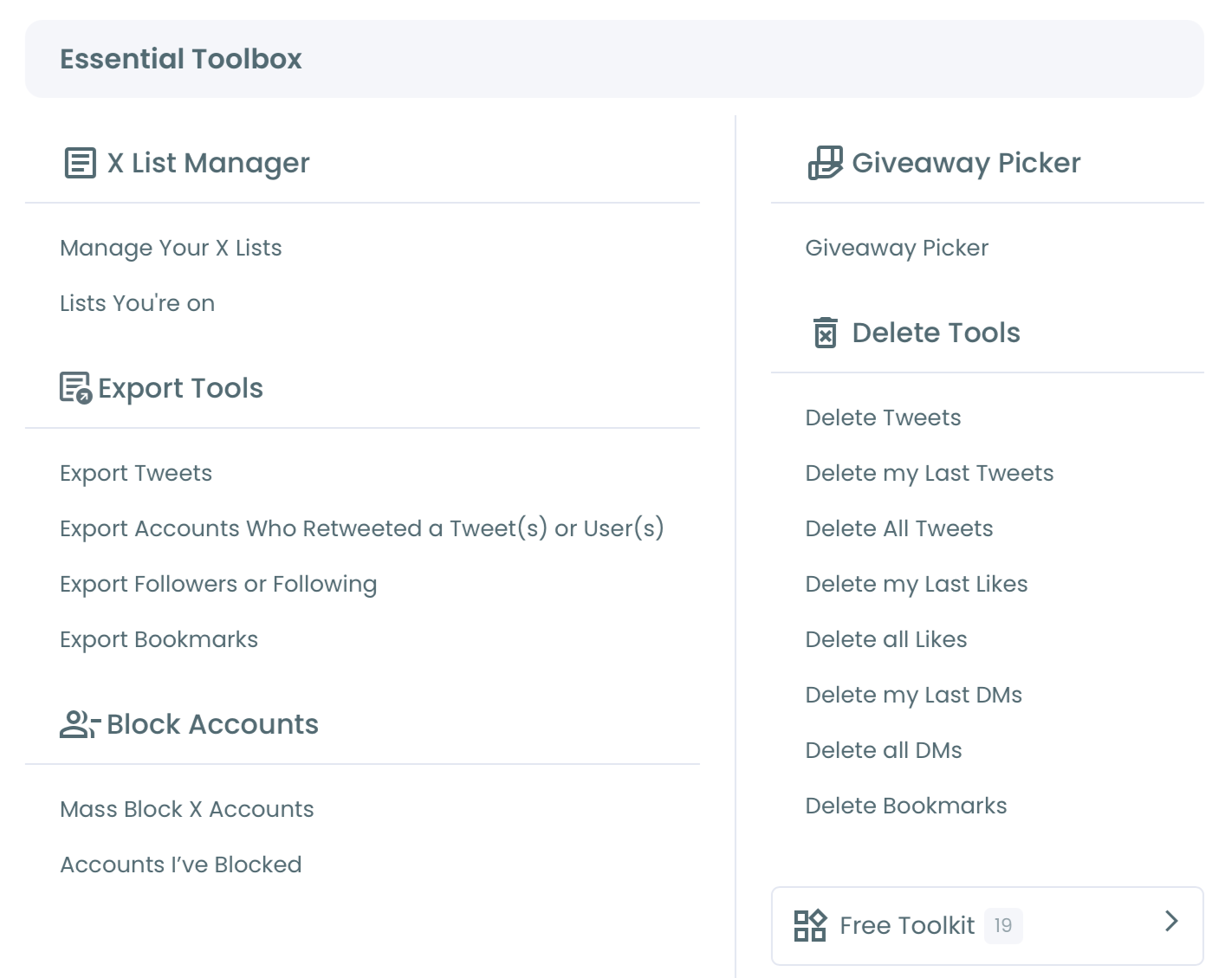
Sign in to Circleboom Twitter, open Giveaway Picker, enter the tweet URL, set entry condition to "reply," apply quality filters.
Step 6. Announce the winner with the selected reply highlighted
Post the winner announcement with the result image. Optionally quote the winning reply to showcase the response quality.
Total operational time: about one hour across the campaign cycle.
How Giveaway Picker Handles Reply-Based Selection
The tool retrieves the reply list for the campaign tweet through the X Enterprise API. The list includes all replies with their associated accounts, timestamps, and content.
Quality filters narrow the pool before selection. Standard filters include minimum reply length (excludes one-word entries), bot account exclusion, account age threshold, and follower count threshold.
The random selection runs uniformly on the filtered pool. Each eligible reply has equal probability of being selected. The output includes the winner identity, the winning reply text, and a result image suitable for public posting.
What the Reply Contest Generates Beyond Reply Counts
Three secondary effects.
Effect one: substantive comment threads. The replies form a discussion under the campaign tweet. Many evolve into conversations between participants.
Effect two: visible audience expertise. The reply quality showcases the knowledge or perspective of your audience, which builds credibility for the account.
Effect three: long-tail engagement. Replies continue arriving after the deadline. The conversation persists in the timeline beyond the formal campaign window.
These effects compound across multiple contests. Audiences that have participated in previous reply contests engage more readily in future ones, building a community pattern around the account.
For the broader engagement-building framework, the patterns in finding brand advocates to increase Twitter engagement apply.
Why Direct Asks for Replies Underperform
"Comment below" or "let me know what you think" produces minimal lift over baseline reply rates. The reason is that follower attention is a scarce resource; an ask without incentive does not justify the effort to type a response.
Contest structures provide the incentive. The follower invests in writing a response because there is a tangible chance of winning. The same person who would not have replied to the direct ask reliably replies to the contest.
The structure is what converts intent into action. Content quality and prompt design still matter; the incentive is what unlocks the reply volume that direct asks cannot reach.
Watch how to get more impressions and replies on Twitter for a related walkthrough.
How Reply Contests Compare to Other Contest Types
Different entry conditions produce different outcomes.
Like-based contests. Low friction, broad participation. Produce engagement count but not substantive interaction.
Retweet-based contests. Moderate friction, broader reach. Produce reach amplification but not deep engagement.
Reply-based contests. Higher friction, narrower participation. Produce substantive engagement and visible community signal.
The choice depends on the goal. Reach goals favor retweet contests. Engagement-depth goals favor reply contests. Many accounts run different contest types for different goals.
For broader campaign strategy, the framework in how to run a successful Twitter contest covers the trade-offs.
What Reply Contests Cannot Do
Three limits.
Reply contests do not work for highly specialized topics where the audience does not have ready opinions. The prompt has to be answerable by the audience.
Reply contests do not produce broad reach. The participation is depth, not breadth.
Reply contests cannot run frequently. Audience fatigue sets in faster than for lighter contest types.
Frequently Asked Questions
What is the typical reply lift?
3 to 5 times the baseline reply count for the same audience, depending on prompt quality and prize relevance.
How should the prompt be designed?
Specific enough that participants have a starting point, open enough that responses can vary. Question, experience, or opinion prompts work best.
What minimum reply length should I require?
10-15 characters typically. The Giveaway Picker filter set excludes very short entries.
Can I combine reply with retweet requirements?
Yes, but the compound friction reduces participation substantially.
How often can I run reply contests?
Quarterly. Reply contests fatigue audiences faster than like or retweet contests.
How does Giveaway Picker exclude bot replies?
The filter set includes bot account detection based on profile signals and behavior patterns.
Should I publicly quote the winning reply?
Yes, when the reply is substantive. Showcasing the winning reply reinforces the contest’s authenticity and rewards the participant.