
Knowing what people are saying about a topic on Twitter is only useful if you can actually see all of it.
The problem with native X search is that it shows you recent tweets ranked by relevance. Not everything. Not historically. And not in a way that lets you act on what you find. You get a snapshot of the last few hours, with no account quality signals, no engagement filters, and no path from discovery to action.
Circleboom Twitter gives you both depth and immediacy for keyword monitoring. Search any keyword across months of tweet history to see who's been discussing it and how. Monitor the same keyword in real time to catch new tweets the moment they're posted.
Both modes surface the accounts behind matching tweets with full engagement data and direct action options.
Can you monitor keywords on Twitter?
Yes. Circleboom Twitter gives you two modes for keyword monitoring.
Historical Tweet Search scans past tweet data across any date range you set and returns every tweet containing your keyword with full engagement stats and account data.
Real-Time Tweet Search monitors the same keyword in real time and surfaces new tweets as they happen. Both modes let you follow, add to lists, or export the accounts behind matching tweets directly from the results.
What Is Circleboom Twitter?
Circleboom is an Official X Enterprise Developer. All tweet and account data is retrieved through X's official APIs using publicly available information. No scraping, no workarounds, fully compliant with platform rules.
Here's what Circleboom Twitter gives you for keyword monitoring:
- Search any keyword across historical tweet data using AI-powered plain language queries
- Monitor keywords in real time and see new tweets as they're posted
- View every matching tweet with full engagement data including impressions, likes, retweets, replies, and timestamps
- Switch to profile view to analyze the accounts behind matching tweets
- Follow, add to Twitter Lists, or export discovered accounts directly from the results
How to Monitor Keywords on Twitter with Circleboom Twitter
Step #1: Log in to Circleboom Twitter and connect your X account.
Circleboom is an Official X Enterprise Developer, meaning all tweet and account data comes directly from X’s official APIs in a safe and compliant way.

Step #2: Open the left menu and go to “Historical Tweet Search”.
You can find it under:
“X Account Search / on Tweets” → “Historical Tweet Search”
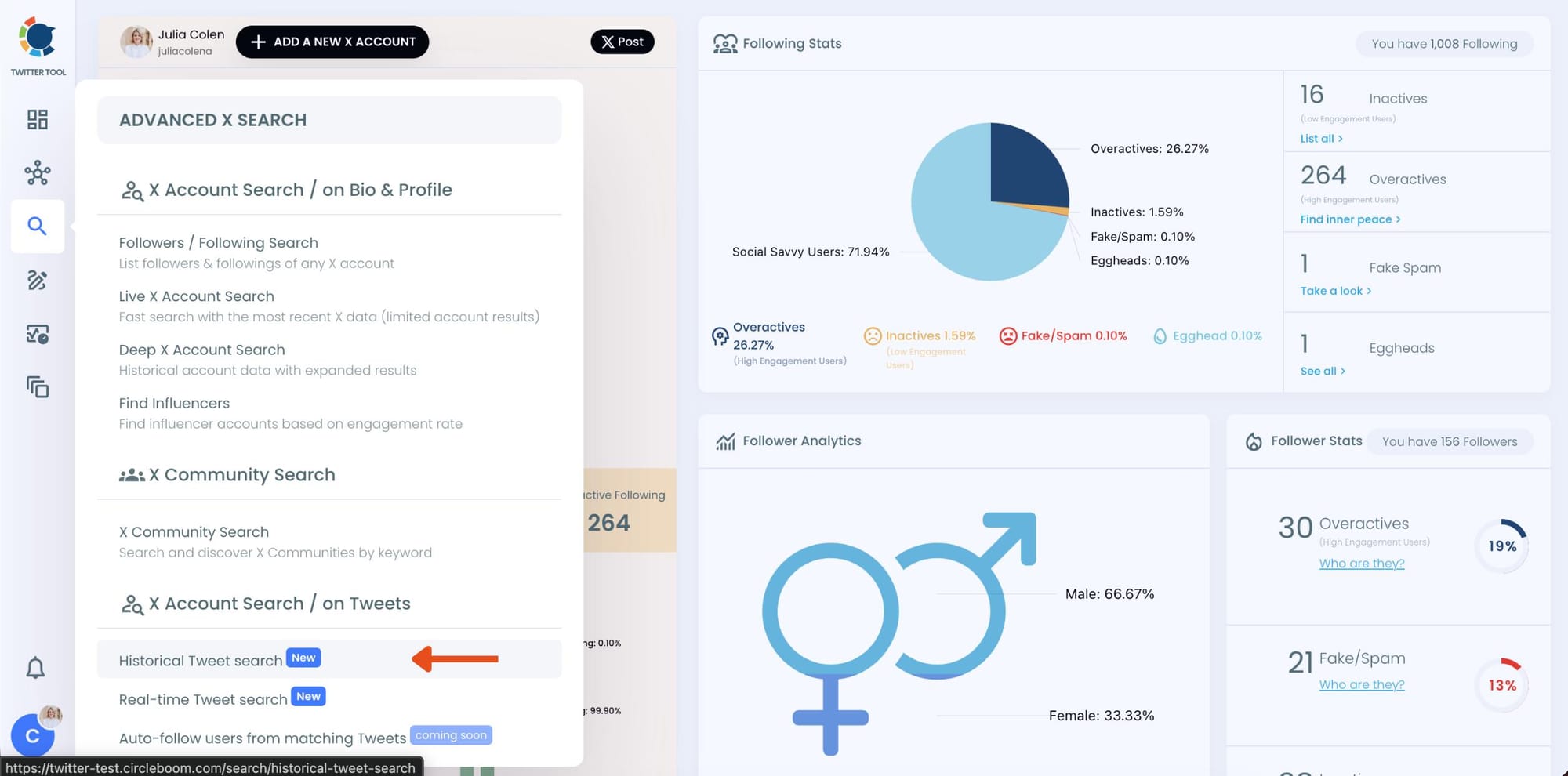
Circleboom also offers “Real-time Tweet Search” in the same section. Historical Tweet Search helps you discover people who tweeted about a keyword in the past across a selected date range, while Real-time Tweet Search continuously monitors new tweets as they happen.
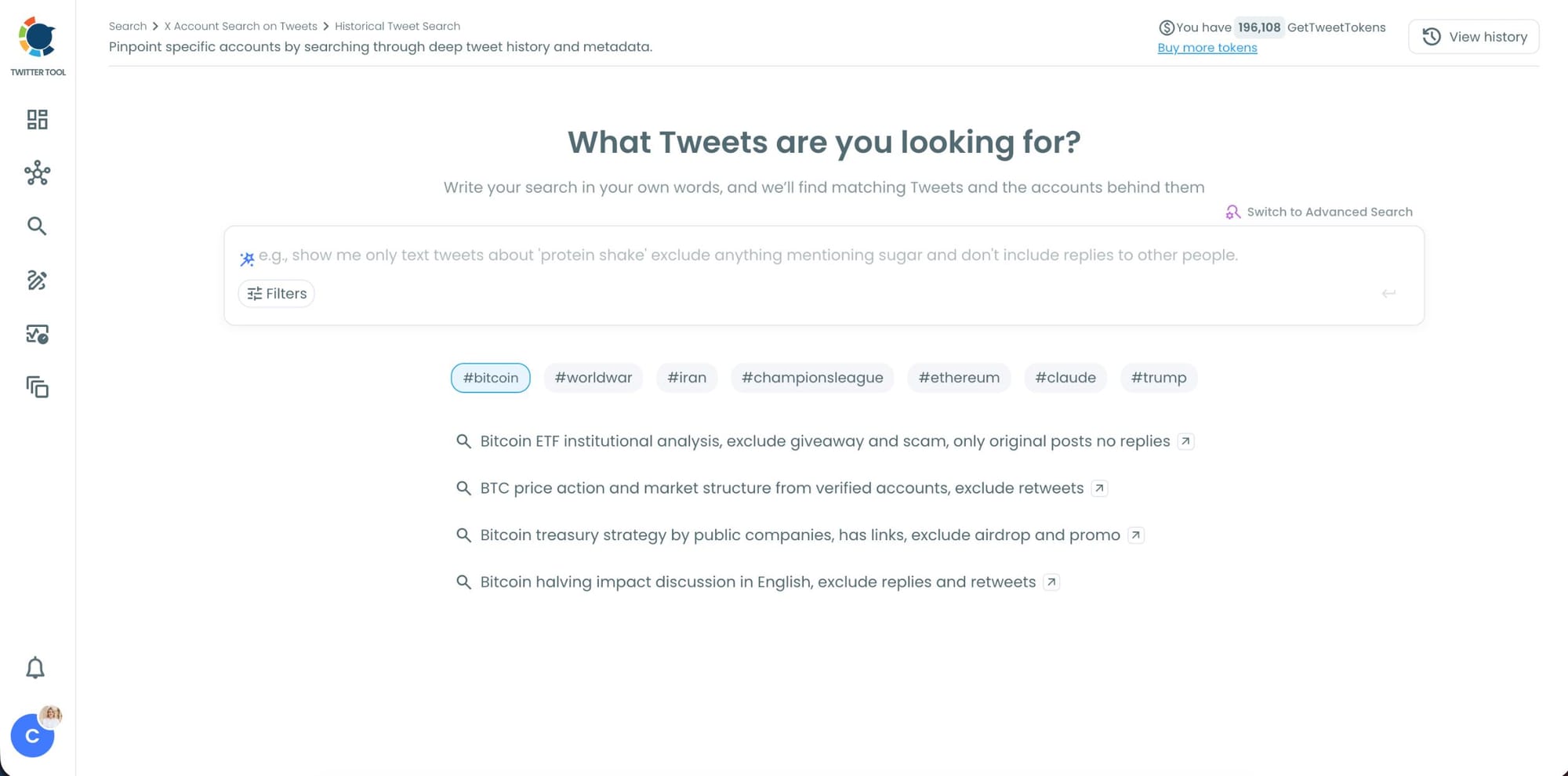
Step #3: Describe the tweets you want to find using AI Smart Search.
Instead of writing complicated Twitter search operators, you can simply type what you are looking for.
For example:
“Find tweets about people looking for a smartwatch or fitness tracker, exclude retweets.”
Circleboom AI automatically understands the intent behind your query, extracts the important keywords, and applies filters automatically.
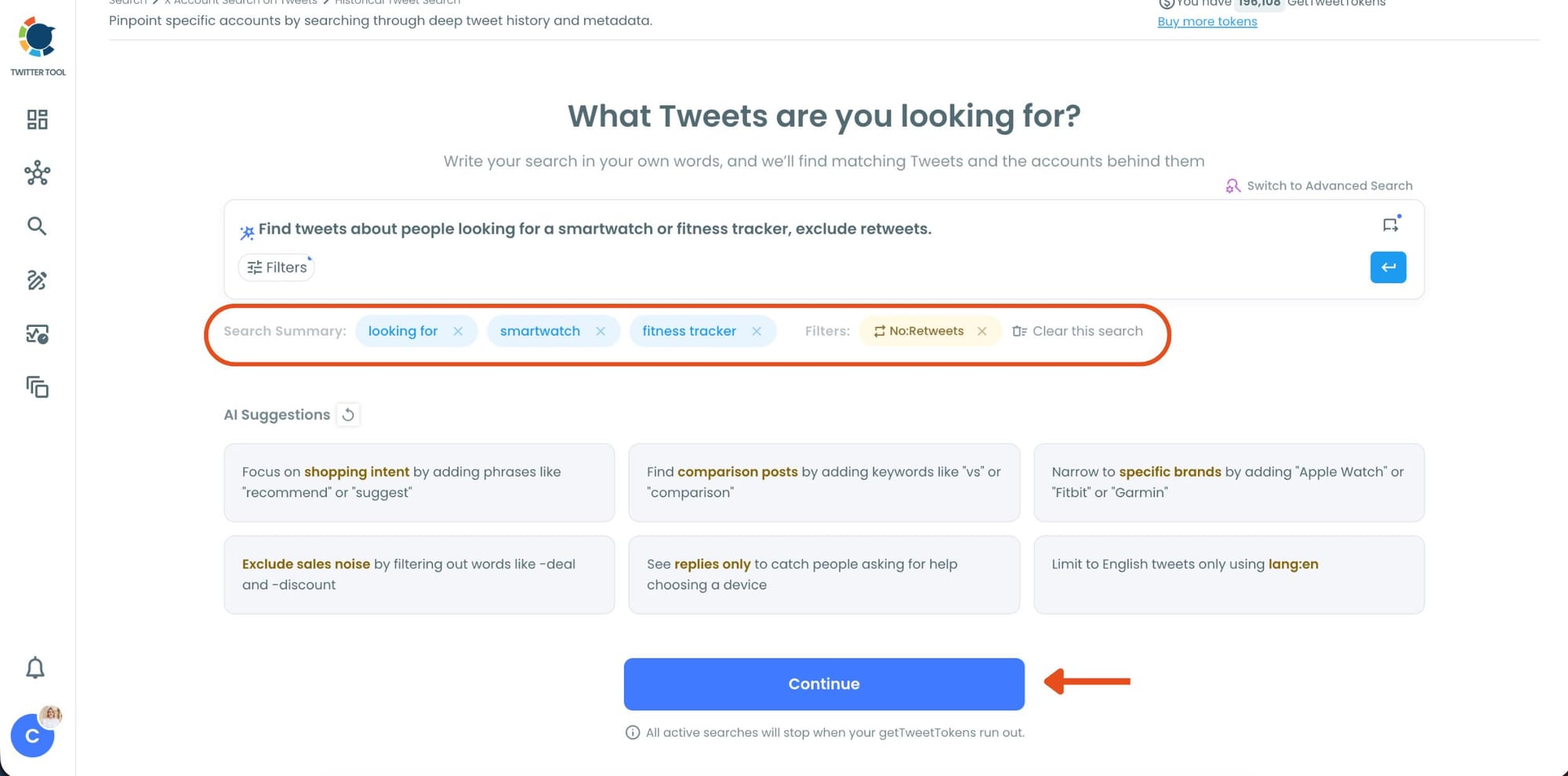
Step #4: Refine your keyword monitoring search with AI suggestions and filters.
Circleboom also suggests ways to narrow your search results. You can focus on intent, comparison posts, replies, or specific languages while filtering out spam, retweets, and noise.
This helps you find more relevant people tweeting about your keyword instead of scrolling through random tweets.
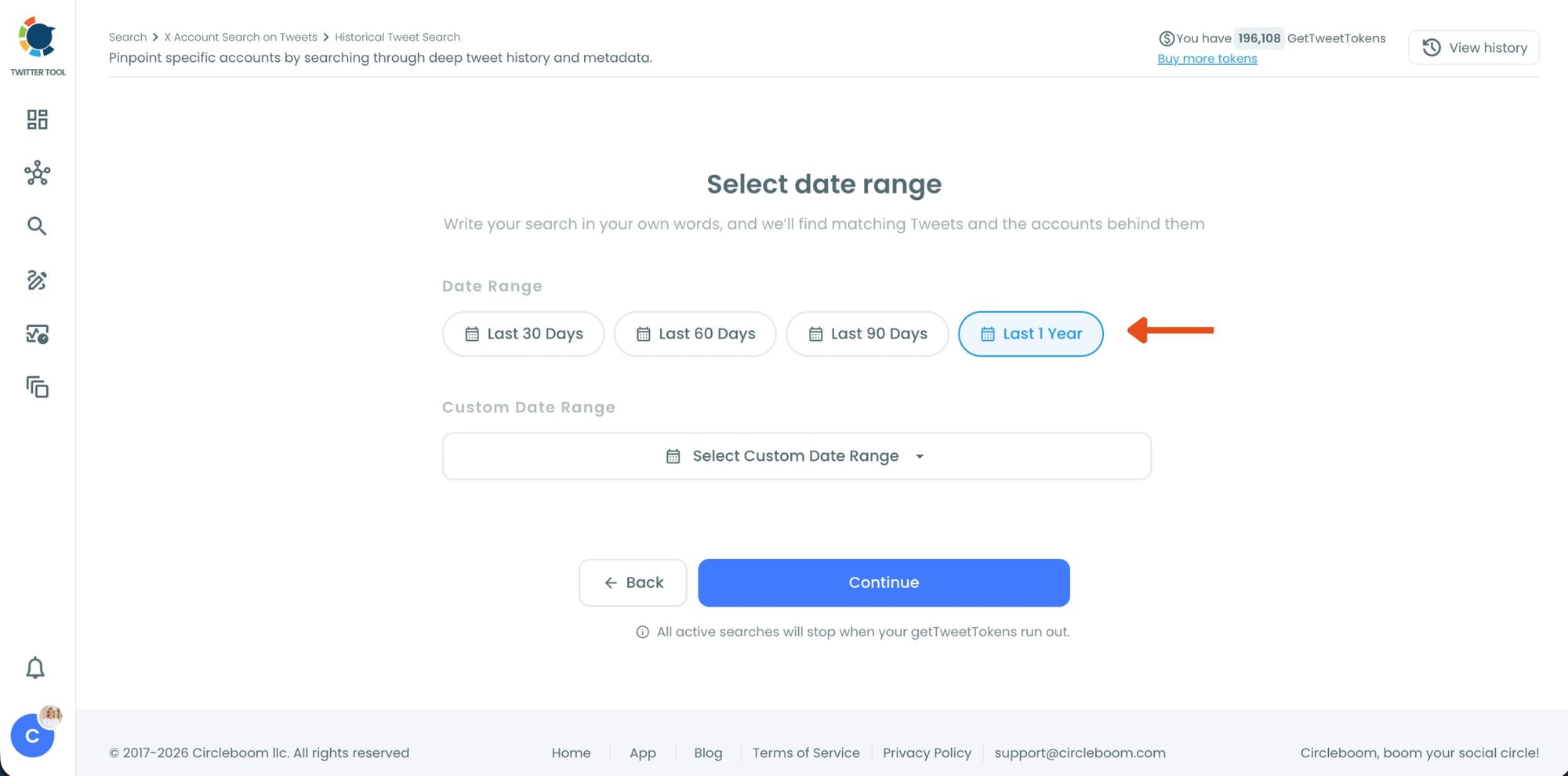
Step #5: Select your historical search date range.
You can monitor tweets from the last 30, 60, or 90 days, search across the last year, or define your own custom date range.
This makes it possible to discover people who tweeted about your topic weeks or even months ago, not just recent tweets.
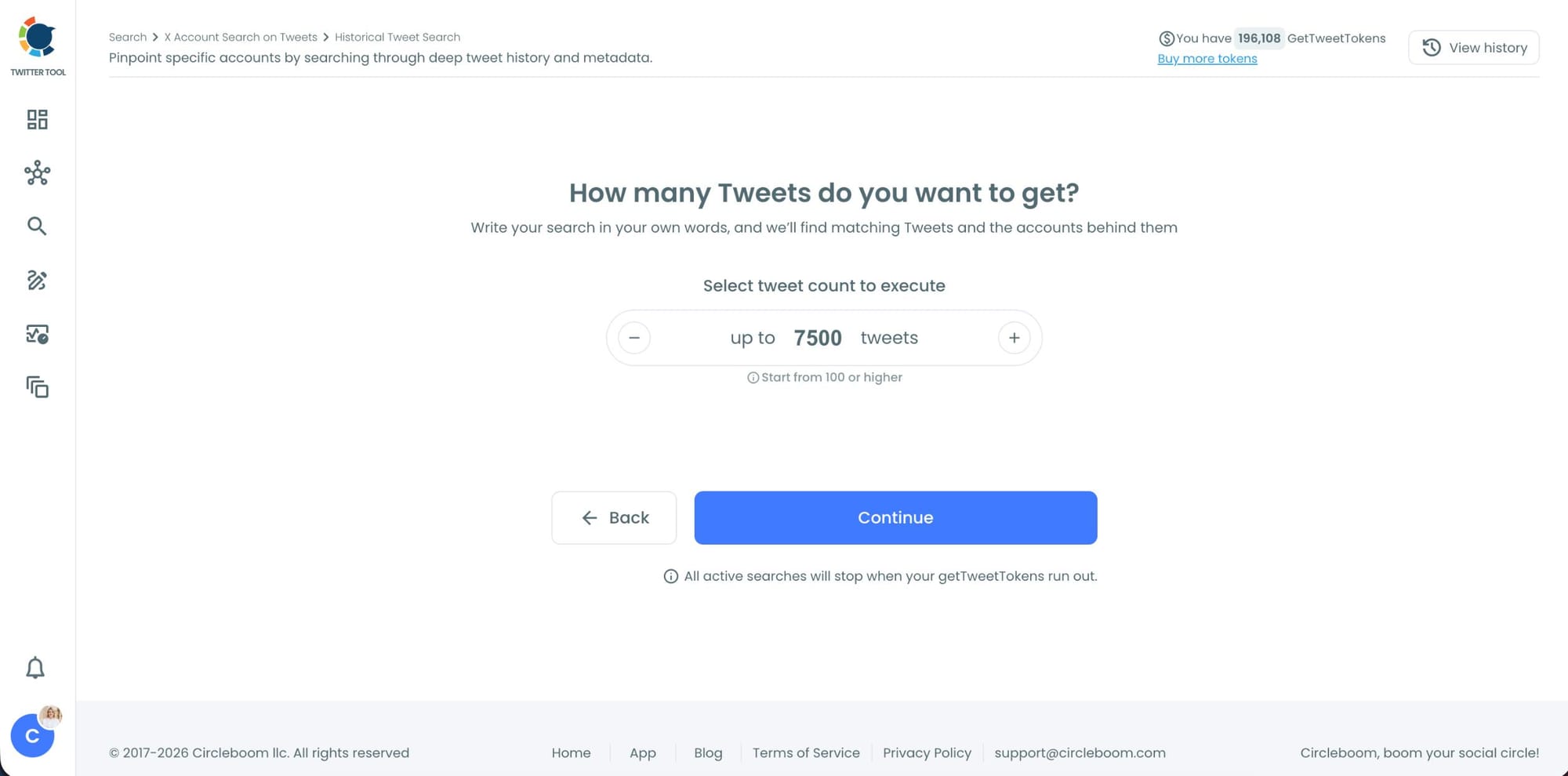
Step #6: Choose how many tweets Circleboom should collect.
Before the search starts, Circleboom lets you select the tweet volume you want to analyze.
Once you click “Continue”, Circleboom scans historical tweet data and starts collecting matching tweets together with the accounts behind them.
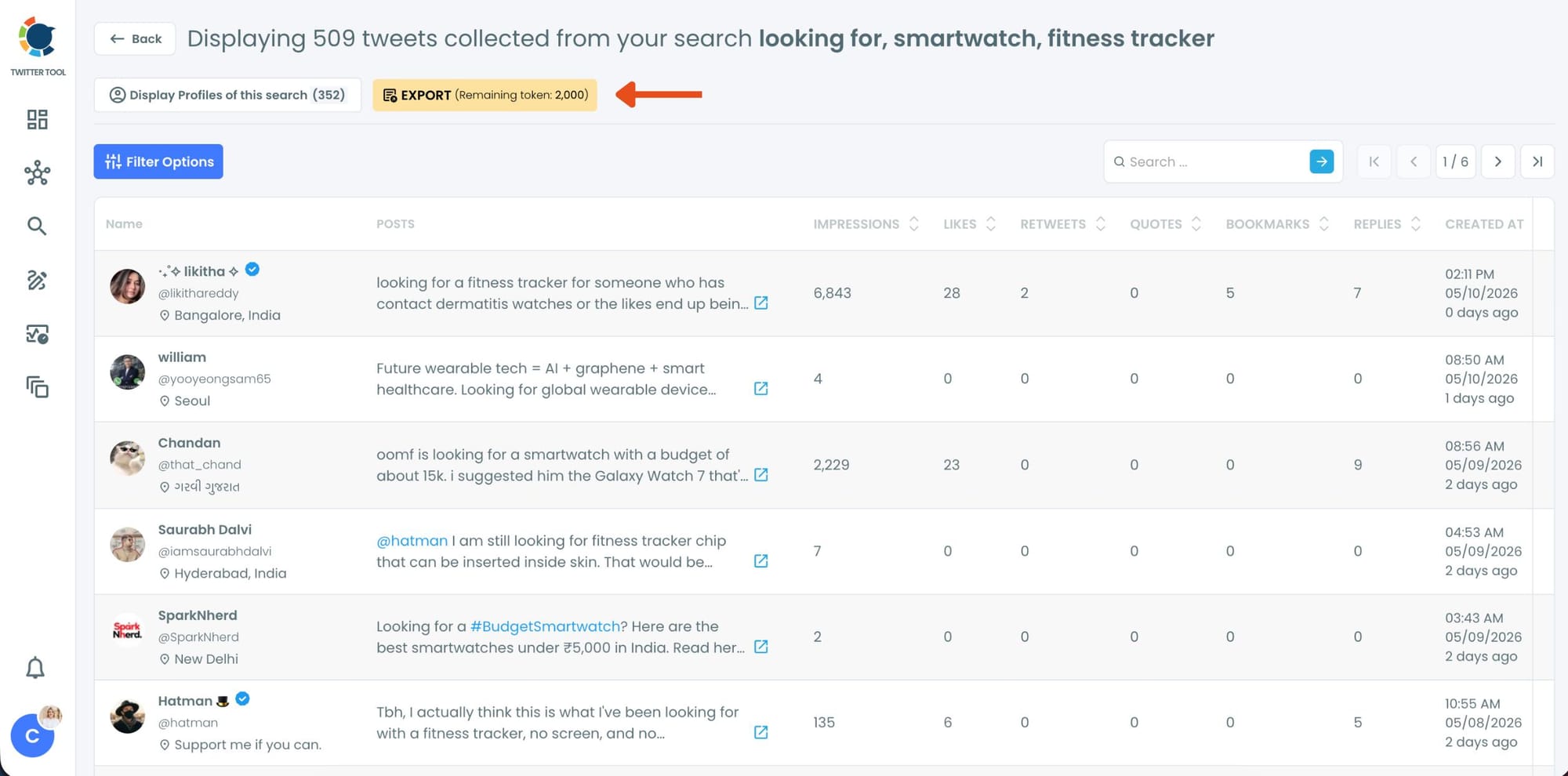
Step #7: Analyze the matching tweets and discover the accounts behind them.
Tweet View displays the matching posts together with impressions, likes, retweets, replies, bookmarks, and posting dates so you can quickly understand which conversations are getting attention.
You can also switch to Profile View to focus on the people behind those tweets.
Profile View displays follower count, following count, account age, tweet count, follow ratio, and engagement activity levels so you can evaluate account quality before interacting with them.
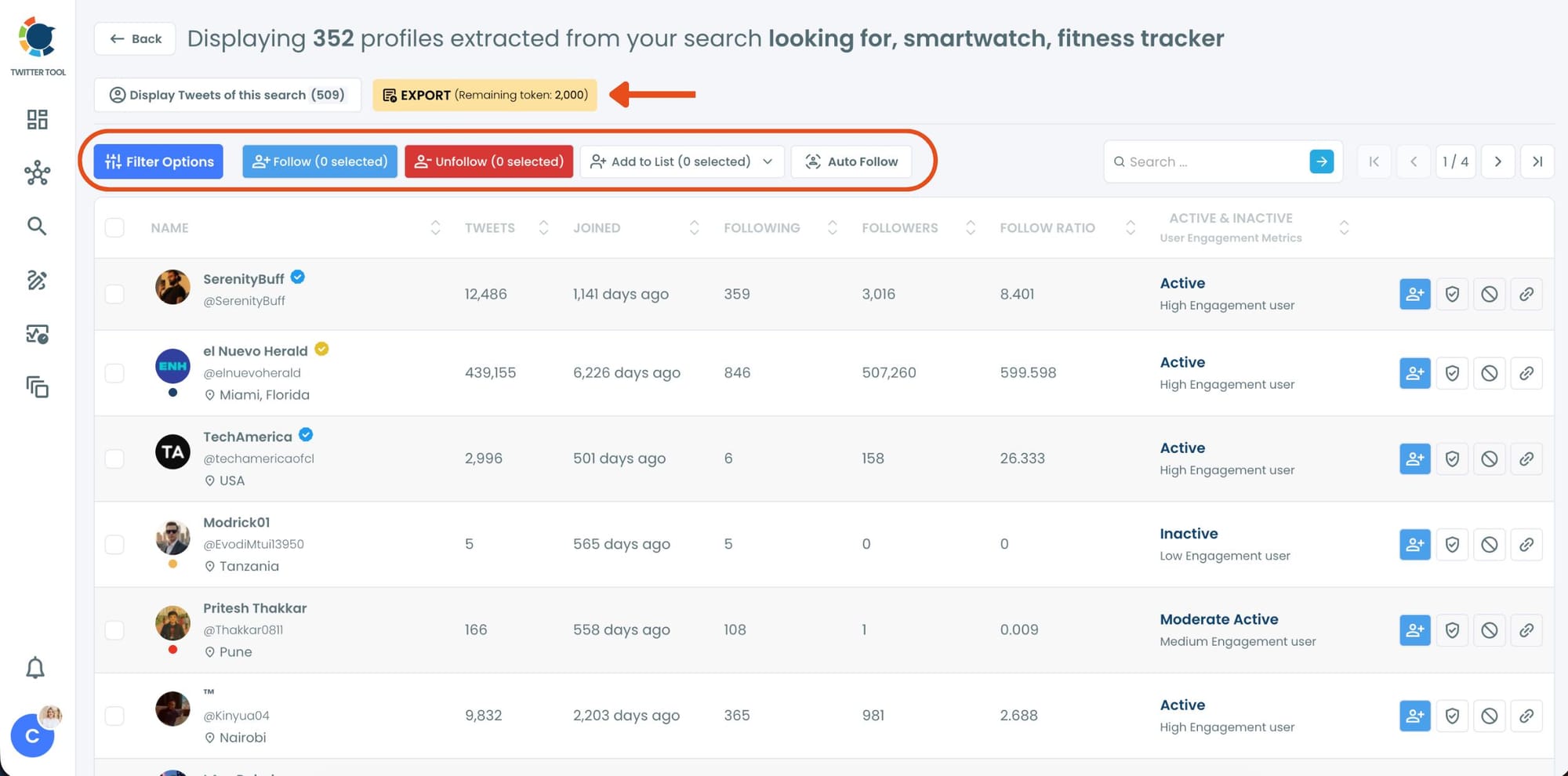
From there, you can directly follow accounts, unfollow them, add selected users into Twitter/X Lists for ongoing monitoring, auto-follow matching users, or export the collected profiles and tweets as CSV files.
Historical Tweet Search vs Real-Time Tweet Search
The two modes serve different monitoring needs and work best together.
Historical Tweet Search
Historical Tweet Search goes back in time. You choose a date range, set how many tweets to collect, and Circleboom scans past tweet data for every post containing your keyword. The options are the last 30, 60, or 90 days, the last year, or a custom window you define.
The search uses AI-powered Smart Search. Instead of typing keyword operators, you describe what you want.
"Find tweets about remote work burnout, exclude retweets and sales posts." The AI extracts the key terms, applies the right filters, and also suggests ways to sharpen the query: focus on questions, limit to a specific language, narrow to replies where real conversations happen, or exclude promotional noise.
Historical search is best for: auditing an industry topic before entering a conversation, researching what's been said about a trend over time, catching mentions you missed because you weren't monitoring yet, or building a comprehensive dataset from a specific period.
Real-Time Tweet Search
Real-Time Tweet Search monitors in real time. A keyword goes live and from that point, every new tweet containing that term shows up in your results immediately. No batch processing. No waiting for a refresh.
Real-Time search is best for: responding to conversations while they're active, catching breaking discussions around a topic, monitoring during events or product launches when conversation volume spikes, and staying present in fast-moving discussions.
📌 Historical and live monitoring together give you the complete picture. Historical search tells you what was said and who said it. Real-Time search tells you what's happening right now. Running both on the same keyword means no conversation slips through.
What the Results Show You
Results come in two views.
Tweet view shows every matching post with engagement data: impressions, likes, retweets, quotes, bookmarks, replies, and the exact timestamp. You see the conversation in context, evaluate the sentiment and intent, and identify which posts are driving the most discussion.
Profile view shows the accounts behind the tweets. Follower count, following count, account age, tweet count, follow ratio, and an active or inactive status with an engagement level indicator. This is what turns keyword monitoring from a passive read into an active workflow. You're not just collecting tweets. You're identifying the people in the conversation and evaluating whether they're worth engaging with.
From profile view you can follow accounts, add them to a Twitter List, or export the full dataset as a CSV for reporting, CRM import, or external analysis.
What You Can Monitor and Why
Industry topics and trends. Monitoring a topic keyword shows you who the active voices are in that conversation, what perspectives are being shared, and where the discussion is moving. This is more valuable than reading articles about a trend. You're seeing what practitioners and engaged audiences are actually saying.
Competitor names and products. Searching a competitor's name surfaces every public tweet about them with the same depth as your own brand monitoring. You see complaints they're not addressing, praise that reveals what their audience values, and comparison questions where your brand could be the answer.
Your own brand and product names. Beyond @-tagged notifications, untagged mentions of your brand name sit in tweet data that keyword monitoring is the only way to reach. Every tweet that mentions your brand without tagging you is a conversation you didn't know was happening. Historical search finds the backlog. Real-Time search catches new ones in real time.
Campaign hashtags. Running a campaign hashtag through historical search shows you who participated, what they said, and how much reach the hashtag generated. Filtering by engagement level surfaces the highest-impact posts from that campaign.
Niche phrases and intent signals. "Looking for a recommendation on" followed by your product category. "Anyone tried" followed by your industry. "What's the best tool for" followed by a problem you solve. These are the phrases that signal intent before someone has decided what to buy. Monitoring them gives you a pipeline of accounts actively in the decision process.
For ongoing outreach from keyword monitoring results, combining with Circleboom Twitter's Find Influencers feature helps identify which accounts in a conversation have the most reach and influence in that topic area.
 infocircleboom.com
Frequently Asked Questions
Can you monitor keywords on Twitter in real time?
Yes. Circleboom Twitter's Real-Time Tweet Search monitors any keyword in real time and surfaces new matching tweets as they're posted. You can run live monitoring alongside historical searches to cover both past and present activity around any keyword.
How is Circleboom's keyword monitoring different from Twitter's native search?
Twitter's native search returns a limited, algorithmically ranked set of recent tweets with no historical depth, no account quality signals, and no bulk action options. Circleboom Twitter's keyword monitoring scans historical tweet data across date ranges you define, displays full account quality indicators, and connects directly to follow, list, and export actions.
How far back can I search for keyword mentions?
Historical Tweet Search supports date ranges of the last 30, 60, or 90 days, the last year, or a custom window you set. The depth of results depends on tweet volume and the date range selected.
Can I monitor multiple keywords at once?
You can run separate searches for different keywords and build monitoring across multiple topics simultaneously. Each search returns its own set of results that you can manage, filter, and act on independently.
Can I filter keyword results by account quality?
Yes. After a search returns results, the profile view lets you filter by follower count, account age, activity level, follow ratio, and engagement status. This lets you focus on accounts that match your criteria before taking any action.
Can I set up alerts for new keyword mentions?
Real-Time Tweet Search runs continuously for real-time monitoring. For scheduled monitoring workflows, you can run historical searches at regular intervals to catch new mentions since your last check.
Can I export keyword monitoring results?
Yes. Both tweet data and profile data export as CSV files. The profile export includes username, bio, follower count, account age, and activity status, ready for CRM import, reporting, or outreach workflows.
Final Thoughts
Keyword monitoring on Twitter is only as useful as the depth and speed of the data you can access. Native search gives you neither.
Circleboom Twitter's Historical Tweet Search gives you depth: months of past conversation around any keyword, with account quality signals and action options built into the results. The Real-Time Tweet Search gives you speed: new tweets surface the moment they're posted. Together they make keyword monitoring something you can actually act on.
Monitor any keyword on Twitter with Circleboom Twitter.
infocircleboom.com