Most restaurant owners believe Google Maps is a popularity contest. More reviews, more years, more stars, higher rank.
Camden says otherwise.
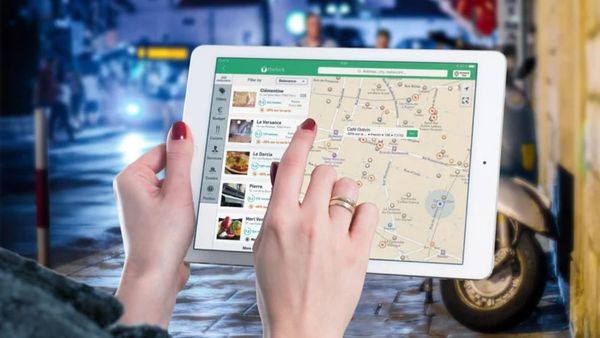
In October 2026, a study of London ramen searches typed one word, "ramen," into Google Maps with the map centred on Camden Town, the way a hungry person standing on the high street would. The #1 result was Umami Lab Sapporo Ramen, a small Sapporo style ramen shop.
Its oldest Google review was five months old.
It ranked above Tonkotsu Kentish Town, part of a well known London ramen group, with the same 4.8 stars and five times the reviews. So how does a brand new shop beat a group with years of history?
It is not luck, and it is not money. It is three habits, done every day.
About the research. The study, published in October 2026, searched "ramen" on Google Maps with the map on Soho, Shoreditch and Camden Town, plus "ramen in London" centred on Soho, and opened almost 20 restaurant profiles. For each one it read the newest reviews, counted owner replies, checked categories, posts and action buttons, then compared every Instagram account. This article focuses on the Camden results. Read the full study here.
What the Camden search showed

| Rank | Restaurant | Rating | Reviews |
|---|---|---|---|
| 1 | Umami Lab Sapporo Ramen | 4.8 | 260 |
| 2 | Tokyo Retro | 4.5 | 246 |
| 3 | EKI BENTO | 4.8 | 100 |
| 10 | Tonkotsu Kentish Town | 4.8 | 1,315 |
Look at #3 for a second. EKI BENTO is a bento shop, not a ramen bar. It still ranked third for "ramen," with a small label under its name: "Menu highlight: ramen." Google had read its menu.
And look at #10. Same rating as the winner, more than five times the reviews, and it replied to 9 of its last 10. On paper, it should be first.
Google Maps does not reward the restaurant with the longest history. It rewards the one that looks most alive and most relevant right now.
Why a five month old shop won
The study loaded all 260 of Umami Lab's reviews. Three things stood out.
1. Its category says exactly what it is. Umami Lab's primary category is "Ramen restaurant." Tonkotsu Kentish Town's is just "Restaurant." When someone types "ramen," Google has to guess about the second one. It does not have to guess about the first.
2. Reviews arrive every day. Its 10 newest reviews all came in within three days. For a shop that size, that is a busy, open, popular place in Google's eyes.
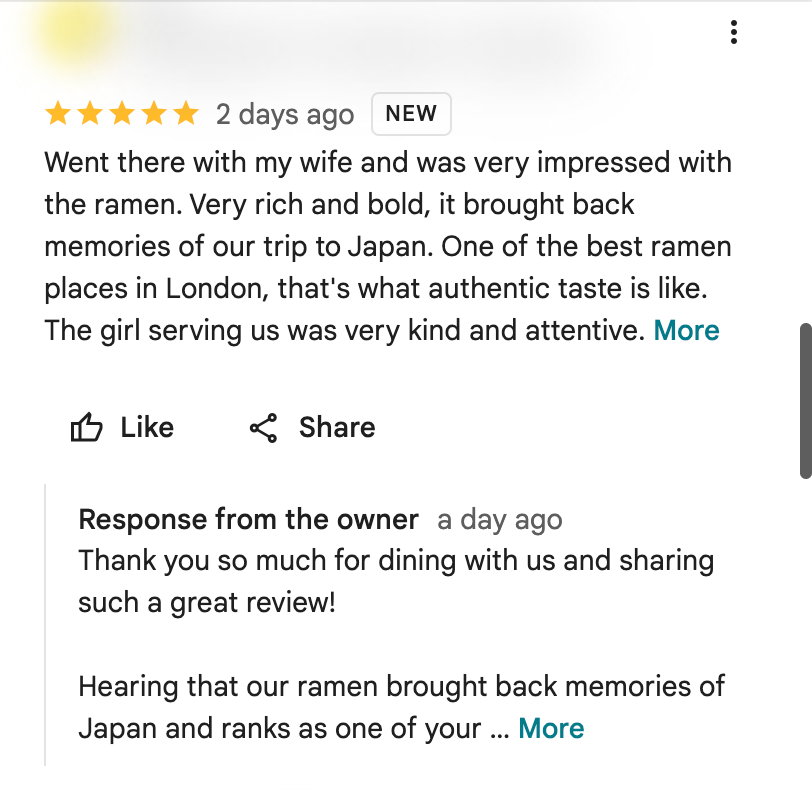
3. The owner answers. Umami Lab replied to 148 of its 260 reviews. That is 57%, including 8 of the last 10. And the replies are not copy and paste: they pick up on what the guest actually wrote.
Two honest notes.
First, distance matters and nobody can change it. Tonkotsu Kentish Town sits about 1.2 km north of the point where the search was made. That alone costs it places. The category, though, takes two minutes to fix.
Second, Umami Lab is not a perfect profile. It had no phone number, no Google updates, and an Instagram account with about 1,000 followers.
Which raises the real question.
If a shop can reach #1 doing only three things well, what happens to the restaurant that does all seven?
How Google Maps decides which restaurant comes first
Google says local results depend on three things: relevance, distance and prominence.
- Relevance is how well your profile matches the search. Your primary category, your menu and your services all feed it.
- Distance is how far you are from the person searching. You cannot move your restaurant, so you focus on the other two.
- Prominence is how known and trusted you look: reviews, how recent they are, replies, photos, links and mentions around the web.
Nearly every local SEO guide published in 2026 agrees on the order of importance too. Experts surveyed for Whitespark's annual local search ranking factors study put the primary category at the top for map rankings, with proximity and reviews right behind it.
That is exactly the Camden story. Umami Lab won on relevance and prominence, the two levers you control.
The playbook: 7 steps
Step 1: Claim and verify your profile
If your Google profile shows "Claim this business," fix that before anything else. Go to business.google.com, find your restaurant and verify it.
In the same study, a London ramen bar called Eat Tokyo Tonkotsu ya showed "Claim this business" on a profile with 919 reviews. Nobody from the restaurant could reply to a single one.
Step 2: Pick the most specific primary category
If you sell ramen, choose "Ramen restaurant," not "Japanese restaurant" and never just "Restaurant." Add the broader ones as secondary categories.
Then upload a menu with real dish names, as text. That is how EKI BENTO, a bento shop, earned its "Menu highlight: ramen" label and a #3 spot for a dish it is not even known for.
A pizza place in Brooklyn works the same way: "Pizza restaurant" as primary, "Italian restaurant" as secondary, and "Margherita" and "Pepperoni" written out in the menu.
Step 3: Fill every field, and keep it true
Phone number, website, hours, menu, booking link, ordering link, photos. Umami Lab skipped the phone number, and that is a call it will never get.
Keep the details true when things change. A study example from Soho, Ramo Ramen, announced on Instagram that it was closing in September. Weeks later its Google profile still said "Opens 5 PM," and it still ranked #6. Every person who trusted that listing walked to a locked door.
If anything changes, tell Google first.
Change the hours in the profile itself, then tell people why. Closing for two weeks over the holidays, or switching to winter hours? Write the Google update in advance and schedule it in Circleboom's Google Business Profile Manager, so it goes live the morning the change starts, even if you are already on holiday.
Step 4: Ask for reviews every week, not once a year
Umami Lab did not collect 260 reviews by accident. A steady flow beats a big pile of old ones.
Put a QR code on the bill. Mention it when the bowl is cleared. Add your review link to your Instagram bio.
A smaller place does not need 10 reviews a day. Three new reviews a week is enough to keep your profile looking open and busy. The study's counter example was Panton Yokocho, ranked #37 in central London: of its 10 newest reviews, eight were "a year ago."
Then put your best reviews to work. A five star quote laid over a photo of the bowl makes one of the strongest posts a restaurant can share. Circleboom has Canva built in, so you can design it once and send the same image to your Google profile and Instagram in one go.
Step 5: Reply to every review within 48 hours
This is the habit that most clearly separates the winners. Umami Lab answered 57% of everything it ever received. Uzumaki London, a top ranked ramen bar in Soho, replied to 7 of its 10 newest reviews, all less than four days old.
Mention the dish the guest ordered. Answer the one star review calmly and specifically. Future guests read those replies before they read your menu.
Three minutes a day covers it.
Step 6: Post a Google update every week
This is the step Umami Lab skipped, and the cheapest upgrade it has left.
Be clear about what posts do. A small 2021 test by the local SEO agency Sterling Sky found no direct ranking lift from weekly posts. But posts do something just as valuable: they turn people who already found you into people who walk in.
Uzumaki London published a Google post 17 hours before the study's search, for a Naruto cosplay night where guests in costume ate for free. Anyone opening that profile instantly knows this place is busy, fun and worth booking.
The problem is never ideas. It is time.
Google's own dashboard publishes a post the moment you press the button, one profile at a time. Most owners do it twice, then a busy Friday comes and the profile goes quiet for months.
That is where Circleboom's Google Business Profile Manager helps. You plan a month of Google posts in one sitting, add Offer and Event posts with CTA buttons and coupon codes, and the queue publishes them on schedule.
A month of posts for a ramen shop can be this simple:
- Week 1: an Offer post, "Tuesday lunch: any ramen plus gyoza for £15," with a coupon code and an Order button.
- Week 2: a photo of the new seasonal bowl, made with a Canva template or an Unsplash image right inside the composer.
- Week 3: an Event post for a tasting night, with a Book button.
- Week 4: a review quote from a happy guest.
Stuck on the words? The AI Google Post Generator drafts the text from one line, like "new spicy miso ramen, Thursdays only." If you already write a blog or a newsletter, connect its RSS feed and new articles become Google posts automatically.
Do the math. A ramen group with three branches that posts once a week needs 12 Google posts a month. Logging into each profile, writing and posting by hand takes about 10 minutes a post, so two hours a month. Planned together in one session, with the same Offer sent to all three branches at once, it is closer to 30 minutes.
And because every branch sits in one dashboard, nobody has to remember which location posted last week.
Step 7: Connect Instagram to Google, and track the sales
Google does not count Instagram followers. But Instagram feeds what Google does count. A Reel brings someone in, they search your name on Maps to find you, they leave a review, they upload a photo.
The study found the restaurants that were active on Instagram were the same ones that were active on Google. Maki & Ramen, #1 in Shoreditch, posted 21 times in 30 days. Ramen moto, a well reviewed bar near Soho sitting at #18, went seven weeks without a post.
Maki & Ramen did one more smart thing. Its Instagram bio link carries a UTM tag (utm_source=ig), so it can see exactly how many orders Instagram sends.
Do the same on Google. Add UTM tags to the website and order links in your profile and posts, so Google Analytics shows every visit, booking and order that came from Maps.
The easiest routine: the Reel of broth being poured on Tuesday becomes a Google update on Wednesday.
Meta's own tools can schedule your Instagram and Facebook posts, but they stop there. Google is not part of them, so the Google side is the one that quietly gets forgotten. With Circleboom, the same photo and caption go to Instagram, Facebook and your Google Business Profile from one composer, each at its own time. Schedule your Instagram and Google Business Profile posts from one dashboard, and the habit survives the busy weeks.
Put a UTM tag on the link in every one of those posts, and at the end of the month you can see which channel sent the most orders: the Reel, the Google Offer or the Facebook post.
FAQ
How long does it take a new restaurant to rank on Google Maps?
There is no fixed timeline, but the Camden example is encouraging. Umami Lab's oldest review was five months old when it ranked #1 for "ramen." Most guides published in 2026 talk about a few weeks for profile fixes like the category, and a few months for review driven gains.
Do Google posts help a restaurant rank higher?
The best available test found no direct ranking effect. Posts still matter, because they show customers you are open and active, and they carry offers and booking buttons that turn views into visits.
What is the most important Google Maps ranking factor for restaurants?
Distance comes first, but you cannot change it. Of the factors you control, local SEO experts consistently rank the primary category highest, followed by reviews: how many, how recent and whether you reply.
Does Instagram affect Google Maps ranking?
Not directly. Indirectly, yes: Instagram drives branded searches, visits, reviews and photos, and those are prominence signals Google Maps uses.
How often should a restaurant post on Google Business Profile?
Once a week is a good rhythm for most restaurants: enough to keep offers and events fresh, light enough to keep up. The easiest way to stick to it is to plan the whole month at once and let Circleboom's Google Business Profile Manager publish on schedule.
The lesson from Camden
Umami Lab did not have history, a famous name or a big Instagram following.
It had a category that said exactly what it serves, reviews that kept arriving, and an owner who answered them.
Those three cost nothing and take an afternoon to set up. The fourth habit, posting every week, is the one that slips first. So take it off your plate: spend one hour this month planning your Google posts in Circleboom, and your profile keeps looking open on the nights you are too busy to think about it.
You do not need to be the oldest restaurant on the street. You need to be the one that looks open today.