
There are two ways to search a Twitter profile for keywords, and they produce completely different results. One reads a single account's posts. The other reads the bios and tweet histories of thousands of accounts and hands you the ones that match.
A keyword search that actually finds accounts gives you three things.Every profile whose bio contains your term, matched in one pass.Every profile whose past tweets prove the topic, even when the bio never mentions it.A filtered, exportable list you can act on, not a scroll of loose posts.
Built on Circleboom's Deep X Account Search and delivered through official X APIs, this is how you search a Twitter profile for keywords at scale.

Native Search vs a Real Keyword Search
Put the two methods side by side and the gap is obvious.
Native X search is a tweet tool. It finds posts by word, and it can pull one account's posts with the `from:username keyword` operator. That answers "what did this person say about X," which is useful when you already have the handle.
A real account search answers a different question: "which profiles belong to this topic." That means reading bios and histories across the whole platform, filtering by real signals, and producing a segment. Native search has no filter panel, no segment, and no export, so it cannot do this job.
The single biggest miss in bio-only search is the expert who never wrote the keyword into their bio. Their tweet history proves the expertise; their headline hides it. Matching both bio and historical tweets is the only way to catch that person, and it is exactly what Circleboom does.
Here is what that looks like in practice. Search "climate policy" on the native app and you get a stream of posts, plus the handful of accounts that wrote the phrase into their bio. Run the same term through Deep X Account Search and you also get the researcher whose bio reads "opinions my own" but whose last three years of tweets are almost entirely on the subject. One method finds the self-labeled, and the other finds the qualified.
What You Need Before You Start
The setup is light. You need a Circleboom account connected to X, the keyword or phrase you want to search, and a rough idea of who counts as a good match, such as a follower floor, a language, or a location.
That last part matters more than it sounds. A raw keyword scan can return up to 5,000 accounts, so knowing your filters in advance turns a large pool into a usable list fast. With those criteria ready, you can search X profiles by keyword and trim the pool in minutes.
How to Search a Twitter Profile for Keywords in Circleboom
The steps below run in order, and each one narrows the result before the next. Circleboom reads every profile through authorized Enterprise access, so the search never depends on scraping.
Video walkthrough: searching an account's actual tweet history for a keyword, not just the bio line.
Connect your account and open Deep Search
- Log in to Circleboom Twitter and connect your X account with official OAuth.
- Open the Advanced X Search menu and select Deep X Account Search.
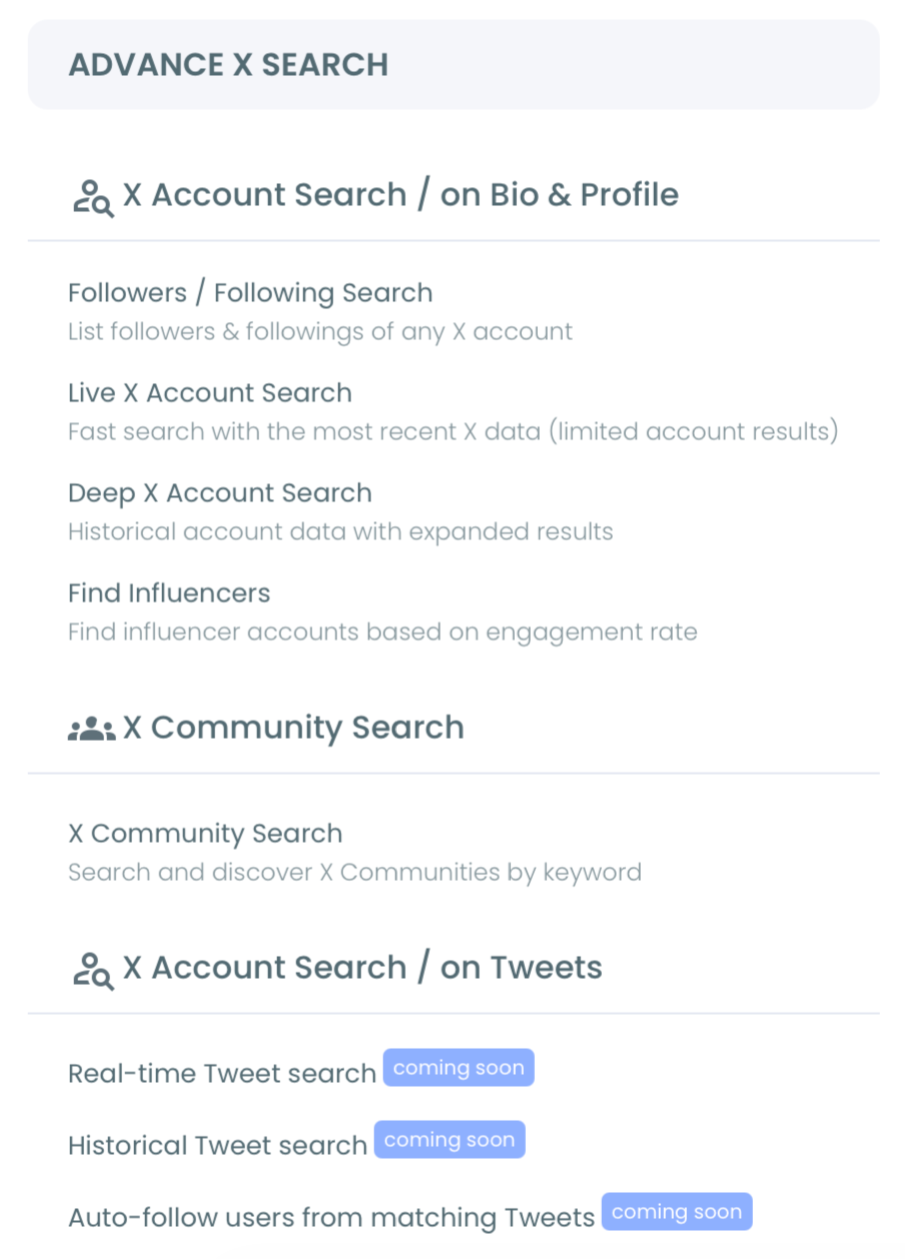
Run the keyword and filter the pool
- Enter your keyword on the Deep X Account Search page. Circleboom scans bios and historical tweets and returns up to 5,000 matching accounts in a sortable table.
- Filter the pool, then sort it. Narrow by the signals that separate a prospect from a passing mention, then sort so the strongest accounts rise first:
- Follower count, follow ratio, and verification status. - Join date and engagement tier. - A bio-and-name field for a second keyword, plus location when region matters.
Act on the accounts you keep
- Select the accounts that pass review and follow them, add them to a Twitter List, or export the set as CSV. Circleboom paces bulk follows at 50 every fifteen minutes and up to 400 a day, so the activity stays inside X's limits and never reads as aggressive.
That order is what makes the result trustworthy. The login unlocks official-API data, the keyword defines the universe, the filters and sort do the judgment work, and review keeps a low-signal historical match out of your feed. A 5,000-row list feels complete, but the filtering is what makes it real.
Quick recap:
- Connect with official OAuth.
- Open Deep X Account Search.
- Search the keyword; filter and sort.
- Follow, list, or export the accounts that survive review.
Turning the List Into Results
Once you search Twitter profiles for keywords and hold a filtered set, the next move depends on your goal.
For outreach, export the segment and work it in a CRM. This is the fastest path to generate Twitter leads from a topic, because the accounts are already qualified by their own words. Circleboom's export carries the full profile data for each row, so no context is lost between the search and the spreadsheet.
For research, sort and slice instead of exporting. You can find people who follow a certain account on Twitter and cross-reference them against your keyword pool to see who overlaps.
Timing signals help too. Combining a keyword with account age lets you search Twitter accounts by join date to separate established voices from brand-new ones.
When you want the highest-reach names first, a focused pass to find Twitter influencers free, step by step uses the same historical index.
Because Circleboom operates as one of the companies on X's official Enterprise developers list, every one of these workflows runs on authorized data. If you prefer to start from identity rather than keyword, the Twitter Account Finder is the front door.
Common Keyword-Search Mistakes to Avoid
Most weak keyword searches fail for the same few reasons, and each one is easy to correct once you name it. Getting your search and keyword strategy right before the first scan prevents most of them.
Trusting the 5,000 count as completeness. A large result set feels thorough, but the tail of any historical scan is full of accounts that mentioned your term once and moved on. The number is the starting pool, not the answer.
Reading bios and skipping histories. This is the mistake that hides the best accounts. A selective expert states their niche through years of posts, not a headline, so a search that reads only bios filters them out. Matching both is the whole reason to use historical search.
Over-filtering on the first pass. Stacking five tight filters at once can empty a good pool and make you think the audience does not exist. Start loose, read the distribution, then tighten one dimension at a time.
Following before reviewing. An account that discussed a topic two years ago may have changed focus entirely. Open a few profiles from the middle and the tail of the list before you act, and whitelist the ones you already know are valuable so a bulk action never catches them.
The pattern behind all four is the same: the search finds candidates, and your judgment turns candidates into a list. Treat the filter panel as where the real work happens, not the keyword box, and the quality of every downstream follow, list, or export rises with it.
Your Next Steps
You now have everything to run a real keyword search instead of scrolling profiles by hand. Work through it in this order:
- Connect your X account and open Deep X Account Search.
- Search your keyword so it reads bios and tweet histories together.
- Filter and sort down to the accounts that genuinely fit.
- Export for outreach or add the best accounts to a Twitter List.
Do that once and you will stop trusting bios to tell you who matters.
→ Set up your keyword search on X
What to Know Before You Search
What is the difference between searching one profile and searching all profiles?
Searching one profile finds a known account's posts on a term, which native X search handles with the `from:username` operator. Searching all profiles finds every account a keyword belongs to, which needs a tool that reads bios and tweet histories across the platform, like Deep X Account Search.
Can I export the accounts I find?
Yes. Any filtered result set can be exported as a CSV that includes each account's full profile data, ready for a CRM, an ad audience, or research. You can also export Twitter accounts from other search views the same way.
Is a keyword-based account search safe for my account?
Yes. Circleboom is an official X Enterprise partner and reads this data through authorized APIs, and every follow or export runs inside X's rate limits, so the workflow stays compliant.
Can I narrow results to one city or region?
Yes. Add the location filter to the keyword scan to search Twitter by location and keep only accounts whose profile location matches.