
The dashboard had been open since the launch post went out at 9 a.m., and the gains column was already showing a clear pattern by lunch. Sixty-one new followers in the first three hours, paced unevenly.
A small burst at 9:08 when the post first picked up reposts, a larger one at 10:42 when a partner account quoted it into a different network, and a steady trickle through the late morning. The losses column was quiet, single digits, and unsurprising given that no one tends to unfollow during an active post cycle.
By 1 p.m. the team had a clear read on which of the day's outreach actions was driving the most acquisition, and the answer was the quote-share at 10:42 by a wide margin.
That read would have been invisible from the profile page. The profile shows a single follower count that ticks up gradually without any timestamp resolution, which makes "which action moved the audience" a question the operator's working memory cannot answer. The daily-tracker view exposes the timing, and the timing is what attributes the gain to the right driver.
A defensible daily-tracking workflow captures follower gains and losses with timestamp resolution, attributes the deltas to the posts or events that triggered them, and runs through the official X Enterprise APIs so the data is reliable and the activity is policy-compliant. The Circleboom workflow produces a per-day dashboard, an exportable CSV, and an attribution-ready timeline. → Track followers gained and lost each day
Why the Profile Page Cannot Answer the Attribution Question
The profile page shows the current follower count and a delta from the prior period if the operator squints. It does not show which followers were gained, which were lost, when those events happened, or what was being posted at the time. The information density is one number, and the strategy question (which action drove the gain) cannot be answered from one number.
The platform's native analytics tab shows aggregated per-post engagement and some longer-window follower trends, but it does not connect specific follower-count changes to specific posts at daily resolution. The connection has to be built outside the platform's surface, which is what the tracker does.
Circleboom's piece on tracking Twitter followers daily, weekly, and monthly covers the cadence question and shows that daily is the right resolution for attribution work even when weekly or monthly is the right resolution for trend work.
What the Tracker Should Actually Capture
A defensible daily tracker captures four data points per day.
The first data point is the gain count, with timestamps when the platform's data allows. A gain of 23 followers on Tuesday is one signal; a gain of 23 followers spaced as 18-in-the-morning-and-5-in-the-evening is a different signal that points to the morning's post or event as the driver.
The second data point is the loss count. Losses are smaller than gains for healthy accounts but carry diagnostic information when they cluster around specific posts. An unfollow spike after a particular post is feedback worth investigating, and the daily resolution catches it cleanly.
The third data point is the per-follower context. The audit captures who joined and who left, which lets the operator look at the bio, follower count, and activity profile of the gained or lost followers to understand what kind of audience the day's content attracted or repelled.
The fourth data point is the net delta and the running cumulative. The single-day net is the day's score; the cumulative across the rolling window is the trend. Both numbers are visible from the same dashboard.
Circleboom's piece on monitoring new Twitter followers without checking notifications covers the notification-window alternative and shows why the dashboard view scales better than refreshing the platform's notification surface.
How to Track Followers Gained and Lost Each Day Step by Step
The workflow runs in two phases: the tracker setup, then the daily review. First-time setup takes 10 to 15 minutes; daily review takes 5 minutes once the dashboard is calibrated.
Phase 1: Set Up the Tracker
Log in to Circleboom Twitter
- Log in to Circleboom Twitter with the X account you want to track. OAuth keeps the credentials with X directly.

Open the Follower-Following menu
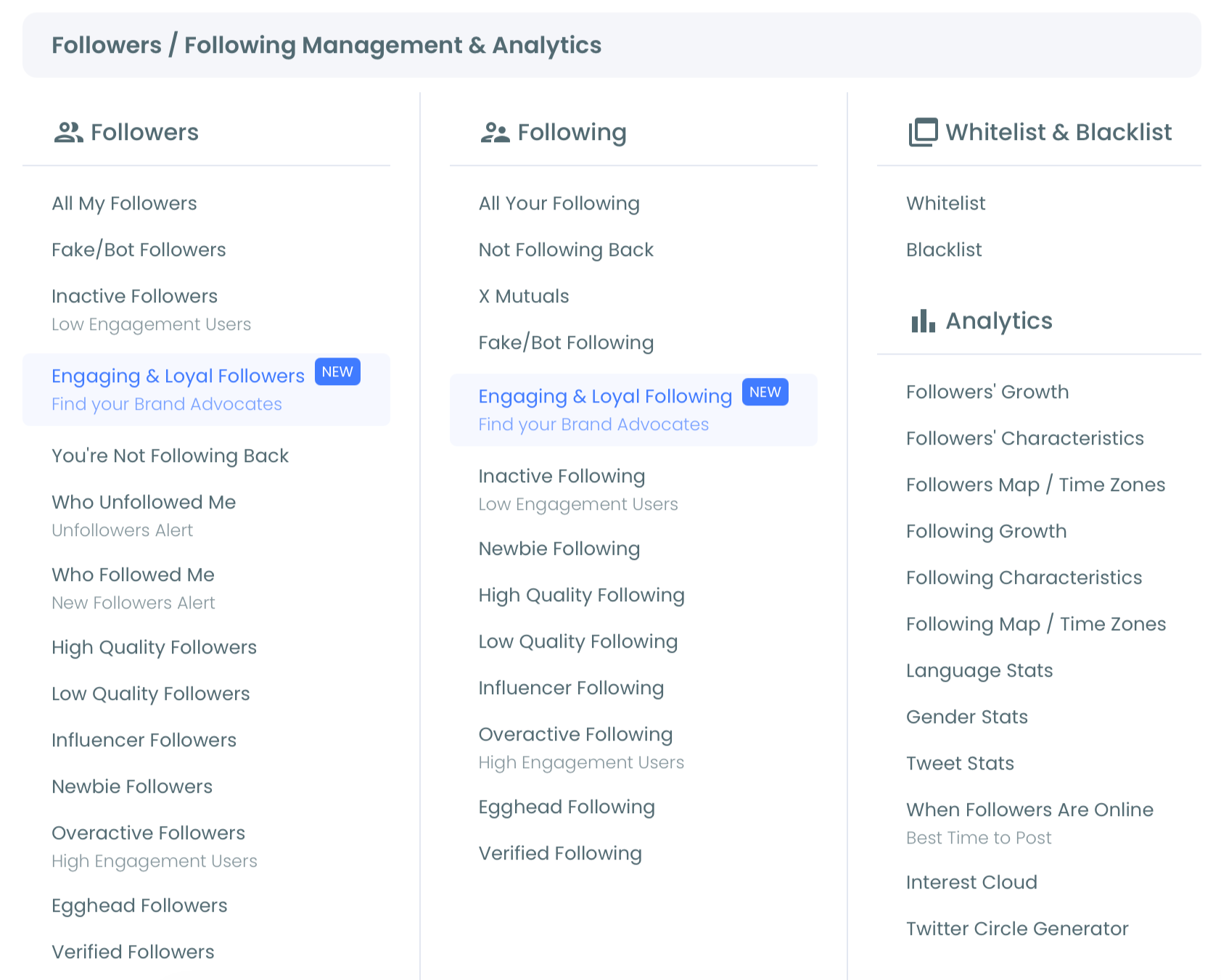
- Open the Follower-Following menu in the left navigation and find the Follower Growth Stats report under the analytics surface.
Configure the tracker for daily resolution
- Configure the tracker for daily resolution with both the gain and loss columns enabled, the per-follower context column turned on, and the rolling-window setting at the cadence the strategy needs (30 days is the default; longer windows are useful for trend work).
Phase 2: Daily Review and Attribution
Open the dashboard each morning and read the prior day's gain and loss
- Open the dashboard each morning and read the prior day's gain and loss. The dashboard shows the net delta, the running cumulative, and the per-follower breakdown. A gain that is meaningfully above or below the rolling average is worth investigating.
Attribute notable deltas to the posts or events that triggered them
- Attribute notable deltas to the posts or events that triggered them. Cross-reference the day's posts and external triggers (mentions, quote-shares, news coverage) against the gain timing. Most days the attribution is straightforward; complex days require the per-follower context column to surface what audience the day attracted.
Export the CSV for downstream segmentation
- Export the CSV for downstream segmentation when needed. The export captures gain and loss events with per-follower data, which feeds into any analysis pipeline that runs across multiple weeks of activity.
The six-step sequence is the full workflow. The setup is one-time; the daily review is the recurring work, and the attribution turns the data into the strategic insight.
Video walkthrough: the tracker setup, the daily dashboard review, and the attribution workflow.
What the Workflow Produces
The output is a per-day dashboard showing gains, losses, net delta, and cumulative trend; a per-follower context column that supports attribution; and an exportable CSV for any downstream analysis. The tracker replaces the single-number profile-page view with a daily-resolution timeline.
The Circleboom workflow uses the official X Enterprise Developer access for both the follower-list snapshots and the per-follower context data. The data is policy-compliant and the column structure is stable across days.
Two adjacent surfaces extend the workflow. The Twitter follower tracker landing covers the broader tracking surface that pairs with the growth-stats dashboard. The check new followers landing covers the new-follower drill-down view for accounts whose daily strategy depends on per-account analysis of new joins.
Related Circleboom reading on the daily-tracking theme.
- Is there a free way to track Twitter follower growth over time on the platform-side options for growth tracking and where they fall short.
- How can I track where my Twitter followers came from on the attribution side of the same question.
Where the Tracker Goes Next
A first month of daily tracking produces a rhythm-level read on which days, posts, and external events drive the audience. The patterns that emerge tend to be specific and actionable: a particular post format that consistently produces above-average gains, a particular time of day when gains cluster, a particular topic that triggers above-average losses.
The strategic value compounds across months. The first month's data is a baseline; the second month tests hypotheses that the first month surfaced; the third month confirms or revises those hypotheses against a larger sample. By the third month, the operator has a calibrated model of what moves the audience on this specific account.
The daily-tracking habit also catches the slow drifts the monthly view misses. A gradual unfollow trend over six weeks shows up as a softening cumulative line on the dashboard, which is a diagnostic signal that the content direction needs review. Track followers gained and lost each day and the profile-page number stops being the only audience signal.
Still Wondering?
How does the tracker handle days where I had no posts but still gained or lost followers?
Gain and loss events happen independently of the operator's posting schedule because followers may discover the account through external referrals, search, or other followers' amplification. A gain on a no-post day usually points to an external referral worth investigating (a mention from another account, a press hit, a viral repost). A loss on a no-post day is usually noise unless it clusters with similar events.
What is the typical accuracy of the timestamp resolution?
The X API exposes follower-list state changes at a resolution finer than daily for accounts on the appropriate access tier, which the Circleboom workflow uses to surface within-day patterns. For larger accounts where the API rate-limits prevent within-day resolution on every event, the tracker falls back to per-day resolution with running totals at known checkpoints throughout the day.
Can the tracker run multi-account dashboards for an agency or portfolio?
The tracker is per-account, but the dashboard supports multiple connected accounts in parallel views. Agencies running portfolio-level tracking typically configure each account's dashboard separately and consolidate the per-day deltas into a portfolio-level spreadsheet for cross-account comparison work.
How does the tracker compare to the platform's native follower-history view?
The platform's native view is limited to a rolling chart with relatively coarse resolution. It does not expose the per-follower context (who joined, who left, what their profile looks like), and it does not provide an exportable artifact that can feed into downstream analysis. The Circleboom tracker is row-level and per-follower, which is the structural reason the attribution work is possible.
What if my account has very low daily activity, so the deltas are small most days?
Low-activity accounts often see day-to-day deltas in single digits, which makes the daily resolution feel noise-dominated. The fix is usually to switch the dashboard's primary view to the rolling 7-day or 14-day delta, which smooths the daily noise while preserving the attribution capability for the days when meaningful events happen.