
If you want to know how to unfollow deactivated accounts, first separate an account that is truly unavailable from one that merely posts rarely. X does not offer one dependable, native “deactivated accounts I follow” filter. Circleboom Twitter’s Inactive Following view can surface low-activity accounts you follow, then lets you review, protect, and unfollow the accounts you decide no longer belong in your network.
→ Review inactive accounts you follow with Circleboom Twitter
Start with the status distinction, not a mass action. A quiet expert, an archive, or a client may look dormant while still being valuable.
When a following list has been building for years, it is tempting to call every missing or quiet profile “deactivated.” That label is often too broad. A profile can be unavailable because its owner deactivated it, because X suspended or locked it, because it was deleted, or because access is temporarily limited. A profile can also be completely available and simply silent. Those states matter because the safest cleanup decision is not “remove everything that looks inactive.” It is “remove the follows that no longer have a purpose after review.”
That is the practical answer to how to unfollow deactivated accounts. Native X makes you inspect profiles one by one and does not give every account state a reliable bulk filter. Circleboom Twitter provides an Inactive Following segment for accounts in your following list that show low activity signals. It is a discovery and review view, not a claim that every listed account has deactivated or that every deactivated account will appear there.
What X account status can and cannot tell you
Deactivation usually means the account owner has made the profile unavailable. Suspension is an action taken by X. Deletion can be permanent, while a locked or rate-limited view can be temporary. A protected account is different again: it may be active but not publicly visible to everyone. None of those labels should be inferred from a single quiet week or a low follower count.
For following-list maintenance, “inactive” is a useful category rather than a verdict. Circleboom evaluates public activity-related signals such as account age, tweet frequency, recency, and engagement classification through the official X Enterprise API. It can identify accounts that are low-engagement or rarely active over time. It does not know whether somebody is reading without posting, planning a return, or maintaining a strategically useful archive.
Circleboom Twitter is listed in X’s Enterprise customer directory, but that access does not turn an inactivity label into a guarantee about an account owner’s intent. Treat the result as a shortlist for a human decision.
A safer way to identify stale follows
Open Inactive Following after signing in to your own Circleboom Twitter account. The view is designed for accounts you already follow. It presents a structured table with identity details and signals such as tweet count, join date, following and follower counts, follow ratio, and an activity classification.
!Circleboom Twitter follower and following management
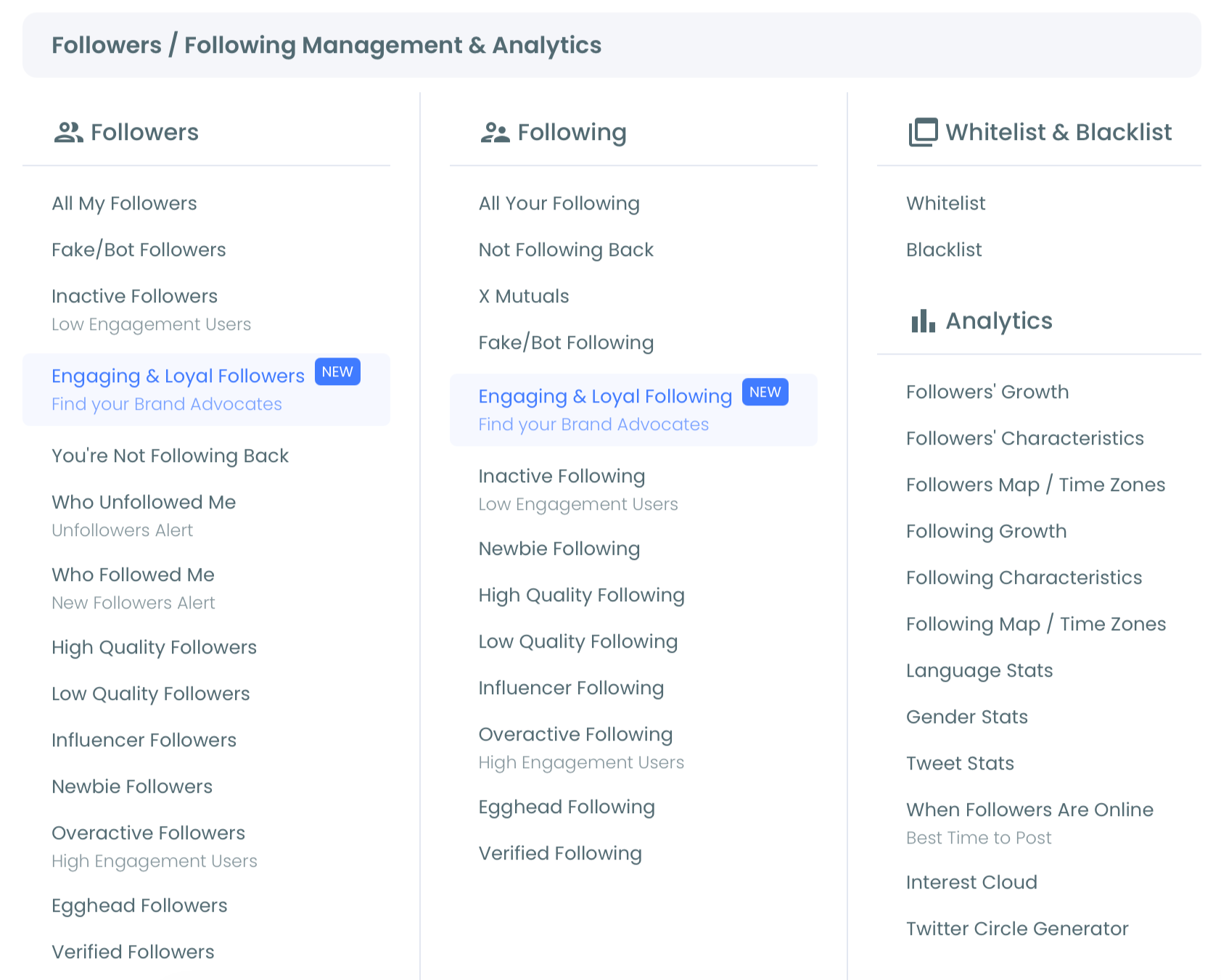
Use the table to create a small review set. Sort by tweet count or join date, search by name, and use filters only to narrow your own decision. An old campaign account with a thin posting history may be an obvious candidate. A seldom-posting regulator, customer, founder, or research archive is not. The useful question is whether you would notice or care if its next post appeared in your timeline.
The same caution applies to profiles you cannot open. An unavailable profile may be deactivated, suspended, deleted, renamed, private, or temporarily inaccessible. Circleboom should not be presented as a forensic status checker. If accuracy matters for a particular relationship, open the profile from the row and confirm what X currently shows before acting.
Protect exceptions before you select anything
The most important cleanup step is to protect rare-posting accounts that still matter. Circleboom’s Whitelist action marks selected accounts as protected across its follower and following workflows. Consider adding official sources, clients, partner organizations, key contacts, niche analysts, and archival references before you build an unfollow selection.
This changes the job from a blunt purge into a repeatable audit. The low-activity view gives you a starting segment. Your whitelist preserves the exceptions. Your reviewed selection contains only accounts you are comfortable unfollowing. A blacklist can be useful for accounts you have decided are unwanted, but it does not itself unfollow or block anyone.
→ Open Inactive Following and protect the accounts you want to keep
How the unfollow action works
After review, select individual rows or a small, reviewed group from the current filtered view. Circleboom offers a per-row Unfollow control and a bulk Unfollow option for selected accounts. Your browser session should remain active and logged in while you work. You authorize the action, review the queue, and confirm the accounts; Circleboom processes the requests with X rather than making a private account-status judgment for you.
Unfollow is not a reversible “hide” setting. If you later want the account back in your timeline, you must follow it again. For that reason, do not use a master checkbox as a substitute for inspection, especially when the group includes quiet accounts you might need for work or research.
X applies rate limits and response conditions. Circleboom’s documented pacing for unfollows is up to 50 actions per 15-minute window and up to 800 per day, but account-specific responses can vary. If X responds with a request limit, let the queue pause rather than repeatedly retrying. Small batches are easier to verify and less likely to turn a useful maintenance session into a mistake.
A decision checklist for an unavailable-looking profile
Before you unfollow, check four things:
- Is the profile actually unavailable? Open it when possible. Do not call a low-activity result “deactivated” without confirmation from X.
- Does it still have a purpose? Official announcements, an old client relationship, an archive, or a local community resource may justify keeping a quiet account.
- Is there another weak signal? Inactivity plus irrelevance, non-reciprocity, an old campaign context, or poor profile quality is a stronger reason than inactivity alone.
- Would you want this account protected next time? Whitelist it before the cleanup so a future review does not force the same decision again.
This method also explains why a broader inventory and characteristics review are useful companions. They show whether inactivity is a major pattern or a small edge case. You can use Mass Unfollow only after the selection has earned that action.
Make the review repeatable
Write a brief note after each batch: why the accounts were selected, which exceptions were whitelisted, and whether X returned any limits. This is a guardrail against changing the meaning of inactive every time you open the view. It also keeps a team account consistent when several people participate in relationship management.
An organization might retain every official source, active customer, and named media outlet regardless of activity classification. It might then review older event follows only when they are both low activity and unrelated to its current audience. A personal account can choose another standard, such as keeping friends, researchers, and local organizations. The tool supplies a segment; the network purpose supplies the rule.
Check the visible filter tags before you select rows. A location, language, account-age, or activity filter changes the group in front of you. Pagination matters as well: a master checkbox normally applies to the page you can see, not a hidden universe of accounts. Confirm the count shown by the interface before authorizing any action.
When approval is needed, export the reviewed segment before unfollowing. A spreadsheet gives a colleague or client the chance to identify an exception your criteria missed. It also records the accounts reviewed at that point in time. Activity and availability can change later, so the export is a checkpoint rather than a permanent diagnosis.
If you need that approval record, export your X following list before the action. Comparing the exported review list with the remaining follows later can make a recurring cleanup more accountable, particularly for a shared brand or client account.
When not to unfollow
Do not unfollow someone merely because their account is suspended today if the relationship has value outside X. Do not turn a list of inactive accounts into a list of bots; inactivity and inauthenticity are different signals. And do not assume a silent profile will remain silent. The tool can organize public activity information, but it cannot assess personal context for you.
If your real goal is a cleaner timeline, consider a gradual routine: review a small portion of Inactive Following, whitelist exceptions, unfollow only the accounts that lack a current purpose, then repeat later. That approach leaves an audit trail in your own judgment rather than trying to solve every status ambiguity at once.
→ Start a reviewed inactive-following cleanup in Circleboom Twitter
Watch the workflow
Video: reviewed inactive-following workflow
https://www.youtube.com/watch?v=tZllzC0-yRM
Use it as orientation, then review the current labels and controls in your own account before confirming an action.
FAQ about unfollowing deactivated accounts
Can X show every deactivated account I follow?
Not through one universal native filter. Profiles may be unavailable for several reasons, and status can change. Review any important case directly on X.
Does Inactive Following only show deactivated accounts?
No. It surfaces accounts you follow with low activity signals. A listed account may be real, available, and worth keeping.
Can I unfollow several reviewed accounts together?
Yes. Select the accounts you have reviewed and use Circleboom’s Unfollow action. Keep the active browser session open and work within X’s pacing and response limits.
Will a whitelisted account be safe in later cleanup sessions?
Circleboom documents whitelist status as protection across its bulk actions. Still review your filters and selection before every confirmation.
Add a review rule you can defend
The timing of cleanup deserves the same thought as selection. Do not begin during a live campaign, a public issue, or a period when a partner may reasonably expect close monitoring. An apparently inactive account may become relevant without warning. If missing its next post would be costly, keep the follow or add it to a separate monitoring process rather than treating a following-list cleanup as a substitute.
Explain each category to someone else before you act. “These are old event follows with no current topic fit” is a defensible category. “These accounts have low tweet counts” is only a partial observation. The explanation should include both activity evidence and the reason the relationship no longer helps. When you cannot state that reason, defer the unfollow and revisit later.
You may also encounter accounts that are active but unsuitable for your feed. That is a curation decision, not proof that they are deactivated. Use another review method instead of stretching the inactivity label to cover every account you prefer not to follow. Clear categories prevent a maintenance task from becoming arbitrary.
Finally, remember that a following list is not an obligation to preserve every historical connection. It is a current reading and relationship tool. The careful approach does not demand perfect certainty about an unavailable profile. It asks whether the remaining evidence and your own context justify continuing to follow it. If the answer is uncertain, protect it or leave it unchanged. If the answer is clearly no, a reviewed unfollow is an appropriate, user-authorized action.
That small distinction protects both the account owner and your future self.
It also keeps your next audit calmer.
Related reading
For a practical starting point, read How to unfollow inactive Twitter accounts.
The need to unfollow inactive Twitter accounts and how to do it provides a maintenance perspective.
To keep bot signals separate from dormancy, see Unfollow inactive Twitter accounts and remove fake accounts.
For an adjacent audience audit, read Check unfollowers, fake, spam, and inactive followers.
Your following list does not need to be perfectly active to be useful. It needs to reflect decisions you can explain. Use an inactivity segment to find candidates, protect the quiet accounts that still matter, and make each unfollow a deliberate choice.